Spa Website Cost, With Gift Vouchers and a Calm Route to Booking
A day spa's hosting is a single yearly $119 or a recurring $19 each month, and its domain is the one other fixed cost. The guide looks at bookers and gift givers, pages, the treatment menu, vouchers, first visits, health checks, requests, search and budgets.
- No coding required
- Live in minutes
- Blog, SEO and chatbot tools included
Hosting a day spa's website on AI Web Maker is a $119 charge per year, or $19 per month, and the domain is the one other fixed cost. Treatment descriptions, the gifts page and the booking route can be shaped in the preview without any cost, so every word can be read slowly before a guest sees it. For a calm, finished reference, the spa website example shows quiet rooms and gift vouchers on a sample site for an invented day spa, generated by AI Web Maker. A single package or a couple of gift vouchers covers the year. The difficulty is that a spa sells a feeling that guests cannot test in advance, and many of its buyers are gift givers who will never lie on the treatment bed themselves. The website has to convey calm, explain each treatment honestly and make booking or gifting simple. What follows looks at who books and who gives, the pages to build, the treatment menu, vouchers and packages, the first visit, health and safety, booking requests and cancellations, search and the yearly budget.
This article is part of our complete guide: Website Builder for Creative Businesses.
Who books a spa day, and who buys one for someone else?
A spa serves two kinds of buyer, the guests who book for themselves and the people who buy treatments as gifts. Guests booking for themselves want to know what each treatment feels like, how long it lasts and whether it suits them. First timers want reassurance about what to wear, what happens and whether they will feel out of place. Couples and celebration groups look for shared treatments and packages that fill an afternoon. Gift buyers want a voucher that is easy to buy, looks good to give and is simple for the recipient to use. A spa website that speaks to both kinds of buyer earns bookings and gifts from the same visit.
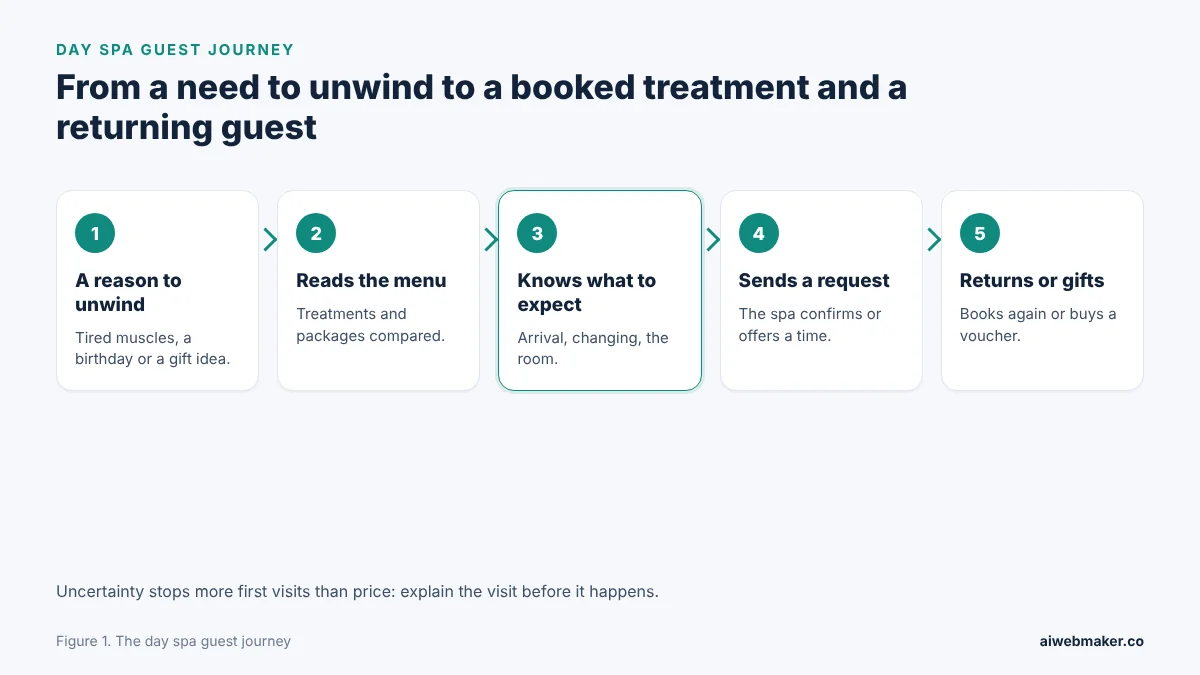
Knowing what to expect is highlighted in this journey, because uncertainty stops more first visits than price does. A need to unwind, a birthday or a gift idea starts the search. The visitor then reads the treatment menu and compares packages, looking for something that sounds right. Before booking, most want to know how the visit works, from arrival and changing to what happens in the room. A request follows, then the visit itself, and a guest who leaves relaxed often returns or buys a voucher for someone else. Each page should ease one of these moments without breaking the calm.
Pages a day spa needs, from treatment menu to finding the door
A day spa website needs pages that describe the experience as carefully as the treatments themselves. The home page sets a quiet tone and still places the booking and gift routes where guests expect them. The treatments page carries the menu, while a packages page groups treatments into a longer visit. A gifts page sells vouchers to people who may never visit. Pages on the first visit, health questions and finding the spa complete the set, along with an introduction to the therapists.
| Page | Guest question | What it should hold |
|---|---|---|
| Home | Does it feel calm? | One serene photo, booking and gift routes |
| Treatments | What will it feel like? | Massages, facials, body treatments, durations |
| Packages | Can a visit fill a day? | Combined treatments, couples and groups |
| Gift vouchers | How is a gift given? | What a voucher covers, validity, how to order |
| First visit | What happens on arrival? | Arrival, changing, robes, phones, timing |
| Health and safety | Is it suitable for this guest? | Conditions to mention, pregnancy, allergies |
| Find us | When is it open, and where? | Hours, address, parking, transport |
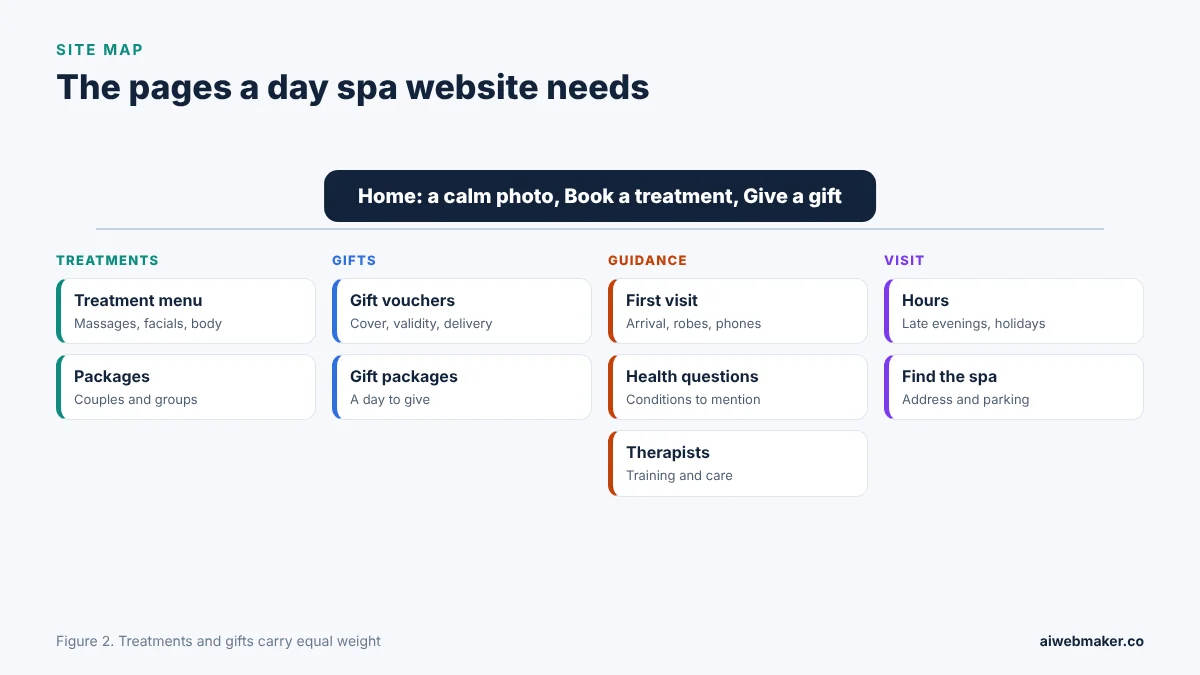
Gifts and treatments share equal weight in this site map, because a spa earns from both. The treatments branch holds the menu and the packages, each bookable as a request. The gifts branch holds vouchers and gift packages for buyers who are not booking for themselves. The guidance branch covers the first visit and health questions, while the visit branch gathers hours, location and directions. Our sample, Still Water Day Spa, offers four bookable treatments, massages, facials, body treatments and spa packages, gives gift vouchers and packages a page of their own with an enquiry route explaining how a gift order works, and adds a treatments page with a section on what to expect and another for guests unsure where to start. Its contact page shows the opening hours and how to find the spa, and the day spa website example with bookable treatments and a gifts page was created in 43 seconds.
Describing treatments by feel rather than promise
A good treatment menu tells guests what they will experience, not what the treatment will cure. Each description should cover the length of the session, the pressure or intensity, the products used and how the guest is likely to feel afterwards. Naming who the treatment suits, such as tired muscles after sport or a first facial, helps guests choose without asking. Claims that a treatment heals, detoxifies or fixes a medical condition invite complaints and may break advertising rules in many countries. Honest, sensory descriptions are both safer and more appealing. A menu written this way sells the experience while keeping the spa on firm ground.
| Element | What to include | Example wording |
|---|---|---|
| Duration | Time on the treatment bed | Sixty minutes, plus time to settle |
| Pressure | Gentle, medium or firm | Medium pressure, adjusted on request |
| Products | Oils, creams, any scent | Unscented oil available |
| Who it suits | A situation, not a diagnosis | Tired shoulders after long desk days |
| Afterwards | How guests usually feel | Relaxed, a little sleepy |
| Not suitable for | Conditions to mention first | Recent injury, skin conditions |
Gift vouchers and packages that sell to people who never visit
Gift vouchers bring income from buyers who will never book a treatment for themselves, and they introduce new guests who may return on their own. The gifts page should say exactly what a voucher covers, whether a named treatment or a value, and how long it stays valid. Buyers also want to know how the voucher reaches them or the recipient and how it is redeemed. Packages make natural gifts, because a combined massage, facial and time to relax is easier to give than three separate treatments. Rules on voucher expiry and refunds vary between countries, and some set minimum validity periods, so the terms should follow the law where the spa trades. A clear gifts page earns twice, once at the sale and again when the recipient becomes a regular.
| Voucher term | What to state | Why it matters |
|---|---|---|
| What it covers | A named treatment or a value | Avoids confusion on the day |
| Validity | How long it can be used | Must follow local rules |
| How it arrives | Printed, posted or sent | Gift buyers plan around it |
| How to redeem | Quote the code when booking | Smooth first contact |
| Changes | Swapping treatments, upgrades | Flexibility for recipients |
| Refunds | Whether and when | Prevents disputes later |
The first visit, explained before the guest arrives
First time guests worry about practical details more than spa regulars realise, and a page that answers them turns hesitation into a booking. It should say how early to arrive, usually enough time to check in, change and fill in any health form without rushing. Guests want to know what to wear, whether robes and slippers are provided and where belongings are kept. A note on phones, quiet areas and what happens in the treatment room removes the fear of getting something wrong. Guidance on eating lightly beforehand and drinking water afterwards is practical without straying into medical advice. A calm, detailed first visit page is the gentlest way to grow the number of new guests.
| Question | Helpful answer to give |
|---|---|
| How early to arrive | Time to check in, change and settle |
| What to wear | Robes, slippers, what to bring |
| Belongings | Lockers or a safe place |
| Phones | Quiet zones and silent mode |
| In the room | Privacy, towels, adjusting pressure |
| Late arrival | Whether the treatment is shortened |
Health conditions, pregnancy and when to check with a doctor
Health questions belong on a spa website because some treatments are not suitable for everyone, and guests appreciate honest guidance. Pregnancy, recent surgery, high blood pressure, skin conditions and allergies to oils or products are among the things guests should mention before a treatment. Many spas ask guests to complete a short health form, and saying so on the website avoids surprise at reception. Guests with a medical condition should check with their doctor or midwife before booking, and the spa should never present its treatments as medical care. Therapists' qualifications and the rules that apply to them vary between countries, so the spa should follow local requirements and describe its training accurately. Careful guidance of this kind protects guests and keeps the spa's reputation safe.
Booking requests, cancellations and a calm way to say yes
Booking should feel as calm as the spa itself, with a short request that the spa then confirms. The guest picks a treatment or package with a preferred time, then submits it, and the spa can approve it, suggest another time or decline it when therapists are fully booked. Any payment or deposit is arranged by the spa directly with the guest, and the platform retains nothing from it. A cancellation policy, written by the spa and shown beside the booking route, explains how much notice is needed to change a visit. The booking website builder for day spas with treatment and package requests sets up the treatments, packages and gifts page after the spa outlines its offer in a few lines. Keeping this route visible on every page lets the design stay quiet without hiding the next step.
Searches for a spa day, a massage or a gift
People searching for a spa type phrases such as day spa near me, couples massage, facial, spa day gift voucher or spa package, often with a city. A treatments page and a gifts page that use those words in their headings answer them directly. On the map listing, the opening hours, calm photos of the rooms and a link to book all belong. Reviews that mention a therapist's skill, the quiet and the cleanliness persuade more than any description of luxury. Seasonal pages for gift giving, such as the weeks before a major holiday, catch voucher buyers when they are most active. Articles on preparing for a first massage or choosing a facial bring readers who may book later.
The spa's running costs, from hosting to treatment articles
Only hosting and the domain recur for a spa site, and neither rises during the busiest gift season. The yearly route totals $119, and $19 a month suits a newly opened spa still filling its first diary. Wellness articles drafted using AI credits are priced near $0.65 apiece. Changing treatments, adding packages or rewording voucher terms costs nothing further. Yearly and monthly billing appear together below, and the $189 tier is noted only as a benchmark.
| Item | Yearly | Monthly |
|---|---|---|
| Hosting the treatments, gifts and booking pages | $119 | $228 over twelve months |
| Domain | Depends on the ending | Depends on the ending |
| Higher plan, for comparison | $189 a year | Not needed |
| Twelve first visit and treatment articles at about $0.65 | About $7.80 | About $7.80 |
| Treatments, packages and voucher terms | No charge | No charge |
| Year before the domain | About $126.80 | About $235.80 |
What makes a guest close a spa's page unbooked?
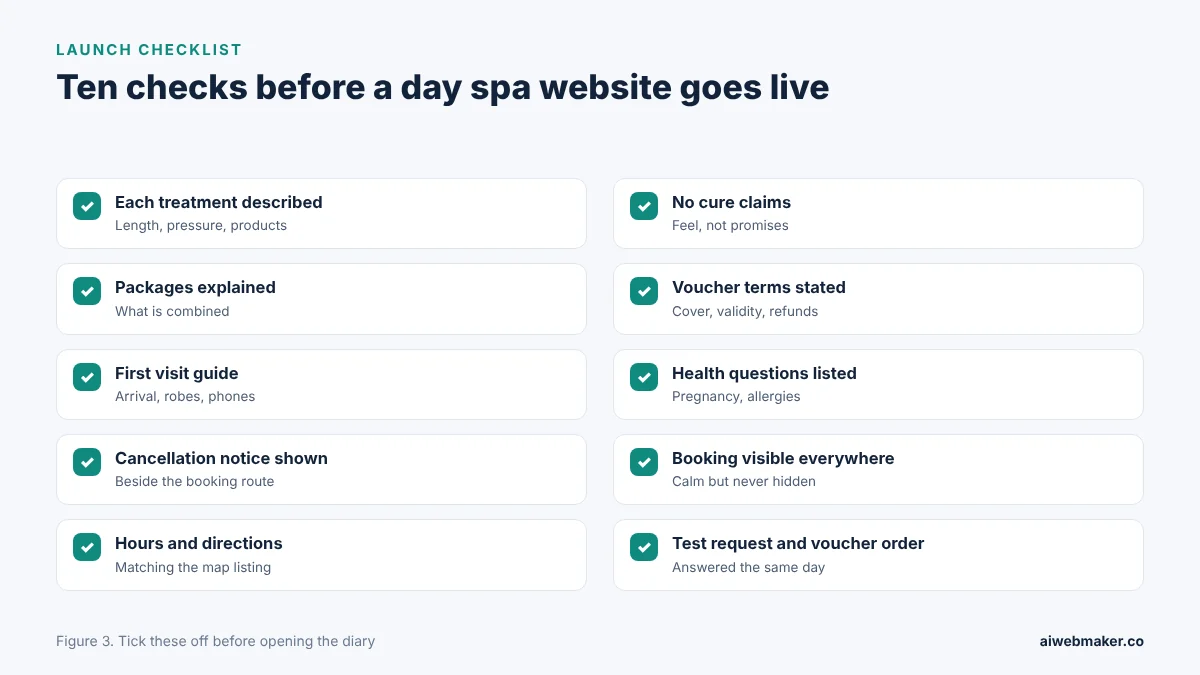
A guest closes the page unbooked when the site feels beautiful but leaves too many questions open. Treatment names with no description of what happens or how long it lasts make choosing hard. A gifts page that does not say how vouchers arrive or how long they last sends buyers to a competitor. No guidance on the first visit leaves nervous guests to imagine the worst. A booking route hidden for the sake of calm frustrates someone who is ready to commit. Each of the ten checks pictured next removes one of those obstacles.
Frequently asked questions
How early should guests arrive for a treatment?
Most spas ask guests to arrive early enough to check in, change and complete any health form without rushing. The website should give the spa's own recommended time and explain what happens if a guest arrives late. Arriving early lets guests settle, which makes the treatment more relaxing. Late arrivals may have a shorter treatment so that the next guest is not delayed. Clear guidance helps every visit start calmly.
Can a gift voucher be used for any treatment?
Whether a voucher can be used for any treatment depends on the spa's own terms, which should be stated on the gifts page. Value vouchers usually work across the menu, while treatment vouchers name a specific experience. Many spas allow recipients to upgrade by paying the difference. Validity periods and refund rules must follow the law where the spa trades. Clear terms make vouchers easy to give and easy to use.
Are spa treatments suitable during pregnancy?
Some spa treatments are suitable during pregnancy and others are not, so the spa should state its own policy clearly. Many spas offer specific pregnancy treatments delivered by trained therapists. Guests who are pregnant should tell the spa when booking and check with their midwife or doctor first. Certain oils, heat treatments and positions may be avoided. Honest information lets expectant guests book with confidence.
What should guests wear during a treatment?
What guests wear depends on the treatment, and the website should explain it simply. Many spas provide robes, slippers and disposable underwear for body treatments. Guests are usually covered with towels, with only the area being treated uncovered. Facials and some treatments need no change of clothing at all. Clear answers spare first timers from worrying before they arrive.
Gift vouchers, returning guests and the year's hosting
A single package or a couple of gift vouchers usually exceeds the $119 hosting cost for twelve months, and one treatment covers any $19 month. Every voucher sold also brings a new guest who may return without needing another gift. Returning guests matter most, since someone who has found the right therapist tends to book again and again. Honest treatment descriptions, a clear gifts page and calm first visit guidance are what build that loyalty. A booking route that never hides makes it easy for that loyalty to turn into appointments. A diary that fills with familiar names and voucher codes shows the website at work.
Build your website in Minutes and get the AI Tools that work
Start Building Your Website →