Piercing Studio Website Cost and the Hygiene Proof Clients Want
Piercing studios pay $119 for a hosting year or $19 per month, domain extra. The guide then turns to clients, the pages, hygiene, metals, healing, age and ID rules, requests, search and the budget.
- No coding required
- Live in minutes
- Blog, SEO and chatbot tools included
A piercing studio's website needs $119 for a year of hosting, or $19 monthly for a lighter regular bill, with the domain picked separately from about 400 endings. Writing the price list, hygiene notes and aftercare cards, then studying them in the preview, triggers no AI Web Maker charge at all. A busy Saturday afternoon of lobe and helix piercings covers that sum several times over. The real work is persuading a nervous visitor, who cannot see the back room, that the needle is sterile, the metal is safe and the studio will still care once the swelling starts. Parents add another layer of questions about age, consent and identity checks. Ahead are who walks in and why, the pages to build, hygiene, metals, healing and downsizing, age and consent, requests, search, the yearly sums and the red flags that send visitors elsewhere.
This article is part of our complete guide: Website Builder for Creative Businesses.
Who walks in for a piercing, and what reassures them?
Piercing clients range from first timers holding a hand to collectors planning a fifth ear piercing, and each needs different reassurance. First timers worry about pain, fainting and whether the studio will judge simple questions. Clients who reacted to cheap earrings want to know exactly which metal goes into a fresh piercing. Parents of teenagers look for age rules, identity checks and whether they must be present. Collectors compare jewellery ranges and the piercer's eye for placement on a particular ear. All of them judge the studio first on hygiene, then on price, then on how well it explains healing.
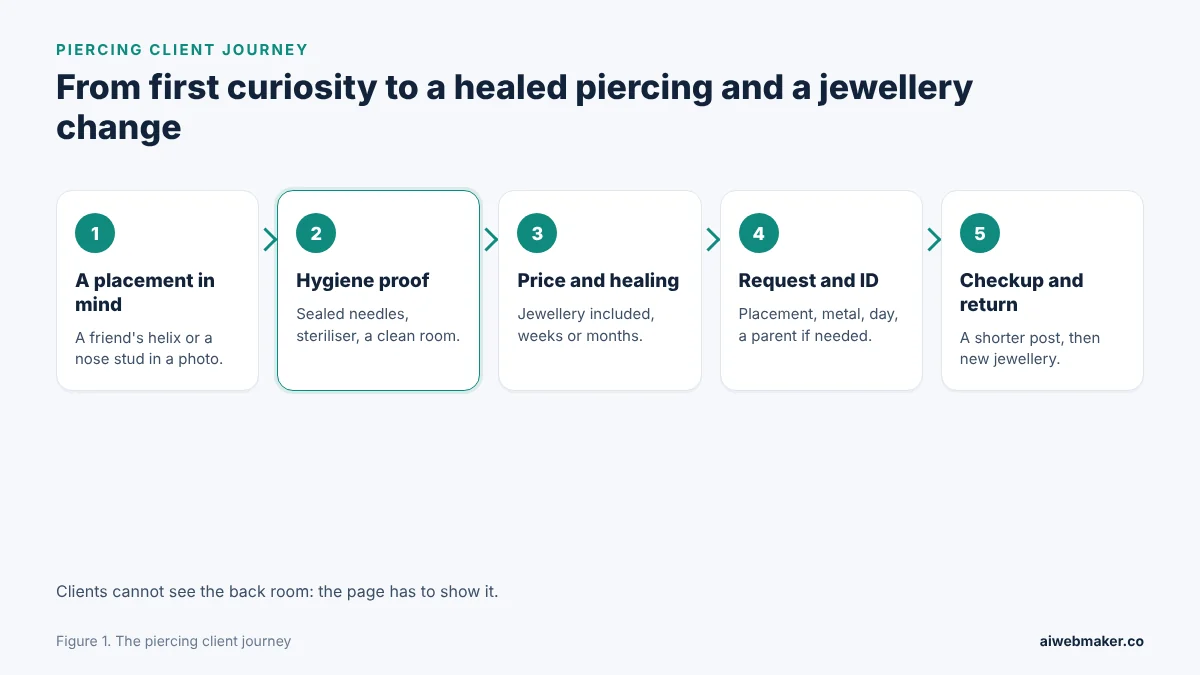
Of the five steps, hygiene proof carries the highlight, since a visitor who doubts the cleanliness never reaches the price list. Curiosity usually starts with a friend's helix or a nose stud seen in a photo. The search that follows compares a handful of local studios, and the one that shows its needles, steriliser and sealed jewellery earns the click. Price and healing time come next, then a request for a placement and a day. After the piercing, the checkup and a shorter post decide whether the client returns for jewellery or another placement. A site that walks through these steps in order turns cautious browsing into a booked chair.
The pages a piercing studio needs, from the price list to aftercare
Six pages cover nearly every question a piercing client asks at the counter, provided each one stays focused. The price list should show each placement with the jewellery included and a typical healing range. A hygiene page explains needles, sterilisation and gloves in plain words, and a metals page shows what goes into fresh skin. Aftercare deserves as much space as the prices, because most problems start at home. Age rules, identity checks and the request route close the set.
| Page | What clients look for | What it should hold |
|---|---|---|
| Prices | The cost of each placement | Jewellery included, pairs, typical healing range |
| Hygiene | Proof of sterile practice | Single use needles, steriliser, sealed pouches |
| Jewellery | What goes into a fresh piercing | Titanium, solid gold, niobium, gem ends |
| Aftercare | How to heal it well | Cleaning, sleep, water, downsizing, warning signs |
| Age and ID | Whether a teenager can be pierced | Ages per placement, consent, photo ID |
| Request | How to secure a time | Placement, metal, day, notes |
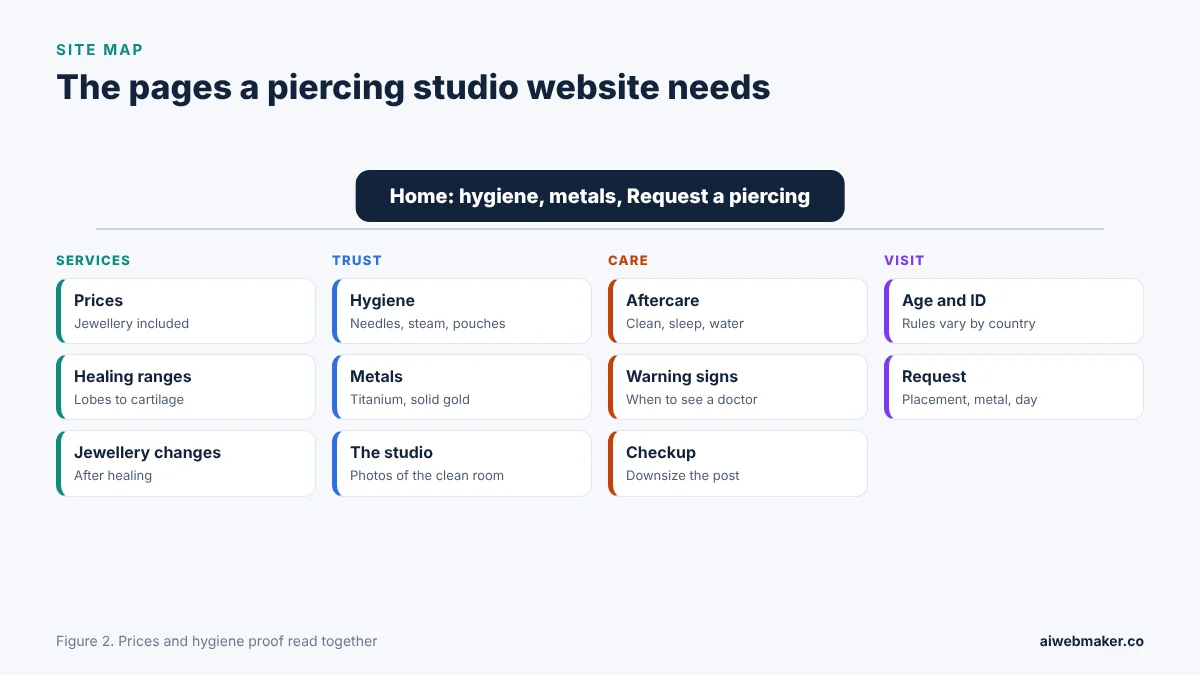
Grouped into four branches, this piercing site puts the price list and the hygiene proof side by side, because clients read them together. The services branch carries placements, prices and healing ranges. The trust branch holds hygiene, metals and photos of the clean room. The care branch covers aftercare, warning signs and the checkup, while the visit branch holds age rules, the request and directions. Our sample studio, Needle and Gem Piercing, sets out a price table with a healing range for each piercing, a hygiene section, the metals it puts in fresh piercings and the steps of a visit, then six aftercare cards: clean twice a day, hands off, sleep on the other side, stay out of the water, downsize at the checkup and know the warning signs; the piercing studio website example with hygiene, metals and aftercare closes with a gallery, questions and a request form.
Needles, steam and sealed pouches: hygiene clients cannot see
Hygiene has to be described on the website because a client cannot inspect the back room before sitting down. The page should state that every needle is sterile, used once and opened in front of the client. Jewellery should be cleaned, sterilised in a steam steriliser and sealed in a dated pouch until the moment it is fitted. Fresh gloves, barrier film on touched surfaces and a sharps bin in every room are details that reassure without jargon. Explaining why the studio never uses piercing guns, which cannot be sterilised in the same way, shows knowledge as well as care. Licences and inspections for piercing studios are set locally and vary by country, so the page should invite clients to ask how the studio meets the rules where it works.
| Practice | What the page should tell clients |
|---|---|
| Single use needles | Opened in front of the client and discarded after one use |
| Steam sterilisation | Jewellery and tools sterilised, with the steriliser tested and logged |
| Sealed, dated pouches | Nothing opened until the moment of piercing |
| Gloves and barrier film | Changed whenever they touch anything outside the clean tray |
| No piercing guns | Why a fine needle is used instead |
Which metals belong in a fresh piercing?
The metals page answers a question many clients bring after reacting to cheap earrings, and it shapes jewellery sales for years afterwards. Implant grade titanium is the common standard for fresh piercings in many studios, and it can be coloured by anodising rather than coating. Solid gold of 14 carat or higher suits clients who prefer gold, though anyone sensitive to nickel should ask about the alloy. Plated jewellery, sterling silver and mixed metals can irritate a healing piercing, so careful studios keep them away from fresh skin. Swatches or close photos turn a technical subject into something visual. Honest metal choices also prepare the ground for jewellery upgrades once a piercing has healed.
| Metal | Why studios use it | What to explain |
|---|---|---|
| Implant grade titanium | Trusted for fresh piercings | Colours come from anodising, not a coating |
| Solid gold, 14 carat or higher | Warm colour for those who prefer gold | Never plated, ask about the alloy |
| Niobium | Dark and bright colours | Often kept for healed piercings |
| Sterling silver or plated pieces | Low price | Can irritate, so not for fresh piercings |
Healing times, swelling and the downsize visit
Healing time is the detail that changes plans, so it belongs beside every price rather than in small print. Lobes often heal in weeks, while cartilage placements such as the helix or conch can take many months. Posts start long to allow for swelling, and a shorter post fitted at a checkup stops snagging and drifting. The aftercare page should cover cleaning with sterile saline, keeping hands off, sleeping on the other side and staying out of pools and the sea until healed. It should also describe what is normal, such as tenderness and a clear crust, and what is not, such as spreading redness, heat, coloured discharge or a fever. Those warning signs should send the client to a doctor, with a note that the advice is general and not medical guidance.
Age limits, photo ID and parental consent
Legal ages for piercing are not the same everywhere, and some regions inside one country set their own, so a studio's website should say so before giving its own limits. The page can list which placements are offered at which ages and when a parent or guardian must attend and sign. Every client, and every accompanying adult, should know to bring photo ID. Reasons to postpone, such as being unwell, drunk or pregnant, or having a condition that affects healing, belong in the same section. Through the booking website builder for piercing studios that take placement requests, a client sends a request naming the piercing and a day. The studio replies by confirming the slot, suggesting a different hour or saying no. Payment for the piercing and jewellery is arranged at the studio directly, and none of it is shared with AI Web Maker.
Helix, septum or first lobes: the searches that bring clients in
People search for the placement and the place together, typing phrases such as helix piercing, septum piercing, nose piercing near me or ear piercing for children. A studio page that names each placement in its own heading, with the price and healing range beside it, matches those searches word for word. On the map listing, accurate walk in times, the correct category and pictures of both the piercing room and healed ears matter most. Reviews that mention a calm piercer, a sealed needle and a smooth checkup carry weight with nervous readers. Articles on downsizing, cartilage bumps or choosing a first metal attract people long before they book. A steady stream of useful aftercare writing turns the studio into the local reference for piercing questions.
A piercer's annual website sums, from hosting to aftercare articles
Each year a piercer's site involves three modest lines: hosting, the domain and article credits of about $7.80 for a dozen pieces. An established studio spends least by clearing the $119 once a year. A new studio that is still building its client list might choose $19 each month instead. Adding placements, new jewellery photos or revised aftercare wording costs nothing further. The $189 tier is listed only to show where it sits beside the other two routes.
| Item | Yearly | Monthly |
|---|---|---|
| Hosting the piercing pages | $119 | $228 over twelve months |
| Domain | Depends on the ending | Depends on the ending |
| Higher plan, for comparison | $189 a year | Not needed |
| Twelve aftercare articles at about $0.65 | About $7.80 | About $7.80 |
| New placements, jewellery photos and prices | No charge | No charge |
| Year before the domain | About $126.80 | About $235.80 |
Doubts that end a first timer's visit to the page
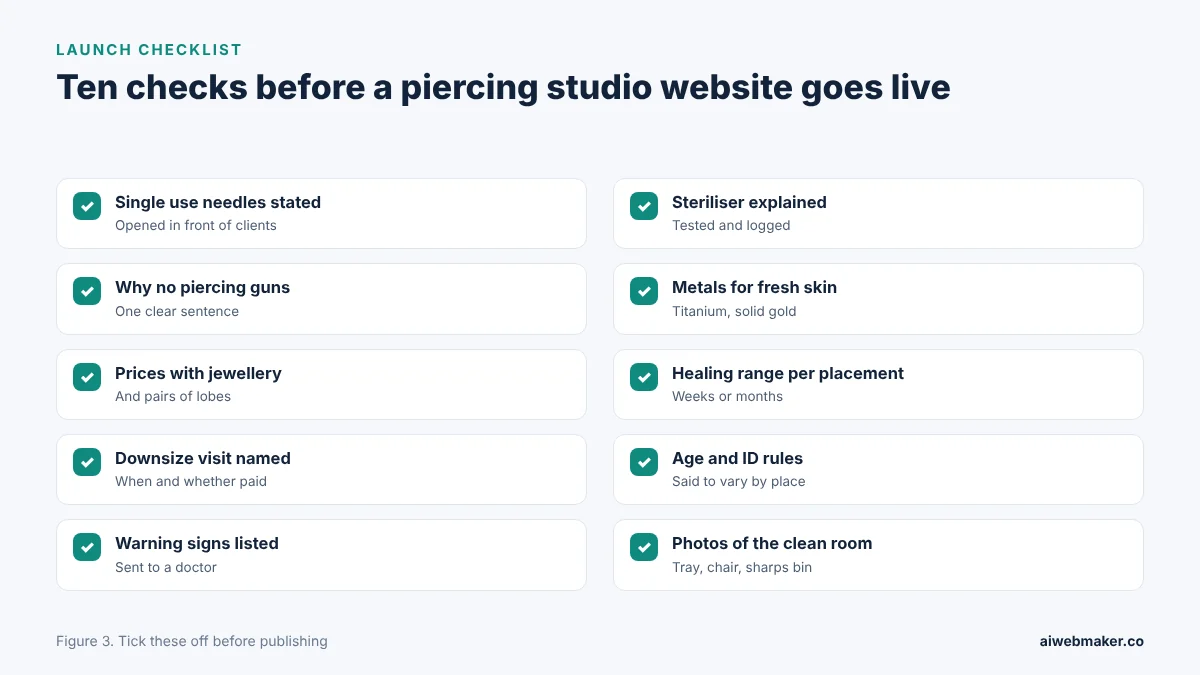
Nervous clients close a piercing website when hygiene is mentioned in one vague line or not at all. A price list without jewellery details suggests a cheap stud now and a costly upgrade later. Missing age and ID rules leave parents unsure whether a trip is worth making. Aftercare that stops at clean it regularly looks careless next to a studio that explains downsizing and warning signs. Photos of a cluttered room undo every reassuring sentence on the page. A piercer can settle every one of those doubts with the ten launch points pictured below.
Frequently asked questions
Why do studios use needles instead of piercing guns?
Professional studios use needles because a sterile, single use needle makes a clean channel and can be discarded after one client. Piercing guns push a blunt stud through the skin and cannot be sterilised in the same way as a needle tray. Many piercers also find that needle piercings tend to heal more smoothly, though healing always varies from person to person. A website that explains this briefly helps clients understand a price that may be higher than a kiosk. Clear reasoning earns more trust than a slogan about safety.
What does downsizing a piercing mean?
Downsizing means swapping the long post fitted on the day for a shorter one once the initial swelling has settled. A long first post leaves room for swelling, but kept too long it can snag on hair and clothing or cause the piercing to drift. Many studios include the downsize in the price and fit it at a checkup a few weeks later. The website should explain when the checkup usually happens and whether it is already paid for. Clients who understand downsizing are far more likely to return for it.
Can a teenager get a piercing?
Whether a teenager can be pierced depends on the law where the studio works and on the studio's own policy, and both change from one country to another. Many studios offer lobes from a younger age with a parent or guardian present and keep other placements for older clients or adults. Photo ID for the young client and the accompanying adult is a common requirement. The website should list the studio's limits clearly so families can plan the visit. Clear rules prevent awkward refusals at the counter.
What should someone do if a piercing looks infected?
Some redness, tenderness and a clear crust are normal while a piercing heals, and the aftercare page should say so. Spreading redness, heat, thick yellow or green discharge or a fever are reasons to see a doctor promptly. Many piercers advise keeping the jewellery in unless a doctor says otherwise, because removing it can trap infection. The client should also let the studio know, so the piercer can check the jewellery and placement. A studio website that lays out these steps calmly protects clients and its own reputation.
Is one afternoon of lobes and helixes enough to fund the year?
A single afternoon of lobe and helix piercings tends to exceed the $119 that keeps a studio's pages hosted from January to December. A single nostril piercing with titanium jewellery covers the monthly $19 on its own. Every client who reads the hygiene page, picks a metal and sends a request is a booking the site helped to secure. Checkups, downsizes and jewellery upgrades then bring the same people back through the door. Studios that keep their price list, aftercare cards and age rules current receive requests that arrive already informed. Parents and first timers who walk in calm, with ID in hand, are the surest return on those pages.
Build your website in Minutes and get the AI Tools that work
Start Building Your Website →