Online Course Website Cost for Creators Who Sell Filmed Lessons
A course creator's shop costs $119 a year to host, or $19 a month, plus a domain. Covered: how learners decide, course cards, preview lessons, options and kits, access and refunds, groups and gifts, search and the hosting budget.
- No coding required
- Live in minutes
- Blog, SEO and chatbot tools included
For a creator selling courses online, AI Web Maker hosting takes $119 out of a year's sales, or $19 out of any single month's, plus a domain. Course cards, kit options and the preview page cost nothing to arrange and test in the preview, so the shop is ready before the first payment. One course sold with its kit usually covers the hosting for the year. The harder problem is that buyers cannot handle a course before paying, and many have been disappointed by courses that promised more than they delivered. They want to know exactly what is inside, how the teaching sounds and what happens if the course does not suit them. What follows covers how learners decide, course cards, preview lessons, options and kits, access and refunds, groups and gifts, search and the yearly figures.
This article is part of our complete guide: Website Builder for Creative Businesses.
How do learners decide which course to buy?
Learners usually decide in three moves: they check whether a course matches their level, they judge the teaching style and they look for a safe way out if it disappoints. Complete beginners want reassurance that no experience is needed and that the first lessons start from the very basics. Returning hobbyists look for a course that builds on skills they already have, such as loose florals or skies and water. Gift buyers want a course that a friend or relative will enjoy, with a start date they can choose. Clubs, schools and care homes look for a way to buy one course for a whole group. A course shop that answers level, teaching and safety for each of these buyers converts browsing into sales.
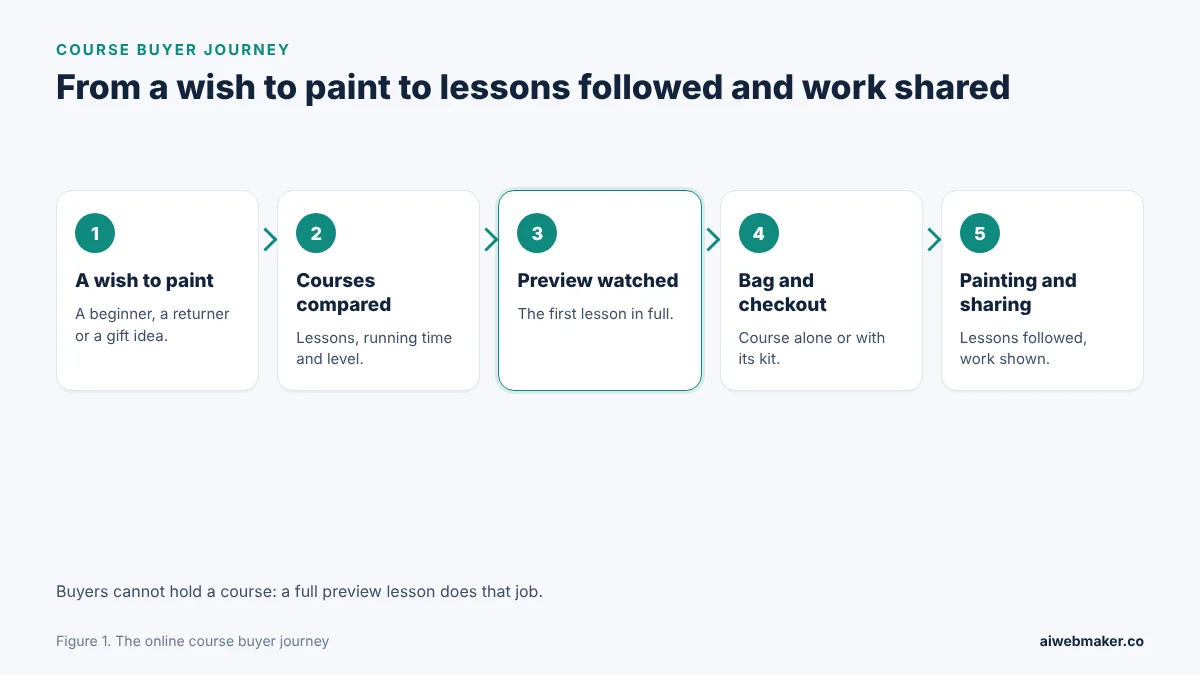
The journey shown here starts with a wish to paint and ends with lessons followed and finished work shared with others. Comparing courses comes early, when buyers check lessons, running time and level on each card. The marked step is the preview lesson, because hearing the teacher and seeing the camera angle settles more doubts than any description. The bag and checkout follow, with the choice of a course alone or a course with its paint kit. The final step, a finished painting that the buyer is proud of, leads to reviews, a second course and recommendations. Each stage needs plain, honest words that let buyers judge for themselves.
Courses, previews, policies: pages a course shop needs
A course shop needs pages that let buyers judge a course from every angle before they pay. The course shop shows each course as a card with its price, level and options. A page on what is inside sets out lessons, running times and outcomes in a single table. A preview page lets visitors watch a full opening lesson, and a policies page explains access and refunds. A gallery of student work proves that the teaching produces results, and a groups and gifts page serves buyers who are not buying for themselves. Taken together, these pages replace the doubt that stops many first purchases.
| Page | What the buyer checks | What it should include |
|---|---|---|
| Course shop | Price and level | Course cards, options, Add to bag |
| What is inside | Exactly what is taught | Lessons, running time, level, outcome |
| Preview | How the teaching feels | A full opening lesson, the camera angle |
| Policies | Access and refunds | Access period, refund window, kit returns |
| Student work | Real results | Paintings captioned by course |
| Groups and gifts | Buying for others | Enquiry route, chosen start dates |
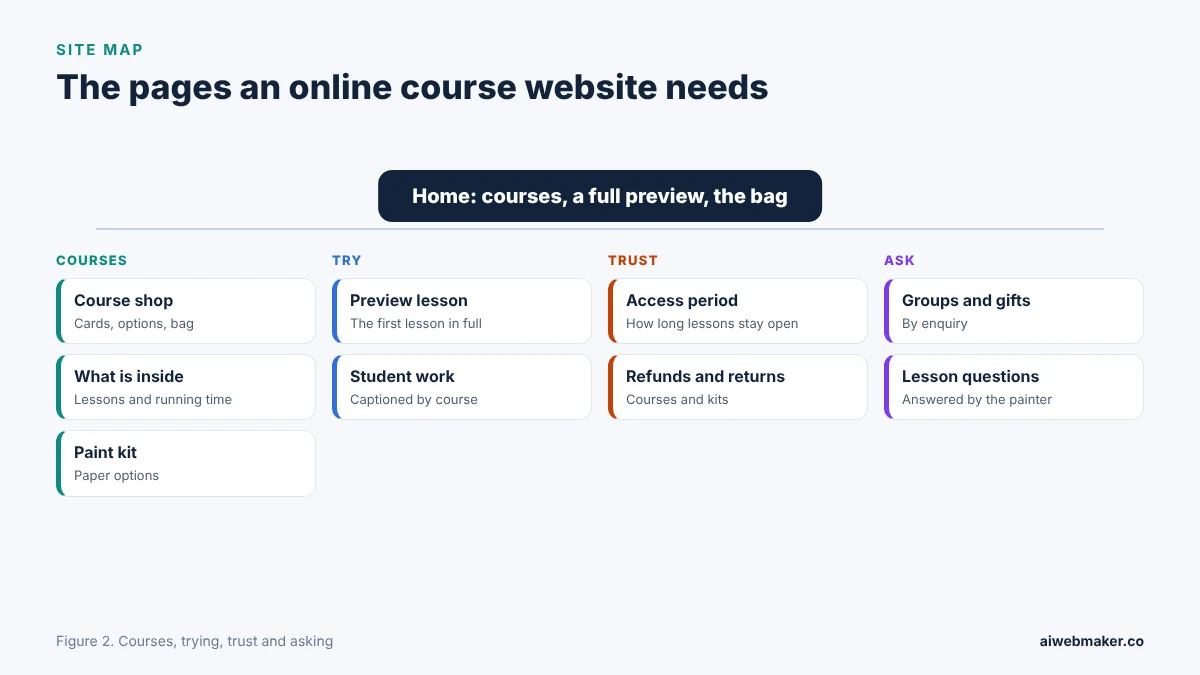
Seen from the home page, this site map sorts the shop into courses, trying, trust and asking. Course pages hold the shop, the contents table and the paint kit, trying pages hold the preview lesson and student work, trust pages hold the access period and refund rules, and asking pages hold groups, gifts and questions to the painter. Our sample creator, Studio Fernhill Courses, sells four watercolour courses called First Washes, Loose Florals, Skies, Water and Light, and Sketchbook Travels, along with a Studio Paint Kit. It offers a group course for a club or school by enquiry, three years of access, a 14 day refund and paint kit returns. The online course website example with preview lessons and a paint kit also shows what each course contains, a full preview, student paintings, reviews and an enquiry route. That layout gives careful buyers every reassurance in the order they look for it.
Course cards that say exactly what is inside
Course cards should state exactly what a buyer receives, because vague promises are the main reason online courses disappoint. Each card can list the number of lessons, the total running time, the level and the work the student will finish. A materials list with cheaper alternatives helps buyers budget before they start. If the course includes no live teaching or certificate, the page should say so plainly rather than leaving buyers to assume. The sample sets out its four courses in a table that buyers can scan in seconds. Honest contents earn trust and cut the refund requests that follow disappointment.
| Course | Lessons | Running time | Level | Work finished |
|---|---|---|---|---|
| First Washes | 10 | 2 h 50 min | Complete beginner | Three small studies |
| Loose Florals | 14 | 4 h 10 min | Beginner to improver | Five florals and a bouquet |
| Skies, Water and Light | 12 | 3 h 25 min | Improver | Two landscapes and six studies |
| Sketchbook Travels | 8 | 2 h | Any level | Eight sketchbook pages |
Preview lessons and filming that sell the teaching
A full preview lesson is the strongest sales tool a course creator has, because buyers judge the teacher as much as the topic. Showing the whole opening lesson, rather than a short trailer, lets buyers hear the pace, see the camera angle and judge whether the explanations suit them. For painting and craft courses, filming from directly above the table shows every stroke, and a second camera on the palette helps when mixing matters. Real time demonstrations, without sped up sections, show how long techniques actually take. Captions and printable notes help learners who watch in noisy places or prefer to read along. A preview that represents the full course honestly brings in buyers who are likely to finish it.
Course options, paint kits and the bag
Options let a buyer shape a purchase without contacting the creator, which keeps the shop moving even while the studio is closed. The online store builder for course creators who sell kits alongside lessons lets each course carry options such as course only or course with a kit, keeps chosen items in a bag, and a delivery fee joins the total at checkout whenever a physical kit is part of the order. Discount codes can reward newsletter readers or launch a new course. Purchases without a fixed price, such as a course licensed to a whole club or school, can carry an Enquire button instead. The page should explain clearly how and when access to the lessons arrives after payment. Clear options reduce questions and make the first purchase feel simple.
| Product | Option the buyer picks | Why it helps |
|---|---|---|
| A single course | Course only or with a paint kit | Beginners get everything in one order |
| Studio Paint Kit | Cold or hot pressed paper | Suits the buyer's chosen style |
| Group course | Enquire | Priced by the number of painters |
| Gift course | Start date by enquiry | Begins on a birthday or holiday |
Access periods, refunds and kit returns in plain words
Policies on access and refunds matter more for online courses than for most products, because buyers cannot inspect the course before paying. The access period should be stated clearly, along with whether lessons added or refilmed during that time are included. A refund window with a simple condition, such as having watched only a few lessons, protects both the buyer and the creator. Physical items like paint kits need their own returns rule, usually for unopened items within a set period. Consumer rules on digital purchases, and on cancelling them once lessons have started, differ from one jurisdiction to another, and the page should add that local law applies where it gives buyers more. Clear policies make a hesitant buyer far more willing to try.
| Policy | The sample's terms | Why buyers care |
|---|---|---|
| Access period | Three years from purchase | Time to learn at their own pace |
| Course refund | Within 14 days, fewer than four lessons watched | A safe way out if it disappoints |
| Kit returns | Unopened within 30 days | Fair treatment for physical goods |
| Local law | Applies where it gives more | Respect for buyers' rights everywhere |
Groups, gifts and questions after purchase
Groups and gifts open new sales without new courses, so the website should make both easy to arrange. Painting clubs, schools and care homes may want to license a course for a whole group, often with a live question session at the end. Gift buyers want to choose a start date, such as a birthday, and receive details to pass on. Students who buy a course often have questions about a particular lesson, and a clear way to ask builds loyalty. The page should state how quickly the creator replies, and the sample promises a reply within three working days. Friendly routes for groups, gifts and questions turn single buyers into lasting followers.
Search phrases learners use before they buy
Learners search for skills more often than for course names, typing phrases such as watercolour for beginners, loose florals tutorial, how to paint skies or online painting course. Course pages and articles should use the words learners use and name the level each course suits. A map listing matters less for courses sold worldwide, although a creator with a real studio that ships kits or hosts workshops may still benefit from one. Reviews that describe what students learned and finished say far more than a row of compliments. Articles that teach one technique fully, such as mixing greens or painting wet in wet, attract learners who later buy the full course. Generous, useful teaching in articles is the most natural way to build an audience for paid lessons.
The yearly figures behind a course shop
A course shop's yearly figures are modest: hosting on the annual or monthly route, a domain, and a little spent on articles. Creators with steady sales usually pay for the year, while someone launching a first course may prefer monthly billing until sales settle. Twelve technique articles draw roughly $7.80 from AI credits across the year. Adding a course, changing a price or creating a new kit option carries no additional charge. The table lists the annual route beside the monthly one, and the $189 tier occupies its own row for reference only.
| Item | Yearly | Monthly |
|---|---|---|
| Hosting the course shop | $119 | $228 over twelve months |
| Domain | Depends on the ending | Depends on the ending |
| Higher plan, for comparison | $189 a year | Not needed |
| Twelve technique articles at about $0.65 | About $7.80 | About $7.80 |
| New courses, kits and prices | No charge | No charge |
| Year before the domain | About $126.80 | About $235.80 |
Why do learners leave a course page unconvinced?
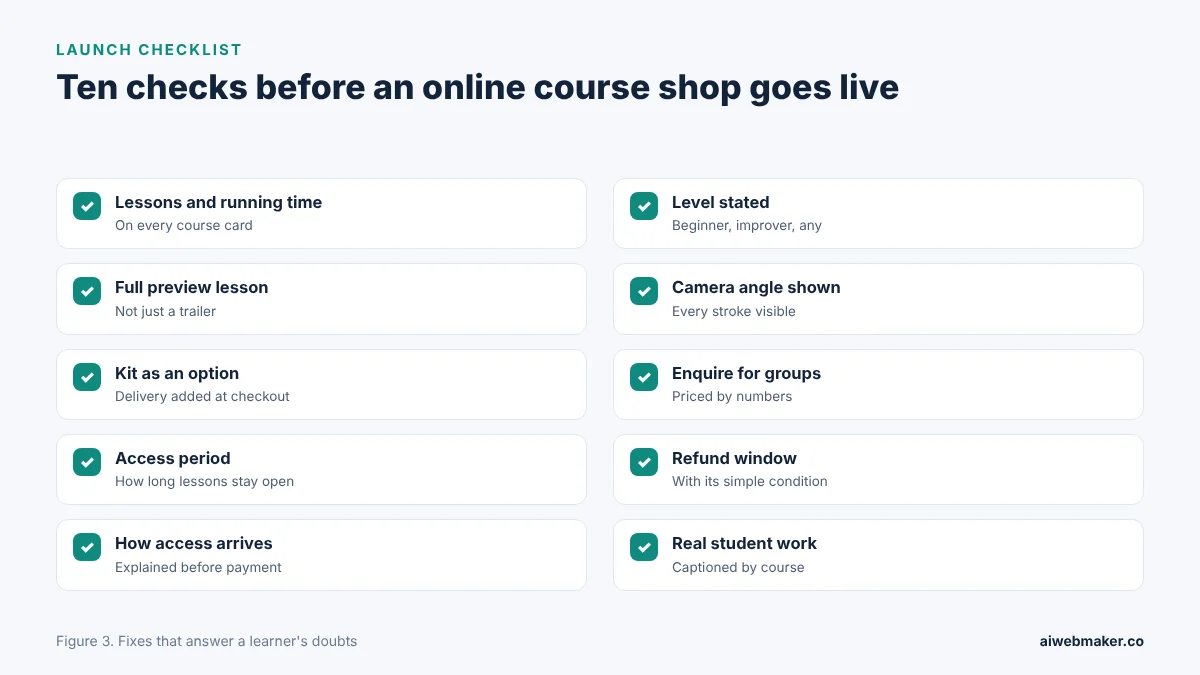
Learners leave a course page unconvinced when it lists no lessons, running times or level, because they cannot tell whether the course suits them. A short trailer instead of a full preview hides the very thing they want to judge. Missing refund terms make the purchase feel like a gamble. No word on how access arrives after payment leaves buyers worried they will pay and receive nothing. Stock images instead of real student work suggest the results may not be achievable. Ten fixes in the figure answer these doubts before a learner clicks away.
Frequently asked questions
Do beginners need experience before buying a watercolour course?
Beginners usually need no experience if the course is designed for them, and the card should say so clearly. A starter course such as First Washes in the sample assumes the learner has never held a watercolour brush. Other courses should state which skills they build on, so buyers can choose the right starting point. A materials list helps beginners buy what they need without overspending. Clear level labels prevent the frustration of starting in the wrong place.
How long does access to an online course last?
Access periods vary between creators, and the sample offers three years from the day of purchase. Some creators include any lessons added or refilmed during that period, which is worth stating. Buyers appreciate knowing whether they can return to a course years later to refresh a technique. The access terms should appear on the course card and in the policies. A clear access period removes one more reason to hesitate.
What happens if a course is not right for the buyer?
A fair refund policy lets a buyer ask for a refund within a set period, often with a simple condition such as having watched only a few lessons. The sample offers a 14 day refund when fewer than four lessons have been watched. Physical kits usually have their own returns rule for unopened items. Where local consumer law gives buyers more than the policy does, the law applies. A clear policy encourages buyers who would otherwise hold back.
Can a club or school buy one course for a whole group?
Many creators license a course for a painting club, a school or a care home, priced by the number of learners. Some add a live question session at the end so the group can ask about their work. The website can offer this through an enquiry, since group prices usually depend on numbers. The creator should explain how the group will reach the lessons and for how long. Group licences can bring in more income than many individual sales.
One course with its kit already settles the hosting
A single course sold with its paint kit usually earns a creator more than twelve months of hosting plus the domain. On monthly billing, one beginner course outweighs the $19 for that month several times. Every learner who watches the preview, buys a course and returns for the next adds income without extra filming. Honest course cards, full previews and plain refund rules persuade buyers who have been disappointed by courses before. A steady trickle of student paintings arriving in the inbox is the most welcome sign the website is working.
Build your website in Minutes and get the AI Tools that work
Start Building Your Website →