What Makeup Artists Pay for a Website, Counted in Wedding Mornings
Makeup artists can keep their site hosted at $119 every twelve months or at $19 in single months, with a domain alongside. Next come who books and when, services and trials, wedding morning timings, travel fees, hygiene, the portfolio, date requests and search.
- No coding required
- Live in minutes
- Blog, SEO and chatbot tools included
For a makeup artist, the website bill is $119 across a year, or $19 monthly for artists who would rather not pay up front, with a domain alongside. Every service description, price and photo can be shaped and previewed in AI Web Maker without any bill arriving. A single bridal booking covers years of hosting, so the fee barely registers against one wedding morning. The real difficulty is timing, because couples often book many months ahead and each date can only be sold once. Seeing how a site handles that pressure is easier on the makeup artist business website sample, an AI Web Maker build for an artist who is purely fictional, centred on the wedding morning. An artist whose site shows the right looks, explains the morning clearly and answers questions about travel and trials secures the best dates before rivals do. The guide moves from who books and when to services and trials, wedding morning planning, travel, hygiene, the portfolio and the yearly website bill.
This article is part of our complete guide: Website Builder for Creative Businesses.
Who hires a makeup artist, and how far ahead do they book?
Makeup clients book on very different timescales, and the website should make each group's route obvious. Brides often secure an artist many months before the wedding, usually after seeing work on a friend or in a photographer's gallery. Bridesmaids, mothers and other close family are often booked as part of the bridal party, so their prices and timings belong beside the bride's. Event clients, such as guests at a gala, a graduation or a milestone birthday, book weeks or days ahead and care most about availability and price. Photographers, brands and models book shoot makeup and look for editorial range, reliability on set and an understanding of how makeup reads on camera. A site that serves all four groups fills the diary well beyond the wedding season.
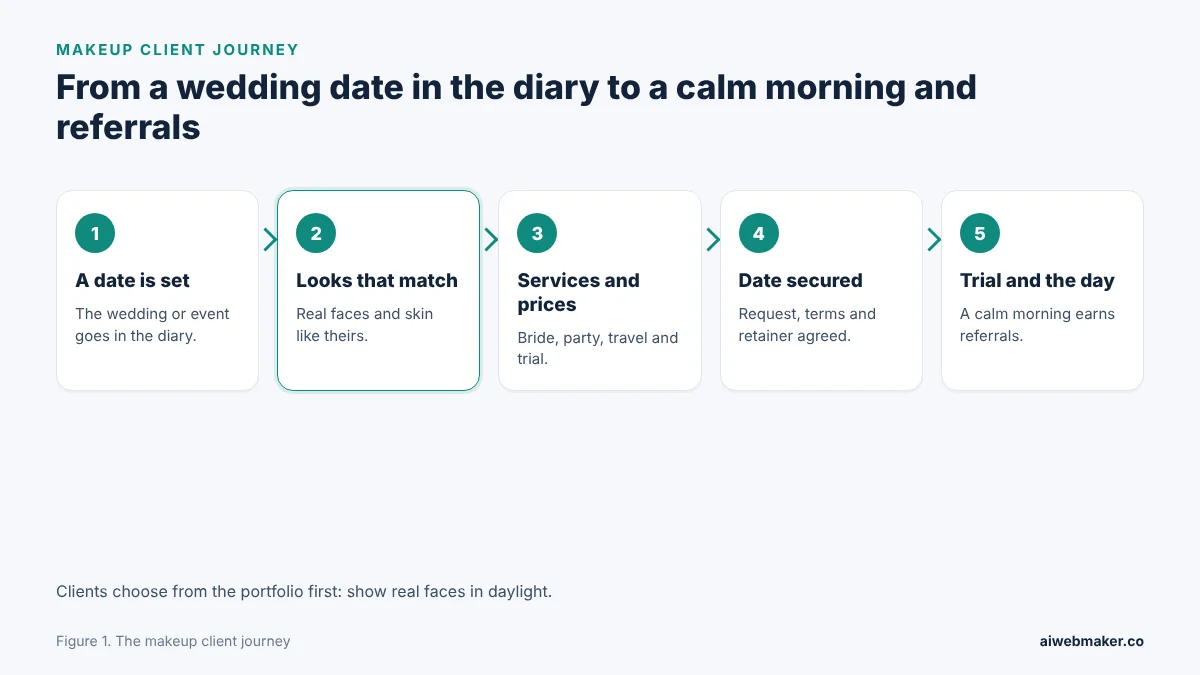
The moment that matters most comes second, when a client studies the portfolio for faces, skin tones and styles that resemble their own. Before that, the date has been set and the search has begun, often with a recommendation from a photographer or a venue. After it, services and prices tell the client whether the artist fits the budget and the size of the party. Securing the date follows, with terms and any retainer agreed directly between the artist and the client. The trial and the wedding morning then decide whether the client recommends the artist to every engaged friend.
Which pages should a makeup artist build around bridal and event work?
A makeup artist's site needs a short set of pages that separate bridal work from everything else, because brides read differently from event clients. The home page should open with a striking finished look, the areas covered and a route to request a date. A services page explains each service, the trial and how pricing and travel work. Real looks sorted by occasion fill the portfolio, while the about page covers training, experience and approach. A contact page invites the details of the occasion, such as the date, location and number of people.
| Page | What the visitor checks | What belongs there |
|---|---|---|
| Home | Does this style suit me? | A finished look, areas covered, a request route |
| Bridal | Can the artist handle our morning? | Bride, party, trial, timings, what is included |
| Events and shoots | Is the artist available soon? | Occasion makeup, shoot makeup, rates |
| Portfolio | Have they worked on skin like mine? | Real looks across tones, ages and styles |
| About | Can this person be trusted? | Training, experience, hygiene, approach |
| Contact | How is a date held? | Date, venue, party size, next steps |
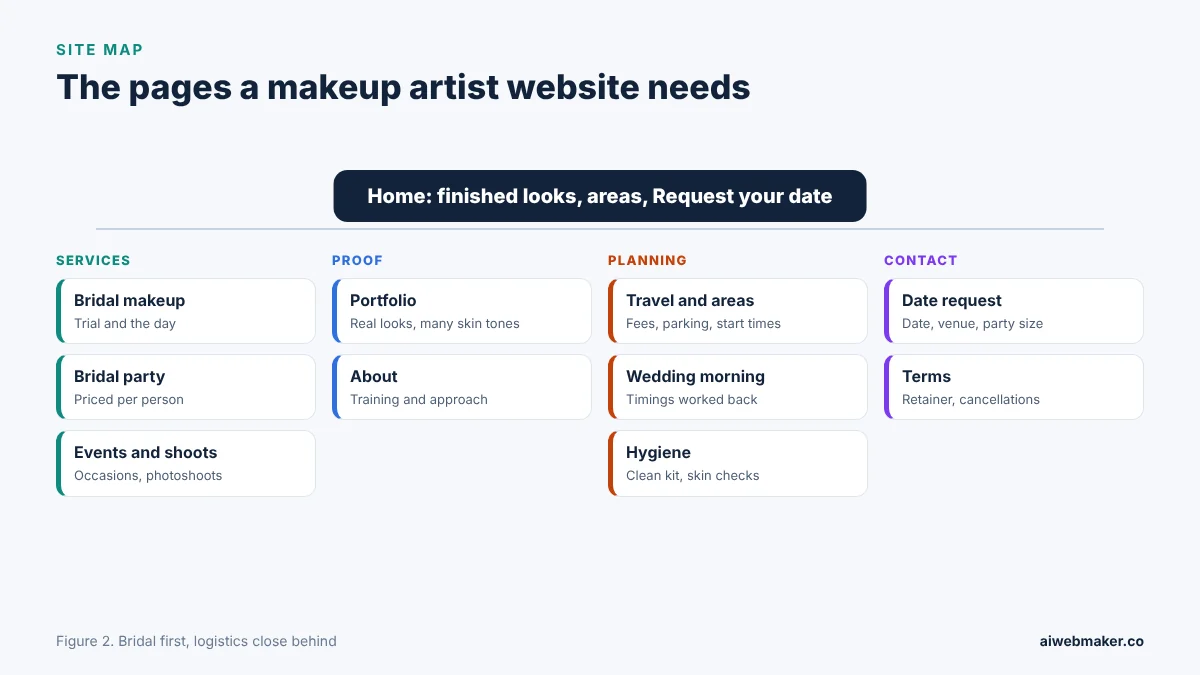
Gathered into four groups, the pages keep bridal work at the front and the practical details close behind. The services group holds bridal, bridal party, occasion and shoot makeup, each with its own description and price. The proof group carries the portfolio and the artist's training, while the planning group covers travel, timings and hygiene. Our sample, Rosewood Makeup Artistry, offers bridal makeup, bridal party makeup, event and occasion makeup and photoshoot makeup as four bookable services, and its services page explains what each one involves, where the artist works and how pricing is set. Its portfolio page shows bridal looks beside client reviews labelled as examples and invites visitors to recreate a favourite look, while the about page covers training, experience and the artist's approach to style. The makeup artist website example with bridal and occasion booking took AI Web Maker 54 seconds to assemble.
How should a wedding morning be planned and timed?
A wedding morning is planned backwards from the moment the photographer wants the bride ready, and the website should show that the artist thinks this way. Each face in the bridal party takes a set amount of time, and the bride's look takes longest because it includes extra care, lashes and final touches. Bigger parties sometimes call for an assistant, and the page can explain at what size the artist brings one. Start times can be very early, and an early start fee, where one applies, should be stated openly. The artist usually finishes the bride last, so the look is freshest for the ceremony and the first photos. A clear timing section reassures couples that the morning will run calmly.
| Morning detail | What the page should explain |
|---|---|
| Time per face | Roughly how long the artist allows for each person |
| Order of the morning | Bridal party first, the bride last |
| Assistant artists | When a second artist joins, and the cost |
| Early starts | Any fee for starting before a set hour |
| Touch ups | Whether the artist can stay, and for how long |
| Space needed | A chair, a table and good daylight near a window |
What should a bridal trial include, and when does it happen?
A trial lets the client see the look on their own face and lets the artist test products on their skin, which makes the wedding morning far calmer. Trials are commonly held some weeks or months ahead of the wedding, often alongside a hair trial or a dress fitting so the whole look can be judged together. The page should say how long a trial lasts and what the client should bring, such as photos of the dress and inspiration images. Notes and photos taken at the trial guide the artist on the day itself. A clear trial section helps clients understand what the bridal package includes.
How should travel, venues and location fees be described?
Most wedding makeup happens at the client's home or venue, so travel terms form part of the price and should never come as a surprise. The page should name the areas covered and explain how travel is charged beyond them, whether by distance, a flat fee or the cost of parking and tolls. Destination weddings may need accommodation and transport arranged by the couple, which is worth stating clearly. The artist also needs a chair, a table near a window and access to power, and saying so in advance avoids a cramped corner on the day. Clear logistics are a quiet sign of professionalism that couples notice.
| Pricing element | What to state |
|---|---|
| Bridal package | What is included, such as the trial, lashes and touch ups |
| Bridal party | Price per person and any minimum number |
| Travel | Areas covered and how travel beyond them is charged |
| Early start | The hour before which a fee applies |
| Staying on | The rate for staying after the last face |
| Retainer | How the date is held and how payment is arranged |
How do clean brushes and skin checks protect clients?
Clients trust a makeup artist with their skin and eyes, so the website should explain the hygiene routine as plainly as the services. Brushes should be cleaned between clients, and creams, foundations and lipsticks moved onto a palette with a clean spatula rather than applied straight from the pot. Disposable mascara wands, lip applicators and sponges, used once, stop infections passing between faces. Before the day, clients should be asked about allergies, sensitive skin and earlier reactions, and someone with an active skin condition, an eye infection or a fresh cosmetic treatment may be told to seek a doctor's view first. Standards and any licensing rules for makeup artists vary by country, so the artist should follow those that apply locally. A visible routine reassures careful clients before they ever sit in the chair.
What should the portfolio show beyond perfect bridal photos?
The portfolio should show real clients across skin tones, ages and styles, because a client wants proof the artist has worked on someone like them. Grouping looks by occasion, such as bridal, party, editorial and evening, helps each visitor find what matters to them. Photos taken in daylight soon after the look is finished show the real texture of skin and the true colour of the makeup. Wedding photographers' images can show the look in context, but they should be credited and used only with permission from the photographer and the client. Placeholder reviews, such as the examples in a template, should be replaced with genuine words or removed before launch. A varied, honest portfolio attracts the clients the artist is best placed to serve.
How should a makeup artist hold dates and agree retainers?
A date can only be sold once, so the request route and the terms that follow need to be clear from the first message. The client chooses a service and sends a request with the date and venue, then the artist checks the diary before answering. If the date is open the artist accepts, if the timing clashes a different start can be offered, and if the day is taken the request is declined. Retainers and balances are agreed and collected by the artist directly, and AI Web Maker keeps none of the fee. The bridal makeup booking website builder with date requests creates the request route, the service pages and the portfolio page once the artist has summed up their style and areas in a short paragraph. Written terms covering cancellations, changes to party size and postponed weddings protect both sides.
Which phrases do brides type when hunting for wedding makeup?
Makeup clients type phrases such as bridal makeup artist near me, wedding makeup in a named town, prom makeup or makeup artist for a photoshoot. The bridal and event sections should carry those phrases in their headings and first lines. On the map listing, the service area, the hours for enquiries and fresh photos of finished faces matter most. Reviews from brides that mention calm mornings, staying power and punctuality persuade later couples far more than general praise. Articles on preparing skin before a wedding, or choosing a look that photographs well, reach clients months before the date. Wedding planners and photographers who link to the artist's site add another steady route in.
What will the website take from a makeup artist's wedding season?
Over a year the makeup artist's website comes to hosting and a domain, with skin preparation or bridal timing articles drafted for about sixty five cents each. An artist with a busy wedding season already booked saves by paying the twelve months at once. Those still building a client list can take the $19 monthly option. Adding new looks, changing prices or updating travel areas costs nothing extra. Each route is shown below, with the $189 tier included as a comparison and nothing more.
| Item | Yearly | Monthly |
|---|---|---|
| Hosting the makeup artist pages | $119 | $228 over twelve months |
| Domain | Depends on the ending | Depends on the ending |
| Higher plan, for comparison | $189 a year | Not needed |
| Twelve skin prep and bridal articles at about $0.65 | About $7.80 | About $7.80 |
| New looks, prices and travel areas | No charge | No charge |
| Year before the domain | About $126.80 | About $235.80 |
Why do engaged couples leave a makeup artist's site without asking?
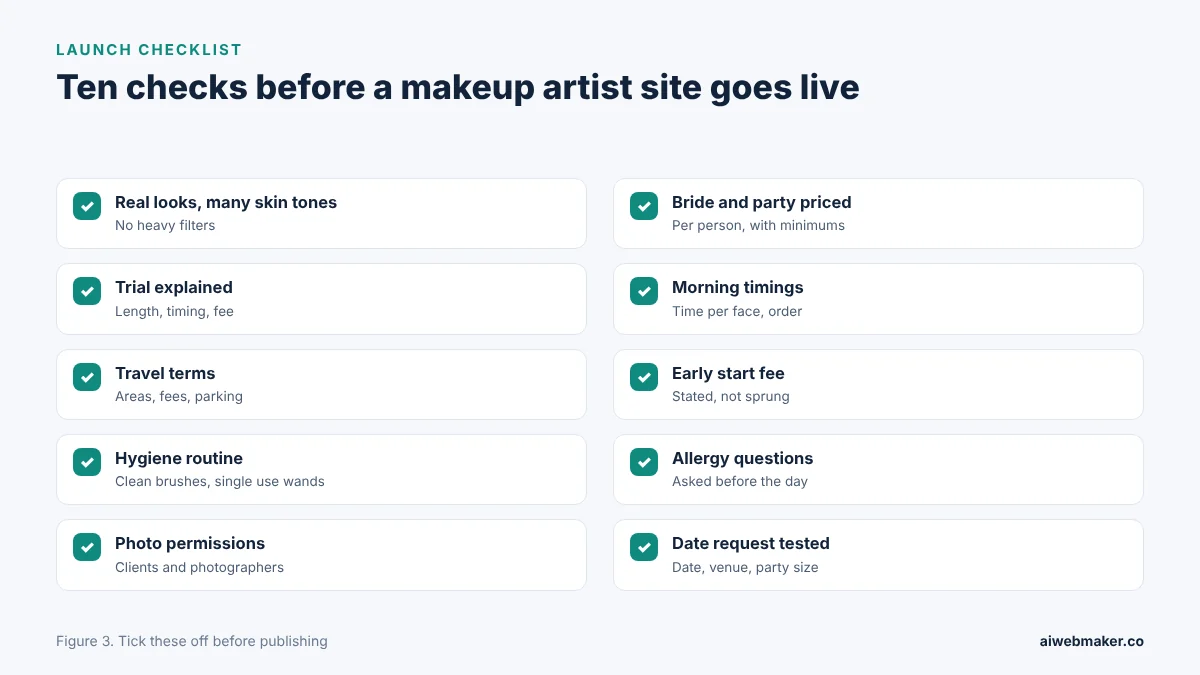
Engaged couples leave fastest when the portfolio shows only one skin tone or only heavily filtered images, because they cannot judge how the artist would work on them. No mention of travel or early start fees makes the true price feel hidden. A services page that never explains the trial leaves brides unsure what they are paying for. Silence about hygiene worries clients with sensitive skin. A contact route that asks for nothing about the date or venue invites slow, vague replies. A final pass over the ten points in this picture catches each of those faults.
Frequently asked questions
Is the bridal trial included in the wedding price?
Some artists include the trial in the bridal package and others charge for it separately, so the services page should say which applies. A separate trial fee is sometimes deducted from the wedding price if the client goes on to book. The trial usually takes longer than the wedding day look, because the artist and client try options and make notes. Booking it close to a hair trial or dress fitting helps the client judge the whole look. Clear trial terms make the package easier to compare.
How early do makeup artists start on a wedding morning?
Start times depend on the size of the party, the ceremony time and when the photographer arrives, and they can be very early. The artist works backwards from the moment the bride must be ready and adds time for setting up. Parties of several people may need an assistant to keep the start time reasonable. Any fee for starting before a set hour should be stated on the services page. Clear timings help the couple plan hair, breakfast and photos around the makeup.
Should a makeup artist patch test products before a wedding?
A patch test can help clients with sensitive skin or known allergies, and many artists offer one at the trial or on request. It cannot rule out every reaction, so the artist should still ask about allergies and past reactions before applying anything. Anyone with a skin condition or a recent treatment is better off asking a doctor before the trial. Rules and expectations about patch testing vary between countries and insurers. Offering a test openly shows care for the client's skin.
Can bridesmaids and guests book without the bride?
Guests at a wedding can usually book on their own, though the bridal party often takes priority on the morning itself. The services page can explain whether event makeup is available on wedding days or only when the diary allows. Prices for guests may differ from bridal party rates, and saying so prevents confusion. Guests who are happy with their look often become brides or event clients later. Clear options for guests widen the artist's reach at every wedding.
How many faces repay the makeup artist's hosting?
A single bridal party, and often just the bride, repays the $119 that hosts a makeup artist's site for the year. On monthly billing, one guest's event makeup covers several $19 payments. Each wedding date won after a couple browses the portfolio is income the pages helped earn, and every happy bride tells her friends. Honest photos, clear morning timings and plain travel terms win the trust that early bookings need. Artists who add new looks after each season keep the portfolio fresh for the next round of couples. A diary that fills with dates many months ahead tells the artist the pages are working hard.
Build your website in Minutes and get the AI Tools that work
Start Building Your Website →