Hair Braiding Website Cost, With Prices Set by Length and Hours
A braiding salon's hosting is $119 yearly or $19 monthly, with a domain on top. Covered: how clients choose, the pages, pricing by length, edges and the scalp, children's styles, chair rules, search and the budget.
- No coding required
- Live in minutes
- Blog, SEO and chatbot tools included
For a braiding salon, hosting costs $119 for the year, with $19 monthly for owners who would rather pay as the chairs fill, and the domain adds its own price. AI Web Maker does not bill for drafting the style pages or for testing them in its preview, so the price chart can be perfected before anything is paid. A single full head of knotless braids at waist length usually brings in more than the whole year of hosting. The harder task is that braiding clients hand most of a day and a large sum to a stranger, so they want the total, the hours and the care of their edges settled before they ask for a chair. A blurry photo and one starting price leave too much unanswered for someone giving up a Saturday. Covered here, in order, are how clients choose, the pages, pricing by length, edges and the scalp, children's styles, chair rules, search, the yearly bill and the doubts that make visitors leave.
This article is part of our complete guide: Website Builder for Creative Businesses.
Who books a braiding chair, and what do they check first?
Braiding clients arrive with a style already in mind and a list of practical questions behind it. Many want a protective style that rests their own hair for weeks, such as box braids, knotless braids or twists. Loc clients return on a cycle for retwists and want a braider who knows their history. Parents look for children's styles that are neat, light at the edges and done in a sitting a child can manage. People with fine or straight hair often ask whether cornrows will hold for a holiday. Every group checks the same three things first: the total for their length, the hours in the chair and proof of hair like theirs.
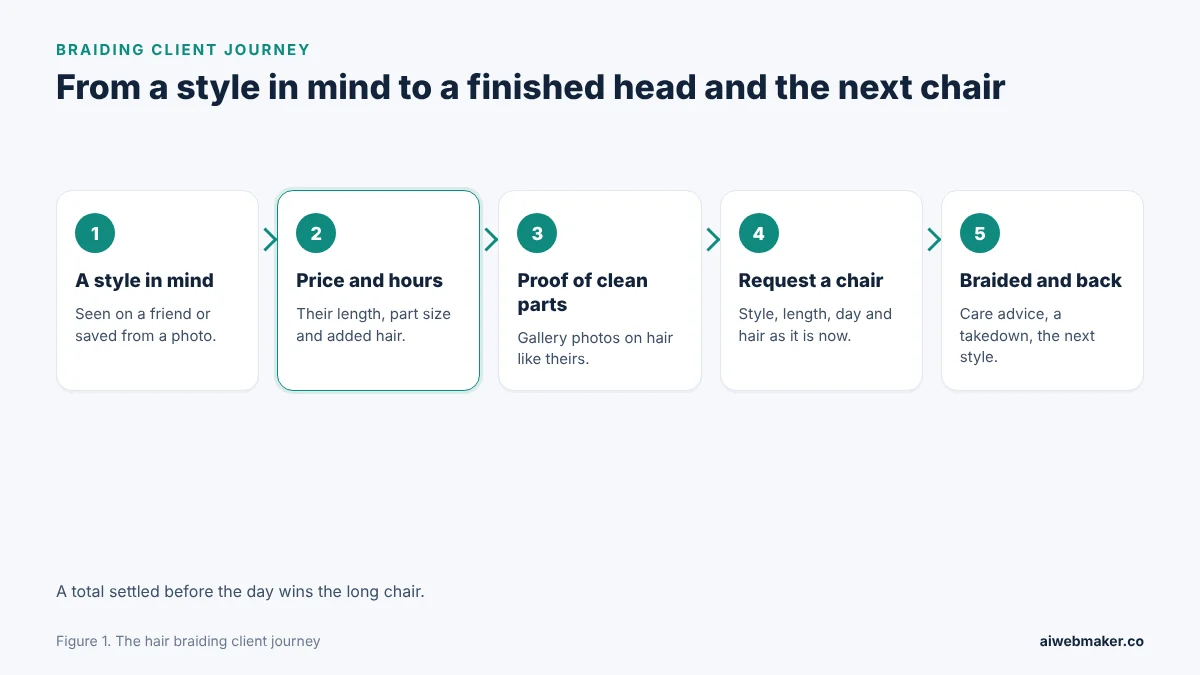
Price and hours sit at the hot centre of this journey, because nobody can plan a day or a budget without them. The path begins with a style seen on a friend or saved from a photo, and the first search is often that style plus a town. Once the total for a length and part size is clear, the gallery decides, and clean parts on a similar texture close the doubt. The request follows with the style, the length, a day and a few words about the hair as it is now. After the takedown, satisfied clients leave a review and book the next style with the same braider. Pages that answer each step in this order lose far fewer visitors along the way.
The pages a braiding salon needs, from style cards to the chair request
A braiding website can stay compact, provided every page settles one specific worry in the client's own words. Style cards carry the core offer, and a chart by length does most of the persuading. A section on textures tells visitors with coils, curls, waves or straight hair that they are welcome. The gallery proves the parting, while a children's section answers parents before they ask. Chair rules and the request then show exactly how to hold a long day.
| Page | What clients look for | What it should hold |
|---|---|---|
| Styles | Which braids, twists and locs are offered | A card per style with hours and a starting price |
| Prices by length | Their own total | Shoulder, mid back and waist columns |
| Your hair | Whether their texture is welcome | Coils to straight hair, tension and edges |
| Gallery | Proof of parting and finish | Captions naming style, size and length |
| Children's styles | Ages, days and sitting length | Lighter tension, breaks, a parent close by |
| Chair rules and request | How to hold a full day | Deposit, notice, lateness, takedowns |
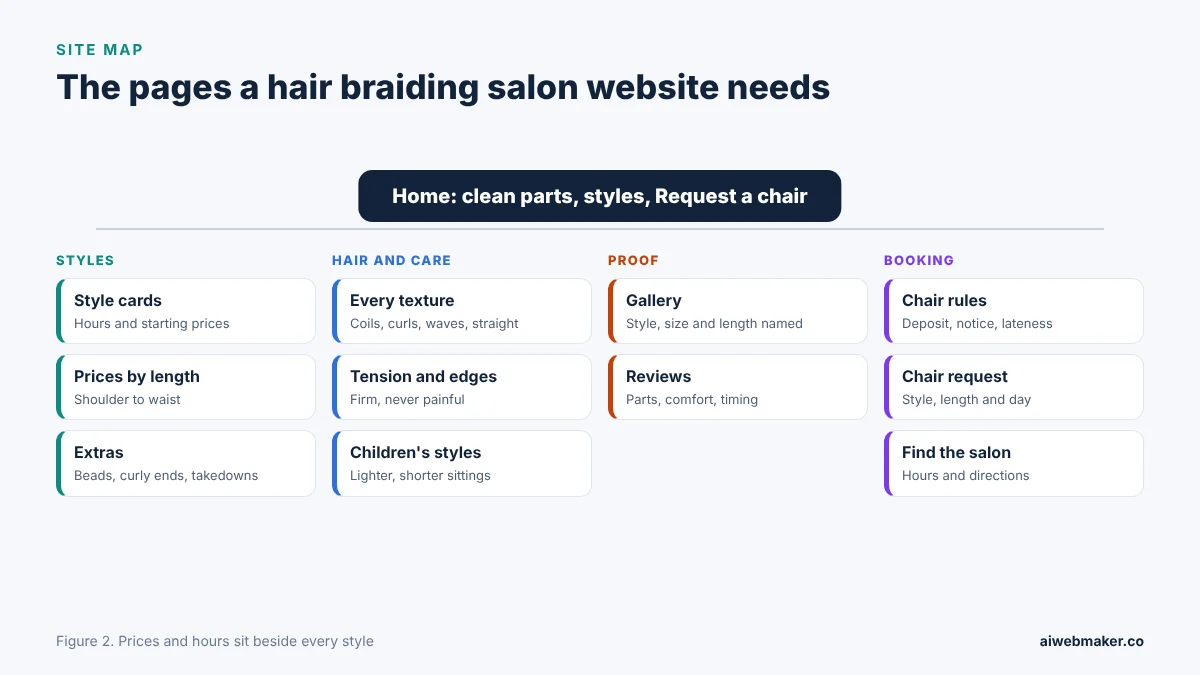
Under the home page, this braiding plan splits into styles, hair care, proof and booking, with each branch settling a separate doubt. The styles branch pairs every braid, twist and loc with its hours and the chart that prices it by length. The hair branch speaks to each texture, explains tension at the hairline and covers children. Proof comes from the captioned gallery and reviews describing parts, comfort and timing. The booking branch carries the rules and the request, where interest becomes a held day. Our sample salon, Crown and Coil Braids, lists box braids, knotless braids, cornrows, twists, locs and children's styles on one long page, followed by a price table by length, a section on coils, curls, waves and straight hair, a gallery, extras, questions and a chair request; the hair braiding website example with styles priced by length runs in that order from top to bottom.
How do length, part size and added hair move a braiding price?
A braiding price moves with length, part size and added hair, so one starting figure hides most of what a client will pay. Length is best measured on the finished braid, which lets someone with short hair price a waist length style. Smaller parts mean more braids and extra hours, while large parts save time and money. Thick hair takes longer to section, which the braider confirms only after seeing it. The page can state that prices assume medium parts on hair that arrives washed and stretched, with the final total confirmed when the request is accepted. Written assumptions like these prevent the one thing clients resent, a surprise at the end of a six hour chair.
| Price driver | Effect on time and price | How to show it |
|---|---|---|
| Length | More hair and more hours | Columns for shoulder, mid back and waist |
| Part size | Small parts add braids and hours | One line on how part size shifts the figure |
| Added hair | Packs of hair add to the cost | Whether hair is included, colours stocked |
| Extras | Curly ends, beads, colour blends | A short priced list beside the styles |
| Preparation | Tangled hair adds time | A wash and stretch offered as an extra |
Tension, edges and the scalp: where care meets caution
Tension deserves plain words on a braiding website, because braids pulled hard at the hairline can thin the edges over time. Clients with coily hair often worry about this, especially if they have lost edges before. The page can explain that braids should feel firm at the root but never painful, and that fragile edges are braided loosely or left out. Heavy extensions and styles worn for months add strain, so guidance on wear time belongs here too. Anyone with a sore, flaking or patchy scalp should see a doctor before booking, and the page should say so without offering a diagnosis. Caution stated briefly like this reads as expertise rather than fear.
| What a client notices | What the page should advise |
|---|---|
| Bumps or redness along the hairline | Tell the braider at once so the section is loosened |
| Soreness lasting beyond a couple of days | Speak to a doctor rather than waiting |
| Thinning or patchy edges | Edges left out, and a doctor if the loss is patchy |
| An itchy scalp under added hair | Mention any past reaction in the request |
Children's styles: lighter tension, shorter sittings
Children's braiding needs its own section, because parents ask different questions from adult clients. They want the youngest age accepted, the length of a sitting and whether they can stay in the room. Styles for children should be lighter at the edges, with little or no added hair. Breaks during the sitting, and a willingness to stop if a child is uncomfortable, reassure parents more than any photo. Loose beads can be a choking risk for very young children, so the page should say when beads are offered and how they are secured. Gallery photos of children's styles should avoid faces, which protects privacy while still proving the parting.
Deposits, lateness and takedowns: chair rules to write down
Chair rules belong on the website because a missed long appointment can cost a braider a whole day of income. A range of hours on every style card lets clients plan childcare, meals and travel, and a deposit for long styles protects the day. With the booking website builder for braiding salons that fill long chairs, a client sends a request for a style and a day from the salon's own pages. The salon then confirms it, moves it to the nearest open day or turns it down when the style would not suit the hair. Any deposit or payment is settled between braider and client, and AI Web Maker keeps no part of it. Clear rules on lateness and notice keep a seven hour style from running into the evening.
| Chair rule | What the page should state |
|---|---|
| Deposit for long styles | The amount and how it comes off the total |
| Notice to move | The hours of notice before a deposit carries over |
| Late arrival | How long the chair is held, and when a style is shortened |
| Hair preparation | Washed, detangled and stretched, or a wash added |
| Takedowns | Booked alone or before a new style |
What clients type when hunting for knotless braids or a loc retwist
Clients usually search for the style before the salon, typing phrases such as knotless braids near me, kids braids or loc retwist. Other common searches pair box braids or cornrows with beads with a district name, so each style deserves its own plain heading. The map listing needs the right salon category, exact opening days and recent photos of finished styles, because long chairs make people check hours carefully. Reviews that mention clean parts, comfortable tension and an accurate finish time persuade more than general praise. Short articles on wear time, preparing hair before a chair and protecting braids at night attract readers weeks before they book. Steady care writing makes the salon a name local clients already recognise.
Hosting sums for a salon that braids from shoulder to waist
Two charges come round every year for a braider, hosting plus the domain, while a dozen care articles written with credits cost under eight dollars in total. Settling the full year at $119 is the cheaper route for a salon whose chairs stay busy most weeks. A braider who rents a chair or has just opened may prefer $19 a month while regulars build up. New styles, adjusted prices and fresh gallery photos can go up at any time without changing the bill. A braider can glance at the $189 tier below purely as a point of reference.
| Item | Yearly | Monthly |
|---|---|---|
| Hosting the braiding pages | $119 | $228 over twelve months |
| Domain | Depends on the ending | Depends on the ending |
| Higher plan, for comparison | $189 a year | Not needed |
| Twelve braid care articles at about $0.65 | About $7.80 | About $7.80 |
| New styles, prices and gallery photos | No charge | No charge |
| Year before the domain | About $126.80 | About $235.80 |
Which gaps send a braiding client back to scrolling?
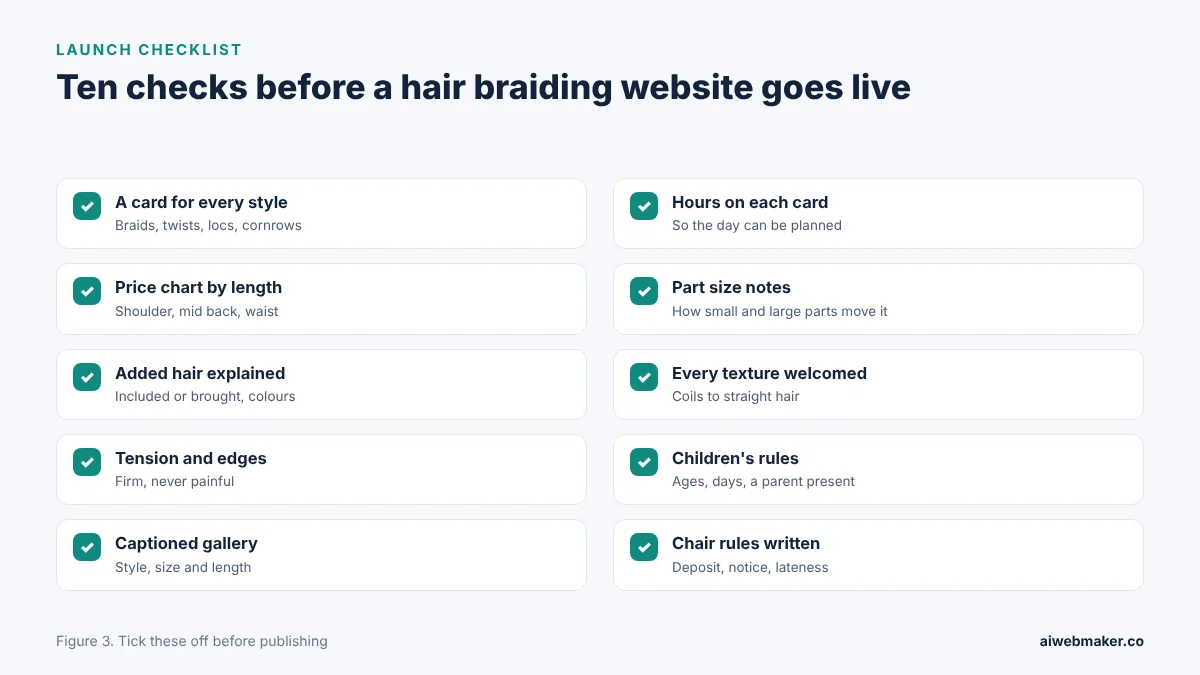
Braiding clients leave a website fastest when they cannot find a price for their own length and part size. Missing hours on the style cards make the day impossible to plan, so they move to a salon that states them. A gallery with no captions, or photos of only one texture, suggests the braider will not know their hair. Silence on tension and edges worries anyone who has lost hair to tight braids before. Vague deposit and lateness rules make a long chair feel risky. The braider's launch list pictured next closes each of those holes.
Frequently asked questions
How long can box braids stay in before a takedown?
Many braiders suggest wearing box braids and knotless braids for around six to eight weeks, though the right span depends on the hair and the style. Leaving braids in much longer lets new growth tangle at the root and makes the takedown slower and harder on the hair. The website can give the salon's own guidance on each style card and in its care articles. It can also offer takedowns as a separate appointment with its own time and price. Clear guidance on wear time protects the hair and fills the takedown chair.
Is braiding hair usually part of the price?
Some salons include braiding hair in the price and others ask clients to bring their own, so the page should say which applies to each style. Including hair simplifies the total and ensures the braider works with fibre that holds well. Naming the colours kept in stock saves questions before the day. If clients may bring hair, the page should name the type that works best and any change to the price. Writing it down prevents a common misunderstanding at the chair.
Do braiders need a licence?
Licensing for hair braiding varies widely, and the answer depends on the country and sometimes on the region. In the United States, for example, rules differ from state to state, with some requiring a braiding licence and others exempting natural hair braiding. A braider should check the rules where the salon works and keep any required licence current. Showing a licence or registration on the website, where one exists, reassures careful clients. Accurate local information matters more than general advice.
Can fine or straight hair hold cornrows?
Fine and straight hair can hold cornrows well when the sections are kept small and the ends are secured. Braids on smooth hair tend to slip sooner than braids on coily hair, so the style may last days rather than weeks. A page that says this honestly attracts holiday and festival clients who might assume they are not welcome. Gallery photos of cornrows on wavy or straight hair prove the point better than words. Honest notes on wear time keep these clients happy and returning.
Does one full head of knotless braids clear the year?
A single knotless appointment to the waist normally outweighs the $119 that twelve months of hosting cost a braiding salon. On monthly billing, one set of children's cornrows covers the $19 with room left over. Every client who prices a style from the chart, studies the parting in the gallery and sends a request is a chair the website helped fill. Loc retwists and repeat protective styles then add value month after month. Braiders who keep their chart, gallery and chair rules current find that requests arrive already settled on style, length and day. A week of full chairs from clients who never had to ask the price proves the pages earn their keep.
Build your website in Minutes and get the AI Tools that work
Start Building Your Website →