Event Photographer Website Cost, With Previews Before the Room Empties
An event photographer's booking pages sit online for $119 a year, under a third of one two hour job, or $19 monthly in slow quarters, and a domain is added. The rest covers who books, the pages, hourly coverage, previews and turnaround, licences by use, guests who opt out, shot lists and date checks, search and the yearly figures.
- No coding required
- Live in minutes
- Blog, SEO and chatbot tools included
An event photographer's booking pages sit online for $119 a year, under a third of one two hour job, or $19 a month in a slow quarter, plus a domain. Coverage cards, the delivery table and the licence list can be drafted, then checked screen by screen in preview, before AI Web Maker raises any charge. One conference morning brings in more than the hosting costs. The real challenge is that event work is bought on speed and rights rather than artistry alone. A communications team wants photos posted while delegates are still in the room, and its lawyers want to know exactly where those photos may appear. Inside: who books, the pages, hourly coverage, previews and turnaround, licences, guests who opt out, shot lists and date checks, search and the yearly figures.
This article is part of our complete guide: Website Builder for Creative Businesses.
Event teams, comms managers and agencies on deadline
Event photographers are hired by people who answer to someone else, so the site must reassure the buyer and the buyer's boss at the same time. In house events teams book conferences, launches and anniversaries, often several times a year. Communications and press officers need a handful of strong images within hours for social posts and next morning releases. Agencies running events for clients subcontract photography and care about reliability, discretion and clean invoices. Sponsors and speakers also receive photos, which makes licensing a practical question rather than a legal footnote.
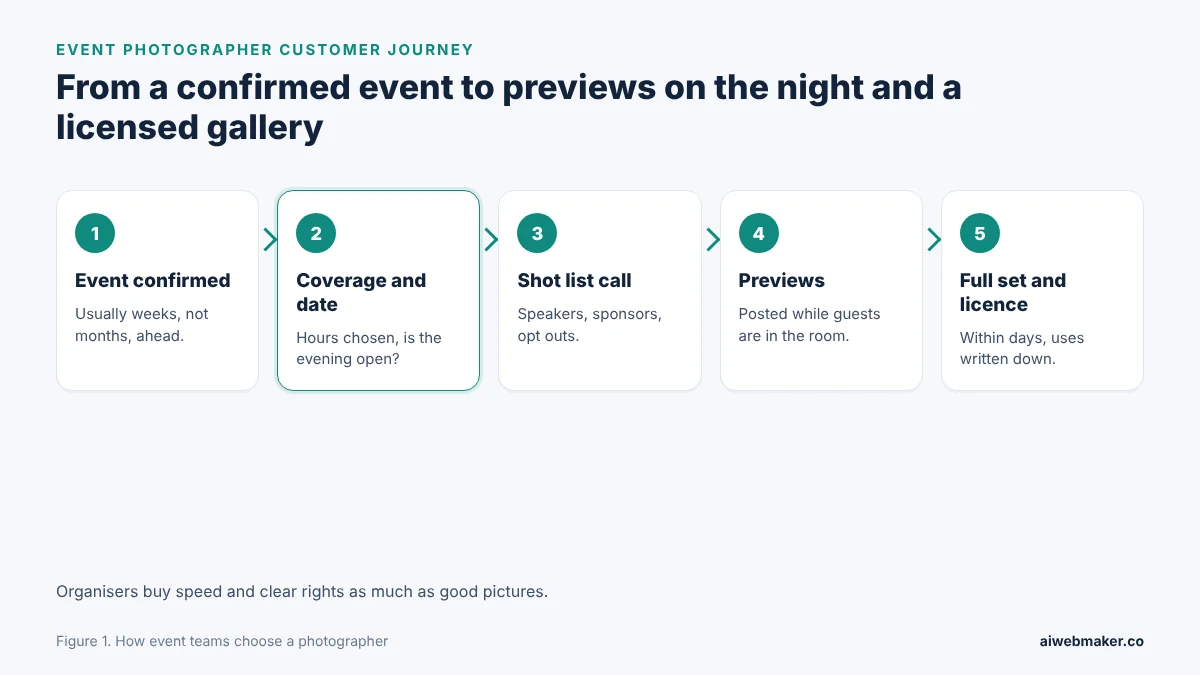
A confirmed event date starts this path, usually weeks rather than months ahead. The highlighted second step is the coverage and date check, when the organiser picks the hours and asks whether the photographer can take that evening. A shot list call a week before agrees the speakers, sponsors and group photos that cannot be missed. Previews during or just after the event are the fourth step, and they are often what the client remembers most. The full set and its licence follow within days, which is the moment the client decides whether to book again.
Coverage, delivery, privacy and licences: what the site sets out
An event photographer's site has to answer three questions fast: how long, how quickly and for what use. Coverage pages show what each block of hours buys and what happens if the event runs late. A delivery page sets out exactly when previews, the full set and special folders arrive. A privacy page explains how guests who would rather not be photographed are respected, which matters more to organisers every year. A licence page and a short request form then close the deal without a long exchange of emails.
| Page | Who reads it | What it must state |
|---|---|---|
| Coverage | The organiser | Hours, image counts, previews, extra hour rate |
| Delivery | Comms and press teams | Previews, full set, rush option, folders |
| Privacy | Organisers and legal teams | Opt out signs, children, quiet rooms |
| Licences | Legal and marketing teams | Internal, press, sponsors, adverts, reports |
| Process | Everyone | Request, diary check, shot list call, delivery |
| Recent assignments | Everyone | Formats covered, shot candidly |
| Date check | The organiser | Coverage, date, start time, event type, venue |
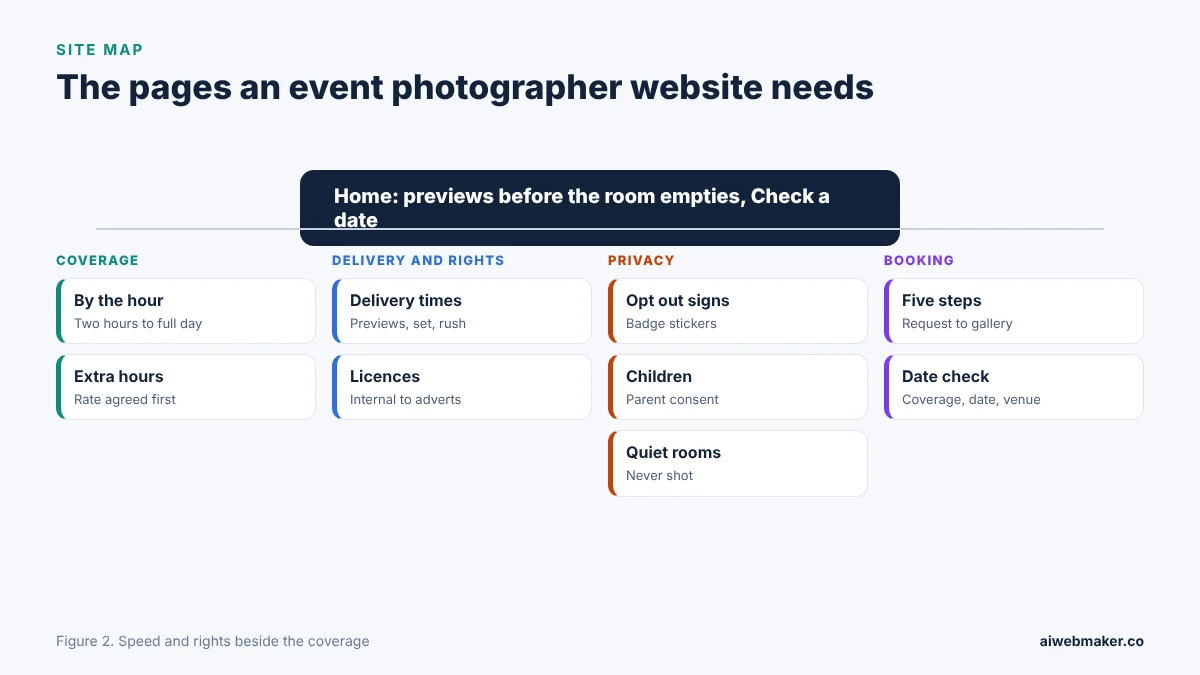
Coverage, delivery and rights, privacy, and booking make up the four branches in this layout. Flashpoint Event Photography, the invented studio in the event photographer website example with same day previews and licences, leads with a two hour minimum, twenty previews on the night and the full edited set in three days. Its coverage runs from Two hours at $450 to a Half day at $780 with a headshot corner and a Full day at $1,350, with extra hours at $140. A delivery table lists same day previews, the full set in three working days, a next morning rush by 10:00 and speaker photos in folders by name. Sections on guests who stay out of shot, six kinds of licence, five steps from request to gallery and a set of questions lead to a form headed "Check a date".
Coverage sold by the hour, and the price of running late
Event photography is sold by the hour because events vary so much that a fixed package rarely fits, and organisers think in programme blocks. Two hours can cover arrivals, the main speech and a busy room, which suits evening receptions and launches. A half day catches speakers, breakouts and networking, while a full day runs from set up to closing drinks with a break agreed. Programmes overrun often, so the extra hour rate should be stated in advance and agreed with the contact on the night before it starts. Travel beyond a stated radius, and a second photographer for large events, belong on the same page so the organiser sees every possible cost.
| Coverage | Typical event | What usually fits |
|---|---|---|
| Two hours | Receptions, launches, short awards | Arrivals, the main speech, a busy room |
| Half day | Seminars, product demos, half day forums | Speakers, breakouts, networking, stands |
| Full day | Conferences, summits | Set up to closing drinks, with a break |
| Extra hour | Any overrun | Agreed with the contact before it starts |
| Second photographer | Large or split venues | Parallel rooms, stage and audience |
Previews during the event: turnaround as the product
For many organisers the previews matter more than the full gallery, because a post sent while delegates are still in the room catches them at their keenest. A set of ten to twenty edited favourites, sized for social channels, can be sent during the event or within two hours of the finish. Press officers sometimes need images by the next morning for a release, which justifies a rush fee. The full edited set within a few working days, with speaker and award photos sorted into folders by name, saves the client hours of searching. Stating these times plainly on the site turns speed into a selling point competitors struggle to match.
Licences by use: internal, press, sponsors and adverts
An event photographer usually keeps the copyright and licenses the client for named uses, so the licence page should read like a menu rather than a contract. Internal use covers intranets, newsletters and presentations, while social and press use covers the client's own channels and releases about the event. Speakers may use photos of themselves, and sponsors may receive images of their stand on request. Advertising, brochures and paid campaigns are normally licensed separately, campaign by campaign, and sometimes need signed model releases from the people shown. Copyright and image rights differ between countries, so the exact licence should be written into each confirmation.
| Licence | Covers | Usual condition |
|---|---|---|
| Internal use | Intranet, newsletters, reports, slides | No time limit |
| Social and press | Own channels, releases about the event | Credit where the channel allows |
| Speakers and sponsors | Their own photos or their stand | On request, for their own use |
| Advertising and print | Adverts, brochures, paid campaigns | Licensed per campaign |
| Annual reports | A published report or yearbook | Licensed per edition |
| Model releases | People shown in adverts | Collected on the day when needed |
Guests who opt out, children and quiet rooms
Some attendees cannot or would rather not appear in photos, for work, family or personal reasons, and a respectful photographer plans for them before the doors open. A simple visible sign, such as a coloured sticker on the badge, lets the whole team keep those guests out of frame. Anyone caught by accident should be cropped out or the image dropped before delivery. Under European Union and British data protection law, for example, photos of identifiable people can count as personal data, so organisers often give notice at registration, and other countries have their own rules. Children should be photographed only with a parent's or guardian's consent, and quiet rooms, prayer rooms and first aid areas should never be photographed at all.
The shot list call and the date check
A short shot list call about a week before the event saves more images than any lens choice, because it tells the photographer who matters and when. The list usually covers speakers, award winners, sponsors, group photos and any guests opting out, plus the name of a contact on the day. A date check form should ask for the coverage, the date, the start time, the type of event and the venue, which is enough to answer within a working day. The booking website builder for event photographers handling date checks puts that request in front of the photographer, who confirms the date, proposes another start time or says plainly that the evening is taken. The deposit and the balance travel from client to photographer, with not a cent of either kept by AI Web Maker. Quick, clear answers to these requests win repeat work from organisers who plan several events a year.
Conference photographer near a named city: the phrases organisers type
Organisers usually search with the event type and the city together, so coverage pages titled that way meet them directly. Typical phrases include conference photographer in a named city, corporate event photography, awards night photographer, product launch photographer and headshots at an event. On the map listing, weekday studio hours and a few recent event frames help organisers who are comparing quotes. Reviews from event teams that mention previews on the night, discreet work and fast delivery carry the most weight. Articles on preparing a shot list, how sponsor licences work or managing guests who opt out bring organisers who are still planning.
The hosting bill beside one two hour job
Next to a camera bag, an event photographer's website is a tiny cost, made of hosting, a domain and the odd article bought with AI credits. One payment a year suits a studio whose conference diary is already steady. A photographer building a client list may pay monthly through the first quarters. Changing hourly rates, adding a licence type or updating delivery times adds nothing to the bill. The grid below gives each billing route its own column and lists the $189 tier on a single reference row.
| Item | Yearly | Monthly |
|---|---|---|
| Hosting the event photography and date check pages | $119 | $228 over twelve months |
| Domain | Depends on the ending | Depends on the ending |
| Higher plan, for comparison | $189 a year | Not needed |
| Twelve shot list and licence articles at about $0.65 | About $7.80 | About $7.80 |
| Rates, licences and delivery times | No charge | No charge |
| Year before the domain | About $126.80 | About $235.80 |
Why an events team books the photographer who answered first
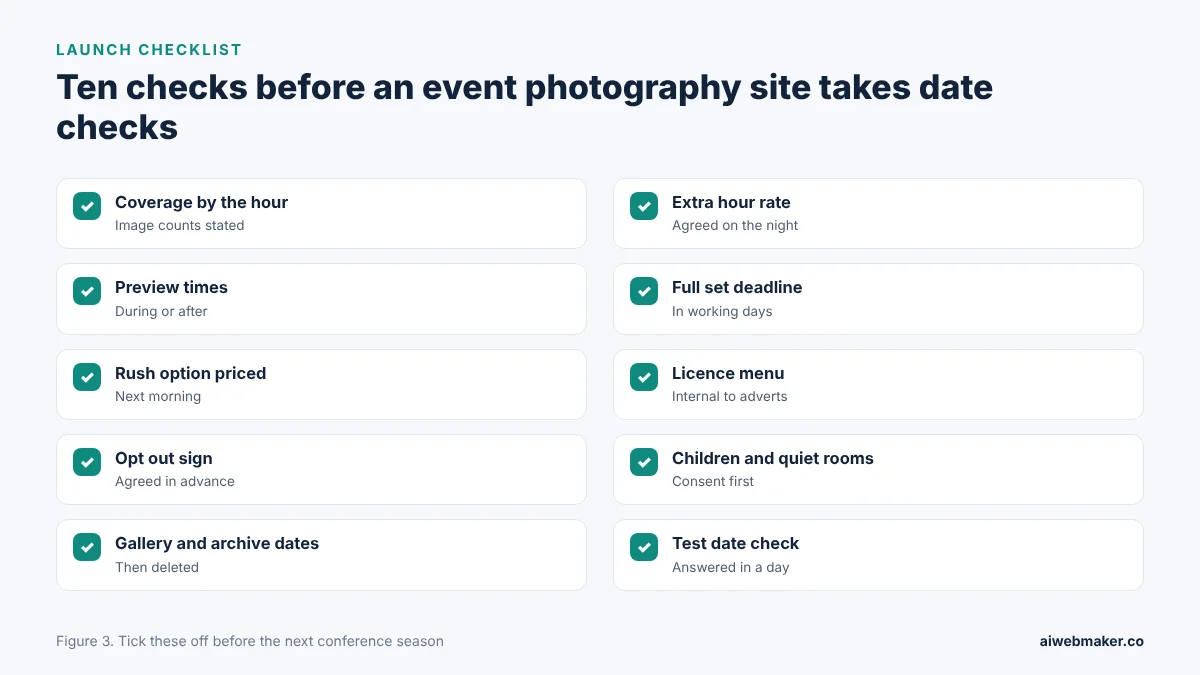
Events teams move on when a site shows a portfolio but no delivery times, because a beautiful gallery that arrives a fortnight late is useless for a social post. Coverage without an extra hour rate leaves the organiser exposed when the awards run long. No licence page makes the legal team nervous about sponsor and advertising use. Silence on guests who opt out, or on children at family events, raises questions organisers now ask routinely. A slow reply to a date check loses the booking to whoever answered first, and the pictured list of ten closes each of those slips.
Frequently asked questions
Can previews reach the social team while the event is running?
Yes, on longer coverage many photographers send a first set of edited favourites during the event. The images are sized for social channels so the team can post at once. Shorter jobs usually receive previews within a couple of hours of the finish. The site should state the exact preview times for each block of hours. Organisers who know the timing can plan their posts around it.
May sponsors use photos of their stand?
Sponsors can often receive images of their stand for their own use, if the licence allows it. The organiser normally agrees this in advance with the photographer. Wider use, such as advertising in a sponsor's paid campaign, usually needs a separate licence. Writing these terms into the confirmation prevents disputes later. Clear sponsor terms also make the organiser look generous to its partners.
What happens when the programme overruns?
Most event photographers stay if the diary allows, at an extra hour rate stated in advance. The extra time should be agreed with the contact on the night before it starts. That prevents surprises on the invoice and keeps the organiser in control of the budget. Late programmes are common at awards nights and conferences. A stated rate turns an overrun into a simple decision rather than a dispute.
How long are galleries and archives kept?
Many studios keep an online gallery open for a set period, such as ninety days, and an archive copy for a year or longer. The client should download its images within that window. After the archive period, files may be deleted, and the site should say so. Data protection rules in some countries also shape how long images of identifiable people are kept. Clear dates help clients store what they need in good time.
A two hour job covers the hosting, a full day covers years
At the sample's illustrative prices, one Two hours booking at $450 pays for almost four years of hosting, and one Full day pays for more than eleven. Paid monthly, the $19 equals about eight minutes of one extra hour. Every organiser who books through the site and receives previews on the night often calls again for the next conference. Plain delivery times, a licence menu and respect for guests who opt out persuade events teams who answer to others. A calendar that repeats with the same clients, season after season, is the result to aim for.
Build your website in Minutes and get the AI Tools that work
Start Building Your Website →