Bridal Makeup Artist Website Cost, Counted in Saturdays and Faces
A bridal makeup artist can keep a booking website up for a year at $119, or for $19 in each month of a quieter winter, plus a domain. The guide then turns to the women in the chair, the pages, date requests, the ceremony clock, deposits, fees, trials and patch tests, search and costs.
- No coding required
- Live in minutes
- Blog, SEO and chatbot tools included
A bridal makeup artist can keep a booking website up for a year at $119, or for $19 in each month of a quieter winter, with a domain added on top. Building the pages and trying them out in preview produces no bill. One bride with a small party pays for the year many times over on a single morning. The harder problem is that a bridal artist sells something scarcer than skill, because each Saturday in the wedding season can be sold only once. A website has to fill those dates with the right weddings, turn away the wrong ones politely and make every rule about deposits, travel and timing clear before anyone books. The guide then turns to the clients, the pages, date requests, faces against the ceremony clock, deposits, fees, trials and patch tests, search and the yearly sums.
This article is part of our complete guide: Website Builder for Creative Businesses.
Brides, mothers and bridesmaids: who sits in the chair on the morning
The person who finds a bridal makeup artist is usually the bride, but the booking almost always covers several faces. Brides look for an artist months or even a year ahead, often as soon as the venue is confirmed. Mothers of the bride and groom want a look that suits mature skin and still photographs well. Bridesmaids want to look like a matching group without losing their own features. Some weddings involve a second outfit change or an evening ceremony, which changes how long the makeup must last. All of them want to know whether the date is open, what the whole party will cost and how the morning will run.
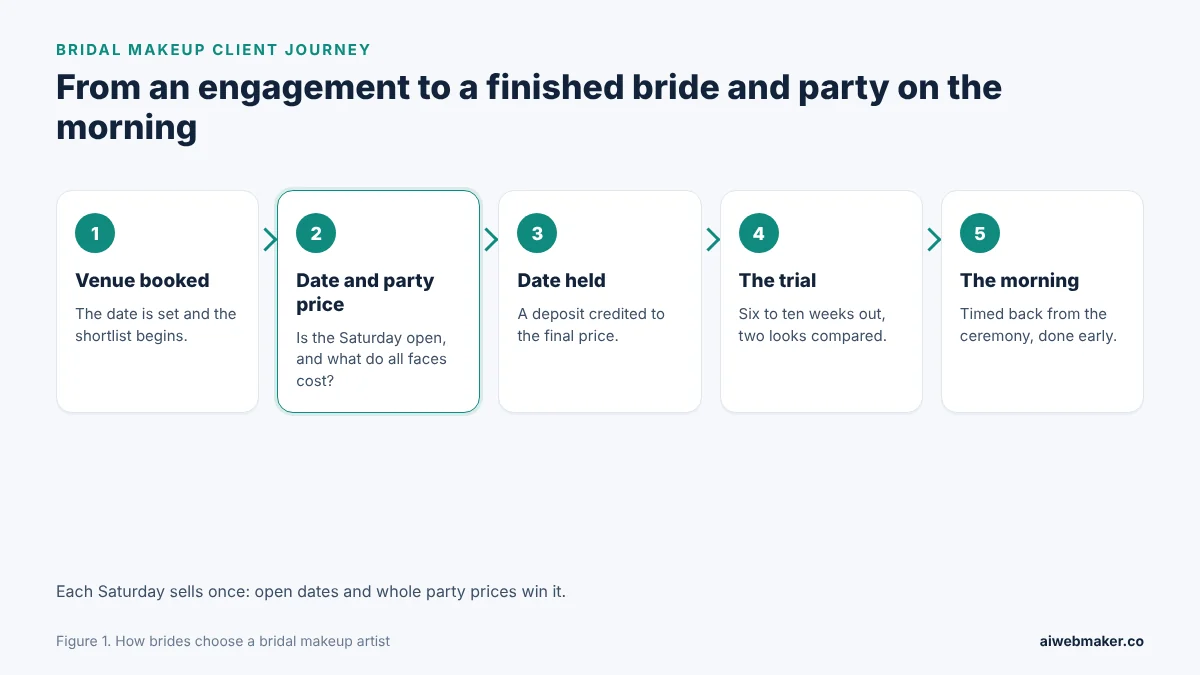
Each card in this journey is a commitment that narrows the bride's options, which is why the second card decides so much. The opening card is the engagement and the venue booking, when brides start shortlisting artists. The highlighted card is the check of date availability and the full party price, because a bride who cannot see either will usually request from someone else. Holding the date with a deposit follows, then the trial six to ten weeks before the wedding. The final card is the morning itself, timed back from the ceremony, which decides whether the artist is recommended to the next bride in the group chat.
Trial, wedding morning and party: the pages a bridal artist publishes
A bridal artist's pages work best in the sequence of the wedding itself, starting with the morning timetable rather than a gallery. A timetable worked back from a sample ceremony shows how the party fits before the photographer arrives. A price section sets out the trial, the bride and each member of the party, with the deposit and balance rules beside them. Separate sections for the trial and for skin preparation answer the questions brides ask months before the wedding. Patch testing and hygiene deserve their own careful section, written calmly. The request route asks for the date, the ceremony time, the number of faces and the venue, so the artist can decide quickly.
| Page or section | What the bride asks | What it should state |
|---|---|---|
| Morning timetable | Will the party be ready in time? | Slots worked back from a sample ceremony |
| Prices | What will the party cost? | Trial, bride, each party look, deposit and balance |
| The trial | When, and what should be brought? | Timing, dress photo, looks compared in daylight and flash |
| Skin preparation | What should change beforehand? | A timeline, with medical questions sent to a doctor |
| Patch tests | What if a product reacts? | Testing ahead, swaps and when to seek help |
| Travel and timing fees | Is the venue covered? | Radius, charge beyond it, early starts, overnight stays |
| Date request | Is the date open? | Date, ceremony time, faces and venue |
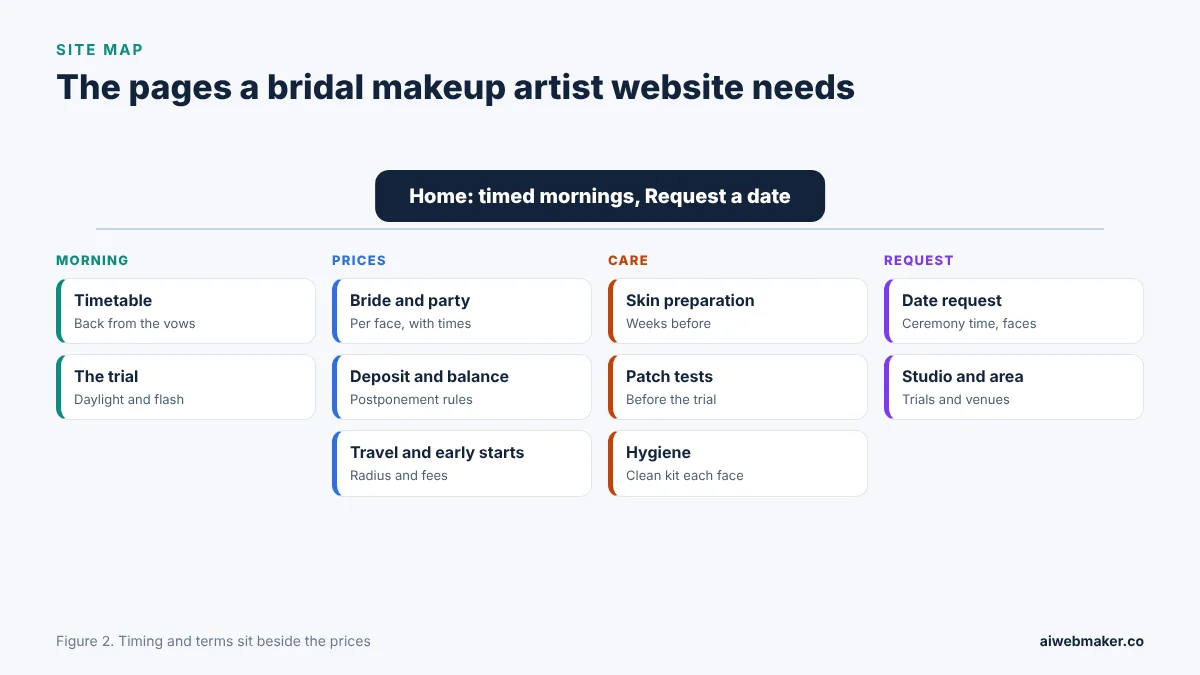
Split into four branches under the home page, a bridal artist's site covers the morning, prices, care and the date request. Morning pages hold the timetable and the trial, price pages hold the bride, party and fees, and care pages hold skin preparation and patch tests. Veil and Glow Bridal Makeup, the sample artist, opens with a morning planned backwards from the vows and then prices a bridal trial, the wedding morning for the bride and the bridal party. Its skin prep section is arranged as eight weeks out, the last fortnight, the night before and on the morning, followed by patch tests and photos of brides and their parties. The bridal makeup artist website example with a timetable worked back from the vows finishes with reviews, questions before the trial and a request for the wedding date.
One Saturday, one bride: the diary as the artist's scarcest stock
A bridal artist can usually serve only one wedding on a given morning, so each peak season Saturday is a product that can be sold once and never restocked. That makes date requests the heart of the business, and the website should treat them that way. Couples who give the date, ceremony time, number of faces and venue let the artist judge in minutes whether the morning works. Clear notes on the season, such as how far ahead popular dates go, encourage early requests. Weekday and winter weddings can be offered at different terms, filling quieter parts of the year. The booking website builder for bridal makeup artists and their wedding dates lets a couple send a request for a date, which the artist then confirms, answers with another arrangement or declines. Deposits and balances are agreed between the artist and the couple directly, with no slice of either passing to AI Web Maker.
Counting faces against the ceremony clock
Every wedding morning is a sum of minutes, and showing that sum openly reassures brides who fear running late more than any makeup mistake. A party look often takes around forty minutes and a bride's makeup a little longer, though every artist's timings differ. Those minutes, plus set up and a buffer, decide how early the first person must sit down. Ceremonies before late morning push the start into very early hours, which is why early start fees exist. Larger parties may need a second artist so that the bride is not rushed at the end. A table of party sizes against start times helps couples see the trade offs before they request a date.
| Faces in the chair | Approximate chair time | Start before a midday ceremony | When a second artist helps |
|---|---|---|---|
| Bride only | Under an hour | Mid morning | Rarely |
| Bride and two | Around two hours | Early morning | Rarely |
| Bride and four | Around three and a half hours | Very early | If hair and dressing overlap |
| Bride and six or more | Five hours or more | Before dawn in many seasons | Usually |
Deposits, postponements and the date that cannot be resold
Deposits exist because a bridal artist who holds a date turns away every other bride who asks for it. A modest deposit that comes off the final price and holds the date is common practice, with the balance paid on or before the morning. Postponement rules deserve plain words, since weddings move for illness, venue problems and family events. Many artists carry a deposit over to a new date when that date is open, and return it when a wedding moves far enough ahead for the date to be resold. Consumer law on deposits and cancellations differs between countries, so the terms should be written for the place the artist works. Clear terms protect both the couple and the artist when plans change.
| Situation | A common approach | What the page should state |
|---|---|---|
| Date held | Deposit taken, credited to the final price | Deposit amount and when the balance is due |
| Wedding moves well ahead | Deposit returned or carried over | The notice period that applies |
| Wedding moves at short notice | Deposit carried to an open new date | What happens if the new date is taken |
| Party size changes | Price adjusted per face | The last date changes can be made |
| Couple cancels | Deposit usually kept | Local consumer rules may apply |
Early starts, travel radius and staying for the evening
Fees beyond the makeup itself cause most of the awkward conversations, so they belong on the website rather than in a late email. A travel radius covered by the wedding price, with a charge per distance beyond it, lets couples work out the total themselves. Early start fees for arrivals before a set hour reflect a genuine cost in sleep and travel. Very early ceremonies at distant venues may require an overnight stay, which the page should mention plainly. Staying on for touch ups through photos, speeches or the first dance is usually charged by the hour and booked in advance. Stating each fee with the rule that triggers it means the couple meets no surprise when the final total arrives.
Trials, skin preparation and lash glue patch tests
The trial is where the look is decided, and booking it six to ten weeks ahead gives time to settle skin, hair plans and the dress. Brides can bring a photo of the dress and any veil or hair pieces, and trying two looks photographed in daylight and with flash reveals which products shine under a camera. Skin preparation advice should stay general, such as keeping to existing skincare and avoiding new treatments in the final fortnight, with any skin condition referred to a doctor or dermatologist. Patch tests for lash glue, foundation and primer, applied a couple of days before the trial, catch reactions while there is time to swap products. A strong or spreading reaction calls for a pharmacist or doctor, and any breathing difficulty for the local emergency number. Calm, careful wording here reassures brides without alarming them.
Bridal makeup near the venue: what couples search and when
Brides search for a bridal makeup artist, wedding makeup or a bridal makeup trial, usually with a town, a region or the venue's name. Many also search for a bridal party package or makeup for the mother of the bride on their own. Headings that use those words, with the travel area written as plain text, match those searches better than a gallery alone. The map listing should show the studio area for trials, the radius covered on wedding mornings and real photos across ages and skin tones. Reviews that mention a morning that ran on time or makeup that lasted through the dancing persuade the next bride. Articles on when to book a trial or how to prepare skin before the wedding reach brides months ahead of their date.
The bridal artist's hosting budget from wedding season to winter
Season by season, a bridal artist's site asks for two recurring payments, one for hosting and one for the domain. Twelve wedding skin and timing articles drafted on AI credits add close to $7.80. An artist with a full season pays least by settling the $119 once in spring. A newcomer still collecting first reviews can pay $19 in each of the quieter winter months instead. Changing prices, adding a timetable or posting new brides is never charged. For contrast alone, a $189 tier is shown in the table as well.
| Item | Yearly | Monthly |
|---|---|---|
| Hosting the bridal makeup pages | $119 | $228 over twelve months |
| Domain | Depends on the ending | Depends on the ending |
| Higher plan, for comparison | $189 a year | Not needed |
| Twelve wedding skin and timing articles at about $0.65 | About $7.80 | About $7.80 |
| Price, timetable and gallery updates | No charge | No charge |
| Year before the domain | About $126.80 | About $235.80 |
Party prices hidden and no date rules: why brides move on
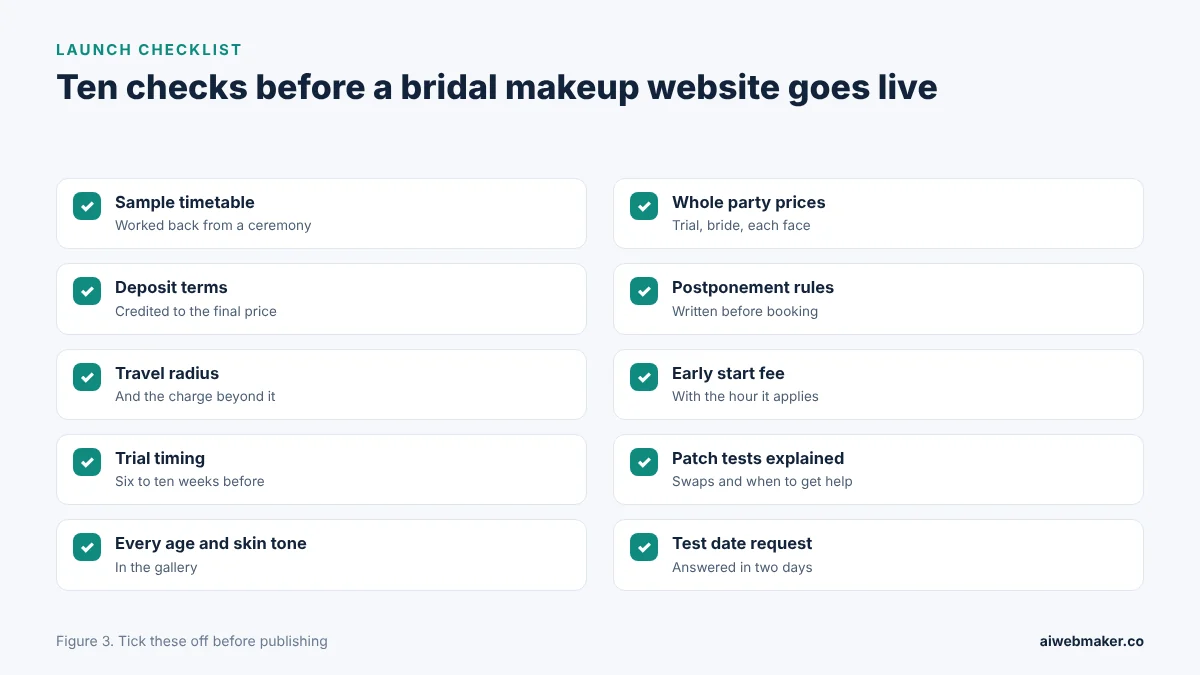
Brides move on when a bridal artist's site shows a lovely gallery but no price for the party as a whole. A missing timetable leaves them worried about the morning running late. Deposit and postponement rules revealed only once the date is held feel like a trap. No mention of patch tests worries anyone with sensitive skin or a history of reactions. A gallery of only one age and skin tone makes many mothers and bridesmaids wonder whether the artist can work with them. Ten fixes for those worries are gathered in the launch list shown beneath.
Frequently asked questions
When do brides need to send their date?
Popular wedding dates are often requested a year or more ahead, especially Saturdays in the peak season. Sending the date as soon as the venue is confirmed gives the best chance of availability. The trial itself is booked much later, usually six to ten weeks before the wedding. Weekday and off season weddings are often easier to secure at shorter notice. A website that explains this timing encourages brides to request early.
What happens to the deposit if the wedding moves?
Many artists carry the deposit over to a new date when that date is open, and some return it when the wedding moves far enough ahead. Short notice changes are harder, because the original date may no longer be resold. The rules should be written plainly on the website and repeated in the confirmation. Consumer law on deposits varies by country, so terms must suit the place. Clear rules prevent painful conversations at a stressful time.
Can the artist stay for touch ups after the ceremony?
Many bridal artists offer to stay through photos, speeches or the first dance, usually charged by the hour. This needs booking in advance, since it affects travel and any other bookings that day. A touch up kit handed to the bride can cover shorter gaps. The website should state the hourly rate and how to add the service. Clear options let couples decide what suits their day.
What if a product reacts at the patch test?
A reaction at a patch test is exactly why testing happens before the trial rather than on the morning. The product is swapped for an alternative and noted, so it never appears on the wedding day. Mild redness usually settles after washing, while a strong or spreading reaction calls for a pharmacist or doctor. Lash glue is a common cause, and some brides choose a defined mascara look instead of false lashes. Careful handling here builds trust with every bride who has sensitive skin.
How few wedding mornings repay a bridal artist's site
A single bride with a small party earns far more on one morning than the $119 that hosts a bridal artist's site for a year. Spread monthly, the $19 is less than one guest's lashes on most price lists. Every bride who recommends the artist to her bridesmaids adds future dates the pages helped secure. A clear timetable, whole party prices and plain deposit rules persuade brides more than any single beautiful photo. Artists who show work across ages and skin tones welcome every face in the chair. Requests that arrive with the ceremony time and the number of faces already given show that brides have read the pages closely.
Build your website in Minutes and get the AI Tools that work
Start Building Your Website →