Barbershop Website Cost and a Price List That Fills Every Chair
Every chair in a barbershop shares one hosting bill, $119 settled annually or $19 on monthly terms, alongside a domain. Then: choosing a barber, pages, prices, walk ins and requests, galleries, hygiene, house rules, search and costs.
- No coding required
- Live in minutes
- Blog, SEO and chatbot tools included
Every chair in a barbershop shares one hosting bill on AI Web Maker, which is $119 when paid yearly or $19 on monthly terms, and the shop buys its domain alongside. Building the price list and the booking page, then requesting a test cut as a customer in the preview, costs the shop nothing. A price list and booking page of that kind are already in place on the barbershop website example, where a made up shop shows its fades, chairs and walk ins on pages AI Web Maker generated. A single morning of fades covers the year. The hard part is the chair itself, because every phone call answered mid cut, every missed appointment and every empty slot between walk ins is time that never comes back. A barbershop website earns its place by protecting that chair time while making the shop easy to choose. From here the guide covers how clients pick a barber, the pages a shop needs, the price list, walk ins and requests, fade vocabulary and the gallery, hygiene and licensing, lateness rules, search and what the year costs.
This article is part of our complete guide: Website Builder for Creative Businesses.
How do clients pick a barber they have never sat with?
Clients pick a new barber mostly by looking at cuts, because a haircut is a visible result that a photo can prove. Someone who has just moved to the area searches nearby and scrolls through photos until a fade looks like the one they want. Regulars of another shop switch when their barber leaves or waiting times grow too long. Parents look for a shop that is patient with children, while grooms look for a shop that can handle a wedding party in one morning. Price and convenience settle the choice between shops that look equally skilled. A barbershop site that shows real cuts, clear prices and an easy way in wins most of these comparisons.
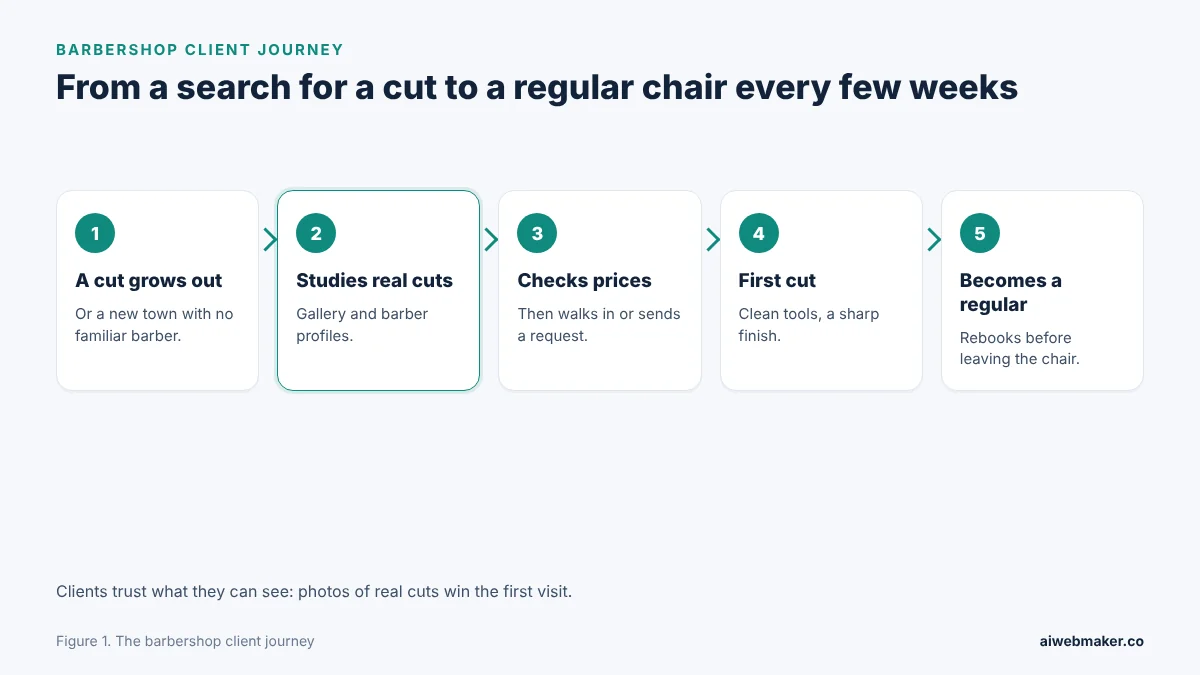
Photos of real cuts are highlighted in this journey, because they decide which shop a new client trusts with their head. A need starts it, often a cut that has grown out or a new town without a familiar barber. The client then studies the gallery and the barbers' profiles, looking for someone who does their style well. Prices and the choice between walking in and sending a request come next. A good first cut, followed by an easy rebooking, turns that client into a regular who returns every few weeks. Every page on the site should shorten the distance between the first search and that second visit.
Pages a shop needs between the window and the chair
A barbershop website needs only a handful of pages, but each one should answer a question that otherwise arrives as a phone call during a cut. The home page shows the shop, the hours and a clear route to book or walk in. The services page lists every cut and shave with its price. A barbers page introduces the people behind the chairs, and a gallery proves what they can do. A visit page explains walk in times, location and parking, while a short policies section covers lateness and missed appointments.
| Page | Client question | What it should hold |
|---|---|---|
| Home | Does the shop suit this client? | Photo of the shop, hours, book or walk in |
| Services and prices | What will it cost? | Every cut and shave, extras, packages |
| Book | Is there an opening soon? | Bookable services and how requests are confirmed |
| Barbers | Who does this style well? | Profiles, specialities, days in the shop |
| Gallery | Can they do the style wanted? | Real cuts, the shop, client comments |
| Visit | When and where? | Walk in hours, address, parking, transport |
| Policies | What happens after a late arrival? | Lateness, missed appointments, children |
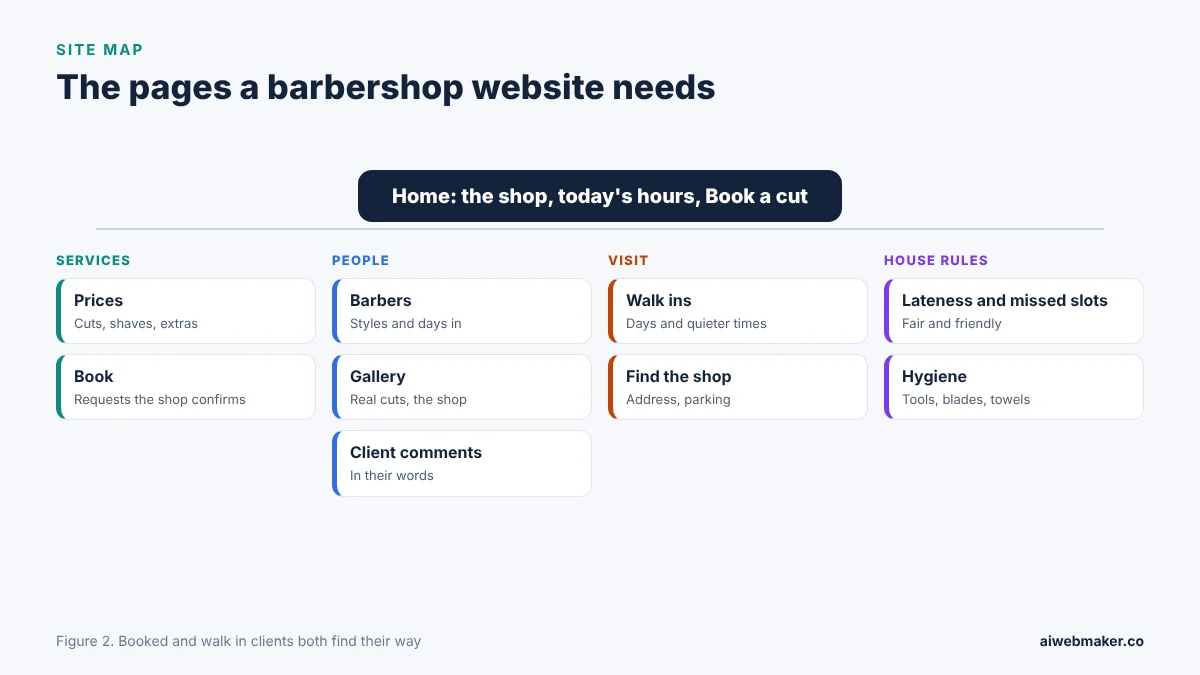
The barbershop site map groups pages around the two ways clients arrive, booked and walking in. The services branch holds the price list and the bookable cuts. The people branch introduces the barbers and the gallery of their work. The visit branch covers hours, walk in times and the location, while the policies branch sets out the house rules that protect the chairs. Our sample shop, Sharp Edge Barbers, lets clients book five services online, a classic haircut, a skin fade, a beard trim, a hot towel shave and a cut with beard, and lists them on a services page with prices and any extras or packages. Its gallery combines haircuts, the shop itself and client comments, and its about page introduces the barbers and how the shop approaches its craft, and the barbershop website example with online booking for cuts and shaves was produced in 45 seconds.
A price list that reads the way clients talk
A barbershop price list works best when it uses the words clients use and shows every price openly. Barbering prices are simple enough to publish in full, and hiding them only adds friction and phone calls. Each service should say what it includes, such as a wash, a hot towel or a line up, so the client knows what the price buys. Extras like a beard oil finish or a design shaved into a fade can sit beside the main services. Packages, such as a cut with beard, often give regulars better value and lift the takings per chair. A clear list also filters out clients looking for a cheaper shop before they sit down.
| Service | What it usually includes | What to state |
|---|---|---|
| Classic haircut | Clipper and scissor work, styled finish | Price, whether a wash is included |
| Skin fade | Fade to the skin, blended top, line up | Price, how often to return |
| Beard trim | Shape, line up, finish | Price, whether a hot towel is used |
| Hot towel shave | Hot towels, lather, straight razor | Price, skin advice |
| Cut with beard | Both services in one sitting | Package price |
| Extras | Designs, colour, beard oil | Price per extra |
Walk ins, booking requests and a quieter phone
Most barbershops mix walk ins and appointments, and the website should make the balance obvious before anyone arrives. Stating which days or chairs take walk ins, and when the shop is usually quieter, saves clients a wasted trip. For booked services, the client chooses a cut and a time and sends a request, which the shop can accept, shift to another slot or decline when the chair is taken. Payment stays between the client and the shop, settled at the chair in whatever way the shop chooses, with nothing deducted by the platform. The barber booking website builder that lists cuts and takes requests sets up these bookable services with the price list and gallery once the owner describes the shop in a few lines. Fewer calls during a fade is often the first change a barber notices.
Fade vocabulary and a gallery of real cuts
Clients often struggle to describe the cut they want, and a gallery labelled with plain barbering terms helps them ask for it accurately. A low fade, a mid fade and a high fade differ in where the shortest hair starts, while a taper keeps more length at the sides and back. A skin fade blends down to bare skin, and a line up sharpens the edges around the forehead and temples. Photos of each style, taken in the shop with the client's permission, show what the barbers can actually do. Pictures of the shop itself help nervous first timers know what to expect. A gallery that teaches clients the words leads to better conversations in the chair and fewer disappointed faces at the mirror.
| Term | What it means | Good photo to show |
|---|---|---|
| Taper | Length reduces gradually at sides and back | Side profile |
| Low fade | Shortest hair starts just above the ear | Back and side |
| Mid fade | Shortest hair starts around the temple | Side profile |
| High fade | Shortest hair starts near the crown line | Side and back |
| Skin fade | Blends down to bare skin | Close up of the blend |
| Line up | Sharp edges at forehead and temples | Front view |
Hygiene, razors and the licence on the wall
Clients notice hygiene in a barbershop even when they say nothing, so describing it on the website builds quiet confidence. Clippers, combs and scissors should be cleaned and disinfected between clients, and a fresh blade should be used for every straight razor shave. Clean towels and capes for each client, together with neck strips, show care that people can see. Licensing and hygiene rules for barbers differ between countries, states and cities, so a shop should follow the rules where it trades and display any licence that is required. A short paragraph on these practices reassures first timers, especially those booking a hot towel shave. Visible standards are one of the easiest ways for a good shop to stand apart.
| Practice | What to describe |
|---|---|
| Tool cleaning | Clippers, combs and scissors disinfected between clients |
| Razor blades | A fresh blade for every shave |
| Towels and capes | Clean for each client |
| Workstations | Wiped down between cuts |
| Licences | Displayed where local rules require them |
Lateness, missed appointments and children in the chair
House rules protect the chair, and clients accept them more easily when they are written down before the visit. A lateness policy might say that a client arriving well after the booked time may need a shorter service or a new slot. Missed appointments cost a barber income that cannot be recovered, so a polite note asking clients to cancel in good time is fair. Any deposit for long services or wedding parties is agreed and taken by the shop directly. A note on children, such as the ages the shop cuts and whether a parent should stay, helps families plan. Clear, friendly rules keep the diary full without awkward conversations at the till.
Phrases clients type when a cut has grown out
People looking for a barber type phrases such as barber near me, skin fade, beard trim, hot towel shave or kids haircut, usually with the name of a neighbourhood. A services page that names each cut in its heading answers those queries head on. Accurate walk in hours, fresh photos of cuts and the shop, and a link straight to booking belong on the map listing. Clients' reviews naming a barber, a sharp fade or a relaxed atmosphere persuade the next client more than any slogan. Short articles on keeping a fade fresh or caring for a beard between visits offer search engines fresh text while giving regulars a reason to visit the site. Kept current, these pages make the shop the name locals meet first.
One hosting bill shared by every chair
The website's fixed costs are hosting and a domain, and they stay the same whether the shop runs two chairs or eight. Yearly billing brings hosting to $119, and a new shop finding its rhythm may prefer $19 a month. Grooming articles drafted through AI credits cost around $0.65 each. Changing prices, adding a barber or swapping gallery photos is part of the plan at no further cost. Both routes are set out here, while the $189 tier appears only to mark the gap.
| Item | Yearly | Monthly |
|---|---|---|
| Hosting the price list, booking and gallery | $119 | $228 over twelve months |
| Domain | Depends on the ending | Depends on the ending |
| Higher plan, for comparison | $189 a year | Not needed |
| Twelve fade and beard care articles at about $0.65 | About $7.80 | About $7.80 |
| Prices, barbers and gallery photos | No charge | No charge |
| Year before the domain | About $126.80 | About $235.80 |
Why do clients walk past a barbershop's site?
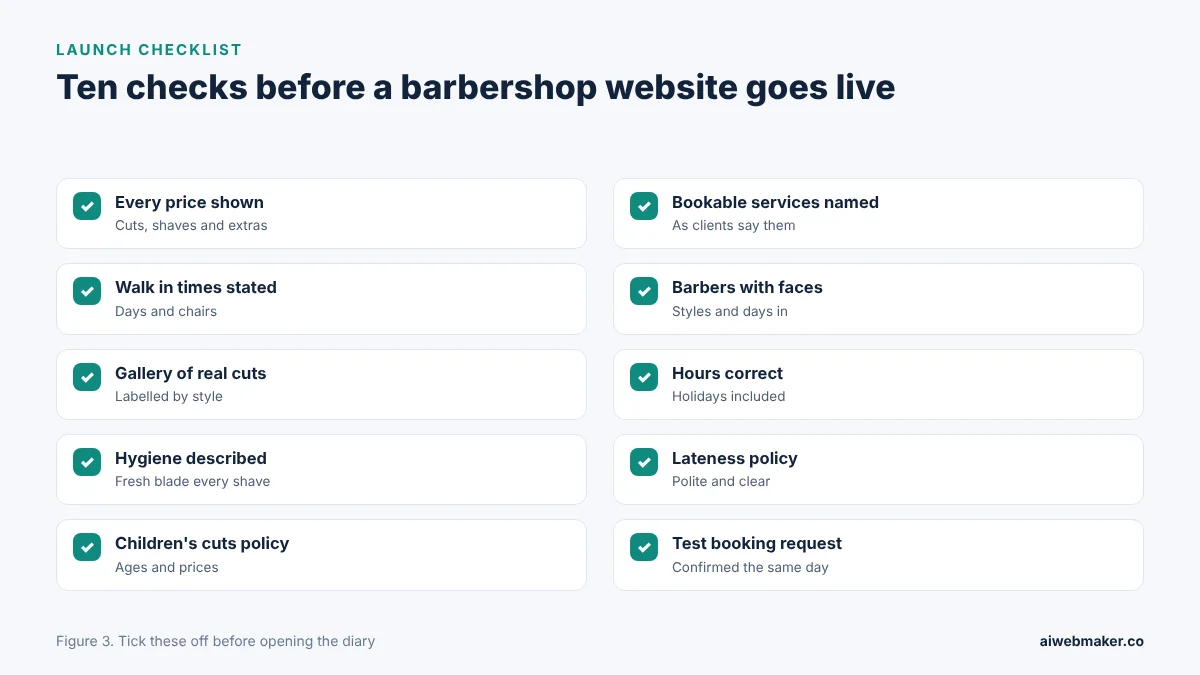
Clients move on when the site hides prices, shows no real cuts or gives no clue whether they can walk in today. A gallery of stock photos tells a visitor nothing about the barbers' skill. Wrong hours, especially on a Sunday or a holiday, waste a client's trip. Silence about walk ins forces a phone call that many people would rather not make. Barbers without names or faces make it hard to choose a chair. Ten fixes for these gaps make up the checklist shown here.
Frequently asked questions
Can regulars book their next cut before they leave?
Regulars can book their next cut on the way out, because the booking page lists each service with its price. The client picks a cut and a time and sends the request, and the shop confirms it or suggests another slot. Many fade wearers return every few weeks, so booking ahead keeps their usual time. That habit fills the diary well in advance without a single call. A quick booking route is often what turns occasional clients into regulars.
Does the shop cut children's hair?
Whether a shop cuts children's hair is its own choice, and the website should say so clearly with any age limits. Shops that welcome children can mention patience with first haircuts and whether a parent should stay in the chair area. A separate price for children's cuts helps families plan. Quieter times of day suit young children best, and the site can suggest them. Clear guidance saves parents an awkward visit.
How can a client ask for the fade they actually want?
A client can ask for the fade they want by naming the style, such as a low, mid or high fade, and showing a photo. The gallery on the shop's website helps by labelling real cuts with these terms. Saying how short the sides should go and how much length to keep on top adds precision. The barber may suggest changes to suit the client's hair and head shape. A shared vocabulary leads to better cuts and happier clients.
Is a hot towel shave suitable for sensitive skin?
Many people with sensitive skin enjoy hot towel shaves, but anyone with a skin condition, a rash or recent irritation should mention it before the barber starts. The barber may suggest a trim instead of a close shave when the skin is inflamed. Hot towels and good lather soften the hair and reduce pulling. Persistent skin problems are a matter for a doctor rather than a barber. A short note on the website encourages clients to speak up before they sit down.
Chair time, regulars and the price of a year online
A single morning of cuts typically outearns the $119 hosting bill for a year, and one or two cuts cover any $19 month. After that, every booking and walk in found through the site adds to the takings. Regulars matter most, since a client who returns every few weeks brings many visits a year without new effort. Clear prices, a real gallery and an easy request route are what turn a first visit into that habit. Fewer phone calls during cuts give the barbers back time that goes straight into the chair. A diary booked weeks ahead by familiar names shows the site carrying its share of the work.
Build your website in Minutes and get the AI Tools that work
Start Building Your Website →