SEO for Professional Services: Firms That Sell Expertise
How law, accounting, financial advice and consulting firms get found on Google, from practice area pages and credentials to reviews within professional rules and measuring booked consultations.
- Any website
- Visits within reach
- Each problem joined to its fix

Expertise is invisible on a search results page, so the firms that win clients online are the ones that make it visible before anyone picks up the phone. Most people looking for a solicitor, an accountant, a financial adviser or a consultant do not search for the profession at all: they type the problem that is keeping them awake, such as a dispute with a landlord or a tax letter they do not understand. Good SEO for professional services meets that search with a page written for that exact problem, shows who will handle the work and why they are qualified, and makes the next step easy. It also has to respect rules that most industries never face, from bar rules and the SRA in law to the SEC, FINRA and the FCA in financial advice. What follows covers how clients search, the pages a firm needs, trust, Google Business Profile, reviews, directories, content and measurement. Each part applies to law, accounting, advice and consulting firms in the USA, the UK and Europe.
This article is part of our complete guide: SEO for Service Businesses.
How clients search for expert help
Searches for professional help fall into three broad groups, and a firm needs pages for each of them. The first group describes a problem in everyday words, such as "can my employer change my contract without asking" or "HMRC letter about undeclared income", and the person often does not yet know which kind of professional they need. The second group names a specialism and usually a place, such as "employment solicitor Bristol", "CPA for rental property Denver" or "fee-only financial planner Minneapolis", and comes from someone much closer to choosing. The third group is a firm's or a person's name, typed by people who were referred and want to check you out before they call. Problem searches are won by question pages, specialism searches by practice area pages and Google Business Profile, and name searches by bios, reviews and directory profiles. Most firms build only for the second group, leaving the first and last moments of the decision to competitors.
| Search type | Example search | Page that should answer it |
|---|---|---|
| Problem in plain words | "can I be dismissed while on sick leave" | A question article that explains the rules and when to get advice |
| Specialism and place | "estate planning attorney Phoenix" | A practice area page tied to the office in that city |
| Specialism and client type | "accountant for Airbnb hosts" | A niche page for the clients the firm serves |
| Firm or person name | firm name plus "reviews" | Home page, bio pages, Google Business Profile and directory profiles |
The words clients use are rarely the words professionals use, and that gap costs firms more visits than any technical fault. A lawyer writes "wrongful termination" or "unfair dismissal", while the person searching types "fired for no reason". An accountant writes "self-assessment compliance", while the client types "how do I do my tax return as a sole trader". The fix is to collect the exact phrases people use on intake calls, in enquiry forms and in the first email they send, and to build headings and page titles from those phrases. Keep the technical term in the body as well, because some searchers know it. Search Console's Performance report then shows which phrases your pages already appear for.
Trust signals clients and Google look for
Google's Search Quality Rater Guidelines treat legal and financial topics as "Your Money or Your Life" subjects, which could affect a person's finances or wellbeing. The raters do not rank pages themselves, but their assessments help Google judge whether its systems reward experience, expertise, authoritativeness and trust. For a firm, that translates into plain, checkable signals on the page. Every article and practice page should name the person who wrote or reviewed it, link to their bio, state their qualification and show the date it was last checked. A tax article from an accountant in Dublin that reads "Reviewed by a Chartered Accountant for the 2026 tax year" is more useful to a reader than an anonymous page with no date. Regulatory details belong in the footer and on the contact page too, such as the SRA number for a solicitors' firm in England or the firm reference number for an FCA-authorised adviser.
Case studies are the strongest proof of expertise, and also the place where professional rules bite hardest. Lawyers owe clients confidentiality, so a case study usually describes the type of matter, the approach and the kind of outcome without names, and only with the client's written consent. Financial advisers face rules on how results and performance are presented, so most keep case studies to the planning problem and the process rather than investment returns. Consultants are often bound by non-disclosure agreements, so an anonymised description of the challenge and the method is safer. Whatever the profession, avoid wording that promises a result, because regulators in law and finance treat unjustified expectations as misleading, and a careful client distrusts them anyway.
Practice area pages that win specialist searches
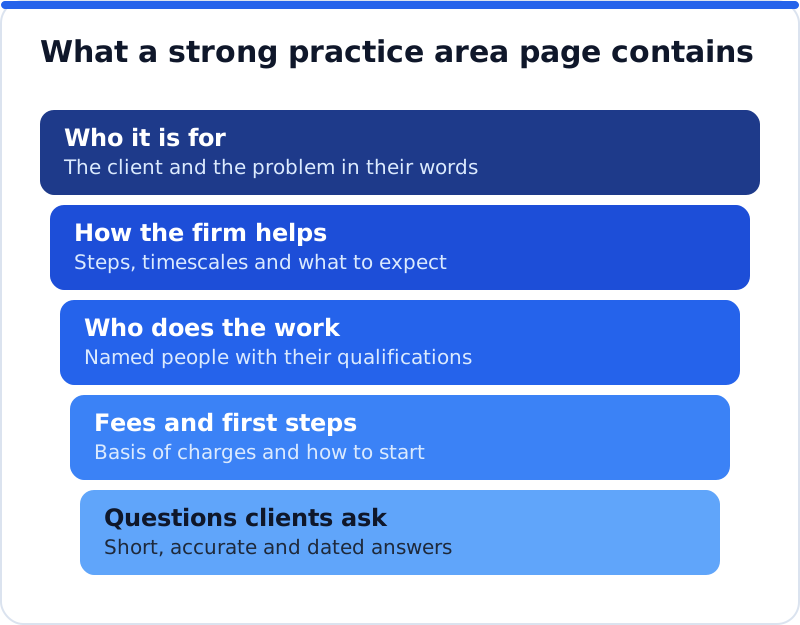
A single "Services" page that lists ten specialisms cannot rank for any of them, because it says too little about each. Strong SEO for professional services gives every specialism its own page, with its own title, heading and description, written for the client who needs that help. A management consultancy in Amsterdam that works on supply chains for food producers should have a page for exactly that, not a paragraph inside a page called "What we do". Each page should explain who it is for, the problems it covers, how the work is done, who does it, how fees are worked out and how to start. Split a practice area once it covers clearly different situations, such as divorce and child arrangements, and link each focused page from a short overview so two pages never compete for the same search.
Location pages for real offices
Location pages work when they describe a real office and real local knowledge, and fail when they are the same page with a different town name. A firm with offices in Manchester and Leeds should have a page for each, showing the address, the team based there and the specialisms handled from that office. Local detail is what makes the page useful: the courts a litigation team appears in, the tax office a firm deals with, or the local business networks a consultancy belongs to. Jurisdiction matters too, because Scotland has its own legal system and each US state licenses its own lawyers and CPAs, so a page should be clear about where the firm can act. If you serve clients in places where you have no office, say so honestly on the practice page, for example "we advise clients across Texas by video", rather than inventing addresses. Google's Business Profile guidelines do not accept virtual offices where nobody works, and a page that pretends otherwise undermines trust.
Google Business Profile for firms and practitioners
Google Business Profile puts a firm in the map results for searches such as "tax accountant near me", and its rules for professionals are detailed. Google's guidelines describe an individual practitioner as a public-facing professional with their own client base, which covers many lawyers, accountants and financial planners. A practitioner can have their own profile if they can be reached at the verified location during the stated hours, but support staff should not have one, and nobody should create separate profiles for each specialism. When a solo practitioner is the only public-facing professional at a branded firm, Google recommends one shared profile named in the form "Firm: Practitioner name". Choose the most specific primary category you can, add each practice area as a service, keep the hours accurate and use real photographs of the office and the team.
Consulting firms that work only by video need to read the eligibility rules carefully. A suspended profile is far harder to fix than it was to avoid. Google's eligibility guidelines say a business must make in-person contact with customers during its stated hours, and they list online-only businesses as not eligible. A consultancy that meets clients at their premises can usually be set up as a service-area business, with the address hidden and the areas served listed instead. A firm that never meets clients in person should not create a profile, and should put its effort into its website, directories and articles.
Reviews and testimonials within the rules
Reviews influence which firm a client calls, but they come with rules that apply to every business and further rules that apply to professions. In the USA, the Federal Trade Commission's rule on consumer reviews, in force since late 2024, prohibits fake reviews and buying positive ones, and UK consumer law now bans fake reviews explicitly as well. Google's own policies forbid offering incentives for reviews and asking only happy clients, so the safest habit is to ask every client at a natural point, such as when a matter closes or a return is filed. Respond within a few days and keep the tone calm, because future clients read the replies as closely as the reviews. A steady flow of recent reviews also tells a reader the firm is active and responsive.
Professional rules then add a layer. Lawyers must protect client confidentiality, and the American Bar Association's Formal Opinion 496 makes clear that a lawyer generally may not reveal client information when answering criticism online, so a reply should never confirm that the reviewer was a client or discuss their matter. US state bar rules vary on testimonials and past results. Investment advisers registered with the SEC fall under its Marketing Rule, which allows testimonials and endorsements only with specific disclosures and oversight, while UK advisers must keep any promotion fair, clear and not misleading under FCA rules. None of this is legal advice, so check the rules of your own regulator or ask your compliance contact before you publish testimonials or reply to a difficult review.
Directories that carry weight in each profession
Professional directories matter for two reasons: people use them to shortlist firms, and Google sees them as confirmation that the firm is real. In law, US firms commonly appear on Avvo, Justia, FindLaw and Martindale-Hubbell, while UK solicitors are listed in the Law Society's Find a Solicitor. Accountants benefit from their professional body's member directory, such as the one run by ICAEW, and from the partner directories of the accounting software they use. Financial advisers in the UK are listed on the FCA Register and often use review platforms such as VouchedFor and Unbiased, while US planners may appear in the directories of NAPFA or the CFP Board. Whatever the directory, write the firm name, address and phone number exactly as they appear on your website and Google Business Profile, because mismatches make it harder for Google to be sure the listings belong to one firm. Update every listing when a partner leaves or an office moves.
Content that answers client questions
The questions clients ask on their first call are the best content plan a firm will ever have. Keep a shared list of every question asked in intake calls, emails and meetings, and turn the common ones into articles with a clear answer near the top. A probate team might write "How long does probate take in England" while an estate planning firm in Ohio writes about the probate process in that state, because jurisdiction changes the answer. State which country or state the article covers, add the date it was reviewed and update it when rules or thresholds change, such as at the start of a new tax year. Each article should explain the general position and the factors that change it, say clearly that it is general information rather than advice, and point to the practice page for anyone who needs help with their own situation.
Measuring professional services SEO by consultations
Visits are a means to an end, and the end for a firm is a booked consultation, a call or a qualified enquiry. Set up key events in Google Analytics for form submissions, clicks on phone numbers and completed bookings, to see which pages lead to contact. Google Business Profile shows calls, website clicks and direction requests in its performance view, which covers the map results that analytics cannot see. Add a "How did you find us?" question to your intake process, because many clients read first and call days later. Review the numbers monthly, but judge changes over a quarter.
Where AI Website SEO Tools fit in
AI Website SEO Tools saves a firm from auditing its website page by page. It checks the website the way Google does and gives a score out of 100, with on-site checks counting for 60% and the trust of the sites linking to you for 40%. It reads up to 12 of your pages, lists each page's problems across six areas, from being found by Google to sharing and rich results, and shows the keyword each main page should win. It also estimates the visits a month the website gets now and the visits within reach, and joins each problem to the tool that fixes it. That makes an AI website SEO analysis for professional firms a practical starting point when deciding which practice page to rewrite first.
The fixes come with clear steps and the code to paste, which suits firms whose compliance team reviews every word before it goes live. On WordPress, the plugin can apply approved fixes directly, while websites on Wix, Squarespace or any other platform get the instructions to follow by hand. A monthly re-check emails what changed. Nothing is applied without approval. The wider AI SEO tools for business websites cover keyword research, articles and backlinks when you are ready for them.
Questions business owners ask
Should every lawyer or adviser have their own Google Business Profile?
Only those who meet Google's description of an individual practitioner, meaning public-facing professionals with their own clients who can be reached at the office during its hours. Partners and senior advisers often qualify, while support staff do not. A solo practitioner who is the only public-facing person at a branded firm should share one profile with the firm instead. Each profile needs consistent details and its own care, so do not create more than you can keep accurate. Practitioner profiles can help with name searches, but the firm's main profile usually brings the most enquiries.
Can we publish our fees on the website?
In many cases you can, and in some you must. Solicitors' firms in England and Wales that offer certain services, including residential conveyancing, uncontested probate and some employment tribunal claims, must publish price and service information under the SRA Transparency Rules. Other professions have no such duty, but clear information about how fees work helps clients decide and filters out poor fits. If exact prices are not practical, explain the basis of charges and the factors that change the cost. Whatever you publish, keep it current, because an out-of-date fee is a quick way to lose trust.
How long does SEO take for a professional firm?
Small changes, such as a clearer title, can show in Search Console within a few weeks once Google has recrawled the page. New practice pages and articles usually take a few months to settle into their positions, and competitive city searches can take longer. Steady, accurate publishing tends to build gains over a year. Track enquiries by quarter, not by week, so normal swings do not lead to rushed changes. The firms that do best treat their website as part of practice development, not a one-off project.
Your first month of professional services SEO
In the first week, list your specialisms and check that each one has its own page with a named expert, a review date and a clear next step. In the second week, fix your Google Business Profile, then check that every directory listing matches your website exactly. In the third week, pick the five questions clients ask most often on intake calls and write a reviewed, dated answer to each. In the fourth week, set up key events for calls, forms and bookings, and add a source question to your intake process. Then run a check of the whole website, fix the problems that cost the most visits first, and measure enquiries again at the end of the quarter.
Your website as a network: every part of its SEO checked while you watch, your score, the traffic within reach and the fix for each problem.
Check your website with AI Website SEO Tools →