SEO for Coaches and Consultants: Ranking for Your Niche
How business, career and life coaches and independent consultants get found on Google by choosing a niche, building the right pages, earning links and tracking discovery calls.
- Any website
- Visits within reach
- Each problem joined to its fix
Coaching is sold on trust in one person, yet most coaching websites describe that person in words a thousand others could use. "Helping you reach your full potential" does not match anything a real client types, so the page ranks for nothing and convinces nobody. SEO for coaches works when the website names a specific group and a specific problem, then proves that the coach understands both. That means choosing a niche keyword you can actually win, writing an About page that does the selling, giving each package its own page and earning links from podcasts and guest articles. It also means deciding whether you need local visibility at all, since many coaches work only online and Google treats those businesses differently. The same thinking applies to independent consultants, and the sections below show how to measure success in discovery calls rather than visits.
This article is part of our complete guide: SEO for Service Businesses.
Get an analysis of your coaching website from AI website SEO tools and find your niche keyword
Why SEO for coaches starts with a niche
Broad terms such as "life coach" or "business coach" are searched often, but they are crowded with directories, large training companies and thousands of individual coaches. A solo coach rarely wins those searches, and the people who type them are often still deciding what kind of help they need. A niche phrase, such as "career coach for nurses leaving the NHS" or "executive coach for first-time founders", is searched less often but by people who already know what they want. Those searchers are far more likely to book a call, because the page speaks directly to their situation. Coaching is one of the less regulated corners of SEO for professional services, which makes a clear niche the main way to stand out.
| Broad phrase | Niche phrase | Who searches for the niche |
|---|---|---|
| life coach | coach for women returning to work after children | Parents planning a return to their career |
| business coach | business coach for independent bookshop owners | Owners of one type of shop with shared problems |
| career coach | career change coach for teachers | Teachers looking at roles outside schools |
| leadership coach | leadership coaching for new engineering managers | Engineers promoted into their first team lead role |
| consultant | pricing consultant for software startups | Founders unsure how to price their product |
Choosing the keyword your practice can win
The best niche keyword sits where three things meet: the clients you serve best, the words they actually use and a results page you can realistically compete on. Start with the words from your discovery calls, because clients describe their problem in their own language long before they learn yours. Type candidate phrases into Google and look at the suggestions, the "People also ask" questions and the related searches at the foot of the page. Then look at who ranks: if the first page is full of large directories and national publications, try a more specific phrase, and if it shows individual coaches with modest websites, you have a fair chance. Once your website is live, Search Console's Performance report shows which phrases already bring impressions, which is the most reliable guide to where to go next.
Avoid choosing a niche only because it looks easy to rank for. A leadership coach in Copenhagen who works mainly with engineering teams should target that work, even if a broader phrase has more searches, because the visitors it brings will be the right ones. The keyword should appear in the home page title and heading, the About page and the main package page, written naturally rather than repeated. You can serve more than one group, but each group needs its own page, so do not try to cover three niches in one paragraph. Revisit the choice after six months, when your own data shows which pages bring calls.
An About page that does the selling
On a coaching website, the About page is often the most visited page after the home page, because clients are choosing a person. It should open with who you help and the change you help them make, then tell your story in a way that explains why you are suited to that work. Include your training and credentials, such as an ICF credential (ACC, PCC or MCC) or an EMCC accreditation, and any relevant career history, such as years spent as an engineer or a head teacher. Add a professional photograph, a short description of how you work and a clear link to book a call. A business coach in Manchester who spent fifteen years running restaurants should say so plainly, because that experience is exactly what a restaurant owner wants to hear.
Service and package pages
Each coaching offer deserves its own page, because each answers a different search and suits a different buyer. A typical coaching practice might have pages for one-to-one coaching, a group programme, team workshops and a short intensive, each explaining who it is for, what happens in each session, how long it lasts and what the client should expect at the end. Consultants can do the same for each type of project, such as a pricing review, a market entry study or an operations audit. Stating a price or a starting price helps many clients decide, while others prefer to discuss fees on a call, so choose the approach that suits your market. Every package page should end with one clear next step, such as booking a discovery call, rather than a list of options.
Case studies and testimonials with permission
Case studies are the strongest evidence a coach can offer, but they depend on the client's trust and consent. Always get written permission before publishing any story, and offer to remove names, employers and identifying details. A good case study describes the starting point, the work done together and the change that followed, in honest and specific terms. In the US, the Federal Trade Commission's Endorsement Guides expect testimonials to reflect real experiences, and when a result is not typical the advertising should make clear what people can generally expect, which matters for any claim about income or promotions. In the UK, the advertising rules enforced by the Advertising Standards Authority expect claims to be backed by evidence and testimonials to be genuine, so keep the permission and the original words on file.
Online clients or local clients
Many coaches work entirely by video with clients anywhere, while others meet clients in person in one town, and the SEO approach differs. An online coach should target the niche phrase without a place name and write for the whole country or language, since the client does not care where the coach lives. A coach who meets clients in person should add the place, such as "business coach in Austin", and build a page for that location. Google Business Profile is only for the second group, because Google's guidelines require a business to make in-person contact with customers during its stated hours and list online-only businesses as not eligible. If you meet clients at their offices, you can set up a service-area profile with your address hidden, but if you never meet anyone in person, put the effort into your website and your niche content instead.
Podcasts and guest articles for links
Links from other reputable websites tell Google that others trust your work, and coaches have good ways to earn them. Appearing as a guest on podcasts in your niche usually earns a mention in the show notes with a link to your website, and the episode itself introduces you to listeners who already care about the topic. Writing a guest article for an industry publication or a professional association's blog works in the same way, as long as the article teaches something useful. A marketing consultant in Lisbon might write for a regional business publication, while a coach for software engineers might appear on a technical podcast. Ask for the link to point to the most relevant page, such as your package page or a related article, and keep a list of every link you earn so you can see which appearances paid off.
Schema for a coaching business
Structured data helps Google understand who you are and what you offer. Schema.org still lists ProfessionalService as a type of LocalBusiness, but it notes that the broad type was deprecated as a general category because it was confused with the Service type. In practice, a coach who meets clients at a business address can describe the practice as a LocalBusiness or ProfessionalService with the address and opening hours. A solo coach who works online is often better described with the Person type on the About page, including job title, credentials through the hasCredential property and topics through knowsAbout, together with Organization for the business name. Each package can be marked up with the Service type, naming the provider and the areas served, and you can test the result with the Schema Markup Validator.
Measuring SEO for coaches by discovery calls
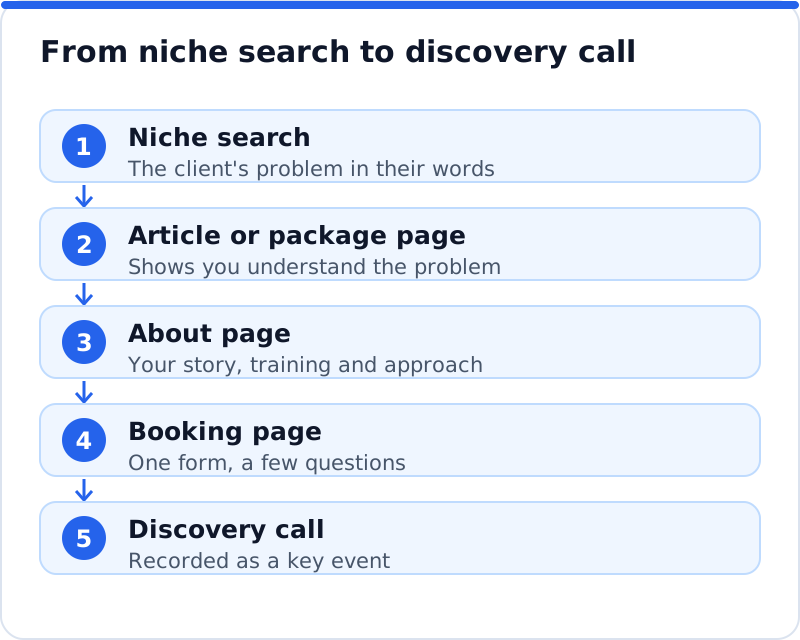
A coach's measure of success is the number of discovery calls booked and the clients who sign, not the number of visits. If you use an online booking tool, set it up to record a key event in Google Analytics when someone books, and see which pages lead to it. Add a question to the booking form asking how the person found you, because many people read your articles, listen to a podcast and only book weeks later. Search Console shows which phrases bring impressions and clicks, which helps you see whether your niche keyword is gaining ground. Review the figures monthly, but judge changes over a quarter, because coaching decisions are personal and often slow.
AI Website SEO Tools shows where a coaching website stands before you change anything. An executive coach in Boston or a career coach in Glasgow can run a check that reads the website the way Google does, gives a score out of 100 and lists each page's problems across six areas. It shows the keyword each main page should win, the visits a month now and the visits within reach, and links each problem to the tool that fixes it. Fixes come as steps and code to paste, or are applied by the plugin on WordPress, and a monthly re-check emails what changed. When you are ready for more, the wider AI SEO tools for business websites help with keyword research, articles and links.
Questions business owners ask
Do I need a blog to rank as a coach?
A blog helps, but only if each article answers a real question your ideal client asks. Ten useful articles on your niche will do more than fifty general posts about motivation. Each article should link to the package page that solves the problem it describes. Write when you have something specific to say, and update older articles when your thinking changes. If writing is not your strength, turn the questions from discovery calls into short, clear answers, because those are the searches your clients make.
Should I use my own name or a business name for the website?
Both can work, and the choice depends on how you plan to grow. A personal name suits a coach whose clients are buying them specifically, and people who hear you on a podcast will search for your name. A business name suits a practice that may add other coaches or programmes later. Whichever you choose, make sure your name appears clearly on the About page and in your profiles, because clients still want to know the person behind the brand. You can also own both domains and point one to the other.
How long does it take for a coaching website to rank?
New websites often take several months to start appearing for their niche phrases, and longer for competitive terms. Coaches who publish useful content regularly and earn a few good links from podcasts and articles tend to see steady gains over the first year. Niche phrases usually move faster than broad ones, which is another reason to choose a niche early. Track discovery calls each quarter to judge progress rather than checking rankings every day. A clear niche, a strong About page and a few good links will do more than any short-term trick.
Your first step toward more discovery calls
Write down the niche you serve best, in the words your clients use, and check it against Google's results to make sure you can compete. Then rewrite your home page title, About page and main package page around that phrase, with a clear link to book a call on each. Set up a key event for bookings and add a "how did you find me" question to the booking form. Pitch yourself to two podcasts in your niche this month and ask for a link in the show notes. Once those pages are live, run a check of the whole website and fix the problems that cost the most visits first.
Your website as a network: every part of its SEO checked while you watch, your score, the traffic within reach and the fix for each problem.
Check your website with AI Website SEO Tools →