SEO for Chiropractors: Pages and Signals That Bring Patients
How a chiropractic clinic gets found for back pain, sciatica and sports injury searches, and how to write pages that stay within advertising rules.
- Any website
- Visits within reach
- Each problem joined to its fix

Back pain rarely waits for office hours, and the person lying on the floor with a phone held above their face is searching in very specific words. They type the symptom, the town and sometimes the word "chiropractor", and they call one of the first clinics that looks trustworthy and open. SEO for chiropractors is the work of being that clinic, with pages that match those searches, a Google Business Profile that shows the right hours and reviews that reassure without breaking any rules. It is more delicate than SEO for most local businesses, because chiropractic advertising is watched closely by regulators in the USA, the UK and Europe, and a careless claim on a condition page can cause real trouble. You will learn how patients search, how to write condition and treatment pages that are useful and careful, how to show credentials, where local links come from and how to measure the calls that matter. Each step is practical enough to start this week.
This article is part of our complete guide: SEO for Service Businesses.
Check your chiropractic website with AI website SEO tools and find the pages patients cannot reach
What SEO for chiropractors has to get right
A chiropractic website is judged on the same trust signals as any health website, plus a few of its own. Google treats health content as a topic where accuracy and expertise matter a great deal, so pages need a named author or reviewer, clear credentials and claims that match the evidence. The general groundwork is laid out in the guide to medical SEO, which covers patient search behaviour, review rules and privacy for every kind of practice. Chiropractors face an extra layer, because advertising regulators have repeatedly ruled against clinics whose websites promised more than the evidence supports. The good news is that careful, specific pages are also the pages that rank and convert, because patients trust a clinic that explains what it can and cannot help with.
How patients search for a chiropractor
Most people start with the problem rather than the profession. Typical searches include "lower back pain treatment" with a town name, "sciatica help near me", "stiff neck after whiplash", "sports injury clinic" and "chiropractor open Saturday". Many are comparing chiropractors with physiotherapists and osteopaths, so searches like "chiropractor or physio for back pain" are common, and a fair answer builds trust. In the USA, people often add their insurance plan, while in the UK they ask about price, since most chiropractic care there is paid privately. The table maps the main searches to the pages a clinic needs.
| Page | Searches it answers | What it must include |
|---|---|---|
| Lower back pain | back pain chiropractor (town), lower back pain help | Assessment, treatment options, when to see a doctor |
| Sciatica | sciatica treatment (town), leg pain from back | Careful wording, red flags, realistic timescales |
| Sports injuries | sports chiropractor, running injury clinic | Which injuries, links with clubs, return to training |
| New patients | chiropractor first visit, what to expect | Length, price, forms, what to wear |
| Practitioner profile | the chiropractor's own name | Qualifications, registration, approach |
Condition pages without risky claims
A condition page should help a worried person understand their problem and decide whether your clinic is the right first step. Explain the condition in plain words, describe how the chiropractor assesses it, what treatment may involve and how many visits are typical, and say clearly which symptoms need a doctor or emergency care instead. Signs such as numbness around the groin, loss of bladder control or pain after a serious fall belong on a back pain page, because naming them shows patients you put their safety first. Each page should name the chiropractor who wrote or reviewed it and show the date of that review. A sports chiropractor in San Diego who writes a running injury page with a section on "when this is not for us" will usually earn more calls than one who claims to fix everything.
The wording on these pages is where clinics get into trouble. In the UK, the Advertising Standards Authority accepts claims for a limited range of mainly musculoskeletal problems and has published specific guidance on sciatica, sports injuries, whiplash and the treatment of babies, children and pregnant women. In the USA, the Federal Trade Commission expects health claims to be backed by competent and reliable scientific evidence, and state chiropractic boards add their own advertising rules. A weak line such as "chiropractic cures sciatica for good" makes a promise nobody can keep, while a stronger line such as "we assess the cause of your leg pain and explain whether treatment here is likely to help" is accurate and still persuasive. Avoid claims about conditions such as asthma, colic or infections unless you are certain the evidence and the rules in your country allow them.
Credentials, practitioner pages and schema
Patients want to know who will be treating them, and Google looks for the same signal on health websites. Give every chiropractor a profile page with their qualifications, their registration, the year they started practising and the kinds of patients they see most. In the UK, "chiropractor" is a protected title that only people registered with the General Chiropractic Council may use, and its guidance says anyone using "Dr" must make clear they are not a registered medical practitioner. In the USA, practitioners hold a Doctor of Chiropractic degree and a state licence, and the profile page should say so plainly. Link each condition page to the profile of the chiropractor who reviewed it, so authorship is visible to both readers and search engines.
Structured data helps search engines read these details precisely. Schema.org has no dedicated business type for a chiropractor, so most clinics use MedicalBusiness, or MedicalClinic for a clinic with several practitioners. Add the name, address, telephone, opening hours, website and links to your profiles elsewhere through sameAs, and describe each practitioner with the Person type, including their job title. Test the markup with Google's Rich Results Test and the Schema Markup Validator after any change. Markup does not create a special display for a clinic, but it removes doubt about where you are and when you are open.
Google Business Profile for a chiropractic clinic
For many patients the profile is the clinic, because they call straight from the map without visiting the website. Choose "Chiropractor" as the primary category and add secondary categories only for services you really offer, such as sports massage, if Google lists a category for it. Fill in services with short, careful descriptions that follow the same claim rules as your website, since regulators treat the profile as advertising too. Set the opening hours precisely, including early mornings and late evenings, which many working patients need, and add special hours for holidays. Upload photos of the treatment rooms, the reception and the team, and set the appointment link to your online booking page. A clinic in Copenhagen with practitioners who treat patients in Danish and English can say so in the description, which helps visitors who search in either language.
Reviews and testimonials
Reviews influence chiropractic patients heavily, because many are trying chiropractic for the first time and feel unsure. Ask every patient in the same way, for example by a short message after their third or fourth visit, and never offer discounts or extra treatment in exchange, since Google's policies forbid incentives and consumer law in the USA and the UK now targets fake reviews. Reply to every review, but never confirm that someone is a patient or mention their condition, even if they named it first, because health privacy rules such as HIPAA in the USA and GDPR in Europe apply. Testimonials on your own website are a separate matter, because regulators treat them as your claims. A testimonial saying "my migraines disappeared after two sessions" can break the rules as surely as if you had written it yourself, so choose testimonials about the experience, the explanation and the care rather than cures.
Local links from sports clubs and gyms
Links from respected local websites tell Google that the clinic is a real part of its community. Chiropractors have natural partners: running clubs, rugby and football clubs, cycling groups, gyms, Pilates studios and personal trainers who see injured clients every week. Offering a talk on preventing running injuries, providing pitch-side support at a local race or writing a stretching guide for a club's website all tend to earn a mention with a link. A clinic in Brighton that sponsors a youth football team and writes its injury advice page will gain a link that a directory could never match. Keep these relationships honest, because a link bought on an unrelated website adds little and can harm trust.
Directories matter too, though they rarely move rankings on their own. In the USA, patients use Yelp, Healthgrades and the find-a-doctor tools of professional associations, while in the UK they check the General Chiropractic Council register and association directories. Keep the clinic name, address and phone number identical in every listing, matching the Google Business Profile exactly. Remove or correct listings for a previous address, which are common when clinics move to larger rooms. Consistent listings help Google trust the details it shows on the map.
New patient pages and offers
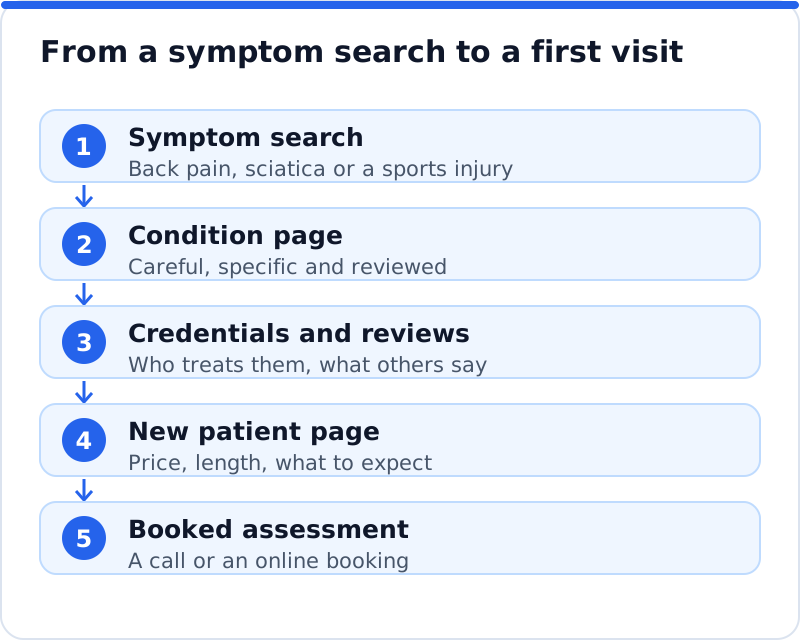
Many people hesitate before booking because they do not know what will happen in the first appointment. A new patient page should explain how long the first visit lasts, what the assessment involves, the price, what to wear, which forms to complete in advance and the cancellation policy. Introductory offers are common, but the wording needs care: state exactly what is included, avoid pressure such as limited-time countdowns, and do not tie the offer to signing up for a long course of treatment. In the USA, a clinic that bills insurance should check with its state board and billing adviser that a discounted first visit does not create problems with insurance rules. A chiropractor in Boise who explains the first visit step by step, with the price stated clearly, will often convert more visitors than one who simply says "book now".
Measuring calls and bookings
Phone calls are the main way chiropractic patients book, so they must be measured. The Google Business Profile performance view shows calls, website clicks, direction requests and bookings each month. On the website, set up key events in Google Analytics for taps on the phone number, submissions of the contact form and completed online bookings. Search Console shows which condition pages gain clicks, so you can see whether the new sciatica page is working. Ask every new patient how they found the clinic and record it, because many calls that began with a Google search look like direct calls in the numbers.
How AI Website SEO Tools help
Our AI website SEO tools check a clinic website the way Google reads it and give a score out of 100, with on-site checks counting for 60% and backlink trust for 40%. The report covers six areas, reads up to 12 pages and lists each page's problems, such as a sciatica page without a search title or a profile page that loads slowly on a phone. It shows the keyword each main page should win, the visits a month now and those within reach. Each problem is joined to the tool that fixes it, with steps and code to paste or, on WordPress, applied by our plugin. A monthly re-check emails you what changed, and the wider AI SEO tools for business websites include a backlink checker for tracking links from clubs and gyms.
Questions business owners ask
Should we write pages about conditions we treat less often?
Write a page only when you can explain the condition accurately and when your rules allow you to say you help with it. A page about a condition the evidence does not support can lead to complaints and regulatory action, whatever it does for traffic. For conditions you do see, such as neck pain or shoulder problems, a careful page answers real searches and brings the right patients. Start with the three or four problems that make up most of your appointments. Add others slowly, and have each one reviewed by the chiropractor whose name appears on it.
Do we need a page for each chiropractor?
Yes, if more than one person treats patients, because people search for practitioners by name, especially after a recommendation. A profile page gives that search a clear answer and shows the qualifications and registration patients want to see. It also gives condition pages an author or reviewer to link to, which supports the expertise Google looks for on health websites. Keep the pages up to date when someone joins or leaves the clinic. When a chiropractor leaves, redirect their page to the team page rather than leaving it broken.
Can we use patient testimonials on our website?
You can, but regulators treat a testimonial as a claim you are making, so it must follow the same rules as your own words. Choose testimonials about the welcome, the clear explanation and the care, rather than about a condition being cured. Get written consent before publishing any testimonial, and do not add details that identify a patient's health beyond what they agreed to share. In the USA, the FTC's endorsement guidance expects an advertiser to show what results patients can generally expect when a testimonial describes results that are not typical. If you are unsure about a particular testimonial, leave it out, because one risky sentence can outweigh ten good ones.
Ninety days of SEO for chiropractors
In the first month, correct the Google Business Profile, rewrite the back pain page with careful wording and red flags, and publish profile pages for every chiropractor. In the second month, add pages for sciatica and sports injuries, set up key events for calls and bookings, and start asking every patient for a review in the same way. In the third month, contact two local clubs or gyms with a specific offer, such as a talk or an injury guide, and correct any old directory listings. Review calls and bookings at the end of each month and note which pages brought patients. Before you begin, run a full check of the clinic website to see which pages and problems to fix first.
Your website as a network: every part of its SEO checked while you watch, your score, the traffic within reach and the fix for each problem.
Check your website with AI Website SEO Tools →