SEO for Accountants: Being Found Before Tax Season
How accounting and bookkeeping firms win clients from Google with service pages, niche pages, credentials and reviews, and why the tax calendar should set the timing of every change.
- Any website
- Visits within reach
- Each problem joined to its fix
Tax deadlines arrive on the same dates every year, and so do the panicked searches that come with them, which makes accounting one of the most predictable businesses to market online. The firms that win those searches are the ones whose pages were ready weeks earlier, not the ones that start writing when the phones are already busy. SEO for accountants means building pages for each service and each type of client, showing the credentials that make a firm trustworthy and timing content to the tax calendar in the US, the UK and Ireland. It also means a Google Business Profile that reflects how the firm really works, listings in the directories of professional bodies and accounting software, and reviews gathered without breaking confidentiality. You will find a deadline calendar to plan around, the pages an accounting website needs and the schema type that describes it. The last sections cover how to measure enquiries when demand rises and falls through the year.
This article is part of our complete guide: SEO for Service Businesses.
Try AI website SEO tools to analyse your accounting firm website before the next tax deadline
Why timing matters in SEO for accountants
Most businesses see fairly even demand through the year, but accountants see sharp peaks before filing and payment deadlines. People search for "self assessment accountant" in January in the UK, for "CPA near me" before mid-April in the US, and for help with company accounts as their filing deadline approaches. A new page usually needs weeks, and often a few months, to be crawled, indexed and settled in its position, so content published during the rush often arrives too late for that season. The practical answer is to publish and update seasonal pages two to three months before each peak. Accounting is one of the most seasonal corners of SEO for professional services, and a calendar like the one below keeps the work ahead of demand.
| Region | Deadline | Searches to prepare for | Publish or update by |
|---|---|---|---|
| USA | 15 March, partnership and S corporation returns for calendar-year businesses | Business tax return help, S corp accountants | December |
| USA | 15 April, individual federal returns and the first estimated payment | Tax preparers, CPAs for individuals, filing extensions | January |
| UK | 31 January, online Self Assessment returns and payment | Self assessment accountants, help for sole traders and landlords | October |
| UK | 5 April, end of the tax year | Year-end planning, Making Tax Digital for Income Tax | January |
| Ireland | 31 October, self-assessed income tax returns | Tax return help for self-employed people and landlords | July |
Service pages for the work clients search for
Clients search for a specific service, not for "accountancy", so each service needs its own page. A typical firm needs pages for bookkeeping, payroll, personal tax returns, business tax returns, year-end accounts, VAT or sales tax, and advisory work such as cash flow forecasting. A bookkeeping firm in Manchester might add a page on Making Tax Digital for Income Tax, which has applied since April 2026 to sole traders and landlords with qualifying income over £50,000 and extends to those over £30,000 from April 2027. A CPA firm in Seattle might write separate pages on LLC tax returns and on S corporation elections, because those are questions business owners ask by name. Each page should explain what is included, who it suits, how the work is done, what the client needs to provide and how fees are set.
Pages for the clients you serve
Niche pages often bring better clients than general service pages, because they speak to a group with shared problems. A firm that works with contractors, landlords, medical professionals, restaurants or online sellers should have a page for each of those groups, explaining the issues that matter to them. A contractor accountant in Reading can explain the off-payroll working rules and the choice between operating through a limited company or as a sole trader, while a firm in Denver serving dental practices can cover practice purchases and payroll for clinical staff. These pages should show real knowledge, with the questions that group asks and examples of the help the firm gives, written without naming any client. They also give the firm natural pages to link from articles and directory profiles, and they make it easier to rank for searches such as "accountant for landlords" where a general page would struggle.
Credentials that make an accounting firm credible
Clients hand an accountant their bank statements and their tax position, so visible qualifications matter. In the US, the CPA title is restricted to people licensed by a state board of accountancy, and enrolled agents are licensed by the IRS to represent taxpayers. In the UK and Ireland, common bodies include ICAEW, ICAS, Chartered Accountants Ireland, ACCA and CIMA, with the Chartered Institute of Taxation awarding the Chartered Tax Adviser qualification and AAT covering many bookkeepers. Professional bodies set rules on how members and firms describe themselves, including when a firm may use descriptions such as "Chartered Accountants", so check your own body's guidance before you change your wording. Put each person's qualification on their bio page, show the firm's regulatory or practising details in the footer, and add the name and qualification of the reviewer to every tax article.
Google Business Profile through the tax year
A Google Business Profile puts the firm in the map results for searches such as "tax accountant near me", which is where many local clients choose. Pick the most specific primary category that fits, such as an accountant, certified public accountant, tax preparation or bookkeeping category, and list each service with a short description. Use special hours to show extended opening in the weeks before major deadlines, because people searching late in the evening want to know if they can reach someone. Post short updates before each deadline, such as what documents to gather, and add photographs of the real office and team. If the firm works remotely and never meets clients in person, read Google's eligibility rules first, since online-only businesses are not eligible for a profile.
Software partner and professional directories
Accounting has a set of directories that most industries lack, and they bring both visits and trust. Accounting software companies run partner directories, such as Xero's advisor directory and the QuickBooks ProAdvisor directory, where businesses look for an accountant who already uses their software. Professional bodies keep member directories as well, and many US state CPA societies offer a way for the public to find a CPA. Complete each profile with the firm's name, address and phone number written exactly as on the website, the services and industries you cover, and a link to the most relevant page rather than the home page. Keep these profiles current when staff leave or a certification level changes, because an outdated profile sends clients to someone who no longer works at the firm.
Reviews from clients who share their finances
Reviews matter to accountants because choosing one feels risky, and other clients' experiences reduce that risk. The best moment to ask is right after a return is filed or the year-end accounts are signed, with a short email from the person who did the work and a direct link to the profile. Never offer a discount for a review and never ask only the clients you expect to be pleased, because Google's policies forbid both and consumer law in the US and UK now targets fake and incentivised reviews. Replies need care, because accountants owe their clients confidentiality, so never mention a client's tax position, fees or circumstances in public. A good reply thanks the reviewer, speaks about the firm's approach in general terms and, for a complaint, offers a private conversation.
Schema for an accounting firm
Structured data tells Google in a standard format what the business is. On schema.org, the type for an accounting firm is AccountingService, which is a kind of FinancialService and therefore a kind of LocalBusiness. Add it to the home page or each office page with the firm's name, address, phone number, opening hours, website and the areas it serves. Partners can be described with the Person type on their bio pages, and schema.org's hasCredential property can record professional qualifications for people and organisations. Test the markup with Google's Rich Results Test and the Schema Markup Validator, and avoid marking up your own collected reviews, because Google does not show review stars for a business reviewing itself.
Planning content around the tax calendar
A firm that publishes useful articles at the right time of year can win searches that larger firms ignore. Good topics come straight from client questions, such as "what expenses can a landlord claim", "do I need to register for VAT" or "what is a quarterly estimated tax payment". Every tax article should state the country and tax year it covers, because a reader in Galway, a reader in Glasgow and a reader in Ohio need different answers. Thresholds, rates and deadlines change, so review each article before its season and update the year in the title only when the content has really been checked. Mark each article as general information rather than advice, and end with a link to the matching service page for readers who want the work done for them.
Measuring enquiries season by season
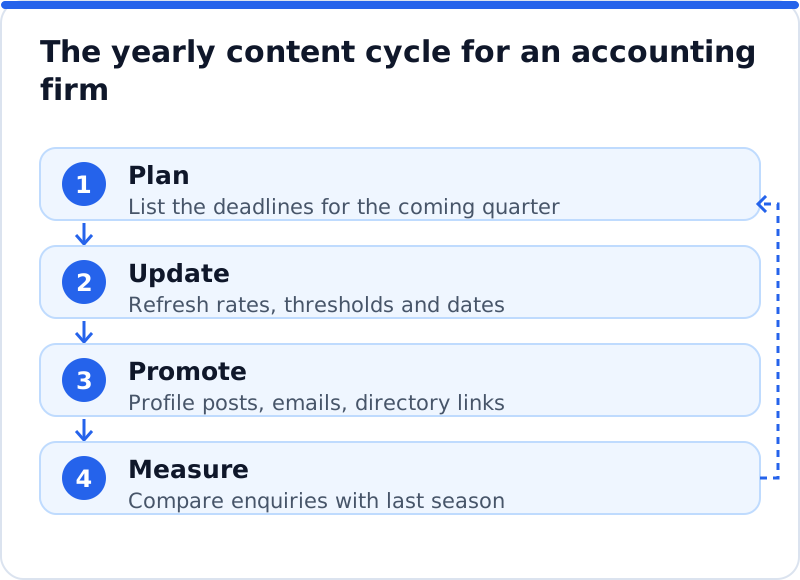
Because demand is seasonal, compare each month with the same month last year rather than with the month before. Set up key events in Google Analytics for enquiry forms, phone clicks and bookings, and check Search Console's Performance report with a year-on-year comparison. Google Business Profile shows calls and website clicks from the map results, which often peak in the days before a deadline. Ask each new client how they found the firm, and record the answer alongside the service they bought, so you can see whether search brings tax return work, bookkeeping or higher-value advisory clients. That last point matters, because a page that brings ten one-off returns may be worth less than one that brings a single monthly bookkeeping client.
AI Website SEO Tools makes the starting point clear. It checks any accounting website, whether built on WordPress, Wix, Squarespace or another platform, the way Google does and gives a score out of 100. It reads up to 12 pages, lists each page's problems across six areas, shows the keyword each main service page should win and estimates the visits a month now and the visits within reach. Every problem is joined to the tool that fixes it, with steps and code to paste, or with the plugin applying approved fixes on WordPress. A monthly re-check emails what changed, and the wider AI SEO tools for business websites cover keyword research and articles when the season's pages need writing.
Questions business owners ask
When should an accounting firm start preparing for tax season?
Start two to three months before each major deadline. New pages need time to be found and to settle in search results, and updates to existing pages also take a few weeks to be picked up. For the UK's 31 January deadline, that means having Self Assessment pages ready by October or early November. For the US mid-April deadline, aim to finish updates in January. Use the quieter months after each deadline to review what worked and plan the next season.
Should we publish our prices?
Many accounting firms now publish prices or starting prices for standard services, such as a personal tax return or monthly bookkeeping. Clear pricing helps clients decide and filters out enquiries that are not a good fit. For complex or advisory work, explain how fees are set instead, such as by the number of transactions, employees or entities. Whatever you publish, keep it current and say what is included, because surprises at the invoice stage lead to poor reviews. Check your professional body's guidance on how fees are advertised before you change your wording.
Do we need separate pages for the US and the UK?
Only if the firm actually serves clients in both countries, for example a firm that helps Americans living in London with both tax systems. In that case, separate pages are essential, because deadlines, forms and terms such as "tax year" differ completely. Each page should state clearly which country it covers and use that country's terms. A firm that serves one country should write only for that country and say so on the page. Mixing the two on one page confuses readers and weakens both.
A pre-season plan for your firm
Look at the next major deadline on the calendar and count back three months, because that is when the work should start. In the first week, list the services and client groups that deadline affects and check that each has a page with clear details and a named, qualified reviewer. In the second week, update your Google Business Profile with special hours, services and a short post about what clients need to prepare. In the third week, update the directory profiles and refresh the seasonal articles with this year's dates and thresholds. Then run a check of the whole website so the pages that matter most this season are fixed first.
Your website as a network: every part of its SEO checked while you watch, your score, the traffic within reach and the fix for each problem.
Check your website with AI Website SEO Tools →