Medical SEO: Getting a Practice Found by Patients
How patients search for care, the pages and listings a practice needs to be chosen, and how to handle reviews, privacy and tracking without putting patients at risk.
- Any website
- Visits within reach
- Each problem joined to its fix

A patient choosing where to be treated rarely starts with the name of a practice: they start with a symptom, a treatment or the words "near me", and they choose whoever explains it clearly and looks trustworthy. Medical SEO is the work of being that practice, and it differs from ordinary search work because the stakes are higher for patients, for Google and for regulators. Google holds health pages to a stricter standard of accuracy and expertise than most topics. Reviews and testimonials carry privacy duties that can lead to enforcement if they are mishandled. You will see how patients search, which pages and listings a clinic needs, how to describe clinicians and treatments so they earn trust, which schema types fit a practice, and how to handle reviews, privacy and tracking safely. The examples cover practices in the USA, the UK and Europe, and the steps work for a solo clinician as well as a multi-site group.
This article is part of our complete guide: SEO for Service Businesses.
How patients search for care
Patients search in a few distinct ways, and a practice website needs a page for each. Symptom searches, such as "heel pain when walking" or "mole changed colour", come from people who do not yet know what they need. Treatment searches, such as "ingrown toenail removal" or "laser eye surgery consultation", come from people who know what they want and are choosing a provider. Local searches add "near me" or a town, and urgent ones add words such as "same day", "today" or "walk in". Payment shapes the search too: patients in the USA add their insurer or "in network", while patients in the UK add "private" or "NHS" depending on how they plan to pay.
Each kind of search needs a different page, and the table pairs them. A podiatry practice in Brighton, for example, needs a condition page for heel pain, a treatment page for orthotics and a clear page on private fees. Symptom pages bring patients earlier, but they must be careful and accurate, and they should guide people to the right care rather than promise a cure. Treatment pages are usually where bookings come from, so they deserve the most attention. Read the searches in Search Console's Performance report before writing anything, because they show the exact words your own patients use.
| Kind of search | Example | Page that answers it |
|---|---|---|
| Symptom | "heel pain in the morning" | Condition page explaining causes and when to seek help |
| Treatment | "custom orthotics consultation" | Treatment page with steps, risks, costs and booking |
| Local | "podiatrist near me" | Home or location page and Google Business Profile |
| Urgent | "same day GP appointment" | Appointments page with hours and how to book today |
| Payment | "dermatologist that accepts my insurer" or "private GP fees" | Insurance or fees page kept accurate and current |
Why medical SEO is held to a higher standard
Google's search quality rater guidelines, which Google uses to assess its results, describe health as a topic where poor information can harm people. Pages on such topics are judged most strictly for experience, expertise, authoritativeness and trust, often shortened to E-E-A-T. In practice, Google looks for signs that real, qualified people stand behind the content and that the practice is what it claims to be. That means naming the clinician who wrote or reviewed each clinical page, showing their qualifications and registration, and dating the review. It also means stating facts carefully, avoiding claims the evidence does not support, and explaining risks as well as benefits.
Credentials should be specific and checkable. In the UK, a doctor's General Medical Council number, a dentist's General Dental Council number or a physiotherapist's registration with the Health and Care Professions Council can be stated and verified by patients. In the USA, state licensure and board certification play the same role. A fertility clinic in Copenhagen might add each doctor's specialist title. A profile page per clinician, with photo, training and special interests, serves patients and Google alike.
Advertising rules shape what a page may say. In the UK, the Advertising Standards Authority enforces the CAP Code, which applies to claims on your own website, and prescription-only medicines may not be advertised to the public, which is why aesthetic clinics cannot promote botulinum toxin by name. In the USA, the Federal Trade Commission expects health claims to be backed by competent and reliable scientific evidence, and state medical boards set their own rules on advertising. These rules are summarised for orientation, not as legal advice. Ask your professional body or a compliance adviser about any claim you are unsure of.
Google Business Profile for practices and clinicians
The practice profile is often the first thing a local patient sees, so complete it carefully. Choose the most specific primary category, such as "Dermatologist" or "Medical clinic", and add secondary categories only for services you really offer. Enter accurate hours, holiday hours and an appointment link if patients can book online. Add photos of the entrance, the waiting room and the treatment rooms, but never photos in which a patient could be identified without consent. List your main services and keep the description factual, since inflated claims there are judged just as harshly as on your website.
Clinicians can have profiles of their own. Google's guidelines treat doctors and dentists as individual practitioners, who may have their own profile if they are public-facing and can be contacted at the verified location during stated hours. Support staff should not have profiles, and one practitioner should not have several profiles for different specialties. Where one practitioner works at a branded practice, Google recommends a single shared profile named "Practice: Practitioner name". When a clinician leaves, update or close their profile promptly, because a profile that still invites bookings for someone who has gone frustrates patients and attracts poor reviews.
Treatment and condition pages patients trust
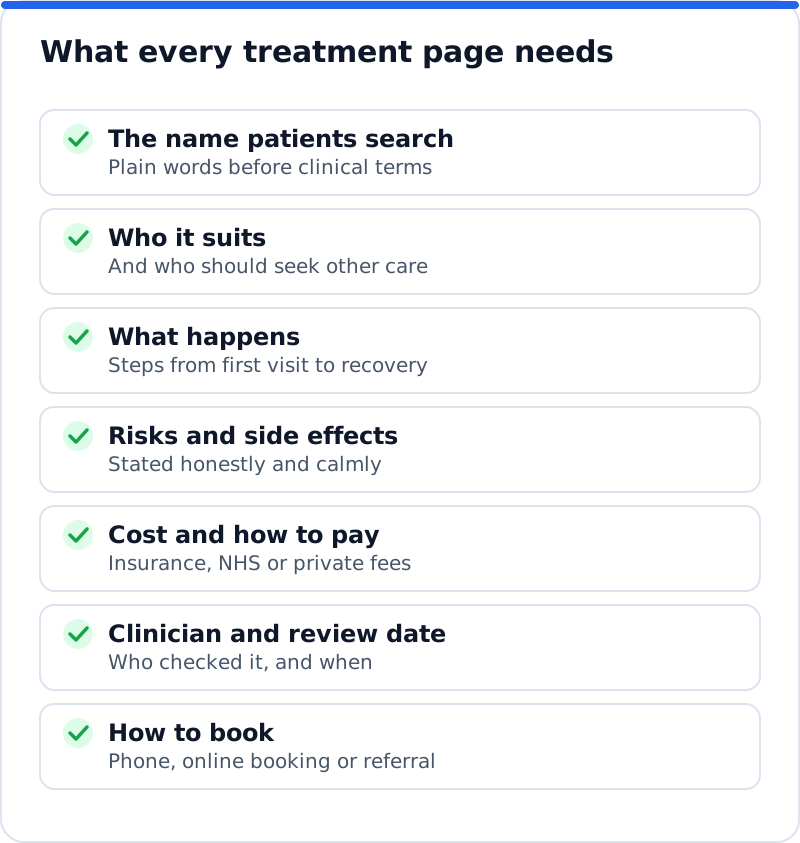
Treatment pages do most of the work in medical SEO, so give each main treatment its own page. A dermatology practice in Phoenix needs separate pages for skin cancer checks, mole removal and acne treatment, rather than one page listing all three. Each page should use the treatment name patients search, explain who it is for and who should seek other care, and describe what happens from first appointment to recovery. State the risks and side effects honestly and without alarm. Then cover cost, insurance or NHS options, and how to book, so the patient has no reason to look elsewhere.
Condition pages help patients earlier in their search, but they need even more care. Describe the condition, its common causes and when to seek urgent help, then explain how your practice assesses and treats it. Avoid promising outcomes, since results vary between patients and regulators take a dim view of guarantees. Link each condition page to the treatment pages that relate to it. Add the name of the reviewing clinician and the date of review at the foot of every clinical page, and set a reminder to review each one at least once a year.
Schema markup for medical practices
Schema markup describes your practice in code that search engines read reliably, and schema.org has a family of medical types under MedicalBusiness. A general or multi-specialty practice usually fits MedicalClinic, a dental practice fits Dentist, and a doctor's practice fits Physician, which has the more specific types IndividualPhysician and PhysiciansOffice. Specialties have their own types too, such as Dermatology, Physiotherapy, Optician, Pediatric and Podiatric, all of which sit under MedicalBusiness. Choose the most specific type that matches the practice, and use the same name, address, phone number and hours as your Google Business Profile. The markup belongs on the home page or the contact page, with each location's page carrying its own details if you have several.
Schema promises no special search feature, and its value lies in confirming facts Google finds elsewhere. Contradictions between markup and page undo that purpose. Test it with Google's Rich Results Test to see what Google can read, and use the Schema Markup Validator for a general check of the medical types. Review the markup whenever hours, clinicians or locations change. An orthodontist in Seattle opening a second site should give it its own page, profile and markup.
Reviews, testimonials and patient privacy
Reviews matter to patients as much as to anyone else, but in healthcare the reply is where practices get into trouble. In the USA, the HIPAA Privacy Rule protects patients' health information, and the Department of Health and Human Services has taken enforcement action against dental practices that disclosed patient details while replying to online reviews. Even confirming that a reviewer is a patient can be a disclosure. In the UK and the European Union, health data is a special category of personal data under the GDPR, with stricter conditions for using it. The safe habit is the same everywhere: reply in general terms and move the conversation offline, following these rules for good and bad reviews alike.
- Never confirm that the reviewer is or was a patient, and never mention a visit, a treatment or a result.
- Thank people in general terms, such as "Thank you for taking the time to share this", without repeating anything personal.
- For a complaint, describe your practice's general approach and invite the person to contact the practice manager directly.
- Ask every patient for a review in the same way, since Google's policies prohibit incentives and asking only happy patients.
Testimonials on your own website need the same care. In the USA, using a patient's information in marketing generally requires their written authorisation under HIPAA, and in the UK and Europe you need a clear lawful basis and the patient's explicit consent for anything that reveals health information. The Federal Trade Commission's rule on fake reviews, in force since October 2024, also bans invented or bought testimonials. In the UK, patients can leave ratings and reviews of NHS services such as GP surgeries and dentists on the NHS website, and practices should read and respond to them there. Keep a written record of consent for every testimonial and every photo, and remove them promptly if a patient withdraws consent.
Health directories and booking platforms
Patients often meet a practice first on a directory, so the listings that rank for your name and specialty deserve attention. In the USA, physician directories such as Healthgrades and booking platforms such as Zocdoc often appear for a doctor's own name, and insurers run their own "find a provider" tools that patients check before booking. In the UK, NHS services have profiles on the NHS website, and private clinics appear on private healthcare review and booking platforms. In parts of Europe, booking platforms such as Doctolib play a similar role. Their features change, but the principle is fixed: claim your profiles and keep them accurate.
Directory profiles should match your website and Google Business Profile exactly. A paediatric practice in Atlanta that moved last year may still show its old address on several directories. Search the names of each clinician as well as the practice, because practitioners often have listings the practice manager never created. Update insurance networks wherever they appear, since outdated insurer details cause angry calls. Link to your own booking page wherever a directory allows it, so patients can book directly.
Measuring bookings without exposing patient data
The numbers that matter are new patient calls, booked appointments and enquiry forms, broken down by the page or listing that produced them. Google Business Profile shows calls, website clicks and direction requests from your listing. Google Analytics can count a booking confirmation or a tap on the phone link as a key event, and Search Console shows which searches bring patients to which pages. Compare month with month, and look for pages with visits but no bookings. Those usually need clearer booking steps, an honest price or a better answer.
Tracking itself carries a privacy risk on health websites. In the USA, HHS guidance warned that analytics and advertising tracking tools on health websites can disclose protected information, and although a federal court set aside part of that guidance in 2024, tracking on patient portals and booking forms remains a real risk. In the UK and Europe, analytics and marketing cookies need consent, and data revealing health interests needs extra care. Keep advertising pixels off appointment, symptom checker and patient portal pages, and never send form contents to analytics. Ask your compliance adviser to review your tracking set-up, because these rules are summarised here generally rather than as legal advice.
How AI WebMaker's tools support medical SEO
A practice manager rarely has time to audit every page by hand. Our AI Website SEO Tools read your website the way Google does and give it a score out of 100, with on-site checks counting for 60% and backlink trust for 40%. The results cover six areas, from Found by Google and Your Google listing to Content and Keywords and traffic. You see up to 12 pages the check read, the problems on each, the keyword each main page should win and the visits a month now and within reach. That makes it easy to check every treatment page on your practice website and spot the ones missing a clear title, a description or business schema.
Each problem is joined to the tool that fixes it, with steps and the code to paste on any website builder, and on WordPress the plugin can apply approved fixes for you. A monthly re-check emails you what changed, which suits a practice that reviews its pages on a schedule. The check cannot judge clinical accuracy, which remains the job of your clinicians. It does show which pages Google struggles to understand and which searches are within reach. You can also see how it works alongside backlink and keyword checks among our AI SEO tools for business websites.
Questions business owners ask
Should every clinician have their own page?
Yes, for any clinician patients can book with or ask for by name. Patients search for named doctors, dentists and therapists, and a profile page is the best answer to those searches. The page should show the clinician's photo, qualifications, registration, special interests and the treatments they offer. Link each profile from the treatment pages they cover, and link the treatments back to the profile. When someone leaves, redirect their page to the most relevant team or treatment page rather than leaving a dead link.
Can we write about conditions we do not treat?
You can, but there is little reason to. Such pages attract visitors who cannot become patients and stretch your clinicians' review time. Google also looks for a clear match between a website's expertise and its content, so a narrow, well-maintained set of pages usually serves a practice better than a broad one. Focus on the conditions and treatments you see every week. If a related condition is often confused with one you treat, explain the difference and where to seek help.
How often should clinical pages be reviewed?
At least once a year, and sooner when guidance, prices or your services change. Put a named reviewer and a review date at the foot of each clinical page, and keep a simple log of what changed. An eye clinic in Amsterdam that adds a new lens option should update its treatment page the same week. Outdated prices and withdrawn treatments cause complaints as well as lost bookings. A yearly review is also a good moment to check that each page still answers the searches patients use.
A medical SEO plan for the next month
Start with the pages and listings closest to a booking, because they bring results fastest. In the first week, complete the practice profile and any clinician profiles, and check your details on the main directories. In the second week, rewrite your three busiest treatment pages using the checklist above, with a named reviewer and date on each. In the third week, add schema markup, review your tracking with your compliance adviser and remove pixels from booking and patient pages. In the fourth week, agree a reply policy for reviews, train the person who handles them and ask every patient for feedback in the same way. Then measure the month's bookings by source, and use what you learn to choose the next three pages.
Your website as a network: every part of its SEO checked while you watch, your score, the traffic within reach and the fix for each problem.
Check your website with AI Website SEO Tools →