Watch Repair Website Cost and the Estimate That Comes Before the Work
A watch repair workshop's hosting is $119 covering twelve months, or a monthly $19 when cash flow favours it, plus a domain. Inside: who brings a watch, service pages, estimates first, servicing, water resistance, parts, search and the yearly budget.
- No coding required
- Live in minutes
- Blog, SEO and chatbot tools included
A watch repair workshop pays $119 for a full year online, or a monthly $19 when cash flow favours it, and buys its domain at whatever its chosen ending costs. Writing the service cards and the estimate steps, then proofreading every screen in the AI Web Maker preview, happens before any bill exists. One full mechanical service, or a busy Saturday of batteries and straps, covers that hosting with plenty left over. The difficulty lies elsewhere, because an owner handing over a watch is often handing over a grandparent's wrist, a graduation gift or years of savings. Skill at the bench is invisible until the case is open, so the website has to show method, honesty about price and clear limits before anyone climbs the stairs. Ahead are the owners, the pages, estimates, servicing, water resistance, parts and vintage limits, search and the yearly sums.
This article is part of our complete guide: Retail Website Design.
Heirlooms, daily wearers and battery stops: who climbs the stairs
People bring watches to a repairer for reasons that range from a dead quartz battery to an inheritance that has not ticked in twenty years. The daily wearer notices an automatic stopping overnight or gaining a minute a week and wants it fixed without a long absence. Someone holding a family piece wants reassurance that it will be treated with care, and that an honest opinion comes before any money. Quick jobs, such as batteries, straps and bracelet links, bring the most footsteps and often lead to a full service later. Every one of these visitors checks hours, prices and the promise of an estimate on a phone before they set out.
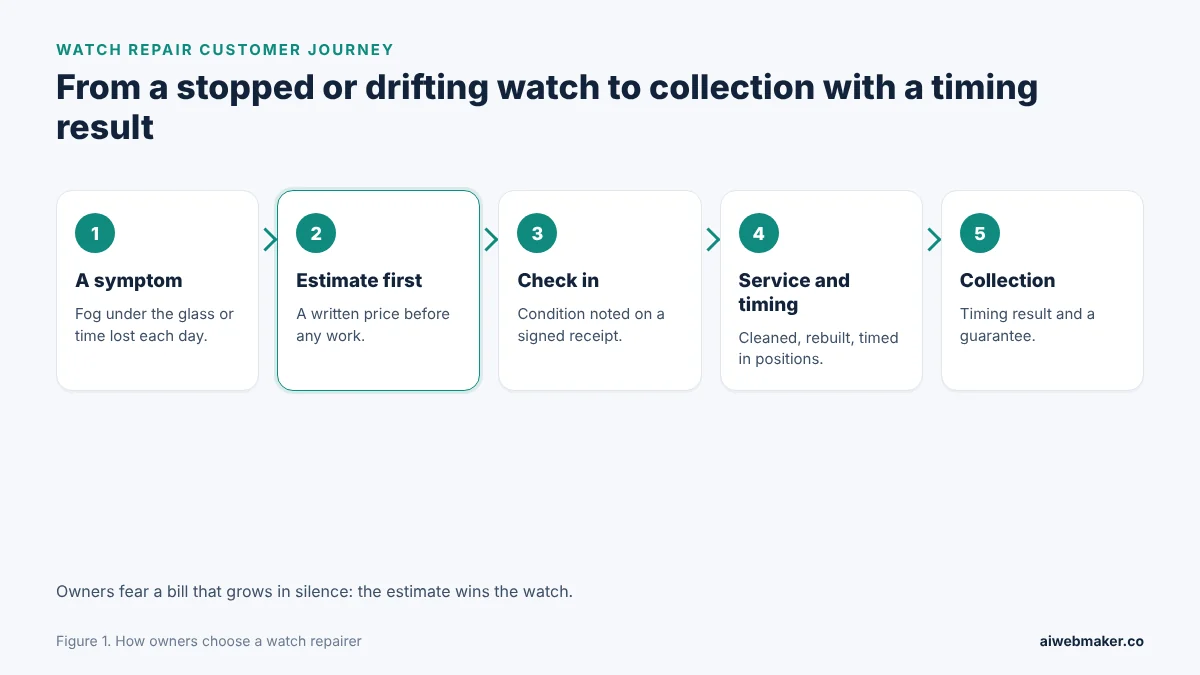
Five stages carry an owner from a worrying symptom to a watch back on the wrist with a timing result. A symptom appears first, such as fog under the glass or a second hand jumping every four seconds. The highlighted stage is the promise of a written estimate, because owners fear handing over a precious object for a bill that grows in silence. Check in at the counter follows, with the watch's condition written on a signed receipt. Service and timing take the longest, and collection with a guarantee decides whether the owner returns and recommends the bench. A site that speaks to each stage turns a nervous enquiry into a trusted relationship.
Service cards, warning signs and the bench: pages a workshop needs
A watch repair site works best as a short set of sections, each answering one question an owner asks before parting with a watch. Starting prices for the common jobs come first, because owners want a figure before they read about method. A process section shows what happens between the counter and the timing machine. A table of warning signs helps owners judge urgency, while a bench section explains who does the work. A list of watches accepted, and those refused, prevents wasted trips.
| Page or section | The owner's question | What it should answer |
|---|---|---|
| Services and starting prices | What will this roughly cost? | A starting price for each common job |
| Process | What happens after check in? | Receipt, estimate, decision, service, collection |
| Warning signs | Is this urgent? | Symptoms, likely causes and what to do |
| The bench | Who touches my watch? | Work done on site by the person quoting |
| Watches accepted | Will you take mine? | Movements handled and items refused |
| Estimate request | How does a price arrive? | A range by message, a firm price after opening |
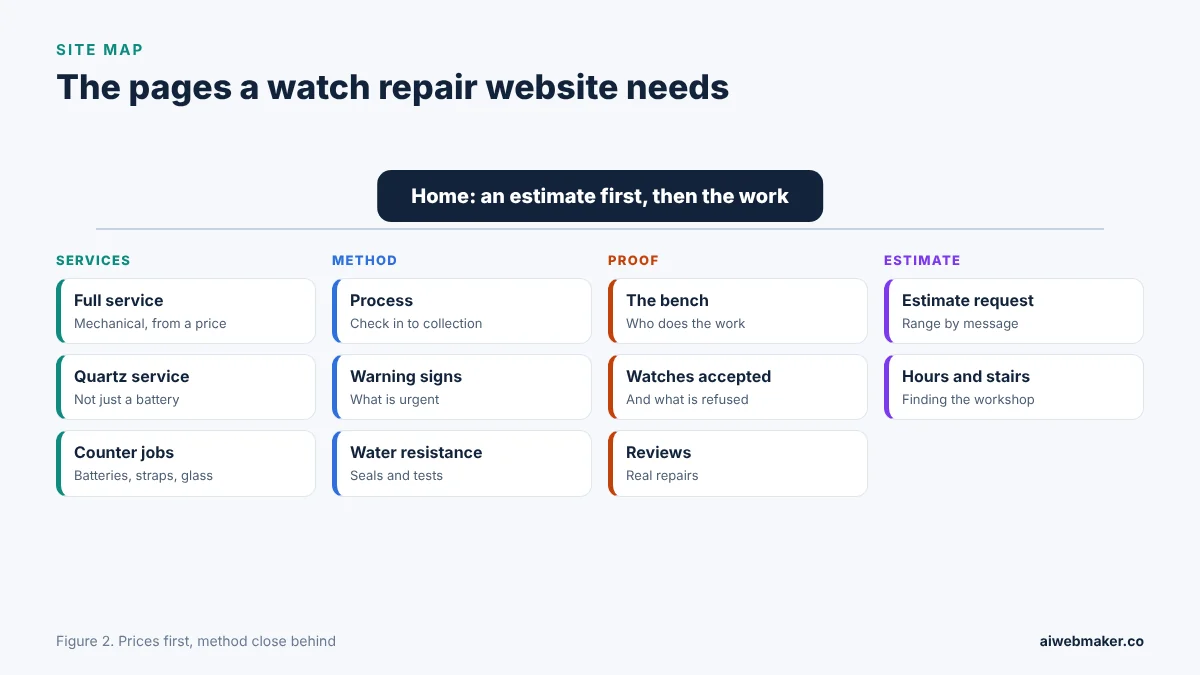
Split by what the owner needs to know, the workshop's site forms four groups: services, method, proof and the estimate. Service cards hold the full mechanical service, the quartz service and the counter jobs, while method pages explain the process and the warning signs. Our sample workshop, Tick and Tock Watch Repairs, lists six cards with starting prices: a full mechanical service, a quartz service, battery replacement, straps and bracelets, glass and crystal, and a water resistance test. Five steps then run from check in to collection, followed by a warning signs table, a bench section, the watches it works on, a gallery, reviews and questions. The watch repair website example with written estimates before work ends with an estimate request and the workshop's hours. Owners reading that order learn the price range, the method and the limits before they ever reach the counter.
Opening the case before naming a price
Two watches that look identical on the wrist can need very different work, so a careful repairer opens the case before committing to a figure. Rust on a winding stem, a cracked jewel or a broken mainspring only shows once the caseback is off. A written estimate after inspection means the owner agrees to a real price rather than a guess that grows later. The page should say how long the estimate takes, what it includes and what happens if the owner says no. Declined watches should come back closed up as they arrived, and the workshop's own terms on any inspection charge should be written down. The AI website builder for watchmakers and repair counters drafts these estimate steps, the service cards and the rest of the pages once the owner sums up the jobs and hours at the bench, and any line can be rewritten afterwards.
| Stage | What the owner should read |
|---|---|
| Check in | Condition, scratches and running noted on a signed receipt |
| Open and inspect | Caseback off, movement examined within a stated number of days |
| Written estimate | Parts and labour itemised, with the expected return date |
| Owner decides | Yes books the work, no returns the watch as it arrived |
| Service and timing | Rebuilt, then timed over several days in different positions |
| Collection | Timing result, guarantee terms, old parts on request |
Inside a full service: cleaning, oiling and timing in positions
Owners pay more willingly for a service once they understand that it means far more than a battery or a polish. In a full mechanical service the movement is taken apart, each part cleaned, worn components replaced, and the whole rebuilt with several different oils and greases in specific places. The balance is then regulated and the watch timed in several positions, dial up, crown down and so on, over a few days. A quartz service is different again: the circuit and gear train are cleaned and checked, seals renewed and the current draw measured. Service intervals vary by maker and movement, and the page should say so instead of promising a fixed number of years. Explaining these stages in plain words shows why a service takes weeks, not minutes.
| Job | What actually happens | Typical time away |
|---|---|---|
| Battery replacement | Correct cell fitted, gasket checked and greased | Usually while the owner waits |
| Strap or bracelet | Fitted, or links added or removed and kept | Usually while the owner waits |
| Quartz service | Circuit and gears cleaned, seals renewed, current measured | Often about a week |
| Full mechanical service | Dismantled, cleaned, oiled, rebuilt, timed in positions | Often several weeks |
| Chronograph or vintage piece | Quoted after inspection | Longer, especially if parts are scarce |
Symptoms deserve a table of their own, because many owners do not know which problems are urgent. A watch gaining several minutes a week may simply be magnetised by a phone, speaker or bag clasp, which is often a quick fix. Fog or droplets under the glass mean moisture inside the case, and rust can start quickly, so that watch should come in the same day. A quartz second hand that jumps every four seconds usually signals a battery near the end of its life. Owners who can match a symptom to an action trust the workshop that taught them.
Water resistance ratings, gaskets and the pressure test
Water resistance is one of the most misunderstood features of any watch, and a repairer who explains it clearly earns lasting trust. The depth printed on a dial reflects a laboratory pressure test, not a promise that the watch can be worn to that depth in daily life. International standards exist for water resistant watches and for divers' watches, but makers interpret the markings in their own guidance, so owners should check the instructions for their model. Gaskets dry out and harden over the years, and a watch that was sealed when new may not be sealed today. A battery change or a new crystal is the moment to renew seals and offer a pressure test, with the result written on the receipt. Honest guidance here saves owners from the costliest kind of damage.
| Common marking | Rough everyday meaning often given | Worth adding on the page |
|---|---|---|
| 30 m or 3 bar | Splashes | Not for swimming |
| 50 m or 5 bar | Brief swimming in some guidance | Check the maker's own advice |
| 100 m or 10 bar | Swimming and snorkelling | Screw down crowns closed |
| Diver's marking | Diving, by the maker's design | Test seals regularly |
Battery work brings its own safety note. Used button cells are dangerous if a small child swallows one, so the workshop should take old cells back for proper disposal and the page can mention it in a line. Dry pressure testing suits most watches, while a wet test is used only where it suits the case. Owners who wear a watch in water should be told that a test after every opening is sensible. Clear notes like these position the bench as the careful choice rather than the quickest one.
Parts from makers, vintage dials and honest limits
Parts are where watch repair gets complicated, and owners respect a workshop that explains the limits openly. Some makers supply parts only to their own service centres, and an estimate that says so plainly, with a suggestion of where to go, is better than a vague delay. Original parts, compatible parts and parts made by hand for very old movements carry different costs and different effects on value. Vintage pieces raise further questions, because refinishing a dial or heavily polishing a case can reduce what a collector will pay. Smart watches and fitness trackers are electronics rather than movements, and a workshop that will not open them should say so before taking one in. Stating these limits upfront saves owners a wasted journey and protects the bench's reputation.
Searches like battery replacement near me and automatic stopped overnight
Owners search using the symptom or the job: watch battery replacement near me, automatic watch stopped, watch service cost, watch glass replacement or vintage watch repair. Headings that use those words on the services and warning signs sections give each search a real match. The map listing should show hours, a photo of the bench and the stairs or entrance, and the address in plain text. Reviews mentioning a clear estimate, a quick battery and an heirloom brought back to life persuade careful owners. Articles explaining magnetism, service intervals or what a water resistance rating means bring in owners still months away from handing over a watch. Patient, useful writing turns a workshop into the name owners remember when the day comes.
The workshop's hosting year in one table
For a watch repair counter the yearly outlay is hosting plus a domain, and twelve articles on magnetism or seals drafted through credits stay below eight dollars. An established bench with steady counter trade is best served by the $119 yearly bill. A new workshop can choose $19 a month until the regulars arrive. Updating starting prices, adding a strap range or changing bench hours adds nothing. Both billing routes sit side by side below, with the $189 plan shown only for reference.
| Item | Yearly | Monthly |
|---|---|---|
| Hosting the watch repair pages | $119 | $228 over twelve months |
| Domain | Depends on the ending | Depends on the ending |
| Higher plan, for comparison | $189 a year | Not needed |
| Twelve watch care articles at about $0.65 | About $7.80 | About $7.80 |
| Price, strap and hours updates | No charge | No charge |
| Year before the domain | About $126.80 | About $235.80 |
Why owners keep a stopped watch in the drawer instead
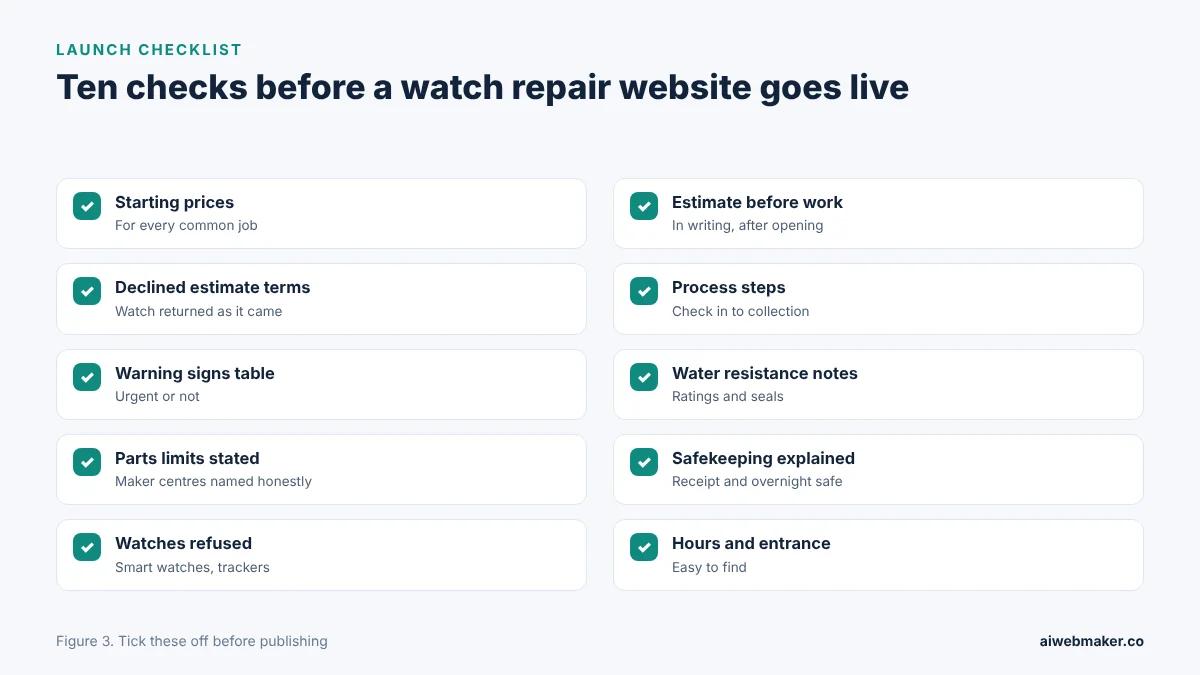
Owners leave a stopped watch in a drawer when the repairer's site gives no idea of price, process or who will open the case. A page with no starting prices makes every job feel like an unknown risk. Silence about estimates suggests the bill will be decided after the work is done. No mention of insurance or safekeeping while the watch is away worries anyone with an heirloom. Vague promises about water resistance or makers' parts sound like a sales pitch rather than expertise. The ten point list pictured next settles those doubts in turn.
Frequently asked questions
Can magnetism really make a mechanical watch run fast?
Magnetism is one of the most common reasons a mechanical watch suddenly gains time, because the fine hairspring coils can stick together when magnetised. Phones, laptop lids, speakers and magnetic bag clasps are everyday sources. A repairer can test for magnetism and remove it quickly, often while the owner waits. Many owners pay for a service they did not need because nobody checked this first. A short article on the subject is one of the most useful pages a workshop can publish.
Why can a full service take three to five weeks?
A full service takes weeks because cleaning, rebuilding and timing a movement cannot be rushed. Parts are cleaned and dried, worn pieces replaced, and the rebuilt movement is then observed over several days in different positions. Waiting for a part from a supplier can add more time. The estimate should give an expected return date so the owner can plan. Patience at the bench is what produces a watch that keeps good time for years.
Is a watch covered while it sits in the workshop safe?
Owners should ask whether a watch is insured from the moment the receipt is signed until collection, and a workshop should state its own arrangement on the website. Many repairers keep watches in a safe overnight and record the condition at check in. The receipt protects both sides if a question arises later. Cover and terms vary between businesses and countries, so the wording must match the workshop's actual policy. Clear words on safekeeping reassure anyone leaving behind something irreplaceable.
What happens to the watch when an estimate is declined?
When an owner declines an estimate, a careful workshop closes the watch up and returns it in the condition it arrived. Whether there is any charge for inspection is the workshop's own decision, and the page should state it plainly. Some repairers waive any charge entirely, while others credit it against later work. Owners appreciate knowing this before they hand over a watch. Clear terms on declined estimates make the first visit feel safe.
Batteries and services that cover the bench's year
A single full mechanical service usually outweighs the $119 a watch repair site needs for its year of hosting. Paying monthly instead, two battery changes and a strap fitting take care of the $19. Every heirloom that ticks again, and every owner who reads the warning signs and comes in early, is work the pages helped to find. Starting prices, a written estimate and plain words on seals and parts persuade careful owners better than any claim of craftsmanship. Workshops that keep their hours and prices accurate become the bench a whole town relies on. Owners arriving with the warning signs table already read show the site has earned their trust.
Build your website in Minutes and get the AI Tools that work
Start Building Your Website →