Bathroom Showroom Website Cost, Room Sets Online and Honest Lead Times
Room sets, a shop and a design desk go online for a bathroom showroom at $119 per hosting year, or else $19 monthly, with the web address bought on top. The rest covers buyers, the showroom online, the shop, lead times, deposits, installers, search habits and a twelve month budget.
- No coding required
- Live in minutes
- Blog, SEO and chatbot tools included
Room sets, a shop and a design desk go online for a bathroom showroom at $119 per hosting year with AI Web Maker, or else $19 a month, plus a domain. Setting up the product cards and the lead time table, then testing the bag in the preview, is not billed. A single thermostatic shower set at the sample showroom's $310 covers that year more than twice. The trickier job is selling an experience that happens on a showroom floor, where buyers sit in baths and stand under running water, through a phone screen late in the evening. Buyers also need lead times, deposits and the name of someone to fit it all, because a bathroom is a project rather than a parcel. This guide works through who visits, the showroom online, the shop, lead times, deposits, installers, search and the yearly budget.
This article is part of our complete guide: Retail Website Design.
Family bathrooms, loft shower rooms and landlords' refits: who walks into a bathroom showroom
Most bathroom buyers spend weeks browsing before they visit, and the website decides which showroom gets the visit. Couples planning a family bathroom want to see layouts, baths and storage that cope with children. Owners of awkward rooms, such as loft shower rooms or narrow cloakrooms, look for proof that the showroom can plan a tight space. Landlords and builders refitting several bathrooms want stock pieces, prices and delivery times they can rely on. Some shoppers simply need a replacement tap, towel rail or shower screen and will buy online if the price and options are clear.
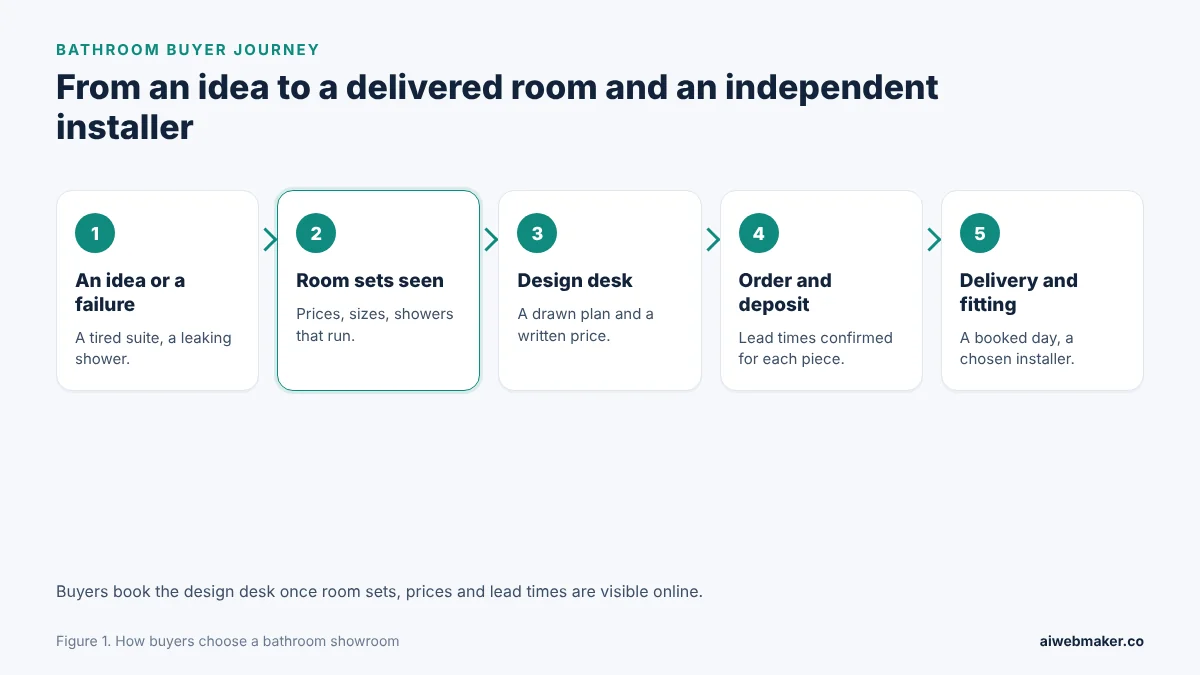
The second step glows here because seeing room sets and working showers, first on screen and then in person, is what turns browsing into a design appointment. An idea or a failing old bathroom starts the search, and photos of real room sets with prices show what the showroom offers. A visit or a design appointment follows, ending with a drawn plan, a written price and lead times for every piece. The order and deposit come next, then delivery on a booked day and fitting by an installer. Buyers who see each step described in advance arrive at the desk ready to decide.
Room sets, the shop and the design desk: how a bathroom showroom site is arranged
A bathroom showroom site has two jobs, selling stock pieces online and bringing whole room projects to the design desk. The home page should say how many room sets and working showers are on the floor and offer both routes clearly. A displays page describes what visitors can try, while the shop page lists stock pieces with their options and prices. A lead time page sets expectations for every type of piece, and a design appointment page explains what happens at the desk. Installation, returns, displays for sale and the visit details complete the site.
| Page | Buyer's question | What it should hold |
|---|---|---|
| Home | Is this showroom worth the drive? | Room sets, working showers, two routes |
| Displays | What can be tried on the floor? | Showers, baths, tap wall, lit mirrors |
| Shop | Can stock pieces be bought now? | Prices, finish and size options, delivery |
| Lead times | How long will it all take? | Stock, made to order, cut to size, cast baths |
| Design appointment | What happens at the desk? | Length, plan, written price, survey |
| Installation | Who fits it? | Installer referrals, responsibility, local rules |
| Returns and guarantees | What if something goes wrong? | Sealed returns, maker guarantees, buyer rights |
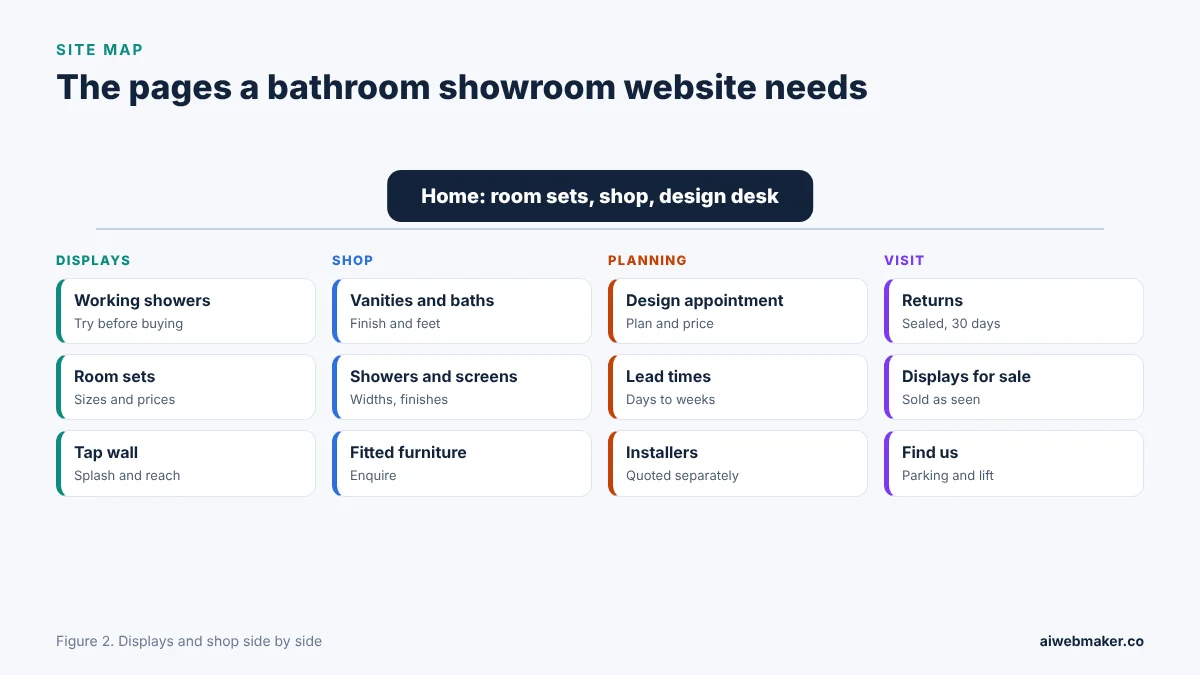
Displays and the shop sit side by side at the top of this map, because buyers move between trying things in person and pricing them online. Planning pages gather the design appointment, lead times and installation notes in one branch. Basin and Bath Showroom, the invented store in our bathroom showroom website example with working showers and lead times, lists four working showers, twenty two room sets, baths to sit in, the tap wall, mirrors and lighting, and panels and tiles on its floor. Its shop sells a wall hung vanity unit, 60 cm, a thermostatic shower set, a heated towel rail and a walk in shower screen, among other pieces. A drawn plan and written price from the design desk serve buyers whose whole room needs planning.
Working showers, baths to sit in and a tap wall: selling the visit
The displays page has to make a visit feel worth an hour's drive, so it should describe what buyers can touch rather than list brand names. Working showers let people feel the difference between a rainfall head and a handset before they buy. Baths that buyers are invited to sit in answer the questions of length, depth and back slope that photos cannot. A tap wall with real basins shows splash and reach, while a darkened bay shows how lit mirrors glow at night. Clear opening hours, parking and a lift to the upper floor turn that interest into a visit.
Stock pieces in the bag, whole rooms by enquiry
A bathroom showroom sells two very different things online, and the shop should separate them clearly. The online store builder for bathroom showrooms with finish options and enquiries gives each stock piece a choice of finish, width or feet, a bag for gathering the order, and a checkout where the delivery fee joins the total before payment. Discount codes can mark a display refresh or reward a trade customer. Fitted furniture made to measure has no fixed price, so the made to measure card shows an Enquire button where a price would sit. The sample prices delivery by the bulk of the order, with baths and vanity units arriving on a two person van on a booked day. Shoppers who can see which route suits their purchase stop calling to ask how to buy.
| Product | Option on the page | Route |
|---|---|---|
| Wall hung vanity unit, 60 cm | Finish: matt white, sage, oak effect, charcoal | Bag and checkout |
| Thermostatic shower set | Finish: chrome, brushed nickel, matt black | Bag and checkout |
| Heated towel rail | Finish: chrome, white, anthracite | Bag and checkout |
| Walk in shower screen | Width: 800, 1000 or 1200 mm | Bag and checkout |
| Roll top bath, 1700 mm | Feet: ball and claw, plinth, bun | Bag and checkout |
| Fitted furniture, made to measure | None until designed | Enquire button |
Lead times from three days to twelve weeks
Lead times cause more bathroom disputes than prices, so the lead time page should be one of the most carefully written on the site. Stock taps and rails may arrive within days, while furniture made in batches, toughened glass and cast iron baths take weeks. Pieces cut to the buyer's measurements need a survey before anything is ordered, which adds time. The sample confirms each lead time on the day of ordering and again when goods are ready, and holds delivered goods in its warehouse for up to eight weeks at no charge if the room is not ready. Honest timings let buyers book their installer for the right week.
| What is ordered | Sample lead time | Why it takes that long |
|---|---|---|
| Stock taps, rails and basins | 3 working days | Held in the showroom's warehouse |
| Vanity units, standard finish | 2 to 3 weeks | Made in batches by the maker |
| Shower screens, standard widths | 2 to 4 weeks | Glass toughened to order |
| Screens cut to measurements | 5 to 7 weeks | Survey before the glass is cut |
| Cast iron or stone baths | 8 to 12 weeks | Cast and finished by the maker |
| Painted fitted furniture | 6 to 8 weeks | Built for the buyer's walls |
Deposits, surveys and the balance before delivery day
Whole room orders involve large sums paid weeks before delivery, so the payment stages should be written down where buyers can find them. The sample's design appointment produces a written list, a price and the lead times, held for 30 days. A survey costing $90 checks the room before anything made to measure is ordered, and that fee is taken off the order. A 25% deposit places the order and the balance is paid before the delivery day is booked. If a maker withdraws a product before delivery, the sample offers the nearest match at the same price or returns the deposit for that item, a rule worth copying.
Independent installers, water pressure and rules for work near water
Many showrooms design and sell bathrooms without fitting them, and the installation page must say exactly who does what. The sample passes the plan and product list to independent installers on request, who visit, quote and are paid by the buyer directly. Plumbing, electrics near water and changes to drains fall under rules that vary by country, so buyers should check that each trade is qualified for its part of the work. Large rainfall heads need enough water pressure and flow, so the page can ask for the make of the boiler or water heater and recommend confirmation on site. The showroom should remain the contact for missing parts and guarantee claims, which reassures buyers that nobody will pass the problem around.
Bathroom showroom near me, walk in shower ideas and other searches before a refit
Buyers search with phrases such as bathroom showroom near me, walk in shower, roll top bath, wall hung vanity unit or small shower room ideas, often with a town. Product and display pages named in those plain terms meet both browsers and buyers ready to order. A map listing with photos of room sets, the opening hours and any late evening noted helps people plan a visit after work. Reviews that mention accurate lead times, a plan that fitted an awkward room or a delivery that arrived on the day booked carry great weight. Articles on planning a small bathroom, choosing a shower for low pressure or what a design appointment involves bring buyers in long before they order.
Room sets, plumbing for displays and the hosting figure
Room sets, plumbed displays, stock and staff dwarf what a showroom spends on its website. A yearly payment of $119 is the cheaper route, and $19 a month suits a showroom in its first year of trading. Endings for the domain number about 400, and the showroom's choice fixes the price. Twelve planning articles take around $7.80 from the AI credit balance, and changing prices, lead times or product photos adds nothing. A $189 tier is listed beneath as a reference point the showroom can ignore.
| Item | Yearly | Monthly |
|---|---|---|
| Hosting the bathroom showroom pages | $119 | $228 over twelve months |
| Domain | Depends on the ending | Depends on the ending |
| Higher plan, for comparison | $189 a year | Not needed |
| Twelve bathroom planning articles at about $0.65 | About $7.80 | About $7.80 |
| Price, lead time and product updates | No charge | No charge |
| Year before the domain | About $126.80 | About $235.80 |
No lead times, unpriced room sets and silence on fitting: why bathroom buyers drive on
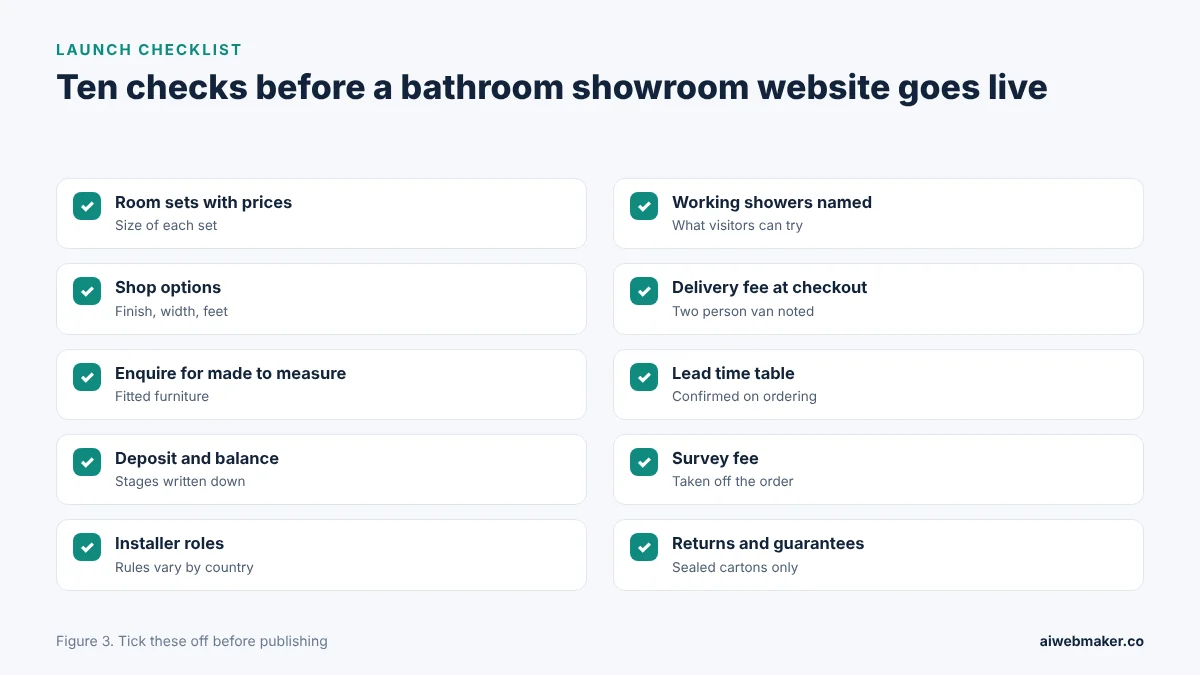
Bathroom buyers leave a showroom's site that shows room sets without a single price or size. A shop without delivery charges or options leaves them guessing what the total will be. Missing lead times worry anyone who has an installer booked or a family relying on one bathroom. Silence about who fits the room, and who to call if a part is missing, suggests problems later. Ten showroom checks pictured below cover each of these weak points.
Frequently asked questions
Are ex display room sets ever sold?
Many showrooms refresh their displays once or twice a year and sell the outgoing pieces as seen at a reduced price. The website can explain how often sets change and invite buyers to ask for the current list. Display pieces may show light wear and often cannot be returned, so the page should say so. Buyers on a budget or with a matching room size can find good value this way. A short note keeps those enquiries coming each season.
What happens if a product is discontinued after ordering?
Makers sometimes withdraw a product between order and delivery, and the showroom's policy should be written on the website. A fair approach is to offer the nearest match at the same price or return the deposit for that piece, as the sample does. The buyer should be told as soon as the showroom knows. Clear terms prevent arguments when the room is half finished. Honest handling of a withdrawn product builds lasting trust.
Will a rainfall shower work with any water system?
Large rainfall heads need enough water pressure and flow, and some home water systems cannot supply them. The website can ask buyers to bring the make of their boiler or water heater to the design appointment. Staff can then suggest shower sets that suit the system. The installer should confirm on site, because water systems differ between homes and countries. A good match avoids a disappointing first shower.
Can sealed pieces be returned?
Most showrooms accept stock pieces still sealed in the maker's carton within a set period, such as the sample's 30 days. Pieces made or cut to order, and anything already fitted, usually cannot come back. Guarantees are set by each maker, and buyers' rights also depend on where they live. The website should state the returns period and the exceptions plainly. Clear rules help buyers order with confidence.
A vanity unit, a towel rail and the hosting they settle
A single wall hung vanity unit at the sample's $540 would cover four full years of the $119 hosting, with money to spare. On the monthly plan, one heated towel rail covers ten $19 payments. A whole room planned at the design desk, roll top bath included, settles more than ten years of hosting in a single order. Room sets described honestly, a shop with clear options and lead times that hold up win buyers who have browsed for weeks. When buyers arrive at the design desk already holding the lead time list, the website has done half the selling.
Build your website in Minutes and get the AI Tools that work
Start Building Your Website →