Luxury Real Estate Agent Website Cost When Discretion Sells the Home
Fine home agencies can hold a polished web presence on $119 yearly, or settle $19 as each month closes, with a domain name picked to match the brass plate. Covered: owners and buyers, the pages, ways to market, commission, vetting, film and plans, appraisals, search and yearly sums.
- No coding required
- Live in minutes
- Blog, SEO and chatbot tools included
Fine home agencies can hold a polished web presence for $119 across the year, or settle $19 as each month closes, with a domain name picked to match the brass plate. Pages on discretion, presentation and private viewings can be refined in the preview until the partners are content, and AI Web Maker bills for none of that refinement. A single commission at the top of the market could pay for the hosting across a lifetime. The challenge is a paradox: the agency must look established and visible online while many of the homes it sells never appear on any website at all. Owners want proof that their privacy will hold, and buyers want proof that the agency has homes worth a long flight. What follows covers owners and buyers, the pages, ways to market, commission, vetting, film and plans, appraisals, search and the yearly budget.
This article is part of our complete guide: Real Estate Website Builder.
Who sells and buys fine homes, and why does privacy weigh so heavily?
Owners of fine homes often have reasons to keep a sale quiet, from public profiles and security worries to family matters they would rather not see discussed. Some live abroad and cannot attend every viewing, while others still live in the house with children and staff. Buyers include people relocating for work, families moving between countries and investors buying through advisers. Many are represented by buying agents, lawyers or family office staff who screen options before the buyer sees anything. Both sides judge an agency by how it handles information as much as by the homes it shows. A website that explains its discretion clearly wins the first conversation.
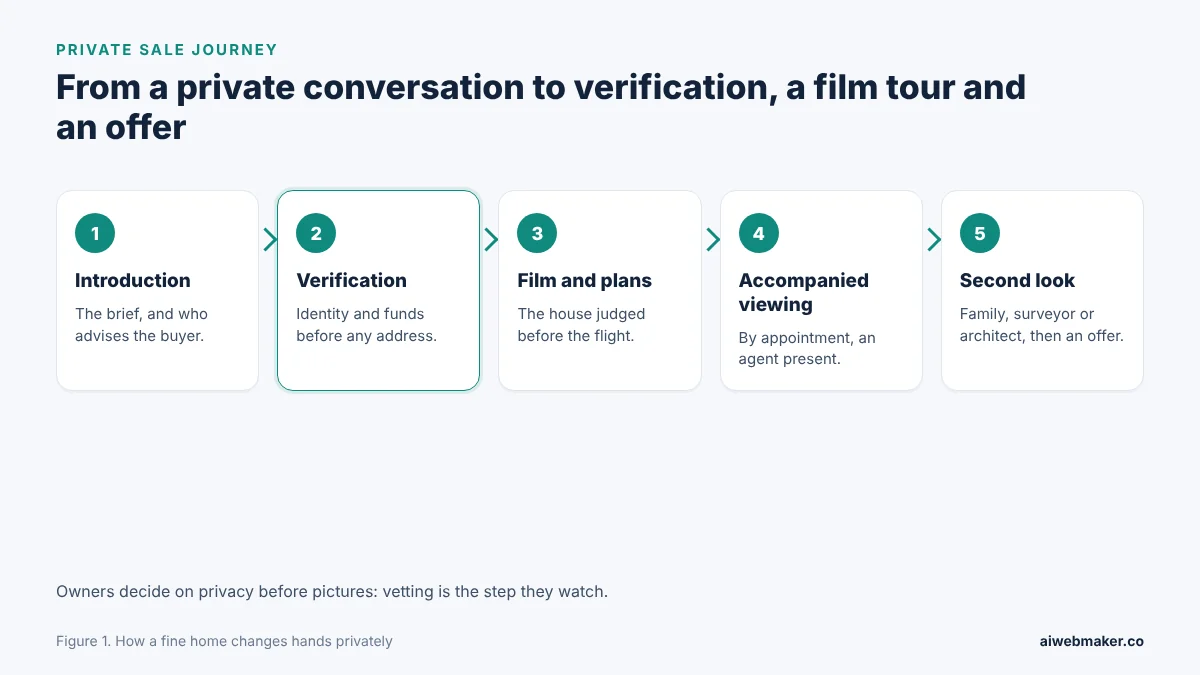
Five steps lead from a first private conversation to a second look and an offer, and the coloured one, verification, is the step that owners care about most. The introduction is a call about what the buyer is looking for and who advises them. Verification follows, with identity and proof of funds checked before any address is shared. A narrated film and measured plans then let the buyer judge the house before travelling. The accompanied viewing and a return visit with family, a surveyor or an architect come only after those checks. An agency site that explains this order reassures owners and saves serious buyers wasted journeys.
Which pages does a luxury agent need when many homes stay unlisted?
A luxury agent's site has to sell the agency rather than the homes, because many of its best houses will never be listed publicly. A discretion page explains how private sales work and who sees what. A presentation page shows the photography, film and plans every home receives, with a gallery of rooms that names no house. A viewings page sets out verification and accompanied visits. An appraisal page invites owners to a conversation, and a buyers' brief page invites buyers onto a private list. A short form that asks for a region rather than an address completes the core.
| Page | Main reader | What it should explain |
|---|---|---|
| Discretion | Owners | Private list, quiet launch, open campaign |
| Presentation | Owners | Photography, film, plans, print |
| Homes | Buyers | Selected homes, area only, by permission |
| Viewings | Buyers and advisers | Verification first, accompanied visits |
| Appraisal | Owners | A written view of the asking price |
| Private conversation | Everyone | Region, timing, how to reach |
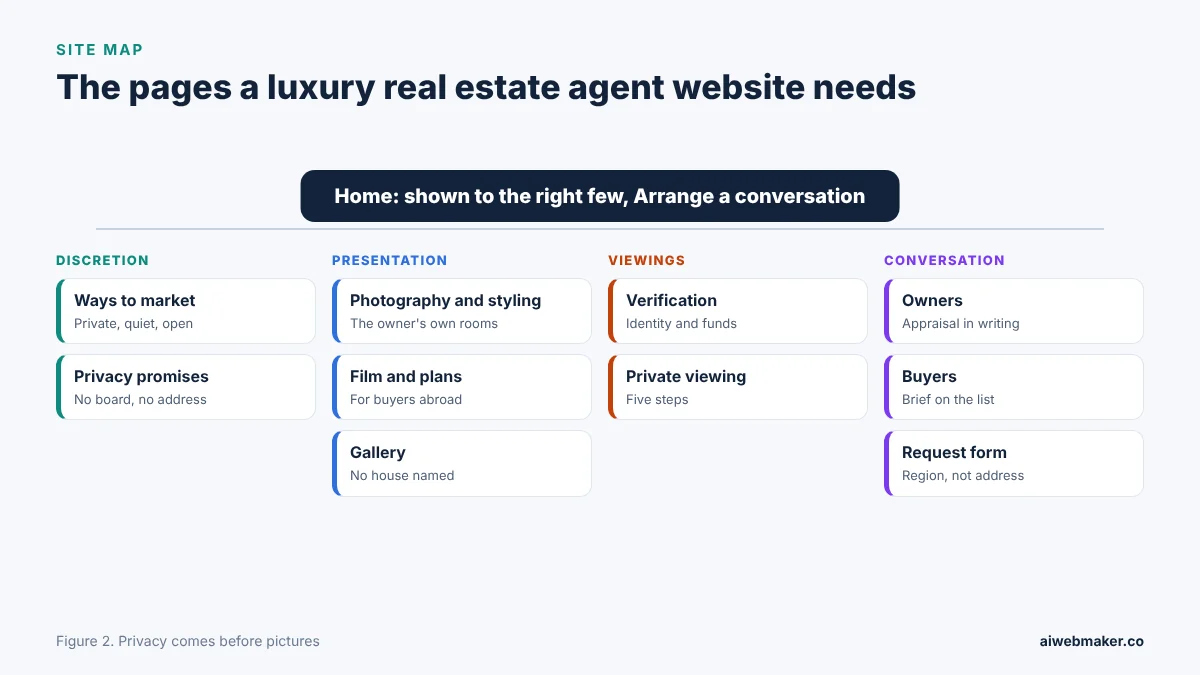
Discretion, presentation, viewings and the first conversation form the four columns, with no house address anywhere on the plan. Halcyon Estates, the fictional agency behind the luxury real estate agent website example built around private sales, opens with two short messages beside a villa: will the house be shown online, and only to buyers the agency has met. A table compares three ways to bring a home to market, a private list, a quiet launch and an open campaign. Six presentation services follow: architectural photography, styling with what the owner already has, a narrated film tour, measured plans, a printed book and live video viewings. Five steps describe a private viewing, from introduction and verification to a second look. The conversation form asks for the kind of home, the region rather than the address, the timing and the best way to reach the visitor. Privacy is visible in every line before a single room is shown.
Private list, quiet launch or open campaign: how should a site explain the choice?
A luxury agent should explain the ways of selling as a scale of exposure, because owners want to choose how public their sale becomes. A private list offers the home only to buyers the agency has met and verified, with the address shared after the owner approves each name. A quiet launch adds advisers who act for buyers and perhaps a private page sent by link. An open campaign uses listings and print to reach the widest field of buyers, usually with the area shown and the address on request. Owners can often move along the scale if the right buyer has not appeared. The AI website builder for luxury agents who sell homes privately drafts the discretion, presentation and viewing pages after the agency explains how it works, and every sentence can be weighed in the preview.
| Way to market | Who hears of the home | Address shared | Trade off |
|---|---|---|---|
| Private list | Verified buyers on the agency's list | After the owner agrees to each name | Privacy over speed |
| Quiet launch | The list plus buyers' advisers | After verification | Reach without broad exposure |
| Open campaign | Anyone, through listings and print | Area shown, address on request | Widest field, least privacy |
What does the commission pay for in a fine home sale?
The commission in a fine home sale pays for presentation, discretion and the agent's time, and owners deserve to see what sits inside it. Most luxury agencies charge a percentage of the sale price, agreed in writing before launch, and a clear site says whether that percentage changes with the way the home is marketed. Presentation is a large part of the work: a full day of architectural photography, styling with the owner's own furniture, a narrated film, measured plans and sometimes a printed book. Verifying buyers, accompanying every viewing and managing staff and family diaries take many hours more. Rules on how agents state their fees differ by country, so the wording should follow local requirements. Owners who understand the work behind the fee rarely haggle over it.
| Presentation item | What it involves | Why it matters |
|---|---|---|
| Architectural photography | A full day, light chosen room by room | First impressions for distant buyers |
| Styling with what the owner has | Moving and removing, not hiring props | The viewing matches the pictures |
| Narrated film tour | The house walked in visiting order | Buyers abroad judge before flying |
| Measured plans | Every floor to scale, grounds plotted | Like for like comparison |
| Printed book | A short run with no address on the cover | A keepsake for serious buyers |
| Live video viewing | An agent carries the buyer room by room | Questions answered before travel |
How should buyer vetting be explained without offending buyers?
Buyer vetting should be presented as protection for everyone, because wealthy buyers expect checks and owners insist on them. The site can explain that the agency confirms identity and asks for proof of funds or a lender's agreement in principle before sharing an address. Estate agents in the United Kingdom and throughout the European Union, among other places, carry anti money laundering duties that require such checks, and the page should say the agency follows the rules where each house stands. Buyers who use an adviser can be told that the adviser may provide the documents. A note that the information is held securely and used only for the sale shows respect. Framed this way, vetting reads as professionalism rather than suspicion.
Why do film tours and measured plans carry more weight at this level?
Film tours and measured plans carry more weight at the top of the market because many buyers live a long flight from the house. A narrated film walked in the order a visitor would move through the rooms tells a buyer how the house flows, while an agent's voice explains light, sound and distance to the nearest village. Measured plans with floor areas let buyers compare homes like for like, and the site should say which measurement standard is used, since standards vary. Honesty matters: views should never be altered, and styled rooms should be described as styled. Aerial footage needs care, since drone rules and neighbours' privacy differ by country and by place. Good film and plans save buyers wasted journeys and owners needless viewings.
How should appraisals and asking prices be discussed online?
An appraisal page should explain that the asking price comes from a written view of the house and of comparable homes, discussed with the owner before launch. At the top of the market, true comparables are scarce, so the page can explain how the agency weighs setting, land, condition and recent sales. It should be clear that an agent's appraisal is not the formal valuation a lender commissions from a qualified valuer, a difference that matters in some countries. Some agencies use guide prices or price on application, and the rules on describing price differ by country. The page should never promise a sale price or a sale date. Calm, evidence based language earns the trust of owners who have been courted by other agents.
What do owners and buyers of fine homes type, and from where?
Owners and buyers of fine homes search with place and type in mind. Typical phrases include country houses for sale in a named county, coastal villa for sale, sell my house privately or luxury estate agent near a named city. Many search from abroad, sometimes in another language, and often through an adviser. Pages on discretion, private sales and buying from overseas, each naming the regions covered, meet those searches without revealing any address. On the office's map listing, appointment hours and a link to the site belong, never street level detail of homes. Reviews from owners and buyers that praise discretion and honest presentation carry weight. Articles on how private sales work or what buyers from abroad should expect bring readers long before they are ready to act.
Does the hosting bill register next to one commission?
For a fine home agency, the web budget is hosting and a domain. Add one article a month on private sales or overseas buying, and AI credits draft the twelve for about $7.80. An established agency usually pays the hosting annually and spends least. A partner setting up a boutique agency might choose monthly billing during the first seasons. Editing the discretion page, adding a gallery image or updating the film tour page carries no fee. The table compares both billing routes and includes the $189 tier strictly as a benchmark.
| Item | Yearly | Monthly |
|---|---|---|
| Hosting the agency pages | $119 | $228 over twelve months |
| Domain | Depends on the ending | Depends on the ending |
| Higher plan, for comparison | $189 a year | Not needed |
| Twelve private sale articles at about $0.65 | About $7.80 | About $7.80 |
| Gallery, film and page updates | No charge | No charge |
| Year before the domain | About $126.80 | About $235.80 |
Why does an owner of a fine home choose another agency?
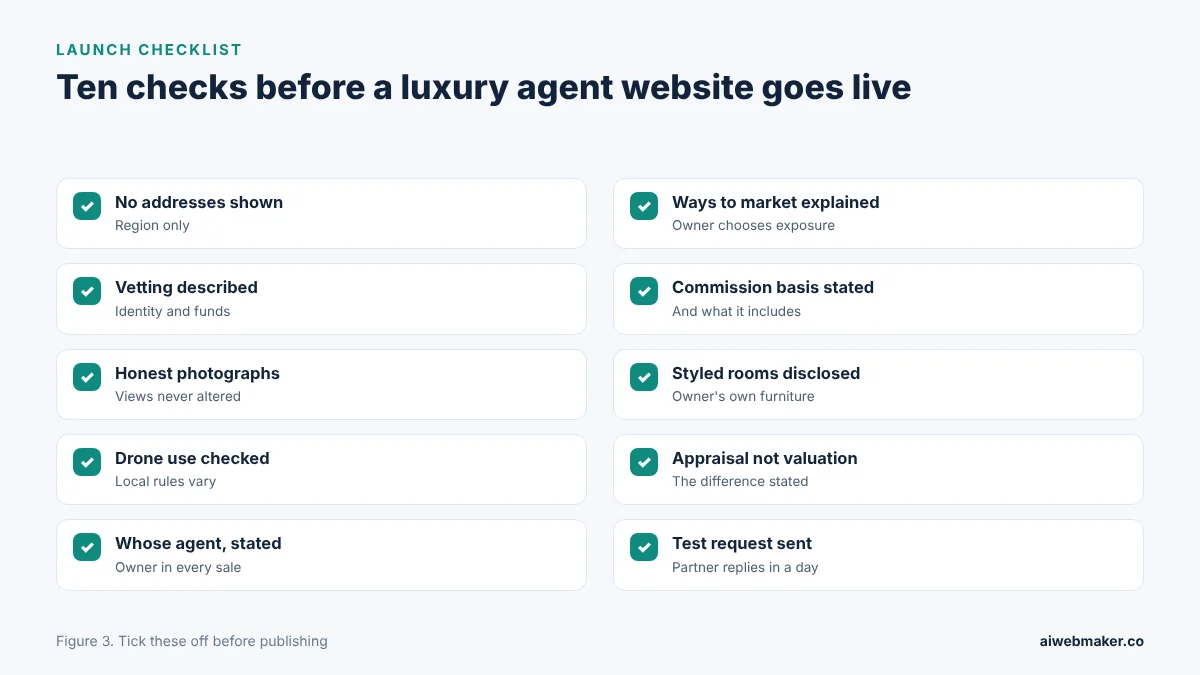
An owner chooses another agency when the website shows addresses, street views or identifiable interiors of homes it has sold, because that suggests their own privacy will not hold. Glossy pages with no explanation of how buyers are vetted leave owners fearing strangers at the door. Over edited photographs with altered skies make careful owners doubt the agency's honesty. No mention of fees or what the commission includes feels evasive at this level. A form demanding a full address before any conversation makes privacy seem an afterthought. The graphic gathers ten launch checks that keep such an owner reading.
Frequently asked questions
Will a privately sold home ever appear online?
Not unless the owner chooses a wider launch, which is the whole point of a private sale. On a private list the home is described only to verified buyers, and the address follows once the owner agrees to each name. A quiet launch may add a private page sent by link, never indexed by search engines if the agency sets it up that way. The owner can widen the search at any time if the right buyer has not appeared. The website should explain these choices so owners feel in control from the first call.
Can a fine home be sold while the family still lives in it?
Most fine homes are sold while the owners still live in them, and the website should say how viewings are arranged around the household. Visits are booked by appointment, an agent is always present and staff can be told as much or as little as the owner wishes. Styling uses the owner's own furniture, so daily life is barely disturbed. Children's rooms and private spaces can be filmed or shown only if the owner agrees. Clear arrangements make a sale bearable for the people living through it.
Who owns the photographs and film once the house is sold?
Who owns the images turns on the agency's terms and the copyright rules of the country where they were made, so the agreement should spell it out. Many owners ask for the images to be removed or deleted after the sale, and a discreet agency agrees. Some owners keep the printed book as a record of the house. The website can promise that images go only to approved buyers and are taken down on request. That promise reassures owners who fear their home circulating for years.
Does a luxury agent act for the buyer as well?
In most sales the agent acts for the owner, even when it keeps a private list of buyers, and the website should state that without hedging. Buyers who want representation of their own can bring a buying agent or adviser, and many do at this level. Rules on dual representation vary by country and by state, so any exception needs disclosure and consent under local rules. Clear statements about whose agent the agency is prevent misunderstandings during negotiation. Honest roles protect the agency's reputation with both sides.
What a single fine home commission does to the hosting sum
One completed sale at the top of the market earns a commission that would cover the $119 hosting fee for longer than any agency is likely to exist. On the monthly plan, the $19 costs less than the flowers arranged in the hall before one viewing. Each owner who instructs the agency after reading how private sales work is a listing that rivals never see. Clear discretion, honest presentation and vetting explained with respect persuade owners who could choose any agent in the region. Agencies that keep their gallery anonymous and their guidance current become the name advisers recommend quietly. Conversation requests that arrive with a region, a timing and an adviser named show the site is drawing exactly the right few.
Build your website in Minutes and get the AI Tools that work
Start Building Your Website →