Land for Sale Website Cost and the Paperwork Plot Buyers Check First
Plot sellers can run a full land website for $119 yearly, or $19 at each month's end, adding a domain of their choice. Topics: buyers, pages, instalments, title documents, transfer costs, site visits, buyers abroad, search and the annual sums.
- No coding required
- Live in minutes
- Blog, SEO and chatbot tools included
Plot sellers can run a full land website on $119 of hosting for the year, or on $19 at each month's end, adding a domain of their choice. Plot cards, the documents section and the instalment table can be corrected in the preview until every figure is right, without a charge from AI Web Maker for any of those corrections. The deposit on one small residential plot exceeds the yearly hosting. The real challenge is fear: land fraud, double sales, missing beacons and titles that turn out to belong to someone else have made buyers in many countries deeply cautious, and buyers living abroad most of all. A land company's website has to show its paperwork before it asks for money, and price its payment plans so nobody feels tricked later. Covered next: buyers, pages, instalments, title documents, transfer costs, site visits, buyers abroad, search and the annual arithmetic.
This article is part of our complete guide: Real Estate Website Builder.
Who buys a plot, and what keeps them awake at night?
Plot buyers range from young families saving for a first house to farmers adding acres and relatives working abroad who want land back home. Many are buying the largest thing they will ever own, often with savings gathered over years. Investors look for plots near new roads or towns that are growing. Farmers ask about soil, water and seasons before they ask about price. Almost every buyer fears the same thing: paying for land that the seller does not own, or that someone else has also paid for. A website that answers that fear with documents and visits wins buyers that a glossy brochure never could.
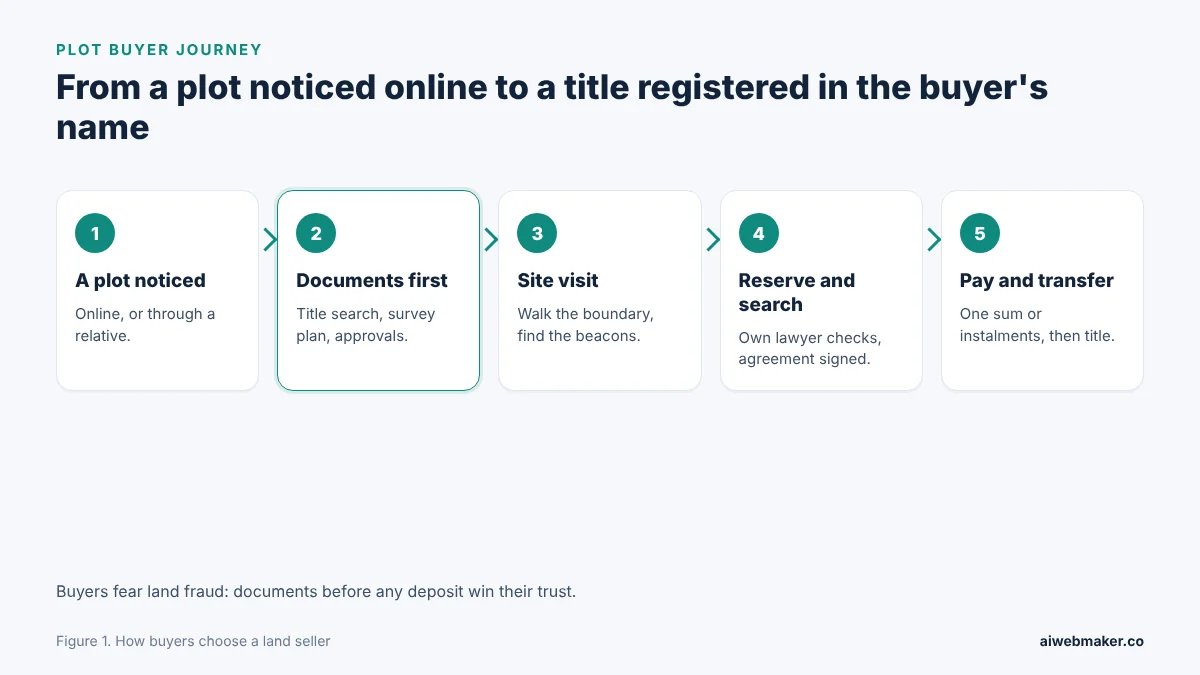
The shaded step in this five step path is the documents check before any deposit, because it decides whether a cautious buyer goes further. It starts when a plot catches the eye online or through a relative's recommendation. Before booking a visit, the buyer wants to see the title search, the survey plan and the approvals. A guided site visit follows, where the buyer walks the boundaries and finds the beacons on the ground. Reservation, the buyer's own searches and a written agreement come next, then payments in one sum or by instalments. The journey ends only when the title is registered in the buyer's name and the original documents are handed over.
Which plot pages and documents does a land company need online?
Compared with a housing developer, a land company runs a lean site, yet every page must be specific enough to survive a lawyer's reading. A plots page lists each kind of plot with its size, location, access, utilities and full price. A documents page explains what has been checked before listing, and an instalments page shows a worked example with every charge. A buying steps page sets out the order from visit to transfer, and a checklist page tells buyers what to verify on any plot, from any seller. A site visit request page, with the days and meeting point, completes the core.
| Page | What buyers look for | What it should state |
|---|---|---|
| Plots for sale | Size, place, price | Area in two units, access, water, power, zoning |
| Documents | Proof the land is real | Title search date, survey plan, approvals |
| Instalments | An affordable route | Deposit, payments, total, when title passes |
| Buying steps | What happens next | Visit, reserve, searches, agreement, transfer |
| Buyer checklist | What to verify anywhere | Ten checks, own lawyer advised |
| Site visits | A chance to walk it | Days, meeting point, no deposit on the day |
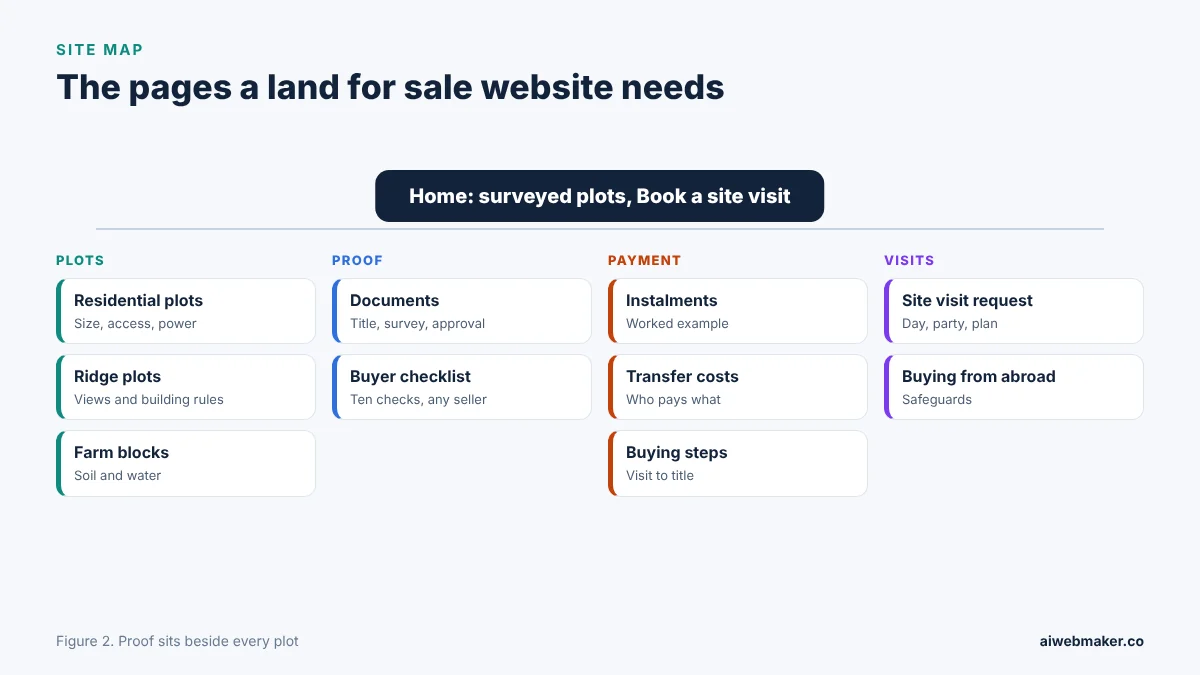
Plots, proof, payment and visits are the four arms of this plan, all reachable from the opening view. Greenacre Land Company, the fictional seller behind the land for sale website example with titles searched before listing, opens with surveyed plots and paperwork in order, backed by ticks for title searches, pegged beacons and confirmed road access. Three kinds of plot follow: eighth acre residential plots, half acre plots on the ridge and five acre farm blocks, each with its size, setting and full price. A documents section explains the title search, survey plan and subdivision approval, and a worked table compares paying at once with plans over 12 and 24 months. A list of ten checks for any plot, from any seller, sits before six steps from a site visit to a title in the buyer's name. The request form asks which plots interest the visitor, the preferred visit day, how many are coming, how they might pay and whether they are buying from abroad. Every element puts proof ahead of persuasion.
How should instalment plans be priced and explained?
Instalment plans sell land that buyers could not otherwise afford, but they also create most of the disputes, so the website must spell out every number. A worked example should show the deposit, each payment, the number of payments and the total, with any charge for paying over time stated as a fixed sum rather than hidden. The page must say who holds the title until the last payment clears and how the plot is reserved for the buyer in the meantime. What happens if a payment is missed, including any grace period and any refund, belongs in plain words before anyone signs. Some countries treat instalment sales of land as credit, with their own disclosure rules, so the agreement should follow the law where the land sits. Receipts for every payment and a regular statement keep long plans calm.
| Plan | Paid at the start | Then | Title passes |
|---|---|---|---|
| Full payment | A reservation deposit | Balance within a set number of days | On completion |
| Shorter plan | A larger deposit | Equal monthly payments over a year | When the last payment clears |
| Longer plan | A larger deposit | Smaller payments over two years | When the last payment clears |
| Any plan | Fixed charge for time, if any | Statement every month | Original documents handed over |
Which documents prove a plot is real, and when should buyers see them?
Buyers should see every key document before paying a deposit, because a deposit paid on a doubtful title is the hardest money to recover. The title search shows who owns the land and whether the register records any charge, caution or dispute, and it should be recent when the buyer reserves. A survey plan prepared by a licensed surveyor, with a beacon at each corner, lets the buyer match the paper to the ground. Subdivision approval and a clearance of land rates, where the country requires them, prove the plot can be sold as offered. The names differ widely: a title deed, a certificate of title or a lease from the state, and a deed plan, a mutation or a cadastral survey. Every page should urge buyers to have their own lawyer check the documents independently.
| Document | What it shows | What the buyer should check |
|---|---|---|
| Title search | Owner and any charges or disputes | Seller's name, date of search |
| Survey plan | Boundaries and area | Beacons on the ground match the plan |
| Subdivision approval | The plot may exist as offered | Approval from the local authority |
| Zoning or land use | What may be built or farmed | Matches the buyer's plans |
| Rates clearance | Local land charges paid | Required before transfer in some places |
What do transfer costs add to the plot price?
Transfer costs can add a noticeable share to the plot price, and buyers who discover them late feel misled even when the seller did nothing wrong. Depending on the country, the buyer usually pays transfer tax or stamp duty, registration fees and their own lawyer, while the seller often pays for the survey and the title search. Valuation for tax purposes, consent from a land control body or a rates clearance may add steps and fees in some places. The website should list these costs by name, explain who usually pays each and promise to set out the amounts in writing before reservation. It should not quote one country's rates as universal. A buyer who budgets correctly from the start completes the purchase instead of stalling at transfer.
How should site visits be run and offered online?
Site visits close land sales, because no photograph replaces walking a boundary and finding the beacons yourself. A land company can run guided visits on set days, leaving from the office at fixed times, with transport offered to buyers without a car. The visit page should say what to bring, such as sturdy shoes, water and a hat, and how long the walk round a larger block takes. It should also say clearly that no deposit is taken on the day, which removes the fear of being pressured in a field. The AI website builder that drafts plot listings and site visit pages for land sellers produces the plots, documents and visit pages once the company describes its land, with every price and plot size open to correction in the preview. A calm, well run visit is the strongest proof a land seller can give.
How can a land seller reassure buyers living abroad?
Buyers living abroad are among the most valuable land customers and the most exposed to fraud, since they cannot visit easily and often rely on relatives. A website can reassure them by sending documents before any deposit, encouraging an independent lawyer in the country where the land sits and stating that payments go only to the company's own account, never to an individual. Some countries limit land ownership by foreign citizens or allow only a lease, so the site should tell buyers to check the rules for their nationality before reserving. Monthly statements and receipts for each payment matter even more when the buyer is far away. Inviting a trusted relative or the buyer's own surveyor to the site visit adds a further layer of comfort. Clear safeguards turn distant interest into completed sales.
What do plot buyers type when searching from near and far?
Plot buyers type the size, the place and the proof they need. Common phrases include eighth acre plots for sale near the town, farm land with title, plots on instalments or land for sale with road access. Buyers abroad often add their home country or ask about buying land from overseas. Headings that repeat those words, with the district and nearest town, put each plot page in front of the right searcher. The map listing for the sales office should carry its hours, the site visit days and a link to the plots. Reviews that mention beacons found exactly where the plan placed them carry more weight than any advert. Articles explaining title searches, survey plans and transfer costs attract careful buyers months before they commit.
Is a year of hosting more than one plot deposit?
The standing costs of a land website are hosting and a domain, and a monthly guide on documents or buying steps drafted with AI credits brings about $7.80 over the year. Sellers with regular plot sales keep costs lowest by paying the hosting yearly. A new land company still selling its first subdivision may prefer twelve smaller payments. Adding plots, marking them sold or changing instalment examples never adds to what is owed. Below, yearly and monthly billing are laid out with the $189 tier for comparison only.
| Item | Yearly | Monthly |
|---|---|---|
| Hosting the plot and document pages | $119 | $228 over twelve months |
| Domain | Depends on the ending | Depends on the ending |
| Higher plan, for comparison | $189 a year | Not needed |
| Twelve land buying guides at about $0.65 | About $7.80 | About $7.80 |
| Plot, price and sold updates | No charge | No charge |
| Year before the domain | About $126.80 | About $235.80 |
Why does a wary buyer close a land seller's page?
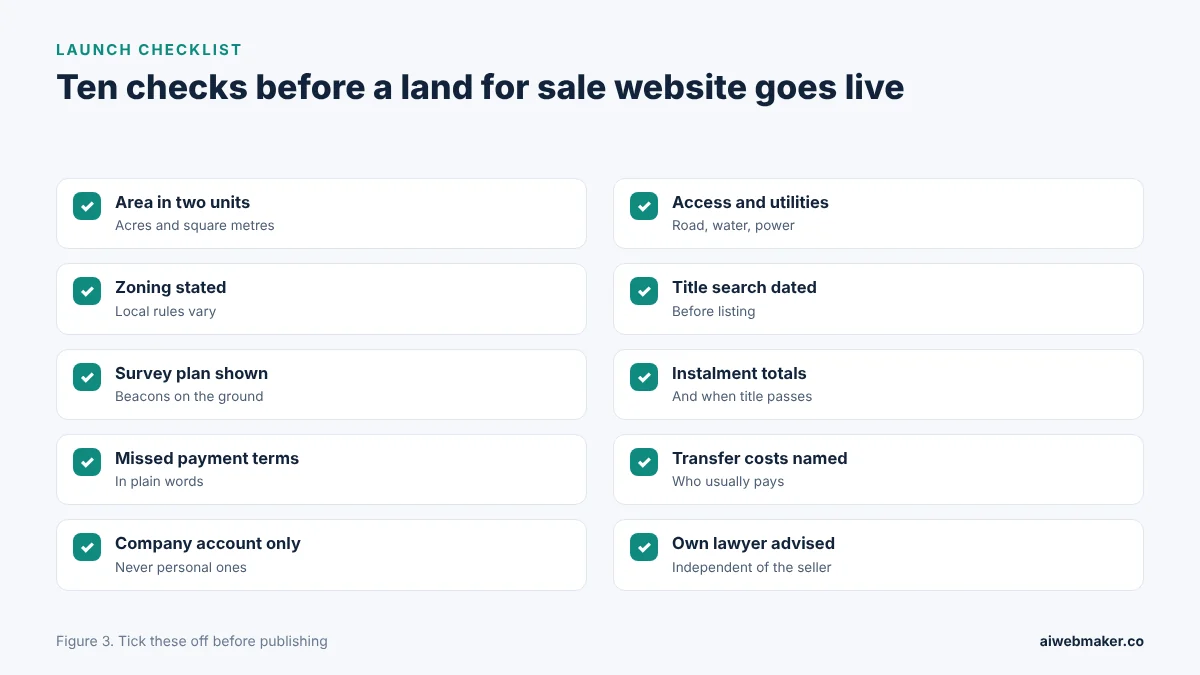
A wary buyer closes the page when plots carry prices but no word on titles, surveys or approvals, because that silence looks exactly like the frauds they have heard about. Instalment offers with no total, or no statement of when the title passes, suggest hidden charges. A request for a deposit before any documents are shown ends the conversation for many careful buyers. Vague locations, with no access road or water source named, make the plot feel unreal. No mention of transfer costs leaves buyers suspecting a second bill. Ten checks, set out in the launch graphic, address every one of these warning signs.
Frequently asked questions
Who holds the title while instalments are being paid?
In most instalment sales the title stays in the seller's name until the last payment clears, and the sale agreement records that the plot is reserved for that buyer alone. How strongly that protects the buyer depends on the law where the land sits, so an independent lawyer should explain it before signing. Some systems allow a caution or similar note on the register to warn others of the buyer's interest. The website should describe the arrangement in general terms and urge buyers to take advice. Clarity on this point prevents most instalment disputes.
Can a house go up as soon as a plot is bought?
A house can be built only within the zoning and with the permits the local planning office requires, which differ by country and district. A seller can show the zoning of each plot, but building plans are approved by the authority, not the seller. Water, power and access also shape how soon building can start. Buyers should check these points before buying if they plan to build quickly. Honest guidance here avoids disappointment after transfer.
What happens if an instalment payment is missed?
The sale agreement should set out what happens, including any grace period, any charge and what is refunded if payments stop for good. A seller that invites buyers to call early usually agrees a short delay in writing. The website should summarise the policy in plain words and point buyers to the full clause. Buyers should read that clause with their lawyer before signing. Fair, visible rules on missed payments make long plans feel safe.
Can buyers bring their own surveyor to the site visit?
Buyers should be welcome to bring their own surveyor, and a confident seller will say so on the website. An independent surveyor can confirm that the beacons match the survey plan and that the area is as stated. The cost of that check is the buyer's, but it is small next to the price of the land. Sellers who encourage independent checks signal that they have nothing to hide. That openness often closes the sale.
How quickly does one plot sale cover the hosting?
The deposit on a single residential plot usually exceeds the $119 that a land seller pays to host its site for the year. A single buyer's instalment dwarfs the $19 that monthly billing asks. Each plot sold to a buyer who trusted the documents page funds many seasons of hosting, and satisfied buyers bring relatives and neighbours. Documents shown before deposits, honest instalment totals and transfer costs named in advance persuade buyers who have been warned about land fraud. Sellers who mark plots as sold promptly and keep the documents page current earn a reputation that spreads by word of mouth. Visit requests that arrive with plots chosen and a payment plan in mind show the pages are preparing buyers well before the Saturday walk.
Build your website in Minutes and get the AI Tools that work
Start Building Your Website →