Commercial Real Estate Website Cost and Listings Tenants Can Compare
A commercial brokerage's pages cost $119 to host through the year, or $19 billed monthly, and the web address is purchased on top. Covered: who searches, the pages, occupancy costs, fees and conflicts, lease terms, requirements, market notes, search and the yearly sums.
- No coding required
- Live in minutes
- Blog, SEO and chatbot tools included
Twelve months of hosting for a commercial brokerage cost $119, or $19 on each monthly invoice, with the web address purchased on top. Listings, lease explainers and the requirement page may be redrafted in the preview through any number of rounds, and AI Web Maker attaches no fee to those rounds. A single letting fee on a small office suite outweighs the year's hosting many times over. The real test is different: occupiers compare total occupancy cost, not headline rent, and a listing that hides the service charge or the lease length wastes everyone's viewing morning. Landlords, meanwhile, judge a broker by how well its pages present their space and how many live requirements it holds. Ahead: who searches, the pages, occupancy costs, fees and conflicts, lease terms, requirements, market notes, search and the yearly budget.
This article is part of our complete guide: Real Estate Website Builder.
Who hunts for offices, shops and warehouses, and what do they arrive with?
Commercial visitors arrive with numbers rather than dreams, and the site must speak in those numbers. A growing company knows its headcount, the district it wants and the date its current lease ends. A retailer wants a frontage, footfall and a use class or zoning that allows its trade. A logistics firm asks about eaves height, dock doors, yard space and access to main roads. Landlords with empty floors want to see how a broker markets space and who is already looking. Investors read the lease lengths, tenants and yields before the photographs.
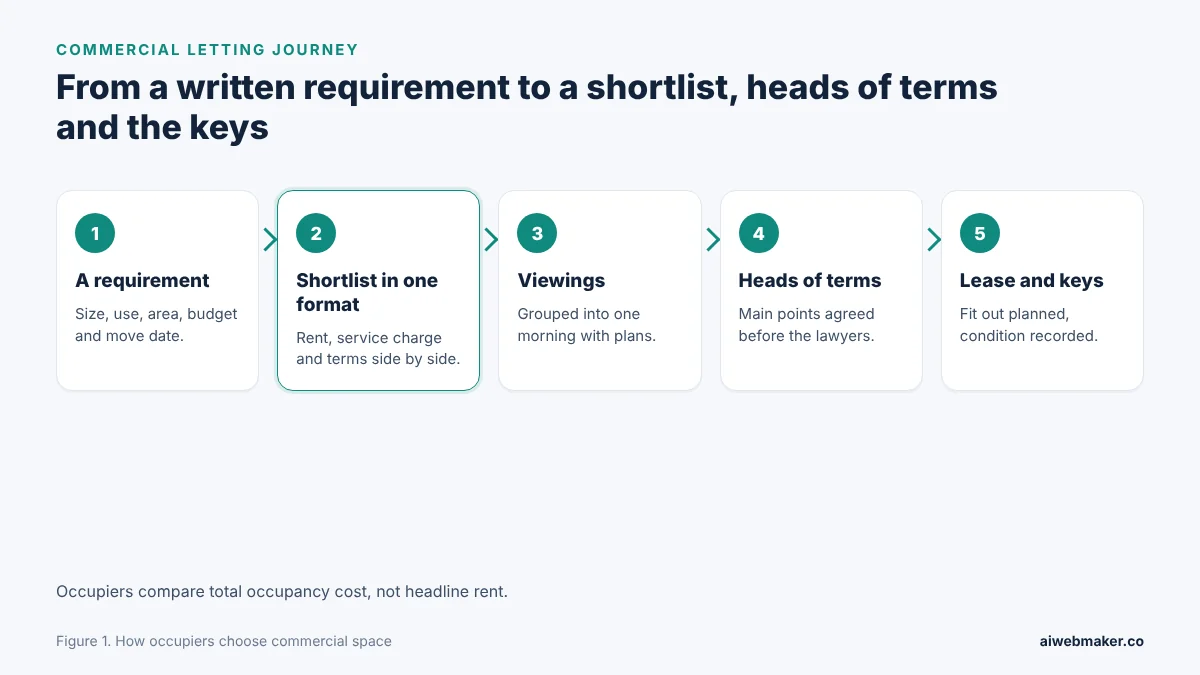
Requirement to keys is the path drawn here, and the shortlist in one format is coloured because that is where a broker proves its value. The first step turns a vague need into a brief covering size, use, area, budget, lease length and move date. The shortlist then sets every building out the same way, with rent, service charge and the main lease terms side by side. Viewings are grouped into one morning where the buildings allow. Heads of terms record the main points of the deal before lawyers draft the lease, and the keys arrive with a record of condition. A site that explains these steps shows tenants and landlords alike that the broker runs an orderly process.
Which listings and briefs belong on a commercial broker's site?
A commercial broker's site needs listings that read like data sheets, because occupiers shortlist on size, cost and terms before they ever visit. Each listing should give the area in square feet and square metres, the asking rent and what it excludes, the lease available and the approved use. A requirement page invites tenants to describe what they need, since good space is often never advertised. A lease terms page and short market notes show expertise that landlords and investors look for. A clear fee and conflicts page, plus a form for both occupiers and owners, completes the structure.
| Page | Main reader | What it should state |
|---|---|---|
| Space available | Tenants and buyers | Area in two units, asking rent, exclusions, use |
| Investment for sale | Investors | Tenants, lease lengths, rent, asking price |
| Send a requirement | Tenants | Size, use, area, budget, move date |
| Lease terms | Tenants and landlords | Reviews, breaks, repairs, service charge |
| Market notes | Investors and owners | Yields, service charges, fit out choices |
| Fees and conflicts | Everyone | Who pays, on what basis, disclosed in writing |
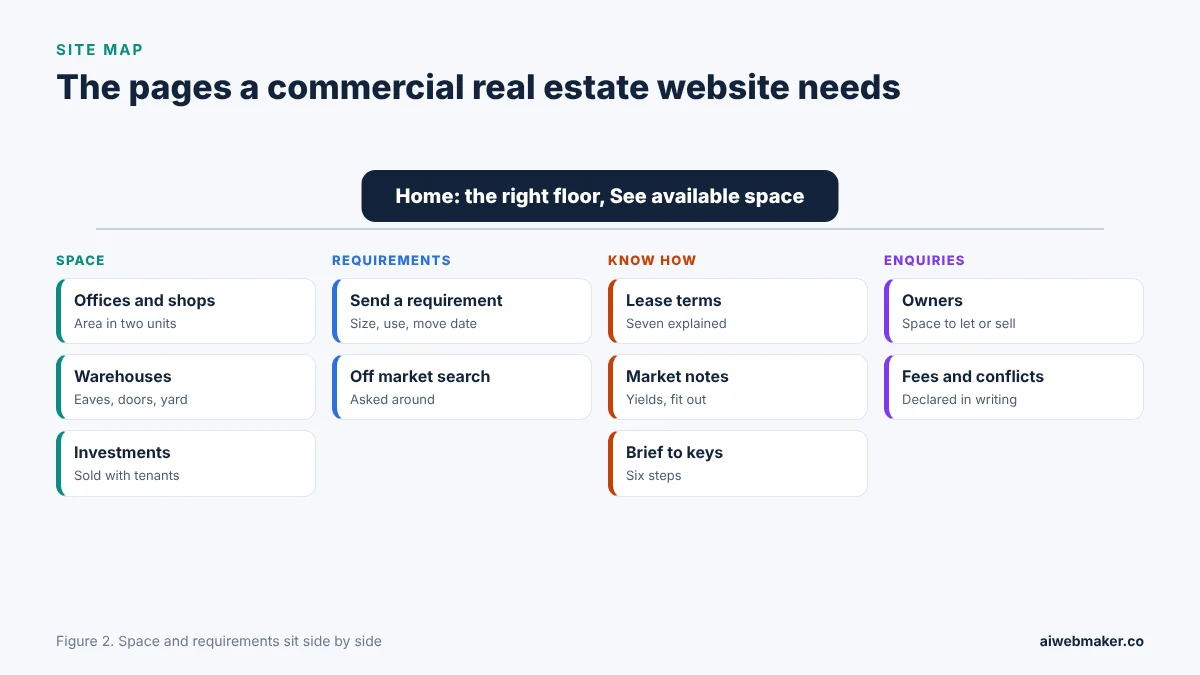
Space, requirements, know how and enquiries split this plan into four lanes. Ironbridge Commercial Property, the invented broker behind the commercial real estate website example with lease terms explained, promises the right floor on a lease the tenant understands. Its listings include a second floor in a former print works, a corner shop on the high street, a distribution warehouse by the ring road, a ground floor clinic or office suite, a terrace of four trade counter units and a parade of three shops sold with tenants in place. A section invites occupiers to send the brief before the address, and a dark table explains seven lease terms, from rent review and break options to incentives and security. Six steps run from the first brief to the keys, and three market notes cover yields, service charges and fit out choices. The form asks who is writing, the type of space, rough size, area and the date it is needed. Tenants and owners each find their own door within a single scroll.
How should a listing show what the space really costs?
A listing should show what occupying the space will cost each year, because the asking rent is only one line of the bill. Service charges cover cleaning, lifts, security and the shared parts of a building, and they vary widely between buildings that look alike. Property taxes are usually paid by the occupier, under names such as business rates in the United Kingdom or property tax passed through a net lease in the United States. Insurance, sales tax where it applies, fit out and a rent deposit add further sums. The listing should say plainly which of these the asking rent excludes. Brokers who present costs this way save their clients from expensive surprises and earn repeat instructions.
| Cost line | What it covers | How to show it |
|---|---|---|
| Asking rent | Use of the space | Per square foot or metre, or per year |
| Service charge | Running the shared building | Budget per year, last year's accounts on request |
| Property taxes | Local taxes on the premises | Who pays, and the local name |
| Insurance | The building and the occupier's contents | Whether recharged by the landlord |
| Sales tax | Tax on rent, where it applies | Whether added to the figures |
| Fit out and deposit | Making the space usable, security | Shell, finished floor or contribution |
Who pays the broker, and how should conflicts be declared?
Commercial brokers are paid by whoever instructs them, and the site should say so before any confusion arises. A landlord or seller usually pays when the broker lets or sells their property, often as a share of the first year's rent or of the price. A tenant or buyer pays when the broker searches on their behalf, sometimes through a retainer with a success fee. Conflicts arise when a tenant's shortlist includes a building the same broker is letting, and both sides should be told in writing before a viewing. Licensing for brokers differs by country and, in the United States, by state, while in other places professional bodies set the standards. A fee and conflicts page written in plain words removes the suspicion that hangs over many property deals.
| Instruction | Who usually pays | Common fee basis | What to disclose |
|---|---|---|---|
| Letting a property | Landlord | Share of first year's rent | Fee agreed in writing first |
| Selling a property | Seller | Share of the price | Any interest in the buyer |
| Searching for space | Tenant | Retainer, success fee or both | Buildings the broker also lets |
| Buying for an investor | Buyer | Share of the price or fixed fee | Other clients bidding |
Which lease terms deserve plain explanations before heads of terms?
Lease terms decide what a space really costs over its life, and tenants who sign without understanding them often regret it. A rent review clause sets how the rent can change, through fixed steps, an index or a review to market level. A break option lets one side end the lease early, but only if every condition is met on the day. Repair clauses can put the whole structure on the tenant, which is why a record of condition matters. Incentives such as months without rent or a fit out contribution may have to be repaid if a break is used. A broker's site that explains these terms in general language, while noting that wording and law differ by country, shows the care that tenants want.
How can a requirement page work as a second set of listings?
A requirement page works as a second set of listings because much good commercial space changes hands before it is ever advertised. A tenant planning to leave early, a landlord willing to split a floor or an owner open to an offer may only surface when a broker asks around. Inviting occupiers to register size, use, district, budget and move date lets the broker search the market on their behalf. Landlords, in turn, are drawn to a broker who clearly holds live requirements. The AI website builder that drafts listings and a requirement page for commercial brokers assembles the listing, lease and requirement pages after the broker describes its patch and its deals, and every rent and area can be proofread in the preview first. Requirements kept confidential, with a reply time stated, turn this page into a steady source of instructions.
What should market notes explain without forecasting rents?
Market notes should explain how deals work rather than predict where rents or values will go, because forecasts age badly and can be mistaken for investment advice. A note on yields can show how a building's rent compares with its price, and why two buildings on the same yield may carry very different risks. A note on service charges can explain why budgets differ and how to compare them fairly. A note on fit out can set out the trade between a bare shell, a finished floor and a landlord's contribution. Each note should say that it is general information, not investment, tax or legal advice. Steady, practical notes build the authority that wins landlord and investor instructions.
What do occupiers and investors type when hunting for space?
Occupiers type the use and the place together. Typical phrases include office to let near the station, warehouse with dock doors, retail unit on the high street or clinic space with parking. Investors search for phrases like commercial property for sale, retail parade investment or warehouse sold let. Listing pages titled with the use, the size and the district meet those searches directly, and expired listings should be marked as let rather than deleted. The map listing for the office should carry hours, viewing arrangements and the website link. Reviews from tenants and landlords that mention clear costs and declared conflicts carry particular weight. Notes on lease terms and service charges draw readers who will need a broker within the year.
How does the hosting bill compare with one letting fee?
A brokerage pays for its pages through hosting and a web address, plus around $7.80 if a lease or market note is drafted on AI credits every month. Brokers with a regular flow of lettings keep the hosting cheapest by paying annually. A broker setting up a new desk may find monthly payments gentler while the first instructions arrive. Adding listings, marking space as let or rewriting a lease note costs nothing more. The table below sets yearly against monthly billing and parks the $189 tier on a reference row.
| Item | Yearly | Monthly |
|---|---|---|
| Hosting the commercial property pages | $119 | $228 over twelve months |
| Domain | Depends on the ending | Depends on the ending |
| Higher plan, for comparison | $189 a year | Not needed |
| Twelve lease and market notes at about $0.65 | About $7.80 | About $7.80 |
| Listing, let and note updates | No charge | No charge |
| Year before the domain | About $126.80 | About $235.80 |
Why does an occupier leave a broker's site for the next one?
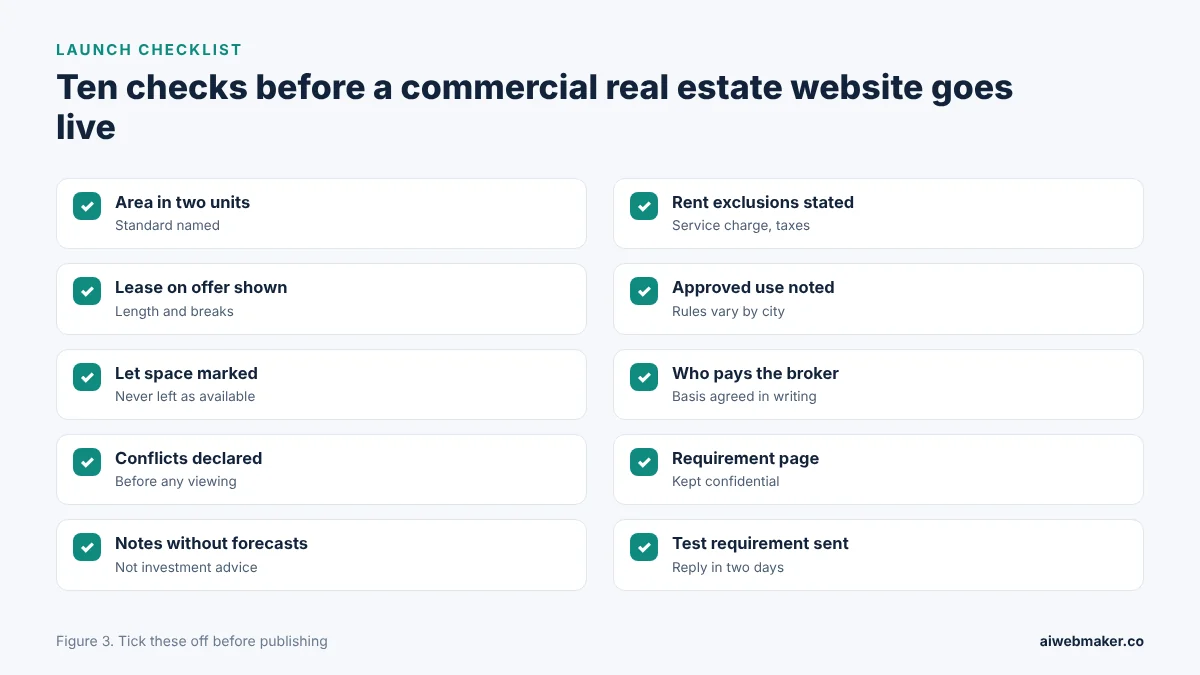
Occupiers leave a broker's site when listings give a rent but say nothing about the service charge, the property taxes or the lease length. Areas in a single unit, with no note of the measurement standard, make comparison impossible. Space shown as available that was let months ago destroys trust in every other listing. A site that never mentions who pays the broker leaves tenants wondering whose side it is on. Landlords leave too when they see no sign of live requirements or market knowledge. These ten checks, pictured in the graphic that follows, are written to stop each of those departures.
Frequently asked questions
How is floor area measured on commercial listings?
Floor area is measured to the standard the local market uses, and those standards differ between countries and between offices, shops and warehouses. Some markets quote net internal area, others gross or rentable area, and the difference can be significant. A listing should say which standard applies and give the figure in both square feet and square metres where readers use both. Two buildings described in different ways may not compare directly. Stating the standard prevents disputes after a lease is signed.
Is it wise to print asking rents on each listing?
Printing asking rents helps occupiers shortlist quickly and filters out enquiries from those with a different budget. The figure should state whether it is per square foot or per year and what it excludes, such as service charge, property taxes and sales tax. A note that rents are open to negotiation keeps landlords' options open. Some landlords prefer rent on application, and a broker can agree that case by case. Clear figures generally bring better qualified viewings.
What should happen to a listing once the space is let?
A let listing is better marked as let than deleted, because it shows the broker's track record and keeps a page that search engines already know. The page can note the type of tenant, in general terms and with permission, and the time taken to let. Space that is under offer should be labelled so occupiers do not waste a call. Keeping availability accurate every week is essential, since one stale listing undermines all the others. Accurate status labels are one of the clearest signs of an active desk.
Can a broker act for both landlord and tenant?
A broker can sometimes act for both, but only with full disclosure and the consent of both sides, and local rules may restrict it. The usual case is a tenant whose shortlist includes a building the same broker is letting. Both parties should be told in writing before a viewing and asked whether they are content for the broker to continue. If either objects, one of them can be referred to another broker. Handling this openly protects the broker's reputation more than any single fee.
What one letting returns on a year of brokerage hosting
One modest letting, even a small trade counter unit, typically earns a broker far more than the $119 its site needs for twelve months of hosting. Paid by the month, $19 is smaller than the parking bill for one viewing morning. Every requirement registered through the site is a potential search fee, and every landlord impressed by the listings is a potential instruction. Listings that show the true occupancy cost, fees stated in writing and lease terms explained plainly persuade both sides of the market. Brokers who keep availability current and add steady market notes become the desk landlords call first. Requirements that arrive with headcount, budget and lease end date spelled out mean the pages are qualifying deals before the phone rings.
Build your website in Minutes and get the AI Tools that work
Start Building Your Website →