Warehouse Storage Website Cost and the Rate Card Sellers Compare
Warehouse storage sites need $119 for a twelve month hosting term, or $19 each month, and a domain is chosen separately. Covered: which sellers need space, the pages needed, rate cards, storage types, goods in, cut offs and reports, special goods, search and the yearly budget.
- No coding required
- Live in minutes
- Blog, SEO and chatbot tools included
Twelve months online for a warehouse storage website come to $119, or operators can pay $19 monthly as pallets come and go, and a domain is chosen separately. Drafting the rate card, the storage options and the quote form, and refining them in the preview, comes before any charge from AI Web Maker. A few weeks of rent on a handful of pallets covers the year, so hosting is a trivial line in a warehouse budget. The real challenge is that sellers moving stock to a third party are handing over the goods they live on, and they fear hidden charges, slow dispatch and stock that goes missing between counts. A warehouse website has to prove, before any visit, that every charge is listed, every unit is counted and every order leaves on time. Ahead are the clients who need space, the pages they expect, rate cards, storage types, goods in, cut offs and stock reports, special goods, search and the yearly budget.
This article is part of our complete guide: Professional Services Website Builder.
Which sellers and importers go looking for pallet space?
Sellers and importers look for warehouse space when stock outgrows a garage or back room, or when dispatch eats the hours meant for selling. Online sellers want pick, pack and dispatch so that orders leave the same day without hiring packers. Wholesalers and importers need pallet storage near ports or main roads, often with container unloading. Manufacturers use third party storage for overflow and seasonal peaks. Each client compares rates, cut off times, stock visibility and the security of the site. Most shortlist two or three warehouses from their websites before asking anyone to quote.
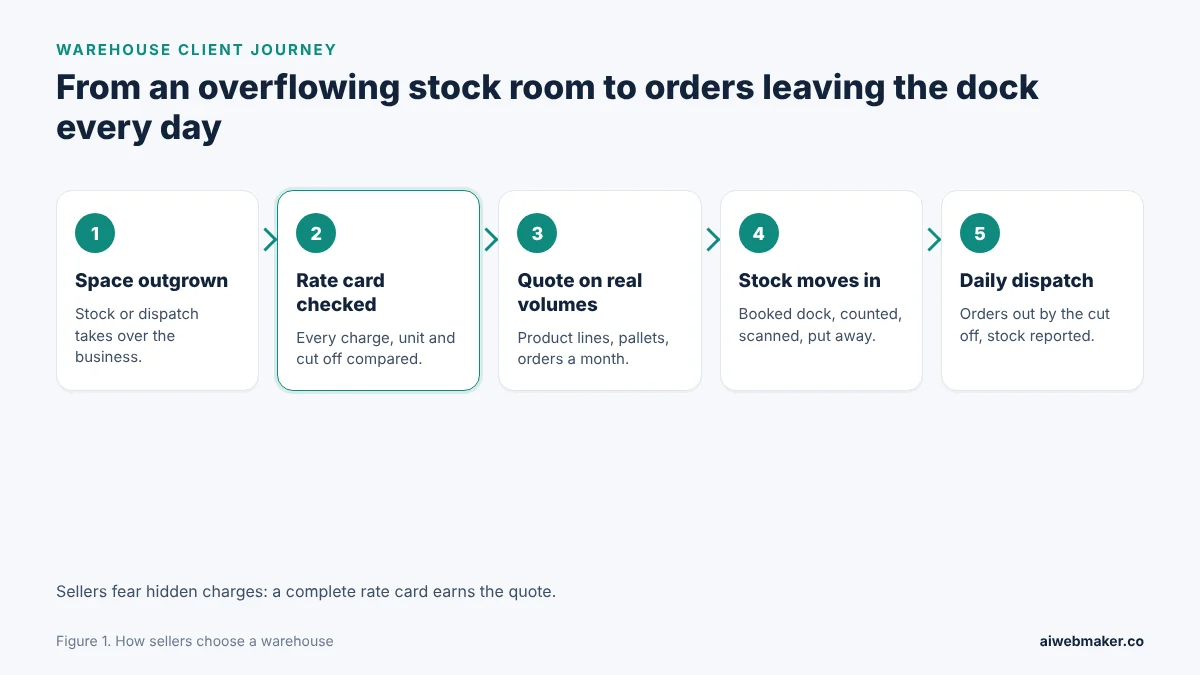
Tracing a client from a crowded stock room to daily dispatch, the five stages show where a warehouse website persuades and where it can lose a seller. Outgrown space is the trigger, often around a busy season or a new product launch. The highlighted stage is the rate check, because sellers compare rate cards line by line before they share their volumes. A quote built from real volumes follows, and onboarding brings the product list and the first booked delivery. Daily dispatch and stock reports then decide whether the client stays for years or leaves after a quarter. A clear page for each stage removes the doubts that slow a seller's decision.
What should a warehouse site cover, from goods in to dispatch?
A warehouse website should cover the services offered, the full rate card, how stock moves in, how orders move out and what goods can and cannot be held. Each service, such as pallet storage, pick and pack or container unloading, deserves its own section or page, since clients often need only one. A rate card page with every charge, unit and starting price is the page sellers study longest. Onboarding, stock reporting and a list of accepted goods answer the practical questions. A quote form built around volumes lets the warehouse price the account accurately.
| Page | What sellers look for | What it should state |
|---|---|---|
| Pallet storage | Space and weekly cost | Pallet size limits, weekly rate, how counts are taken |
| Pick, pack and dispatch | Speed and accuracy | Cut off time, per order and per item fees, tracking |
| Container unloading | Handling imports | Loose or palletised, dock booking, counting |
| Rate card | Every possible charge | Activity, unit and starting price for each line |
| Getting started | How stock moves in | Product list, quote, first delivery, put away |
| Stock reports | Visibility without calls | Daily report, low stock warnings, monthly counts |
| Quote request | A price for real volumes | Product lines, pallets, orders a month, start date |
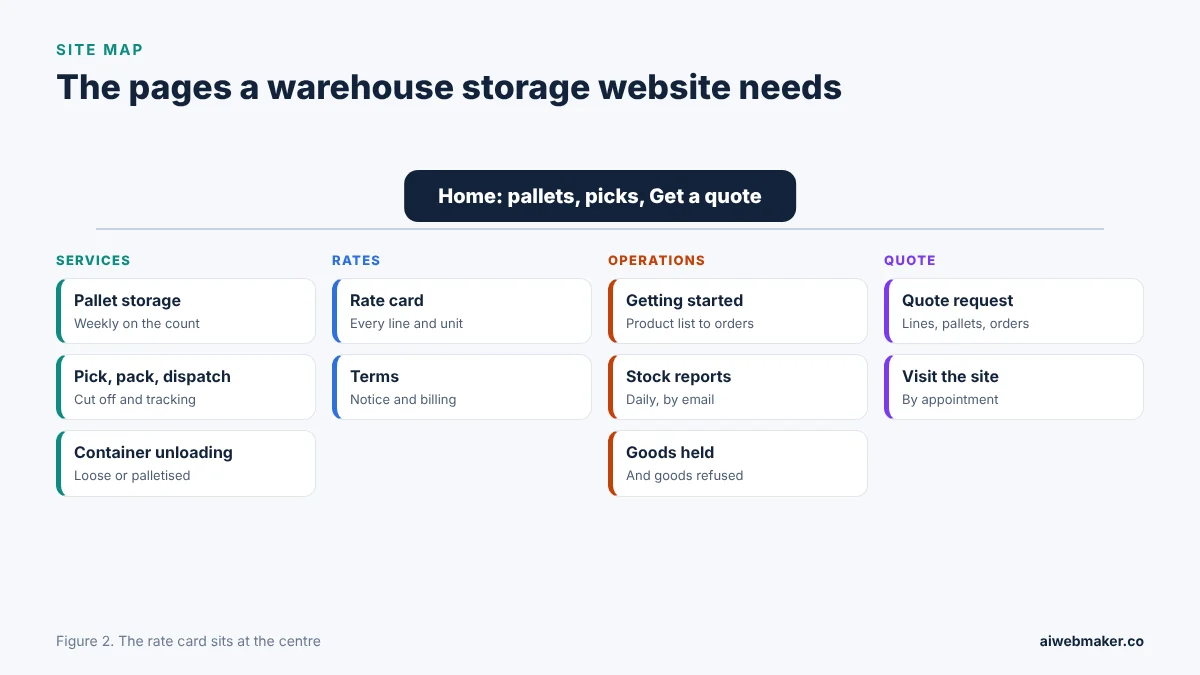
Arranged around four branches, the warehouse site keeps services, money, operations and the quote within one step of the home page. Baybridge Warehousing, the invented company behind our warehouse storage website example with a line by line rate card, offers pallet storage, pick, pack and dispatch, and container unloading as three ways to use the warehouse. Its rate card lists every charge, from goods in and weekly pallet storage to pick fees, returns and kitting, and promises that nothing outside the card appears on an invoice. Stock moves in through five steps, from sharing the product list to the first orders flowing, and a daily stock report shows what arrived, what left and what is running low. A section on what the site stores and cannot store sets limits for chilled and hazardous goods. The quote form asks for the service, the goods, the number of product lines, pallets in storage, orders a month and a start date, which is all a warehouse needs to price an account.
How should a rate card be laid out so no charge surprises?
A rate card should list every chargeable activity, its unit and a starting price, because hidden extras are what sellers fear most. Goods in, storage, picking, packing, pallets out, returns and kitting each have their own unit, such as per pallet, per carton, per order, per item or per hour. Packaging materials and courier postage vary, so they are best shown as charged at cost or by carrier. Billing rules, such as weekly storage on the count and monthly fulfilment on orders sent, belong beside the card. Any minimum term or notice period belongs on the same page, in plain numbers. A complete rate card lets a seller estimate a monthly bill from their own spreadsheet before calling.
| Activity | Usual unit | What the line should explain |
|---|---|---|
| Goods in | Per pallet or per carton | Checking against paperwork, labelling, put away |
| Storage | Per pallet or shelf, per week | How and when the count is taken |
| Pick and pack | Per order, plus per extra item | Scan picking, packaging choice |
| Pallet out | Per pallet | Loading for collection |
| Returns | Per item | Inspection, restocking or quarantine |
| Kitting and labelling | Per hour | Bundles, inserts, relabelling |
| Packaging and postage | At cost or by carrier | Materials used, carrier rates |
Pallet, shelf or bulk: which storage suits which stock?
The right storage type depends on how much of each product a client holds, how fast it sells and how it is packed. Pallet racking suits full pallets of a few products that move steadily, such as wholesale stock or imports. Shelf or bin storage suits online sellers with many product lines in small quantities, because pickers can reach single items quickly. Bulk floor storage suits large or awkward goods that cannot be racked. A locked cage or secure area suits high value lines, and many clients use more than one type at once. Explaining these options on the website helps sellers describe their needs accurately in the quote form.
| Storage type | Suits | Usually charged by |
|---|---|---|
| Pallet racking | Full pallets of steady sellers | Pallet per week |
| Shelf or bin storage | Many lines in small quantities | Shelf or bin per week |
| Bulk floor storage | Large or unstackable goods | Square metre or pallet space |
| Secure cage | High value items | Shelf or pallet, with a surcharge if any |
What happens when stock arrives at the dock?
When stock arrives, a careful warehouse checks it against the client's paperwork, records any damage and puts it away to a scanned location before it can be sold. Sellers should send an advance notice of what is coming, with product codes, quantities and the expected arrival date, so a dock and a team can be booked. Counts that do not match the packing list are reported the same day, with photos of any damaged cartons taken before anyone signs. Each carton or pallet then receives a location in the warehouse system and becomes available for orders, usually within a working day. Container unloading follows the same rules, whether the cargo arrives loose or on pallets. Describing this routine on the website shows sellers that their stock is counted from the very first minute.
How do cut offs, pick accuracy and stock reports build confidence?
Cut offs, pick accuracy and stock reports build confidence because they are the three things sellers feel every day once they move in. A clear dispatch cut off, such as orders received by a set afternoon hour leaving the same day, lets sellers promise delivery times to their own customers. Picking by barcode scan rather than by memory reduces wrong items, and the website can say how picks are checked. A daily stock report showing what arrived, what left and what is running low saves sellers from phoning for numbers. Regular counts, with any gaps investigated and explained in writing, keep the stock figures trustworthy. The AI website builder for warehouses that drafts a rate card and a quote form writes these service, rate and reporting sections as a first draft once the operator describes the site in a few lines, ready to be edited before launch.
Which goods need special licences, temperatures or insurance?
Some goods need more than a dry, ambient shelf, and a warehouse website should say plainly which ones it can and cannot accept. Imported goods held before duty is paid usually require a specially licensed bonded warehouse, and the rules are set by each country's customs authority. Hazardous goods, such as aerosols, flammable liquids and large quantities of lithium batteries, fall under storage and transport rules that vary by country, so an assessment should come before any acceptance. Food and supplements may need registered premises and temperature control, depending on local food safety law. Insurance deserves a clear explanation too, including what the warehouse policy covers, up to what value, and when clients should extend their own cover. Many standard storage terms also give a warehouse a lien over goods for unpaid charges, which clients should understand before signing.
Which phrases do online sellers use when hunting for fulfilment space?
Sellers searching for space usually type the service and the place, such as pallet storage near a city or pick and pack service. Others look for an ecommerce fulfilment warehouse or container unloading near a port. Many add the type of goods, for example clothing fulfilment or book storage. Each service section should open with the wording sellers actually search for. A map entry with working hours, photos of racking and docks, and the website link helps sellers who want to visit before committing. Reviews that mention accurate picking, quick dispatch and clear invoices weigh more than reviews about friendly staff alone. Articles on preparing stock for a warehouse, reading a rate card or planning for a peak season attract sellers months before they move.
How does the hosting bill sit beside a month of pallet rent?
Hosting and a domain are the warehouse website's only recurring costs, and twelve fulfilment articles drafted with AI credits stay below eight dollars a year. Operators with steady clients spend least on annual billing. A site that has just opened may lean towards monthly billing until its racking fills. Adding services, updating the rate card or changing cut off times costs nothing. The $189 plan appears beside them strictly as a comparison point.
| Item | Yearly | Monthly |
|---|---|---|
| Hosting the warehouse storage pages | $119 | $228 over twelve months |
| Domain | Depends on the ending | Depends on the ending |
| Higher plan, for comparison | $189 a year | Not needed |
| Twelve fulfilment articles at about $0.65 | About $7.80 | About $7.80 |
| Rate card and service updates | No charge | No charge |
| Year before the domain | About $126.80 | About $235.80 |
Which gaps on a warehouse site send sellers elsewhere?
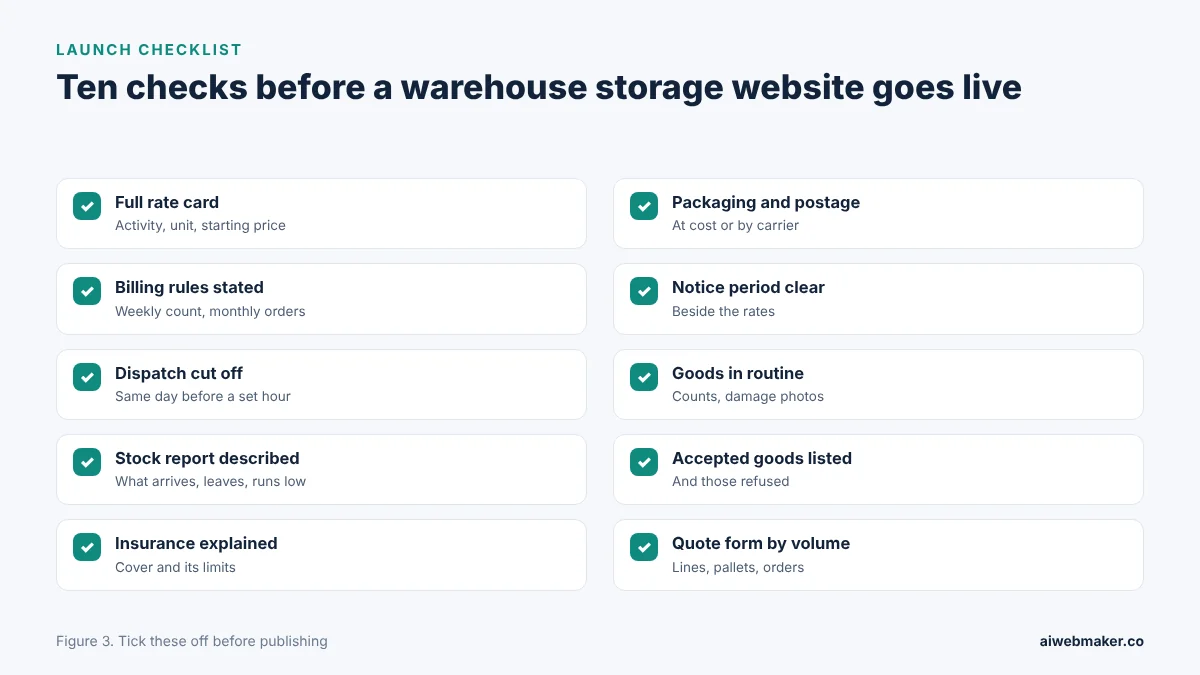
Sellers move on from a warehouse website when the rate card is missing or ends with a vague line about other charges. No dispatch cut off leaves them unable to promise delivery times to their customers. Silence about stock counts and reports suggests that numbers will only be available by phone. No list of accepted and refused goods wastes time for sellers with batteries, food or high value items. A quote form that asks nothing about volumes promises a slow, generic answer. The ten checks in the launch graphic address each of these gaps directly.
Frequently asked questions
Is a minimum contract term normal for pallet storage?
Minimum terms vary between warehouses, and some ask for a fixed period while others run on a notice period only. Shorter commitments suit growing sellers who are unsure of their volumes. Longer terms may come with lower rates for clients with steady, predictable stock. Whatever the policy, the website should state it plainly beside the rate card. Clear terms prevent disputes when a client wants to move.
Can imported goods be stored before duty is paid?
Imported goods can only be stored before duty is paid in a warehouse that holds the right customs approval, often called a bonded warehouse. Rules for these approvals are set by each country and differ widely. A standard warehouse usually requires goods to be cleared through customs before they arrive. The website should say clearly whether the site is approved for this kind of storage. Importers can then plan clearance before booking a delivery.
Who insures the stock while it sits in the warehouse?
Insurance arrangements vary, so the website should explain what the warehouse's own policy covers, such as fire, flood and theft, and up to what value per client. Many warehouses limit their liability under their standard terms, which makes the client's own stock insurance important. Clients holding high value goods may need to extend their cover. The warehouse can supply site details that insurers ask for. A clear explanation avoids painful surprises after an incident.
What happens to orders received after the dispatch cut off?
Orders received after the cut off time usually leave on the next working day, while those received before it leave the same afternoon. The exact cut off depends on the warehouse's carrier collection times. Weekends and public holidays may follow a different pattern. Sellers should mirror the cut off in the delivery promises they make to their own customers. Stating this clearly on the website keeps expectations aligned.
How many pallets a week repay the warehouse's year online?
A single new client storing a few pallets for a season pays far more in rent than the $119 the warehouse spends hosting its site for a year. On a monthly plan, a few days of storage on one pallet matches the $19. Every seller who moves in after reading a complete rate card is an account that could run for years. A full rate card, a firm cut off and daily stock reports win sellers who have been burned by hidden charges before. Warehouses that keep their rates, services and accepted goods current find that quotes turn into accounts more often. Quote requests that arrive with product lines and monthly orders already filled in prove the site is pulling in the right accounts.
Build your website in Minutes and get the AI Tools that work
Start Building Your Website →