Synagogue Website Cost, Sunset Service Times and Life Cycle Pages
A synagogue's pages are hosted for $119 yearly, with $19 monthly as the alternative, before a domain. Covered: who visits, the pages, service times, a first visit, life cycle events, learning, halls and requests, search and the yearly sums.
- No coding required
- Live in minutes
- Blog, SEO and chatbot tools included
Few congregation costs are smaller: AI Web Maker hosts the website for $119 across a year, with $19 monthly as the other route, and the domain adds a modest line. The office can write the service times, the visitor notes and the life cycle pages and read them through in preview while the meter stays at zero. A single kiddush hire of the community hall, or a few months of Hebrew school contributions, settles the hosting easily. What makes the task delicate is that Shabbat and festival times shift every week with sunset, while visitors unfamiliar with Jewish practice need gentle guidance before they feel able to come. Families planning a bar or bat mitzvah, a wedding or a funeral also need to know whom to call, often at an emotional moment. This guide takes those readers in turn, then the page list, service times, a first visit, life cycle events, learning, the hall and festivals, search and the yearly sums.
This article is part of our complete guide: Professional Services Website Builder.
Members, neighbours, school groups and families in a hurry
Several kinds of reader arrive at a synagogue website, and their needs differ sharply. Members check this week's times, the festival timetable and the date of the next class. Newcomers to the area, and people exploring Jewish life, look for a sign that they will be welcomed and told what to expect. Teachers arranging religious studies visits need clear rules on dress, photographs and how to book. Families facing a death need the phone number and what happens next, without searching through other pages. Parents ask about Hebrew school and the year of preparation before a bar or bat mitzvah. Keeping each of these paths short and calm is the main job of the home page.
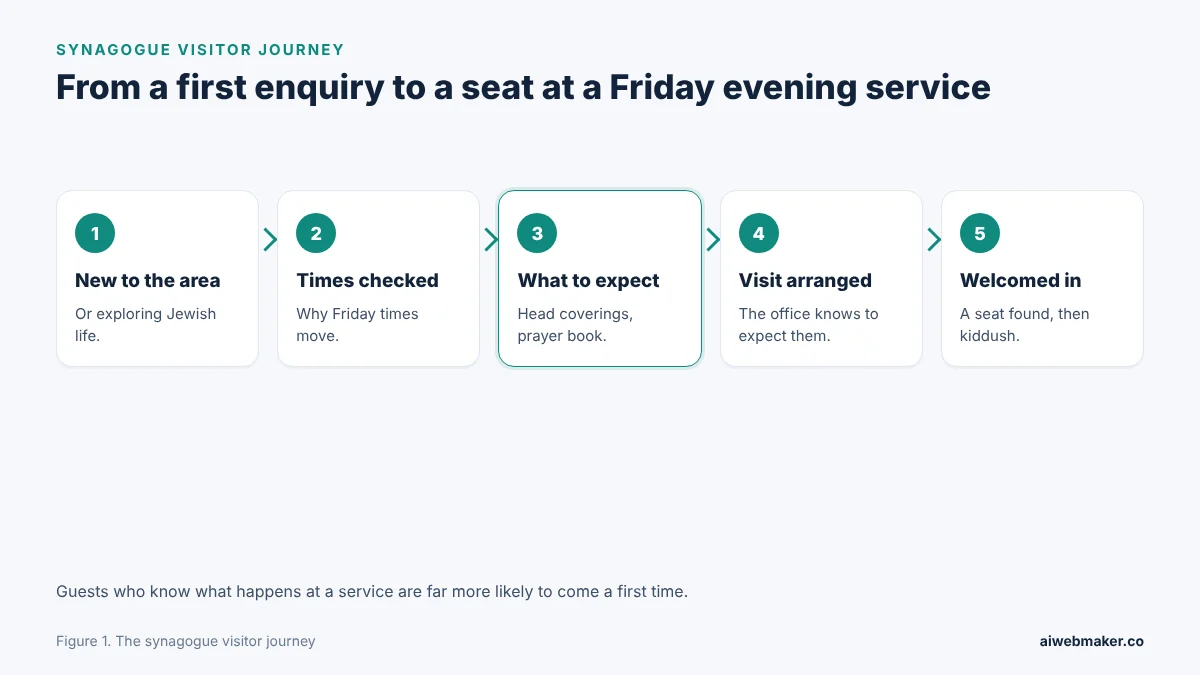
A new arrival appears on the left of the diagram, and a seat found at Friday evening service appears on the right. Highlighted in the middle is the step where the visitor learns what to expect, from head coverings to the prayer book with a translation. Before that comes the times page, which must explain why Friday times move. Arranging the visit through the office follows, which many congregations ask of first time guests. The welcome at the door, and an invitation to kiddush, decides whether the visitor returns. Every page on the site exists to make that first evening possible.
Services, visiting, life events and learning: a synagogue's page list
A synagogue's site is best organised around the questions that reach the office each week. A services page with an example week, and a pointer to the current sheet, answers the most frequent one. A visiting page prepares guests, and a life events page explains how the community supports families from birth to mourning. Learning pages cover Hebrew school, preparation classes and adult courses. Hall hire, the festival year, a short note on supporting the synagogue and a request form complete the set. Once those pages exist, the office spends less time repeating answers and more time with people.
| Page | Main readers | What it should hold |
|---|---|---|
| Services | Members, visitors | An example week, why times move, where the current sheet is |
| Visiting | Guests, schools | Dress, head coverings, shoes, photographs, access |
| Life events | Families | Naming, bar and bat mitzvah, weddings, yahrzeit, funerals |
| Learning | Parents, adults | Hebrew school, preparation class, adult Hebrew, study |
| Hall and rooms | Members, neighbours | Capacities, kosher kitchen, dates not available |
| Festivals | Everyone | The year in outline, how to arrange seats |
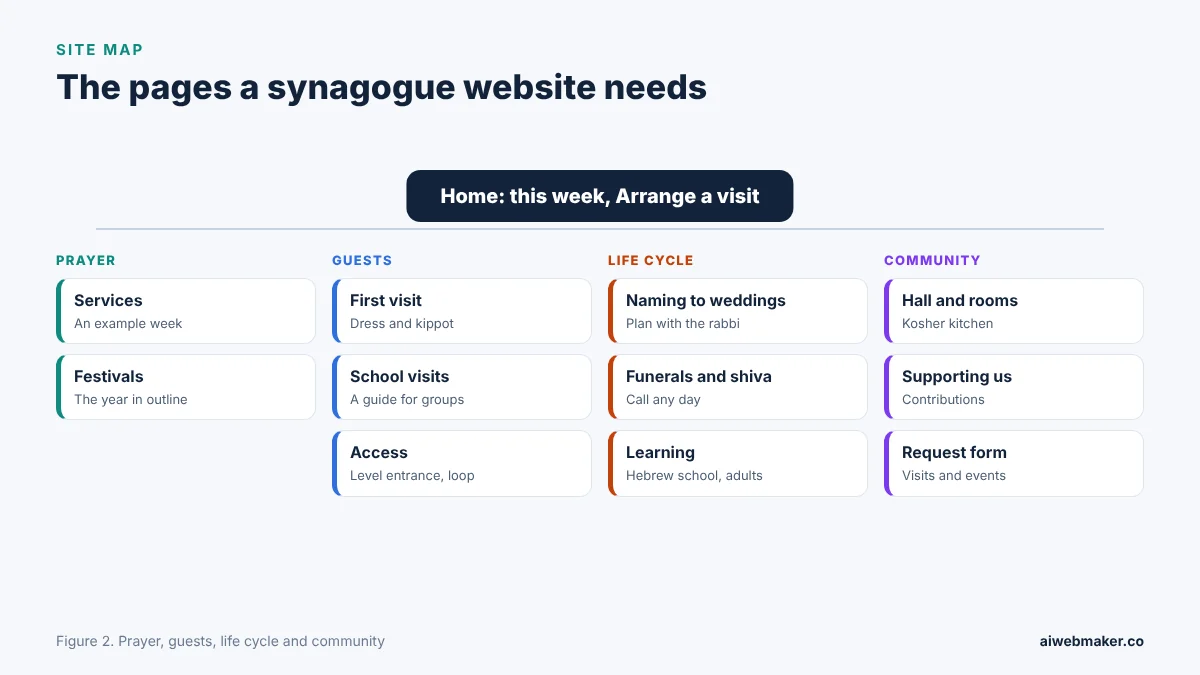
Hanging from a home page with this week's services and a button to arrange a visit, four groups gather prayer, guests, life cycle and community. Our sample congregation, Beth Shalom Community Synagogue, sets out a winter week from Friday candle lighting and Kabbalat Shabbat to havdalah, weekday mornings and a Sunday service, labelled as an example rather than this week's times. A visiting section explains head coverings, kippot by the door and a prayer book with a translation, before a life events section covering baby naming, bar and bat mitzvah, weddings, yahrzeit and memorial, funerals and shiva, and learning about Judaism. Learning runs from Sunday Hebrew school and a bar and bat mitzvah class to Hebrew from the first letter and Torah study, followed by the hall and rooms, festivals, photos and reviews. The synagogue website example with Shabbat service times and visitor guidance finishes on common questions, then a single enquiry covering first visits, school groups, life cycle events and room hire. That flow suits congregations of most sizes and traditions.
Times that move with sunset: the services page
Shabbat begins at sunset on Friday and ends after nightfall on Saturday, so a services page with fixed Friday times would be wrong most weeks of the year. The clearest approach is an example week, labelled as such, followed by a pointer to the current sheet in the entrance or on the website. Times that stay fixed, such as Saturday morning or weekday morning services, can be stated directly. In summer, many congregations hold the Friday evening service earlier than sunset, which deserves its own sentence. Festival services follow their own timetable and should be published a couple of weeks ahead. Explaining why times move turns a confusing page into a small lesson in the Jewish week.
| Moment | How its time is set | What the page should say |
|---|---|---|
| Candle lighting | Shortly before Friday sunset | Changes weekly, see the current sheet |
| Friday evening service | Near sunset, earlier in summer | An example time and the summer rule |
| Shabbat morning | Usually fixed | Start time, children's service, kiddush after |
| Havdalah | After nightfall on Saturday | Changes weekly |
| Weekday services | Fixed days and times | Which mornings, and the start time |
| Festivals | Their own timetable | Published about two weeks ahead |
A first visit: head coverings, prayer books and arranging ahead
Guests who have never attended a service worry about doing the wrong thing, so the visiting page should be warm, short and specific. Dressing as for a family occasion, a note on whether men are asked to cover their heads, kippot available by the door and whether shoes stay on answer the practical questions. A prayer book with a translation beside the Hebrew, and a welcome team member who can whisper page numbers, removes the fear of getting lost. Many synagogues ask first time visitors to let the office know in advance, partly so someone can greet them and partly for security, and the page should explain this kindly while keeping the security arrangements themselves off the website. Cameras and phones are put away on Shabbat and festivals by tradition, and on weekdays guests should ask first and never photograph children without their parents' agreement. Guidance this specific makes a first Friday evening feel possible rather than daunting.
Life cycle events from baby naming to shiva
Life cycle pages are read at some of the most significant moments of a family's life, so they should say whom to contact and how far ahead, in gentle language. A baby naming may happen within weeks, a bar or bat mitzvah is usually planned around two years ahead with a year of preparation, and a wedding often a year or more ahead. Funerals happen quickly in Jewish tradition, so the page should give the main number, available any day, and describe the support offered during the week of mourning. Because a ceremony under the chuppah does not automatically count as a civil marriage everywhere, couples should check registration rules with the authorities in their own country. Conversations with the rabbi for people exploring Judaism or joining a Jewish family deserve a place too. Pages written with this care tell families the community will be there when it matters.
| Life event | When to contact the office | What the page should explain |
|---|---|---|
| Baby naming | Soon after the birth | Held during a service, kiddush if wished |
| Bar or bat mitzvah | About two years ahead | The class, tutoring, choosing a Shabbat |
| Wedding | A year or more ahead | Meetings with the rabbi, legal registration |
| Yahrzeit and memorial | A week before | Names read, memorial plaques |
| Funeral and shiva | Any day, by phone | Help arranging, meals and prayers at home |
| Learning about Judaism | Whenever ready | Conversations with the rabbi |
Hebrew school, the preparation year and adult learning
Learning pages bring in families who may not yet attend services, so each class needs a day, a time, an age range and a contribution. Sunday Hebrew school, organised by age, gives children reading, festivals, stories and songs. A weekly preparation class for young people approaching bar or bat mitzvah, alongside individual tutoring, helps parents see the shape of the year ahead. Adult classes, from reading the prayer book letter by letter to informal Torah study, show that it is never too late to begin. Anyone teaching or tutoring children ought to have passed whatever background checks local law sets, and saying so in one line puts parents at ease. Stating that cost keeps nobody away, with a quiet word to the office as the route, keeps every class open.
Simchas, the kosher kitchen and the festival year
Observance shapes room hire at a synagogue, so the hall page pairs capacities with rules such as a kosher kitchen and no parties on Shabbat or festivals. Members often have first choice of dates, and neighbours may hire rooms for gatherings in keeping with the building, which the page can explain plainly. Festival dates follow the Hebrew calendar and move against the civil calendar each year, so the festival page should give an outline and publish confirmed dates in good time. The AI website builder congregations use for Shabbat times and hall enquiries turns out a draft of these pages after the office writes a short account of the congregation, its services and its rooms. Requests for visits, life events or the hall then reach the office, which can confirm a date, suggest another or explain that a festival falls on the day. Money for the hall or a simcha changes hands only between the synagogue and the family, with no percentage kept by the platform.
From Shabbat times to Hebrew school: phrases that lead to a synagogue
Searches for a synagogue often combine the tradition, a service or a class with the area. Examples include synagogue near me, Shabbat service times, Hebrew school for children or bar mitzvah tutoring with a town name. Pages that name the congregation, its tradition and the town in their headings make those matches easier. On its map listing, the congregation can post office hours and an entrance photo, adding that service times follow the weekly sheet. Reviews from school groups, new members and families who marked a simcha help guests picture the community. Short pieces on a festival, on what havdalah means or on preparing for a first Friday reach readers well outside the membership, and in time they turn the synagogue into a trusted voice on Jewish life locally.
The congregation's yearly website ledger
A congregation's website ledger has just two fixed entries, hosting and the domain. Boards that agree budgets at the members' meeting usually prefer one yearly payment. A young congregation still building its membership may begin with monthly billing. Twelve articles on festivals and first visits cost under eight dollars in credits. Updating the weekly times, the festival outline or hall prices never costs extra.
| Item | Yearly | Monthly |
|---|---|---|
| Hosting the synagogue pages | $119 | $228 over twelve months |
| Domain | Depends on the ending | Depends on the ending |
| Higher plan, for comparison | $189 a year | Not needed |
| Twelve festival and first visit articles at about $0.65 | About $7.80 | About $7.80 |
| Weekly times, festival dates and hall prices | No charge | No charge |
| Year before the domain | About $126.80 | About $235.80 |
What makes a guest hesitate at a synagogue's website
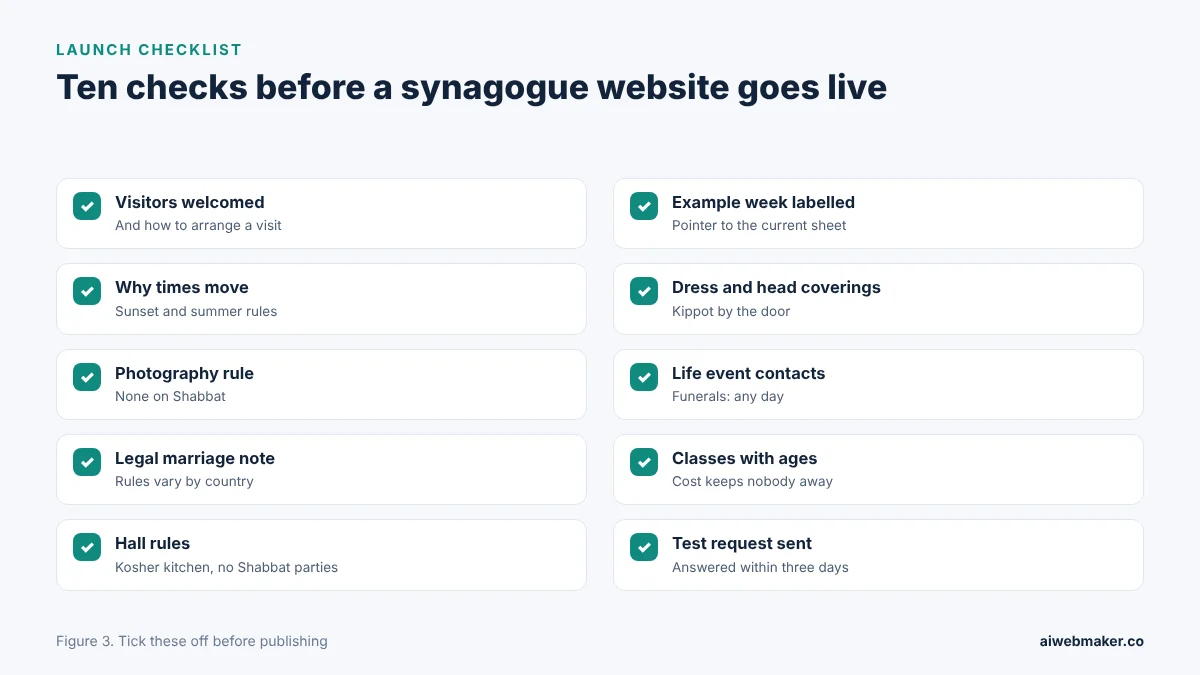
Guests hesitate when the site says nothing about whether visitors are welcome or how to arrange a first visit. Fixed Friday times that are wrong for most of the year undermine trust in everything else. No guidance on head coverings, dress or photographs leaves people worried about giving offence. Life event pages without a phone number fail families at the moment they most need help. A hall page that omits the kosher kitchen rules leads to awkward conversations with caterers. Placed after this paragraph, a checklist of ten points guards against each of those failures.
Frequently asked questions
Do visitors need to be Jewish to attend a service?
Most synagogues welcome visitors of every faith and none, whether alone, with friends or as a group. Many ask guests to contact the office before a first visit so someone can greet them. The website should explain how to do that and what to expect on arrival. Guests are usually not expected to join every prayer and may simply follow along. A clear invitation encourages neighbours who might otherwise never come in.
Why are photographs not allowed on Shabbat?
By tradition, cameras and phones are put away on Shabbat and festivals, when many forms of work, including using devices, are avoided. Practice varies between communities, so each synagogue should state its own rule. On weekdays, photography may be allowed with permission, but children should never be photographed without their parents' agreement. Explaining the reason helps guests respect the rule rather than feel policed. Clear guidance avoids embarrassment for everyone at the service.
How early should a family plan a bar or bat mitzvah?
Many families contact the office about two years ahead to choose a Shabbat, then begin preparation around a year before. Preparation usually combines a weekly class with individual tutoring, and the rabbi meets the family along the way. Hall bookings for the celebration are best made at the same time. The website can describe this timeline so families do not leave it too late. Early planning makes the year calmer for the young person and the whole family.
Where do membership contributions and donations belong on the site?
A short section near the end, explaining that the synagogue runs on members' contributions and donations, is usually enough. Stating that nobody is kept away from services, classes or visits by cost keeps the welcome sincere. Contributions can be described as set to suit each household, with a word to the office as the route. Mentioning that accounts are presented at the members' meeting adds openness. Placing this after the welcome, not before it, shows guests where the priorities lie.
A single kiddush hire outweighs a year of hosting
A single kiddush in the community hall earns a synagogue more than its entire $119 hosting year. With monthly billing, a few weeks of adult class contributions cover the $19. Every guest who arrives prepared, every school group that books a visit and every family that calls the office at the right time strengthens the community. Newcomers are won over by correct times, kindly visitor notes and life event pages that name a person to call. Congregations that keep the weekly times current online spare their office countless calls. A stranger welcomed at Friday evening service, and invited to kiddush the next morning, is the outcome the pages are built for.
Build your website in Minutes and get the AI Tools that work
Start Building Your Website →