Independent Social Media Manager Website Cost and the Plans It Sells
Plans, replies and a quote form sit online for a year once a manager pays $119, with $19 a month as the other route, plus a domain. What follows: the brands, the pages, plans and reply hours, the monthly rhythm, comment care, account access, what the fee leaves out, search and the budget.
- No coding required
- Live in minutes
- Blog, SEO and chatbot tools included
An independent social media manager can run a plans and quote site for $119 of yearly AI Web Maker hosting, or $19 in monthly payments, with the domain the only other purchase. Writing the plan cards, the monthly rhythm and the quote request, then scrolling through them in the preview, is not charged. One month of the smallest plan for a single brand pays for the hosting year, so the website is never the expensive part. The challenge is that brands have been burned by promises of followers, by managers who vanished with the passwords and by fees that grew once advertising began. A site that wins their trust explains plans, approvals, replies, access and what the fee leaves out before the first call. What comes next: the brands, pages, plans and reply hours, the monthly rhythm, comment care, account access, ad budgets, search and the yearly budget.
This article is part of our complete guide: Professional Services Website Builder.
Cafés, studios and product brands that have run out of time to post
Brands that hire an independent social media manager are usually busy owners who know their channels matter but cannot keep posting and replying every day. A café, a salon, a craft brand selling online and a clinic with a waiting list each have a different audience and a different tolerance for risk. Many tried posting themselves and stopped when the business got busy, and some hired help before and were disappointed. They compare managers on the work shown, the clarity of the plans and whether the manager seems to understand their trade. Above all they want to know who will speak for the brand in the comments, and how carefully.
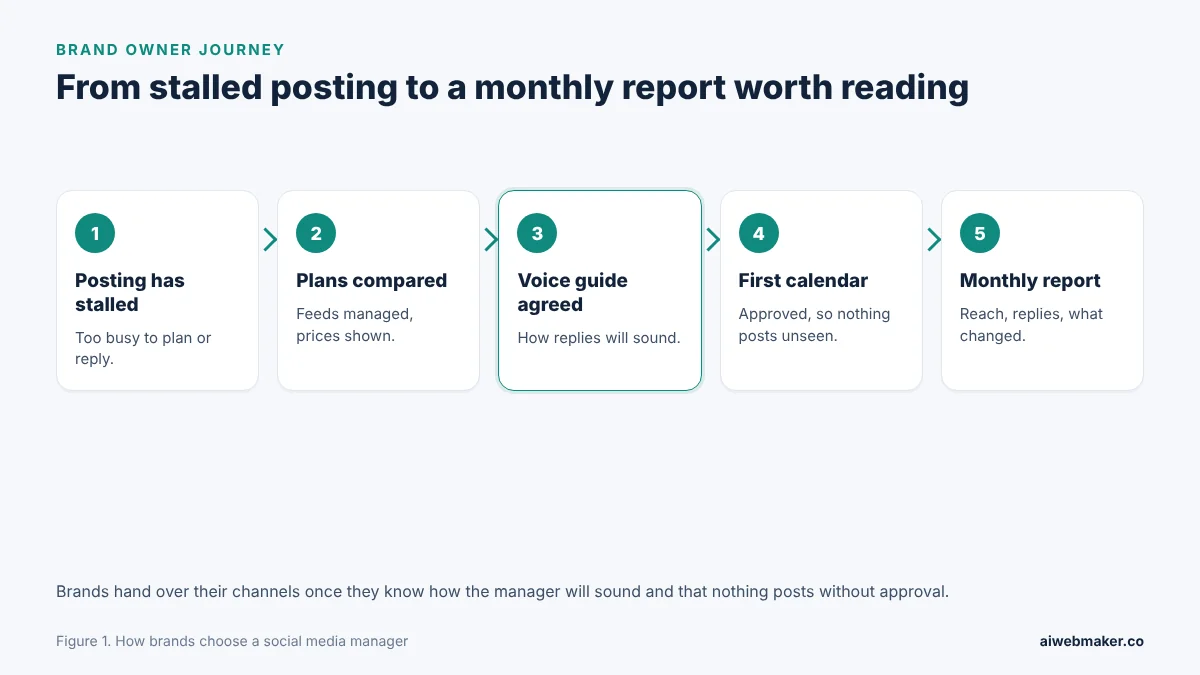
The voice guide is highlighted because it is the moment a brand decides to let someone else speak for it. The journey begins when posting stalls, often after a busy season or the departure of the staff member who handled it. Owners then compare managers by looking at feeds they run and by checking whether plans and prices are clear. A first calendar approved before anything goes out shows that control stays with the brand. The monthly report then decides whether the retainer continues, so it has to show what happened in plain words.
Plans, the monthly rhythm, comment care and the quote request
An independent manager's site should read like a clear offer rather than a portfolio of buzzwords. The home page states who the manager works with and what a month includes, with a button to ask for a quote. A plans page lists posts, channels and reply hours for each level, with the minimum term and what is paid separately. Pages on the monthly rhythm, comment care and account safety answer the questions owners worry about privately. Work examples and a short quote request complete the route.
| Page | Owner's question | What it should show |
|---|---|---|
| Home | Is this person right for my brand? | Who the manager works with, what a month includes |
| Plans | What does each level cost? | Posts, channels, reply hours, minimum term |
| A month | When does the owner approve, and when can they relax? | Planning, calendar, posting and report dates |
| Comment care | Who answers my customers, and how? | Voice guide, reply hours, how complaints are passed on |
| Account safety | Will the accounts stay mine? | Business roles, no shared passwords, ownership |
| Quote request | How do we start? | Plan, channels used now, start date, what the brand needs |
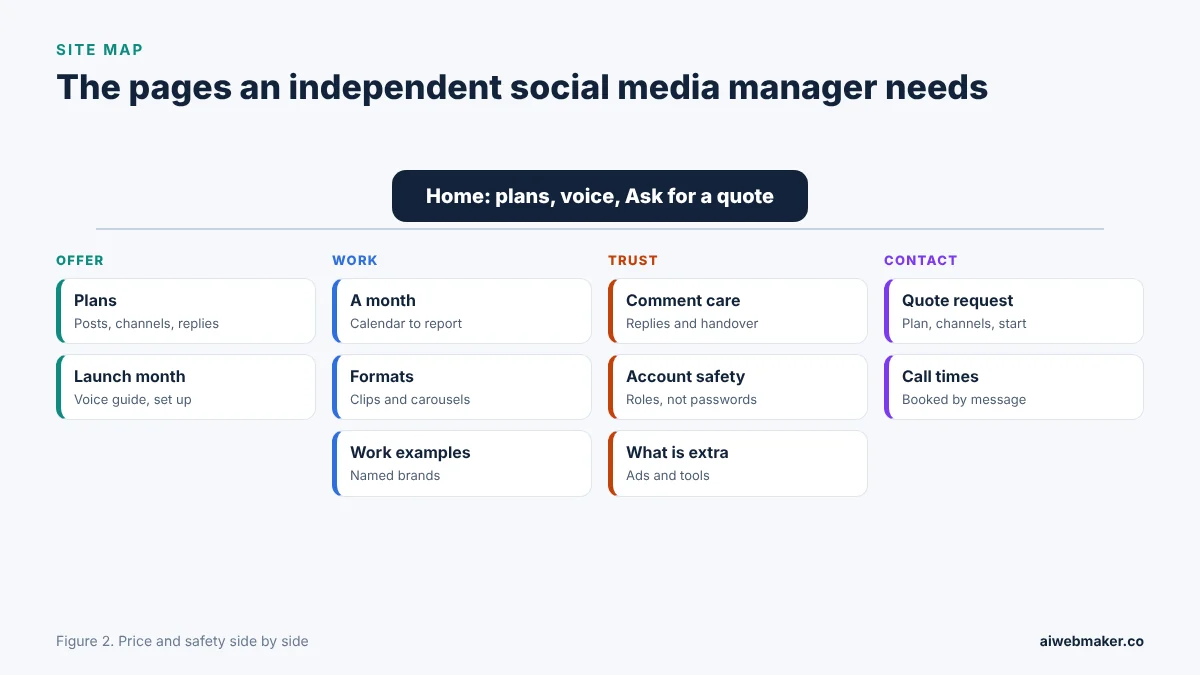
The plans and the safety pages sit next to each other on this map, because owners weigh price and risk in the same breath. The offer group holds the plans and a launch month, the work group shows the monthly rhythm, formats and examples, and the trust group covers comments, access and extras. Scrollstop Social, our invented sample, sells Starter, Steady, Comment care and Launch month, and it lists Content planning, Photos and short clips, Captions and graphics, Comments and messages, a Monthly report and Account safety as the work every plan covers. Its page moves from the plans to a month of content, the comment rules, the formats and the first three weeks before the quote request. The social media manager website example with monthly plans and comment care shows how an independent can look organised without pretending to be an agency.
Posts, channels and reply hours: pricing a monthly plan
Monthly plans are priced on the work behind them, and that work grows with posts, channels, filming and the hours spent replying. A plan that names the posts per channel, the clips per month and the reply hours lets an owner compare it with doing the job internally. Reply cover is the item most often left vague, yet it decides whether a complaint sits unanswered over a weekend. A launch month priced separately pays for the voice guide, access set up and the first calendar, work that never repeats. A minimum term, such as three months, followed by month to month notice gives both sides a fair trial.
| Plan element | What changes the price | What the page should state |
|---|---|---|
| Posts per week | Planning, writing and design time | The number for each channel |
| Channels | Each one needs its own formats | Which channels are included |
| Short clips | Filming and editing time | How many a month, and who films |
| Reply hours | Time spent in comments and messages | Days and hours covered |
| Shoot days | Travel and time on location | How often, and where |
| Launch month | Set up, voice guide, first calendar | A one off fee before the plan begins |
The approval calendar and the monthly rhythm
A brand's biggest fear is reading a post it never approved, so the calendar and its approval date deserve a page of their own. A typical month starts with a planning call, followed by a written calendar sent for approval, then posting and replying through the weeks and a short report at the end. Urgent changes, such as a sold out product or a sudden closure, should be promised the same day, and the page can say how they are requested. Seasonal dates, launches and quiet weeks belong in the calendar early, because good content needs time to film. Publishing this rhythm tells the owner exactly when to look and when to leave the work alone.
Comment care: replies in the brand's voice, complaints passed on
Replying to comments and messages is often worth more to a brand than the posts themselves, because a question answered quickly can become a sale. The page should explain how the voice guide is agreed, which replies the manager writes alone and which go to the owner, such as complaints, refunds or anything legal or medical. A rule never to argue with commenters, and to hide or report abuse under each channel's own rules, shows maturity. Reply hours should be stated honestly, with a note on what happens outside them. A firm handover rule for complaints protects the brand from a well meaning reply that makes a problem worse.
Access without passwords and who owns the content
Account safety is the quiet question behind every enquiry, because owners have heard of managers who left with the passwords. Most major channels let a business grant roles to a manager through their own business tools, so passwords never need to be shared, and the access page should explain exactly that. Two step sign in on every account, and a rule that the brand always owns its accounts, remove most of the fear. Ownership of photos and clips made for the brand should be set out in writing, since copyright rules for commissioned work differ between countries. A short exit routine, with access removed and files handed over, makes it easier for a brand to start.
| Question | Sound practice | Why it matters |
|---|---|---|
| How access is given | Through each channel's own business roles | No shared passwords |
| Two step sign in | Turned on for every account | Fewer takeovers |
| Who owns the accounts | The brand, always | Nothing is lost if the plan ends |
| Who owns photos and clips | Set out in writing | Avoids disputes later |
| Ending the plan | Access removed, files handed over | A clean exit |
Ad budgets, paid tools and what the monthly fee leaves out
Owners need to know which costs sit outside the plan, because the fee for managing channels is not the same as money spent on advertising. Ad budgets, paid scheduling or design tools and any fees charged by the channels themselves are usually paid by the brand directly, and the plans page should list them. Rules on labelling paid partnerships and advertising differ from country to country, so a manager handling sponsored posts should follow the rules where the brand trades. No manager can promise followers, reach or sales, since the channels' own systems decide what each person is shown. The AI website builder for independent social media managers and their plan pages drafts the plans, the monthly rhythm and the quote pages after the manager sums up the work in a few lines, and each price can be corrected in the preview.
Social media help near me and what owners put into the search box
Few owners search for a job title alone, typing phrases such as social media manager for restaurants, social media help for a salon or social media management packages. Many add a city because they want someone who can visit for a shoot day. Pages or headings for the trades the manager knows best catch these searches, so a café owner finds a page about cafés. A map listing with the service area, sample work and the hours for calls helps a local owner check that the manager is real. Articles on what to post in a quiet month or how to reply to a bad review attract owners who later ask for a quote.
Phone, editing apps and the website: a social media manager's yearly line
A good phone, editing apps, a microphone and the odd prop cost an independent social media manager more each year than the website. Annual hosting on AI Web Maker totals $119, while $19 billed every month suits a manager taking on a first client, and the domain cost rests on the chosen ending, with about 400 available. Twelve articles on posting habits, replies and quiet season ideas cost roughly $7.80, since AI credits draft each one for about 65 cents. Nothing is added to the bill for editing a plan price or adding a case study. As for the $189 tier, it appears below only so the options can be compared.
| Item | Yearly | Monthly |
|---|---|---|
| Hosting the plan and quote pages | $119 | $228 over twelve months |
| Domain | Depends on the ending | Depends on the ending |
| Higher plan, for comparison | $189 a year | Not needed |
| Twelve posting and reply articles at about $0.65 | About $7.80 | About $7.80 |
| Plan prices and case study updates | No charge | No charge |
| Year before the domain | About $126.80 | About $235.80 |
Follower promises, shared passwords and other reasons owners look elsewhere
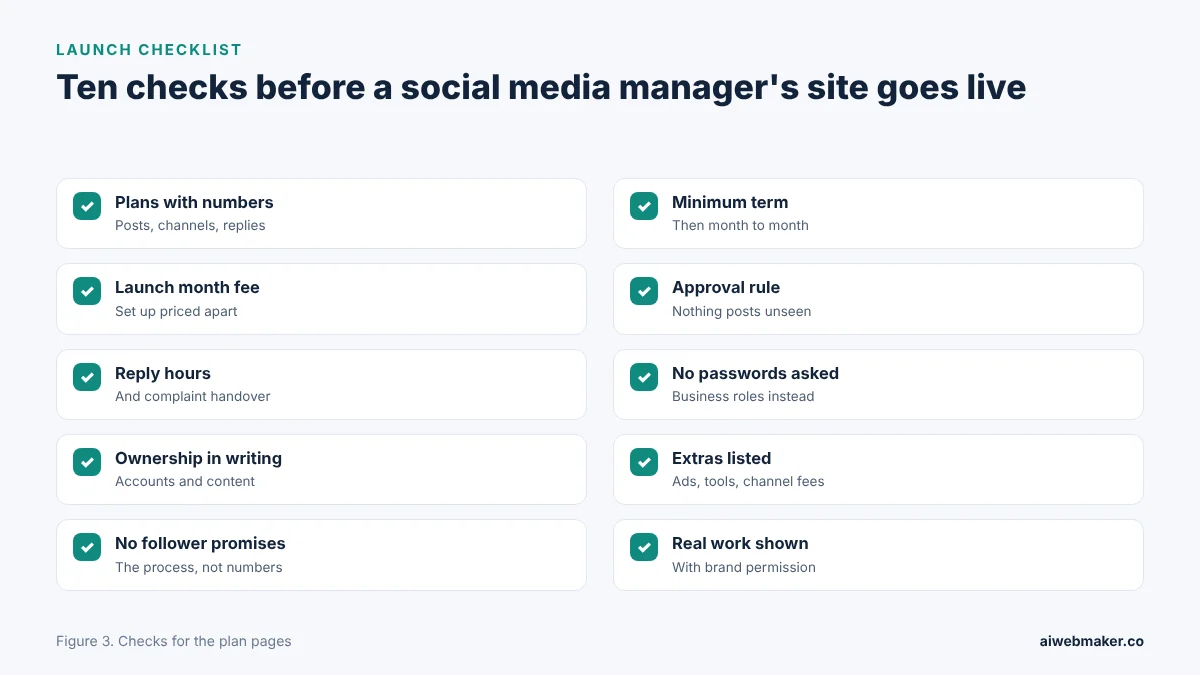
Owners leave a manager's site quickly when it promises followers or viral reach, because they have heard that promise before. A plan with no reply hours makes them wonder who will answer customers at the weekend. Any request for passwords on the quote form sets off alarm bells. Work examples with no brand named, or only stock images, suggest there is little real work to show. The image after this paragraph turns these doubts into ten things to check.
Frequently asked questions
Can a social media manager guarantee more followers or sales?
No honest manager can guarantee followers, reach or sales, because the channels decide what each person sees and customers decide what they buy. A manager can promise the work instead: a planned calendar, posts that go out on time, replies within the stated hours and a clear report. Over time, steady posting and good replies often help, but the page should never put a number on it. Owners who hear a guarantee should ask how it would be measured and what happens if it is missed. Promising the process rather than the result keeps the relationship honest.
Does a social media manager run paid advertising too?
Some independent managers run paid campaigns and many do not, so the plans page should say which applies. Where ads are included, the management fee and the ad budget should be shown as separate amounts, with the budget paid by the brand directly to the channel. Advertising rules, especially for health, finance and products for children, differ between countries and channels. A manager who does not run ads can say so plainly and suggest where a brand might find that help. Clear lines avoid the impression that ad spend disappears into the fee.
Who owns the photos and clips made for a brand?
Ownership of content made for a brand should be agreed in writing before the first shoot, because copyright rules for commissioned work vary by country. Many managers hand over full rights once invoices are paid, while some keep the right to show the work in their own portfolio. Photos of customers or staff need their permission, and rules on using images of people differ between countries. Stock images and music carry their own licences, which may not transfer. A short paragraph on the site settles the question before it becomes a dispute.
Can a plan pause during a quiet season?
Many brands have quiet months, such as a café in a holiday town after the summer, and a pause rule helps both sides plan. Some managers allow one pause a year with notice, while others offer a lighter plan for the quiet weeks instead. Comment care may still be needed during a pause, since customers keep asking questions. The page can explain the options and the notice needed. A fair pause rule keeps a seasonal brand from cancelling altogether.
Starter plans, retainers and twelve months of hosting arithmetic
The first invoice for even the smallest plan usually clears the $119 that hosts a manager's site for the year. Twelve monthly hosting payments of $19 add up to less than one month of a typical starter plan. Every brand that arrives having read the plans, the approval rule and the access page saves a round of explaining on the first call. Retainers that last past the three month start bring in many years of hosting. When owners quote the reply hours and the no password rule back during that call, the pages have already explained the offer.
Build your website in Minutes and get the AI Tools that work
Start Building Your Website →