Private Investigator Website Cost and the Limits That Win Trust
Investigation agencies host their site for $119 annually, or $19 month by month, and the domain costs extra. Inside: who instructs investigators, case pages, legal limits, pricing, reports, confidential enquiries, credentials, search and the yearly budget.
- No coding required
- Live in minutes
- Blog, SEO and chatbot tools included
An investigator's website stays live on $119 of yearly hosting, or on $19 monthly when cases arrive unevenly, and the domain comes from about 400 endings at extra cost. Case pages, the list of refused requests and the enquiry form can all be shaped and tested on screen first, with no AI Web Maker charge for any of it. One background check or a single afternoon of process serving covers that year comfortably. The real difficulty is that clients approach investigators warily, unsure what is legal, worried about discretion and wary of agencies that promise anything for a fee. A careful website wins them by stating plainly what the agency will do, what it refuses, how it reports and how it protects what clients tell it. The pages that follow look at who instructs investigators, case pages, legal limits, pricing, reports, confidential enquiries, credentials, search and the yearly budget.
This article is part of our complete guide: Professional Services Website Builder.
Who instructs a private investigator, and what makes them pick one?
Most private investigations are instructed by people who need facts for a decision or for a legal process, rather than by curious individuals. Solicitors and law firms need evidence, witness statements and papers served on time. Insurers and employers commission enquiries into suspicious claims, while lenders and landlords want debtors traced or tenants vetted. Executors look for missing beneficiaries, families try to reconnect with lost relatives and business buyers want due diligence on a partner. Each client weighs discretion, lawful methods, a clear price and a report that will hold up if questioned. The agency that answers those concerns on its website, before any call, usually receives the instruction.
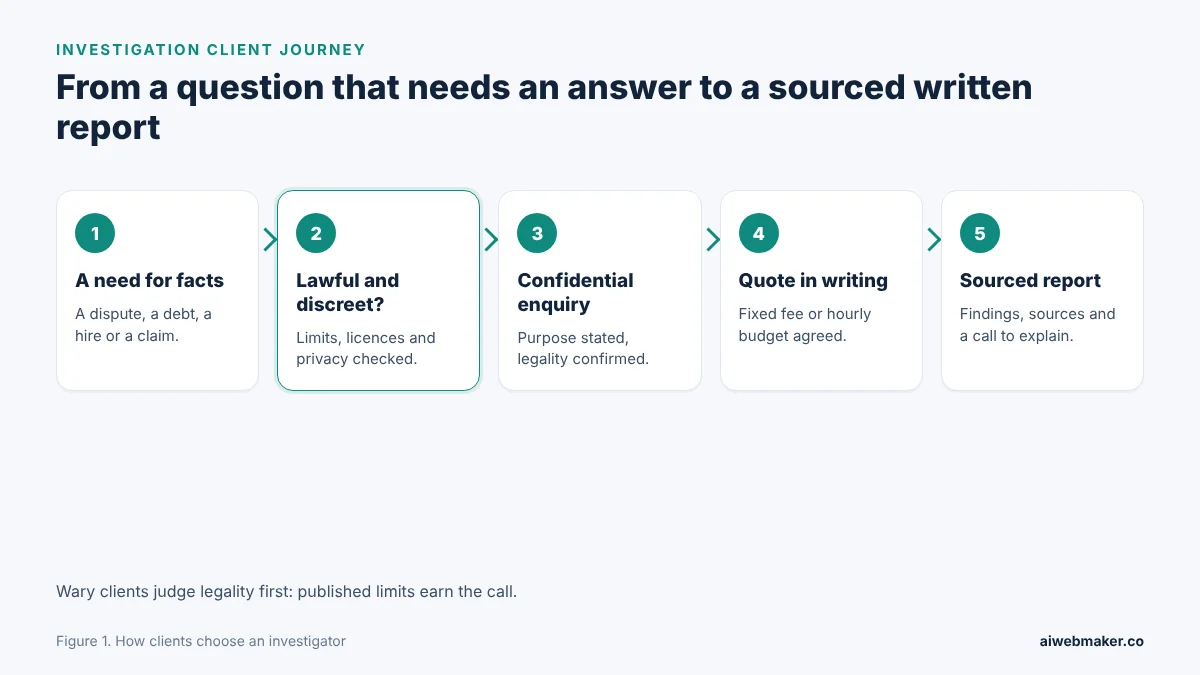
Following a client from an unanswered question to a written report, the five stages show how much of the decision happens before anyone speaks. The process starts with a need for facts, usually linked to a dispute, a debt, a hire or a claim. The client then checks whether the agency works lawfully and discreetly, which is the highlighted stage because most first visits end there. A confidential enquiry and a lawfulness check come next, followed by a fixed quote in writing. The final stage is the report, with sources listed and a call to explain what the findings mean. Agencies whose websites support every stage turn wary visitors into instructing clients.
Which case pages and limits should an investigation agency publish?
An agency should give each kind of case its own page, plus a page stating the requests it refuses, since clients search for their exact problem. Background checks, tracing, evidence for legal cases, due diligence, process serving and insurance enquiries each attract different clients with different worries. A limits page builds more trust than any slogan, because it shows the agency knows where the law draws its lines. A process page and a reports page explain how cases run and what clients receive. An enquiry page, written with confidentiality in mind, completes the structure.
| Page | Who reads it | What it should state |
|---|---|---|
| Background checks | Employers, landlords, business partners | Records checked, consent where required, turnaround |
| Tracing people | Lenders, executors, families | Lawful sources, when a message is passed instead of an address |
| Evidence for legal cases | Solicitors and their clients | Observation in public, statements, dated photographs |
| Business due diligence | Buyers and investors | Company records, ownership, litigation, reputation |
| Serving legal papers | Solicitors, litigants | Personal service and a signed statement of service |
| Requests refused | Every careful client | What the agency will not do, and why |
| Confidential enquiry | Anyone ready to ask | Type of case, purpose, location, deadline |
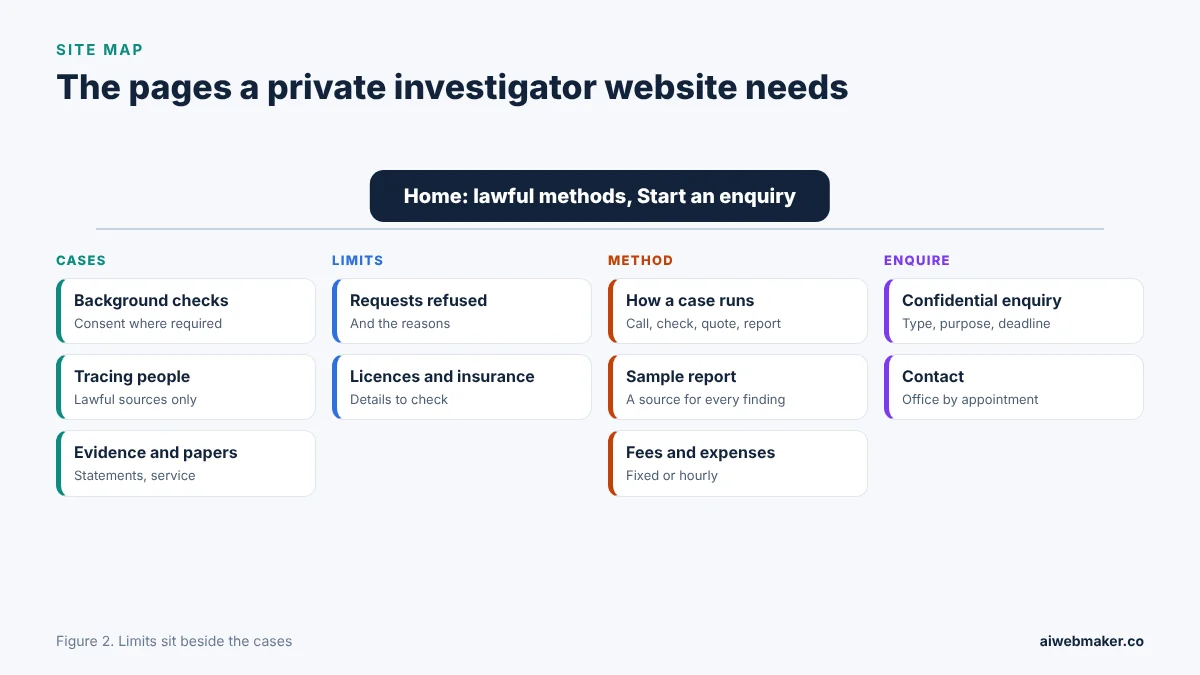
Organised into four branches, this agency site keeps the cases taken, the lines not crossed, the method and the enquiry within one tap of each other. Greyline Investigations, the invented agency behind our private investigator website example with a table of refused requests, lists background checks, tracing people, evidence for legal cases, business due diligence, serving legal papers, and insurance and fraud enquiries. Beside the cases sits a table of what the agency takes on and turns down, from checking a business partner to refusing to follow a former partner or read someone's messages. A case runs from a confidential first call through a lawfulness check and a written quote to enquiries and a report, and each finding in the report lists its source. The enquiry form asks for the type of case, who is asking, the country and city involved, any deadline and what the client needs to find out and why. Asking for the purpose up front signals the agency's standards before a word is spoken.
Where are the legal lines an investigator will not cross?
The legal lines an investigator will not cross should be published plainly, because many clients do not know them and some hope the agency will ignore them. Laws on surveillance, privacy, harassment and personal data differ between countries, so each request must be checked against the rules where the work would happen. Accessing another person's email, phone or accounts is unlawful in most countries, and so is obtaining bank, telephone or medical records by deception. Following a partner or former partner for personal reasons can amount to harassment and can put people in danger. Hidden trackers on someone else's vehicle are unlawful in many places. A table of requests and answers tells clients what to expect and quietly turns away those the agency should never work for.
| Request | Usual answer | Why |
|---|---|---|
| Check a new business partner's history | Yes | Company filings and court records used for a fair purpose |
| Trace a debtor who has moved | Yes | Lawful sources, address given for a legal process |
| Gather evidence for a court case | Yes | Observation in public places and signed statements |
| Watch a partner or former partner | No | Can amount to harassment and put people at risk |
| Read someone's messages or accounts | No | Unauthorised access is unlawful in most countries |
| Obtain bank, phone or medical records | No | Released only to the person or by court order |
| Fit a tracker to another person's car | No | Unlawful in many places and dangerous |
How are investigations priced: fixed fees, hours and expenses?
Investigations are usually priced as a fixed fee for defined tasks, such as a trace, or as an hourly budget for open ended work such as observation. A fixed fee suits clients who need certainty, while an hourly budget with a ceiling suits cases where the scope may change. Expenses, including travel, mileage, court attendance and the fees that registries charge for searches, are usually billed at cost and should be listed on the quote. Observation can need more than one investigator, which affects the price and should be explained in advance. Longer cases often take part of the fee before work begins, with the balance invoiced with the report. Publishing starting prices and the way quotes are built helps clients budget and screens out enquiries that would never proceed.
| Case type | Common pricing | What the quote should show |
|---|---|---|
| Background check | Fixed fee per check | Records covered and turnaround |
| Trace | Fixed fee per trace | What happens if the person is not found |
| Observation | Hourly, per investigator | Number of investigators, hours, mileage |
| Due diligence | Fixed fee per report | Companies and countries covered |
| Process serving | Fee per address | Attempts included, statement of service |
| Insurance or fraud enquiry | Hourly with a budget | Interviews, site visits, report |
What makes an investigation report stand up when it is challenged?
An investigation report stands up when every finding can be traced to a source, such as a public register, a named witness or a dated photograph. Opinion should be kept apart from fact, and findings should be described as findings rather than accusations. Times and places should be recorded as events happen, because notes written days later carry less weight. Where evidence may be used in court, the way each item was obtained matters as much as what it shows, and unlawfully obtained material can damage a case. Whether evidence is admitted is always a matter for the court, and the client's lawyer is the best guide to what the case needs. A sample report outline on the website shows clients and their solicitors the standard they can expect.
How should a confidential enquiry be handled from first message to quote?
A confidential enquiry should ask only for what the agency needs to judge whether it can lawfully help, because clients often share sensitive details in their first message. The form can ask for the type of case, who is asking, the country and city concerned, any deadline and what the client needs to know and why. A note on how long the message is kept, and that it is deleted if the case is declined, reassures cautious visitors. Clients should be able to choose how they are contacted, including through their solicitor, since a call at home may not be safe or private. The website builder for investigation agencies that drafts case pages and an enquiry form produces these pages as a first draft once the investigator outlines the services in a few sentences. The agency can then rewrite every line in the preview before the site is published.
How can a website signal licences, insurance and discretion?
A website signals licences, insurance and discretion by stating them precisely, with enough detail for clients to check where checking is possible. Licensing rules differ widely, since some countries and states licence investigators directly while others regulate the work through privacy and data protection law. Where a licence applies, its number and issuing body can be shown, and membership of a recognised professional association can be mentioned where accurate. Professional indemnity insurance reassures solicitors and insurers who rely on findings. Conflict checks, which confirm that the agency is not already working for the other side, deserve a sentence. Discretion is best shown through behaviour on the page, such as a plain office address, no client names and no dramatic imagery.
Which phrases bring solicitors and families to an investigator?
Clients searching for an investigator usually type the task rather than the profession, such as trace a debtor or process server near me. Solicitors often search for evidence gathering or statement taking in a particular city or region. Each case page should use those plain phrases in its heading and first lines, along with the areas the agency covers. A map entry with office hours, a phone number answered by an investigator and the website link helps clients with urgent court deadlines. Reviews that mention discretion, clear reports and lawful methods carry more weight than reviews that boast of dramatic results. Articles explaining what investigators can and cannot do lawfully draw careful clients who are still deciding whether to instruct anyone.
Is the hosting bill worth a second thought for an investigation agency?
The yearly bill for an investigator's website covers hosting and a domain, and twelve articles on lawful investigation drafted with AI credits add less than eight dollars. An agency with steady instructions pays the least by settling the year up front. A newly licensed investigator may prefer monthly billing while the client base grows. Adding case types, prices or service areas costs nothing more. The $189 plan is included in the table only so the tiers can be weighed against each other.
| Item | Yearly | Monthly |
|---|---|---|
| Hosting the private investigator pages | $119 | $228 over twelve months |
| Domain | Depends on the ending | Depends on the ending |
| Higher plan, for comparison | $189 a year | Not needed |
| Twelve lawful investigation articles at about $0.65 | About $7.80 | About $7.80 |
| Case types, prices and area updates | No charge | No charge |
| Year before the domain | About $126.80 | About $235.80 |
Which warning signs send careful clients to another agency?
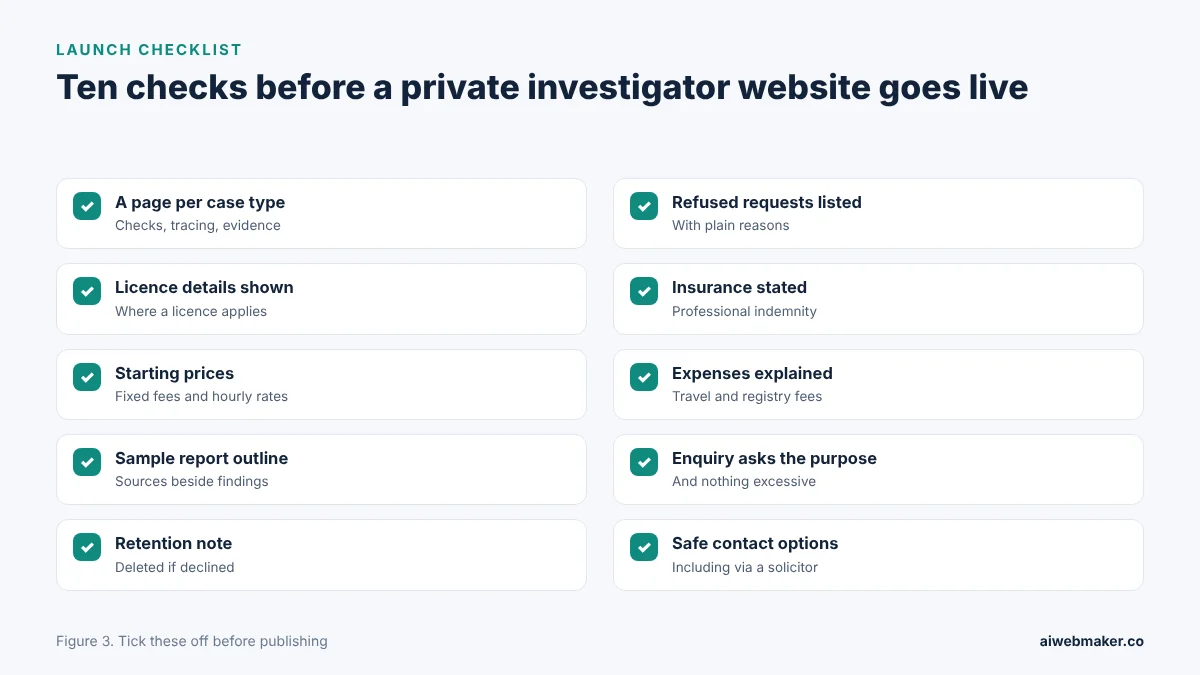
Careful clients leave an investigator's website when it promises to find anything about anyone, because they know that some methods are illegal. Dramatic photos of long lenses and dark cars suggest an agency more interested in image than in evidence. No price guidance or written quote process makes the cost feel open ended. Silence about licences, insurance or confidentiality raises doubts that solicitors will not overlook. An enquiry form that demands full names and addresses of third parties before any conversation feels careless with sensitive data. Every one of these warning signs is matched by a check in the launch graphic that comes next.
Frequently asked questions
Do private investigators need a licence?
Licensing rules for private investigators vary by country and, in some places, by state or province. Some jurisdictions require a licence for the investigator and the agency, while others regulate the work through privacy, data protection and harassment law. An agency should hold whatever licence applies where it works and show it on the website. Clients can then check the details with the issuing body. Clear information on licensing reassures solicitors and private clients alike.
Will an investigator follow a spouse or former partner?
A responsible investigator will not follow, track or investigate a partner or former partner for personal reasons, because it can amount to harassment and can put people in danger. Requests like these are refused even when the client is upset or offers a higher fee. Anyone worried about their own safety should contact the police or a specialist support service where they live. Legal questions about separation are best taken to a family lawyer. Stating this policy on the website protects potential victims and the agency.
Can an investigator find someone's current address?
An investigator can often find a current address from lawful sources, but should release it only for a legitimate purpose such as a debt, a legal claim or an estate. If a person may be avoiding contact for their own safety, a careful agency declines or offers to pass on a message instead. The client should explain the purpose when making the enquiry. Rules on personal data differ between countries, and the agency must follow those where it works. Clear policies on tracing build trust with lawyers and families.
Can an investigator obtain phone or bank records?
Phone, bank and medical records belong to the person concerned and are released only to them or by court order. Anyone offering to obtain them through other routes is likely breaking the law, and evidence gathered that way can ruin a legal case. A legitimate investigator will explain lawful alternatives, such as asking the client's lawyer about disclosure orders. The website should state this clearly in its list of refused requests. Honest limits like these mark out an agency worth trusting.
How many cases pay for an investigation agency's year online?
A single background check or one served set of papers outweighs the $119 an investigator pays to keep the site online all year. Billed monthly, the $19 is covered several times by one hour of casework. Each solicitor who instructs after reading the refused requests and a sample report outline can bring repeat work for years. Clear limits, honest pricing and sourced reports persuade cautious clients in a way that dramatic claims never can. Agencies that keep case pages, licences and prices current become the name solicitors pass to colleagues. Instructions that arrive with the purpose already explained show the website is filtering well.
Build your website in Minutes and get the AI Tools that work
Start Building Your Website →