Marketing Agency Website Cost, Retainers and Proof Buyers Can Check
Agencies pay a flat $119 per year for hosting, with a $19 monthly option, and choose their own domain. After that come buyers, pages, engagement models, media spend, reporting, case studies, onboarding, search and the year in figures.
- No coding required
- Live in minutes
- Blog, SEO and chatbot tools included
Agencies pay AI Web Maker a flat $119 per year to host their own site, with a $19 monthly option for those who prefer it, and choose a domain on top. Every page can be drafted and then rewritten in the agency's own voice while it sits in preview, a step AI Web Maker leaves off the invoice. One month of a single retainer usually repays the year. Proof placed before promises is the idea behind our marketing agency website design sample, a fictional agency put together in AI Web Maker so its pages can be read the way a buyer would. The harder problem is credibility, because buyers of marketing have heard inflated promises before and judge an agency partly by how well it markets itself. A vague site full of buzzwords undermines every pitch, while a precise one qualifies leads before the first call. What follows covers who buys marketing services, the pages an agency needs, engagement models, fees and media spend, reporting, case studies, onboarding, search and the yearly sums.
This article is part of our complete guide: Professional Services Website Builder.
Growing brands, B2B firms and charities: who buys outside marketing help?
Marketing buyers range from founders with no marketing team to experienced directors who need specialist hands, and each reads an agency site differently. Founders want a partner who will explain priorities in plain terms and work within a modest budget. Marketing managers want extra capacity or a channel their team lacks, such as paid search, content or email. Online brands look for experience with paid social, product feeds and retention, while B2B firms need patience with long sales cycles and lead quality. Charities and public bodies want value, careful messaging and transparent reporting for their boards. Every buyer compares sector experience, channel expertise, the seniority of the people on the account, the pricing model and the honesty of the case studies.
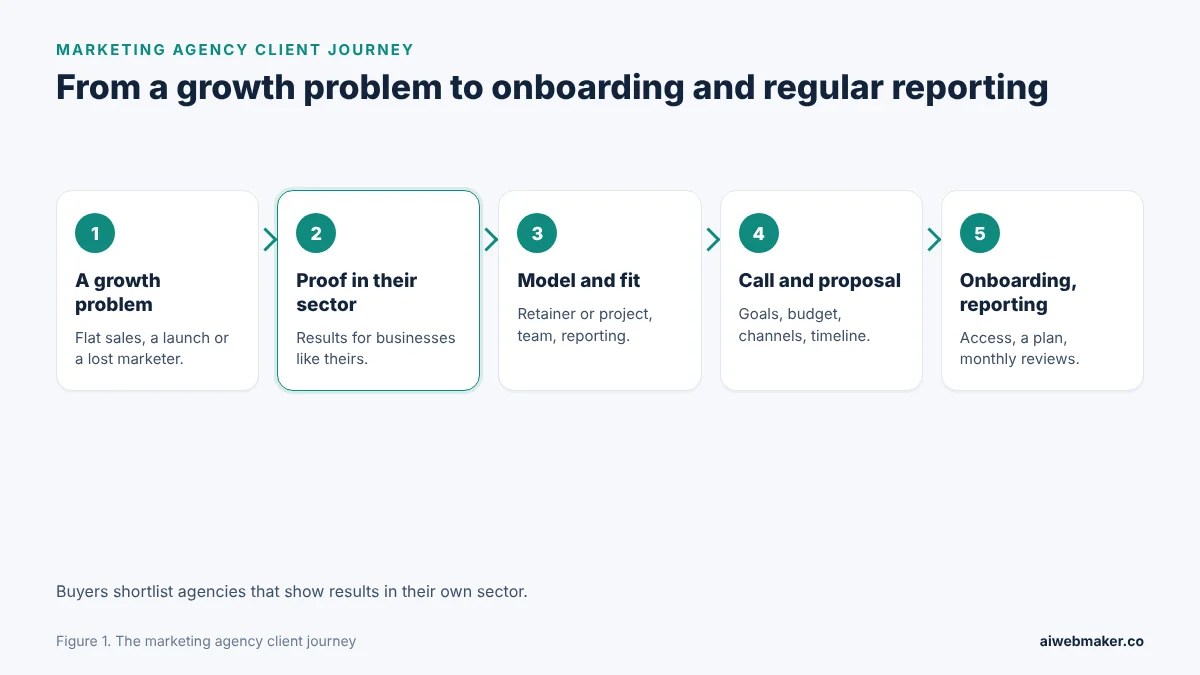
A growth problem starts this journey, whether flat sales, a product launch or the departure of an in house marketer. The highlighted stage is proof in the buyer's own sector, because most buyers shortlist agencies that have produced results for businesses like theirs. Model and fit come next, covering the type of engagement, the team and the way results are reported. A discovery call and a proposal then turn the shortlist into a decision. Onboarding and the first monthly reviews decide whether the relationship lasts beyond the initial term. Agencies whose pages make each stage easy to judge receive calls from buyers who are already halfway convinced.
Services, who they suit, work and team: the agency's own pages
An agency's own site needs fewer pages than its service list suggests, but each one has to be more specific than competitors' pages. The services page describes each channel, what is delivered and who it suits. The work page tells case studies with context, and a page on how the agency works explains engagement models and reporting. A team page names the people who will actually handle the account. A contact page that guides the first conversation completes the set.
| Page | What the buyer asks | What to include |
|---|---|---|
| Home | Does this agency understand businesses like ours? | Positioning line, sectors, one strong result, enquiry button |
| Services | What exactly does it do? | Channels, deliverables, who each service suits |
| Work | Has it delivered for similar clients? | Case studies with context and consented figures |
| How the agency works | What will working together be like? | Engagement models, reporting, onboarding |
| Pricing approach | How is the fee set? | Models, starting points, media spend kept separate |
| About and team | Who will actually work on the account? | Named people, roles, seniority |
| Contact | How does a conversation start? | What to include, reply times |
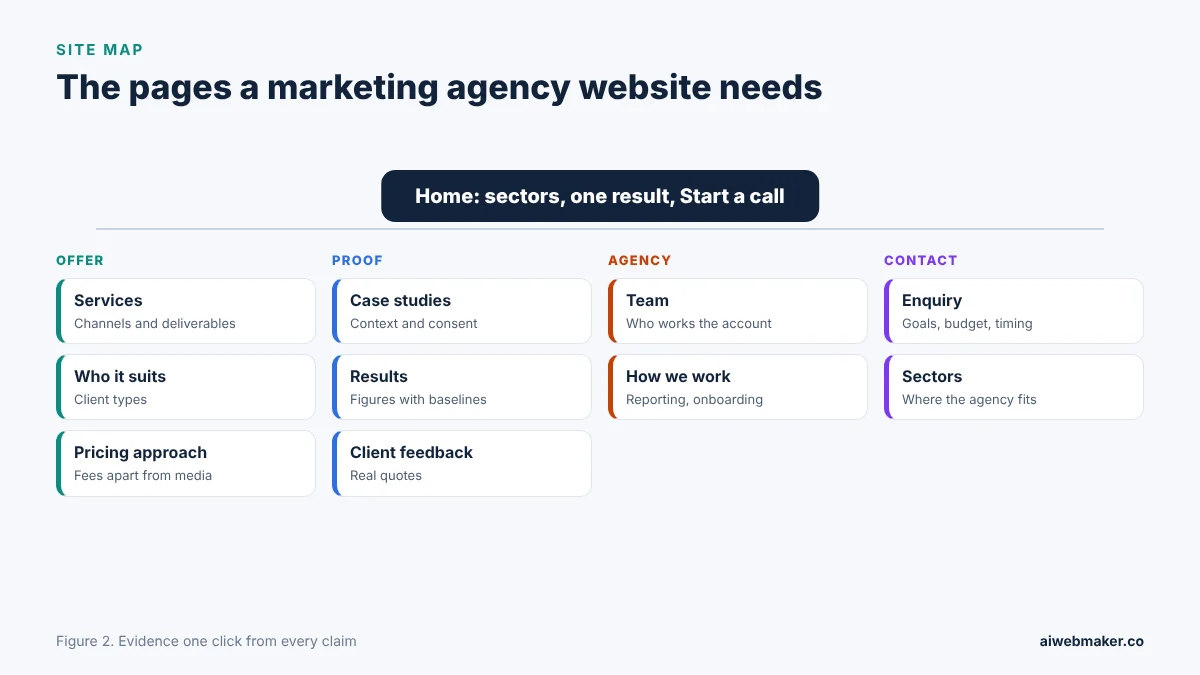
In this agency site map the work branch sits closest to the services, so every claim on a service page is one click from its evidence. Offer pages hold the services, who they suit and the pricing approach. Proof pages hold case studies, results and client feedback. Agency pages describe the team, the way of working and the sectors the agency prefers, while the contact page opens the first conversation. Brightsignal Marketing, the sample agency, opens its services page with a summary of what it offers, follows it with a section explaining who each service suits and invites visitors to build a tailored package; the marketing agency website example with case studies and services matched to client types came together in 41 seconds. Its work page shows selected projects followed by a section on results and client feedback, and its about page names the businesses it enjoys working with beside its story, team and way of working.
Retainers, projects and performance fees: which engagement model fits?
Engagement models should be explained openly, because buyers fear long contracts and unclear fees more than a high price. Monthly retainers suit ongoing channel management, with a defined scope of hours or deliverables. Fixed projects suit launches, audits and rebrands with a clear end. Some agencies add a performance element tied to agreed measures, which needs careful definitions and realistic baselines. Minimum terms and notice periods should be stated in plain language, along with the reason for any initial commitment. A buyer who understands the model before the call spends that call on goals rather than contracts.
| Model | How it works | Often suits | What the page should state |
|---|---|---|---|
| Monthly retainer | A set scope each month | Ongoing channel management | Hours or deliverables, notice period |
| Fixed project | One price for a defined piece of work | Launches, audits, rebrands | Scope, timeline, what is extra |
| Day or hourly rate | Time charged as it is used | Advice and workshops | Rate basis, estimates |
| Performance element | A bonus tied to agreed measures | Mature accounts with clean data | Measures, baselines, caps |
| Hybrid | A retainer plus project work | Growing clients | How the two parts are billed |
Agency fees versus media spend: how should the money be separated?
Agency fees and media spend should be shown as separate lines, because confusing the two is one of the most common sources of mistrust. The management fee pays for the agency's time and expertise. Advertising spend goes to the platforms and is usually best charged directly to the client's own accounts. Tools, production and creator fees may be paid by the client or recharged by the agency, and any markup should be disclosed. Buyers comparing proposals need to see which figure is the agency's income and which is the budget working in the market. Transparent separation makes the agency look confident and the proposal easy to approve.
| Cost | Usually paid to | What the page should say |
|---|---|---|
| Management fee | The agency | The basis of the fee and what it covers |
| Advertising spend | The ad platforms, from the client's accounts | That spend stays in the client's name |
| Tools and software | Vendors, or recharged by the agency | Which tools, and any markup |
| Production | The agency or outside specialists | Photo, video and design costs |
| Creator and partner fees | Creators or publishers | Whether passed through or contracted |
Which reports should clients receive, and how often?
Reports should connect activity to the client's business goals, and their rhythm should be agreed at the start rather than improvised. A short weekly snapshot suits paid campaigns where budgets move quickly. A monthly report can explain what happened, why it happened and what changes next. A quarterly review steps back to strategy, budgets and the measures that matter most. Reports should explain the limits of attribution honestly, since no tool sees every step a customer takes. Clear, candid reporting keeps clients through the months when results are building slowly.
| Report | Frequency | What it contains |
|---|---|---|
| Campaign snapshot | Weekly | Spend, leads or sales, notable changes |
| Monthly report | Each month | Results against goals, insights, next actions |
| Quarterly review | Every three months | Strategy, budget, priorities |
| Annual plan | Once a year | Goals, channels, budget proposal |
| Ad hoc alert | When something changes sharply | What happened and what is being done |
Case studies, consent and claims buyers can verify
A believable case study gives the starting point, the actions taken, the outcome and the time it took, with enough context for a sceptical buyer to judge it. Modest, specific figures persuade more than dramatic percentages without a baseline. Client consent should be obtained in writing before naming a business or sharing its numbers. Founders who did the work at a previous employer can describe it as their own experience, but never as the agency's client. Promises such as guaranteed first page rankings mislead, and advertising rules in many countries treat them seriously. Regulated sectors such as health and finance carry stricter advertising rules, so an agency serving them should show it knows those limits.
Onboarding, account ownership and the first ninety days
A written onboarding sequence reassures buyers who have been burned by agencies that took months to begin work. Advertising, analytics and social accounts should normally stay in the client's name, with the agency given access rather than ownership. The first weeks usually cover access, audits, tracking checks and an agreed plan before major changes. A stated plan for the first ninety days shows when the client can expect early signals and when to expect firmer results. The portfolio website builder that drafts pages for marketing agencies gives an agency a first version of its own site after a few sentences about its services and clients. Clear ownership and a visible plan make leaving easy, which is exactly why clients feel safe staying.
What do buyers type when they need an agency?
Buyers search for phrases such as marketing agency near me, B2B marketing agency, SEO agency or ecommerce marketing agency, often adding a city or sector. Service pages and sector pages that use those words, each linked to matching case studies, reach buyers at the moment of need. For local searches, the map listing should show the office or service area, include team photos and link to the work page. Reviews that mention responsiveness, honest reporting and results over time carry real weight. Articles on briefing an agency, reading a monthly report or setting a realistic budget reach buyers before they shortlist. An agency that ranks for its own services offers the most direct proof of its skill.
Where does hosting fit in an agency's overheads?
Salaries, software licences and office costs dwarf the hosting bill for an agency's own site. An established agency saves by paying for the full year at once. A newly launched agency may spread the cost monthly until its first retainers are signed. Credits for a dozen marketing guides come to roughly $7.80. The figures sit together in the table that follows, with the $189 tier shown for contrast.
| Item | Yearly | Monthly |
|---|---|---|
| Hosting the agency's own pages | $119 | $228 over twelve months |
| Domain | Depends on the ending | Depends on the ending |
| Higher plan, for comparison | $189 a year | Not needed |
| Twelve marketing guides at about $0.65 | About $7.80 | About $7.80 |
| New case studies, services and team updates | No charge | No charge |
| Year before the domain | About $126.80 | About $235.80 |
What makes a buyer drop an agency from the shortlist?
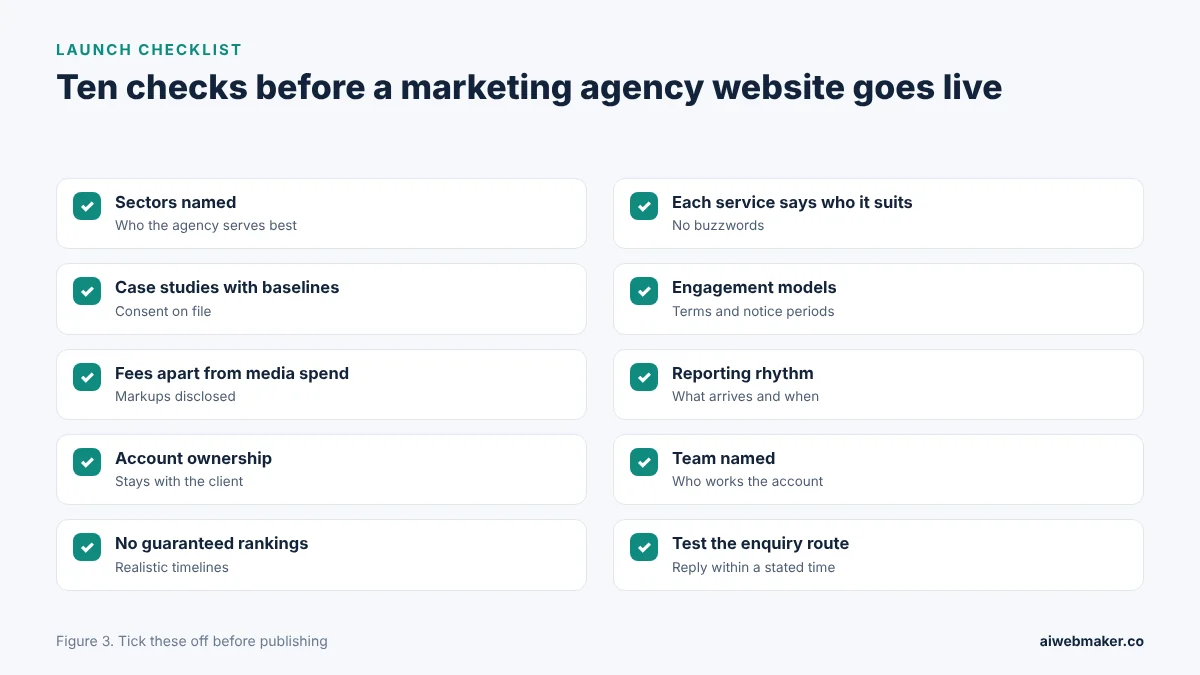
Buyers drop an agency from the shortlist when its own site sounds like every other agency. Buzzwords without sectors or examples suggest the agency has no particular strength. A wall of client logos with no stories leaves buyers unable to judge results. No hint of the pricing model or the team behind the account raises fears of junior staff and surprise fees. Guaranteed rankings or instant growth claims tell experienced buyers to look elsewhere. Ten checks that prevent each of these losses fill the image that follows.
Frequently asked questions
What minimum contract length is fair for a retainer?
Many agencies ask for an initial period, such as three or six months, because setup, testing and learning take time before results settle. After that, a notice period of a month or two is common and fair to both sides. The website should explain the reasoning behind any minimum term rather than simply stating it. Very long lock in periods with no exit route make buyers wary. Clear, reasonable terms help the agency win clients who stay by choice.
Who should own the advertising accounts?
Advertising, analytics and social accounts should normally belong to the client, with the agency given access to manage them. That way the client keeps the data and history if the relationship ends. Agencies that insist on owning accounts make buyers suspicious, however good their results. The onboarding page can explain exactly how access is granted and removed. Clean ownership builds trust from the very first week.
How soon do marketing results usually show?
Timing depends on the channel, the market and the starting point, so no honest agency promises a date. Paid campaigns generate data quickly, though profitable performance often takes weeks of testing. Search and content work usually builds over months rather than weeks. The website can describe typical patterns and how progress is reported along the way. Realistic expectations keep clients patient long enough for good work to pay off.
Can a new agency win clients without case studies?
A new agency can win clients by describing the founders' experience honestly, offering small pilot projects and explaining its process in detail. Work from previous roles can be described as personal experience, never presented as the agency's own client results. Pilot projects for a few clients can quickly become the first real case studies. Pro bono work for a charity or community group can also provide genuine examples. Honesty about being new often appeals to buyers who want senior attention.
Does one retainer cover a year of the agency's hosting?
A single month of one retainer usually earns more than the $119 an agency spends hosting its own site across a year. At $19 a month the hosting is a sliver of one client's fee. Clients who stay several years and refer peers in their sector outweigh years of hosting fees. Specific services, honest case studies, separated fees and clear ownership are what turn a sceptical buyer's visit into a discovery call. Agencies that add new case studies and keep their team page current show buyers a business that practises what it sells. A shortlist invitation from a buyer who has already read the work page is the outcome that matters.
Build your website in Minutes and get the AI Tools that work
Start Building Your Website →