Grant Writer Website Cost, Fixed Fees and Bids That Meet the Deadline
A grant writer's pages stay hosted for twelve months at a cost of $119, or in monthly charges of $19, and the domain is the only addition. Topics: boards and coordinators, pages, fixed fees, the readiness check, budgets and costings, bid timelines, reports and declines, search and the budget.
- No coding required
- Live in minutes
- Blog, SEO and chatbot tools included
A grant writer's funding website sits on AI Web Maker hosting that costs $119 for the year, or arrives as monthly $19 charges, with a domain of the writer's choosing on top. No charge applies while the fee table, the readiness checklist and the project enquiry take shape and get a read through in the preview. The fee for a single application covers the hosting for years, so the website's cost barely features. What does feature is trust, since boards worry about paying for a bid that fails, some have been offered commission deals that funders dislike, and many are unsure whether their group is even ready to apply. A grant writer's site has to explain fixed fees, readiness and the limits of any promise before the first call. Taken in turn below: who hires a writer, the pages, fees and commission, the readiness check, budgets and costings, bid timelines, reports and declines, search and the budget.
This article is part of our complete guide: Professional Services Website Builder.
Treasurers, head teachers and volunteer coordinators with a deadline
Grant writers are usually hired by people who run something worthwhile but lack the time or experience to write a strong application. The treasurer of a local charity, a head teacher planning a new library and the coordinator of a community garden all bring different documents and deadlines. Many have tried applying themselves and been turned down without feedback, while others have spotted a fund closing in a few weeks. Boards want to know what they are paying for, whether the writer knows their kind of cause and how much work will fall on volunteers. Above all they want honesty about their chances, because a failed bid wastes money a group can rarely spare.
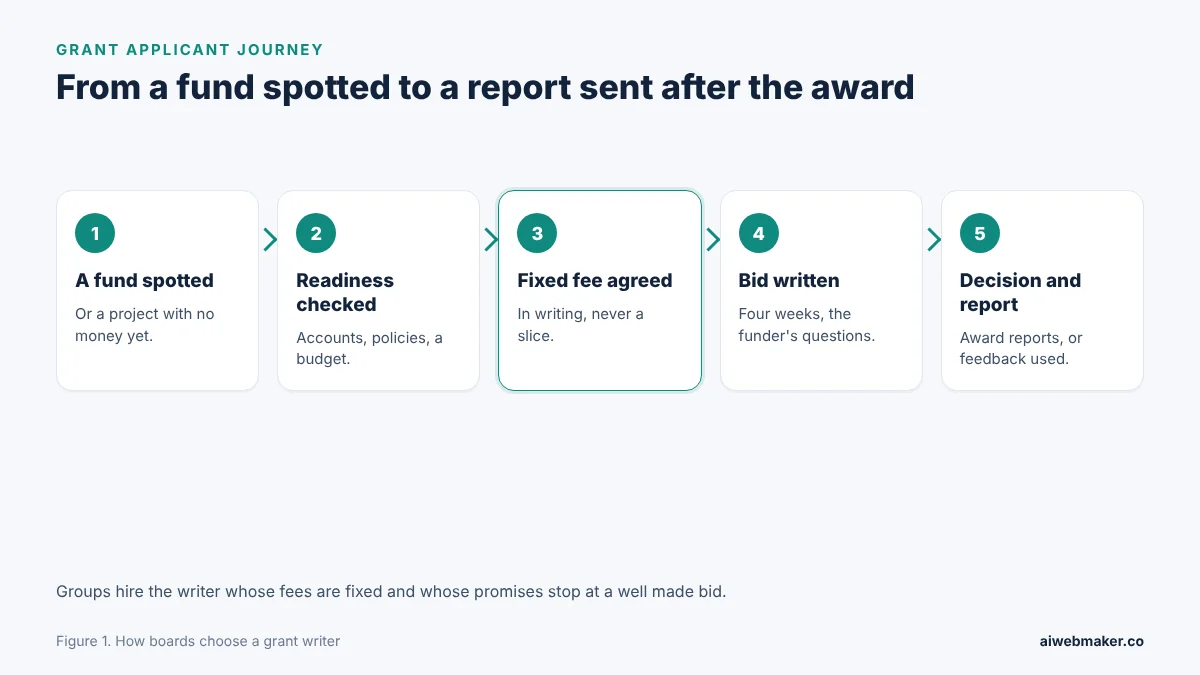
The fixed fee is highlighted because boards decide on cost and honesty together, and a written fee answers both. Most journeys start with a fund someone has spotted, or a project that needs money and no idea where to find it. A readiness check then shows whether the group has the governing document, accounts, bank account and policies that most funders ask for. Once the fee is agreed, the writer drafts to the funder's own questions over a few weeks, with the group commenting. After the decision, either reports to the funder or feedback from a decline shapes the next bid.
Readiness check, services, fees, a bid week by week and the project enquiry
A grant writer's site should feel like the first stage of a bid, organised and specific. The home page states the kinds of organisation served and the promise of applications written to each funder's questions. A readiness page lists the documents most funders want, so groups can gather them before the first call. Service and fee pages cover research, full applications, draft reviews, budgets, reports and a bid library, with fixed prices. A week by week timeline and a project enquiry form complete the route.
| Page | Board's question | What it should show |
|---|---|---|
| Home | Is this writer for groups like ours? | Charities, schools and community projects served |
| Readiness check | Are we ready to apply? | Governing document, accounts, bank account, budget, policies |
| Services | What can the writer do? | Research, applications, reviews, budgets, reports |
| Fees | What will it cost? | Fixed fees, what is quoted separately, no commission |
| A bid week by week | How long does it take? | Call, eligibility, draft, comments, ready to send |
| Project enquiry | How do we start? | Organisation, deadline, amount sought, the project in words |
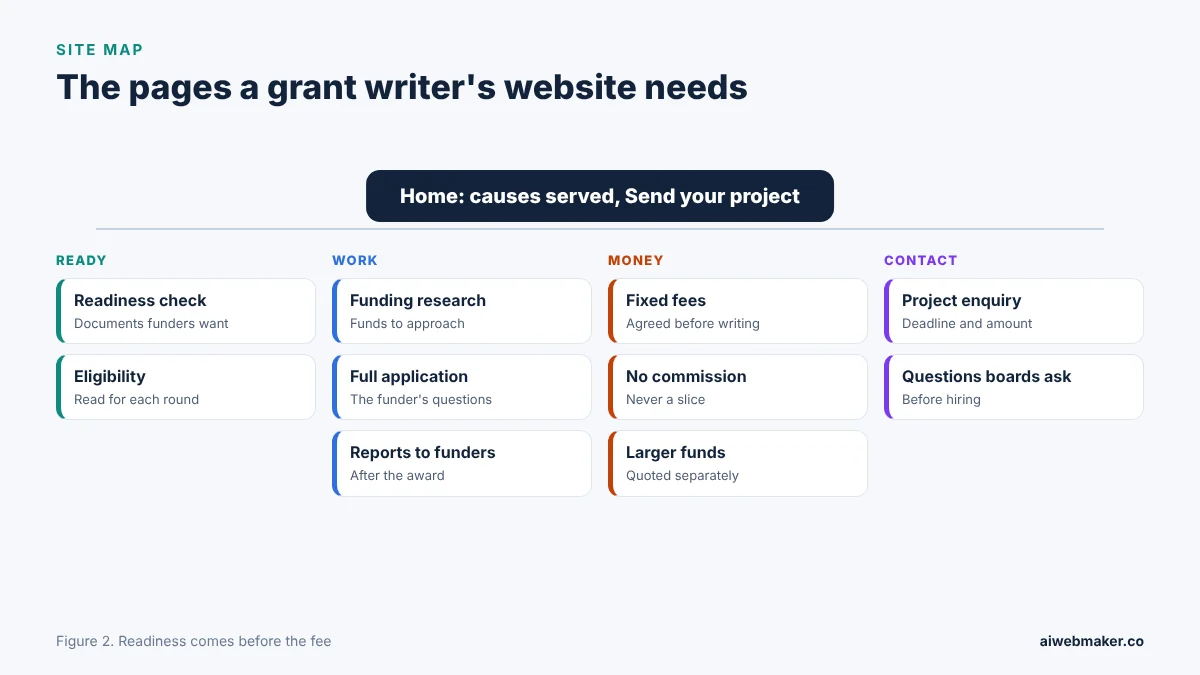
Readiness sits at the head of this plan rather than at the end, since a group that lacks a key document needs to know before it pays for anything. The work group lists the services, the money group holds the fixed fees and the no commission rule, and the contact group carries the enquiry and the questions boards ask. Fundline Grant Writing, our invented sample, offers Funding research, Full application, Review of your draft, Budget and costings, Reports to funders and a Bid library. Its fees are set as a Prospect search, a Single application and a Funding year, after a readiness table and before a week by week account of how a bid comes together. The grant writer website example with a readiness check and fixed fees ends with a project enquiry and the questions boards ask before hiring.
Fixed fees, day rates and why commission stays off the table
Fees are the first thing boards ask about, and the commission question comes straight after. Many professional bodies for fundraisers, in countries including the United States and Britain, discourage or rule out pay based on a percentage of money raised, and many funders will not let grant money cover a writer's success fee. The usual alternatives are a fixed fee per application, a fee for prospect research and an annual arrangement for groups that apply often. Invoicing half at the start and half when the final draft is delivered, whatever the funder decides, keeps the writer's incentive pointed at quality rather than at the easiest fund. Large public funds with several stages are often quoted separately, and the fees page should say so.
| Fee model | How it works | How groups and funders tend to view it |
|---|---|---|
| Fixed fee per application | Agreed before writing begins | A clear budget, paid whatever the decision |
| Prospect search | A fixed fee for a list of suitable funds | Useful before committing to a bid |
| Annual arrangement | A set number of bids and reports | Steady support for regular applicants |
| Day or hourly rate | Time recorded and billed | Flexible, but harder to budget |
| Commission on the award | A percentage of money won | Discouraged by many professional codes and funders |
The readiness check before a word is written
A readiness check protects the group's money, because writing a bid for an organisation that cannot meet basic eligibility wastes everyone's time. Most funders ask for a governing document, recent accounts, a bank account in the group's name, a costed budget and evidence that the need is real. Work with children or vulnerable adults usually requires safeguarding policies, and many funders ask for equality policies too. Requirements differ by country and by funder, and a missing item is rarely a dead end, since it often changes which funds to approach first. Publishing the list lets a group arrive at the first call already prepared.
| Item | Why funders ask for it | If it is missing |
|---|---|---|
| Governing document | Shows the group's purpose and powers | Adopt or update one first |
| Latest accounts | Shows how money is managed | Some funds accept a budget from new groups |
| Bank account in the group's name | Grants are rarely paid to individuals | Open one before applying |
| Costed project budget | Shows what the money buys | The writer can help build it |
| Evidence of need | Proves the project answers a real problem | Gather surveys, waiting lists, letters |
| Safeguarding and equality policies | Expected for work with children or vulnerable adults | Draft and adopt them before the bid |
Budgets that match the story, overheads included
Budgets are where many applications fall apart, because the figures in the table do not match the promises in the text. A good writer builds the budget alongside the narrative, so every activity described has a cost and every cost has a purpose. A fair share of overheads, such as rent, insurance and management time, often belongs in a project budget, and many funders accept it when it is explained. Some funds require match funding or contributions in kind, such as volunteer hours, and the rules for valuing these vary from fund to fund. A budget that adds up and reads honestly tells the panel the group can be trusted with the money.
Four weeks from project call to a bid ready to send
A single application usually needs around four weeks of elapsed time, and the bids written in a rush are often the ones that read worst. The first week covers a project call and an eligibility check against the fund's current guidance, because rules change between rounds. Drafting follows over the next fortnight, written to the funder's own questions and scoring criteria rather than to a stock proposal reused from another bid. The group then comments, figures are checked against the budget and the final version is ready to submit, usually by the group itself through the funder's portal. Publishing this timeline, with the latest date a writer can accept new work before a deadline, helps groups plan rather than panic.
After the decision: reports, declines and the bid library
Winning a grant starts a new piece of work, because most funders expect progress or end of grant reports showing what the money achieved. A writer who offers report writing helps groups keep good relationships with funders, which matters for the next round. When a bid is turned down, asking for feedback where the funder offers it and reworking the application for another fund turns the effort into an asset. A bid library of reusable sections, such as the group's history, its governance and its evidence of need, makes each new application faster. The AI website builder for grant writers and their fixed fee pages drafts the services, fees, readiness and enquiry pages once the writer describes the causes served and the way bids are priced.
Grant writing help near me and other phrases boards type
Charities and schools search with phrases such as grant writer for charities, help writing a funding application or bid writer for community projects, often with a region. Some search for a particular fund first and then for help applying to it, so articles explaining common application questions in general terms can reach them. A map listing matters for writers who meet groups in person, with the service area and office hours shown. Reviews from treasurers and head teachers that mention clear fees and reliable deadlines persuade other boards. Articles on preparing a budget, writing about need or what to do after a decline reach groups months before their next deadline.
Funding databases, memberships and the website: a grant writer's year
Subscriptions to funding databases, professional memberships and insurance outweigh a grant writer's website by a wide margin. AI Web Maker's hosting bill reads $119 for an annual term or $19 for a monthly one, and the domain is a further cost set by the ending picked from about 400. Twelve articles on budgets, evidence of need and reporting, each produced for about $0.65 in AI credits, total roughly $7.80. Changing a fee or adding a new kind of organisation costs nothing. As a yardstick only, a $189 line sits in the table as well.
| Item | Yearly | Monthly |
|---|---|---|
| Hosting the grant writing pages | $119 | $228 over twelve months |
| Domain | Depends on the ending | Depends on the ending |
| Higher plan, for comparison | $189 a year | Not needed |
| Twelve budget and reporting articles at about $0.65 | About $7.80 | About $7.80 |
| Fee and service page changes | No charge | No charge |
| Year before the domain | About $126.80 | About $235.80 |
Success fees, guaranteed awards and other reasons boards hesitate
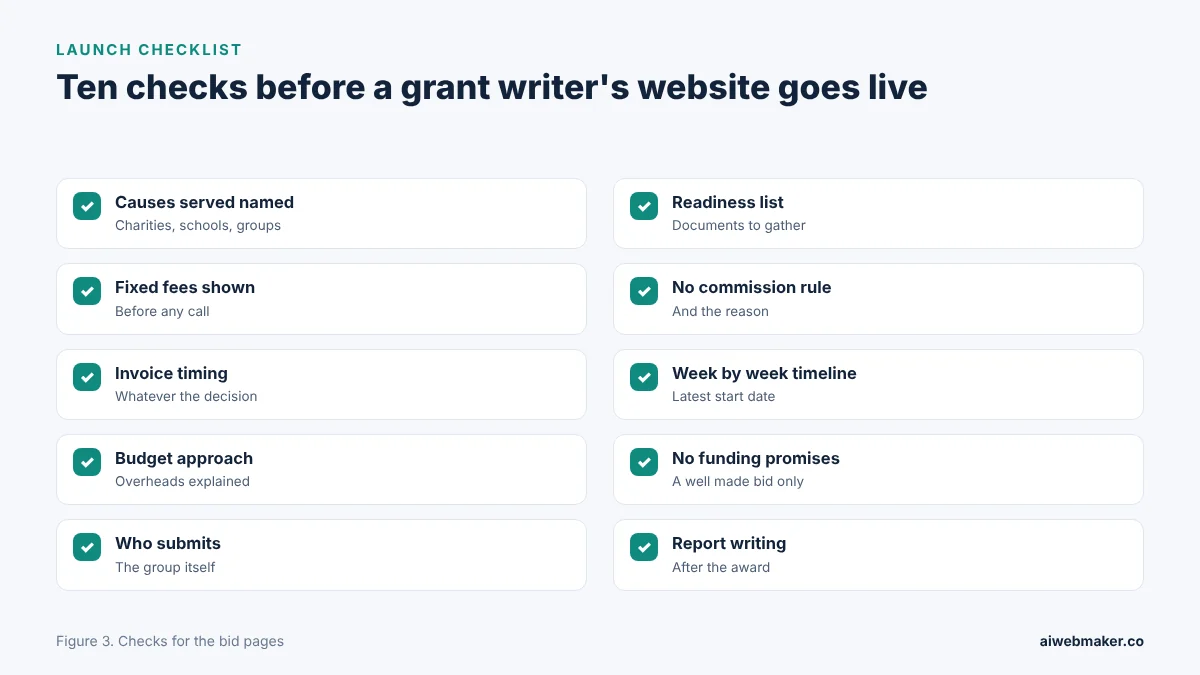
Boards hesitate when a grant writer promises funding, because they know no writer controls a panel's decision. A commission deal raises questions with funders and with treasurers who have read professional codes. Missing fees, or fees that appear only after a call, make volunteer boards uneasy about spending charitable money. No sign of the readiness documents leaves groups unsure whether they are wasting the writer's time and their own. Ten practical checks, pictured next, settle these doubts before a treasurer writes the first email.
Frequently asked questions
Can a grant writer promise that a bid will be funded?
No grant writer can promise an award, because funders decide on many things outside the writer's control, including how many groups applied and the funder's own priorities that round. A writer can promise a bid that answers every question, meets the eligibility rules, presents a budget that adds up and arrives before the deadline. Experience can improve the quality of applications, but success rates vary widely between funds and should never be quoted as a promise. Any offer that guarantees money deserves a board's suspicion. An honest writer's site says this plainly, and the right clients respect it.
Why do grant writers avoid working for a percentage of the grant?
Working for a percentage of the award creates incentives that funders and professional bodies dislike, such as chasing large funds that suit the writer rather than the project. Many funders will not allow grant money to pay a success fee, which leaves the group paying it from elsewhere. Professional codes for fundraisers in several countries discourage or forbid commission for these reasons. A fixed fee agreed in advance lets the group budget and keeps the writer focused on a good application. Explaining this on the fees page answers a question many boards are too polite to ask.
Who submits the application?
In most cases the group submits the application itself, through the funder's online portal or by email, because the funder's agreement is with the group rather than the writer. The writer prepares the final text, the budget and any attachments, and can sit alongside the group while they submit. Declarations, signatures and bank details must come from the organisation's own officers. Some funders ask whether outside help was used, and the honest answer is yes. Clarity on this point avoids confusion in the last hours before a deadline.
How much notice does a grant writer need before a deadline?
Most writers need several weeks of notice for a full application, and four weeks is a common minimum for a single bid of moderate size. Large public funds with several stages can take months, especially when partners or letters of support are involved. Very short deadlines are sometimes possible for reviews of an existing draft. The site can state the latest point at which new work is accepted for a known deadline. Planning early gives the group time to gather documents and the writer time to do the job properly.
One application fee against the hosting year
One application fee comfortably exceeds a grant writer's $119 of annual hosting. Spread monthly, each $19 is smaller than an hour of drafting. Each board that arrives having read the readiness list and the fee table saves a call spent on basics. Annual arrangements with groups that apply often bring repeat work for years. Enquiries that already mention the deadline, the amount sought and the documents in hand show the pages are preparing groups before they write in.
Build your website in Minutes and get the AI Tools that work
Start Building Your Website →