Freight Forwarder Website Cost and the Quote Pages Importers Trust
Forwarding desks keep their website hosted at $119 yearly, or through $19 instalments each month, with the domain priced by its ending. Covered: who ships, mode pages, quote lines, documents, trade terms, customs, search and the yearly budget.
- No coding required
- Live in minutes
- Blog, SEO and chatbot tools included
A freight forwarder's website is hosted for $119 over the year, or $19 in monthly payments for desks that track overheads against bookings, with the domain priced by its ending. Writing the mode pages, the transit table and the quote form, and checking them on screen, happens in the AI Web Maker preview without a bill. The handling fee on one container shipment covers that year comfortably, so the hosting line barely registers. The hard part is that importers and exporters hand a forwarder goods worth far more than the freight, and they need proof that the paperwork, the routing and the insurance will be handled properly. A forwarding website has to show competence in customs, documents and trade terms before anyone shares a commercial invoice. The rest of this article looks at who ships, the pages a forwarder needs, how modes compare, how quotes are built, the documents that cause delays, trade terms and insurance, customs, search and the yearly budget.
This article is part of our complete guide: Professional Services Website Builder.
Which importers and exporters hand cargo to a forwarder, and why?
Importers and exporters use a forwarder because international shipping involves carriers, ports, customs authorities and paperwork that most companies cannot manage alone. Manufacturers bring in components and send out finished goods on regular lanes. Retailers and online sellers import stock from overseas suppliers, often a few pallets at a time. Project shippers move machinery, exhibition stands or building materials once and need careful planning. Each group wants accurate quotes, realistic transit estimates and documents that clear the border first time. Most compare two or three forwarders on how clearly they explain these things before asking for a price.
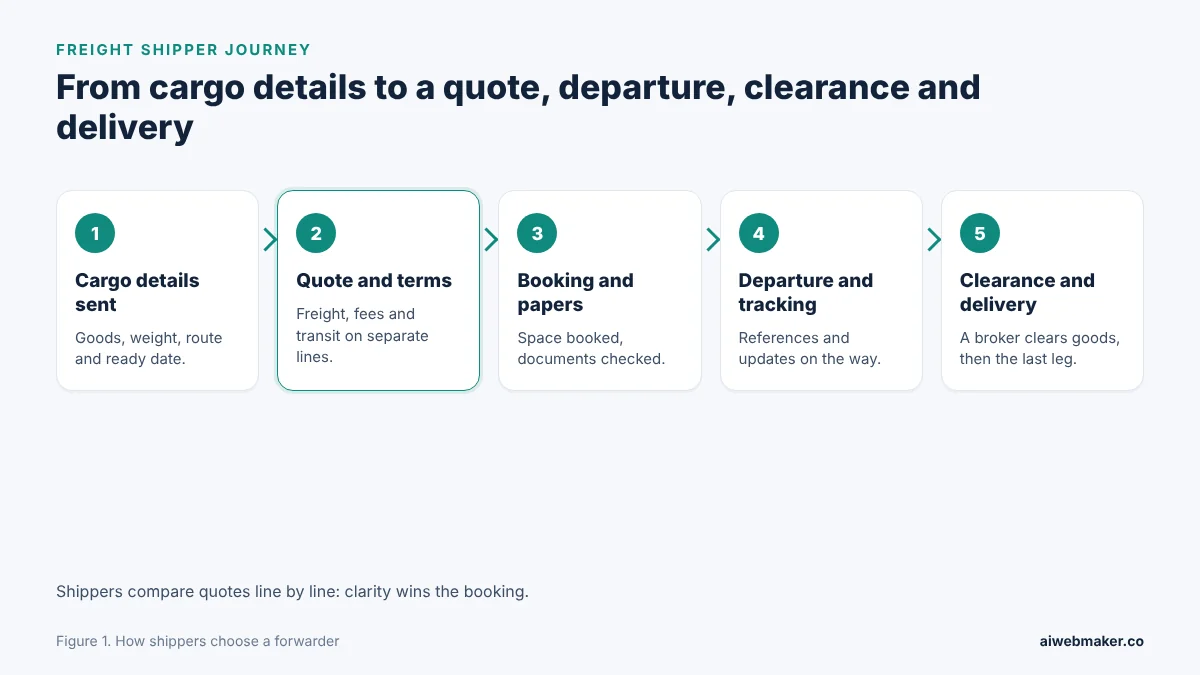
From a shipper's first message to the final delivery, five stages decide whether a forwarder keeps the account. The journey opens with cargo details, which are often rough at first and refined as the quote takes shape. The highlighted stage is the quote itself, where freight, fees and transit estimates sit on separate lines and trade terms are agreed. Booking and paperwork follow, and this is where most avoidable delays start. Departure updates and tracking references reassure shippers while the goods are at sea or in the air. Clearance and the final delivery close the loop, and a forwarder who handles all five calmly is rarely replaced.
What should a forwarding site hold, from modes to customs papers?
Shippers want to judge, before sending any details, whether a forwarder handles their modes, lanes and cargo types, and the pages should make that easy. Each mode deserves its own page, because a company shipping full containers searches differently from one sending urgent air cargo. A transit page with honest estimates and a documents page with a clear checklist answer the questions shippers ask most. A goods page shows which cargo types are handled, including any restrictions. The quote request page then gathers everything the forwarder needs to price the shipment.
| Page | What shippers look for | What it should state |
|---|---|---|
| Sea freight, full containers | Container sizes and routes | Twenty and forty foot boxes, collection, port delivery |
| Shared container loads | Options for a few pallets | Pricing by volume, grouping and splitting times |
| Air freight | Speed and cut off times | General and urgent cargo, screening, air waybill |
| Road freight | Cross border pallets and loads | Part and full loads, transit papers |
| Documents | What must travel with the goods | Invoice, packing list, bills, certificates |
| Cargo insurance | Cover beyond carrier liability | Insured value, how a claim works |
| Quote request | A way to price the move | Mode, goods, route, weight, ready date, terms |
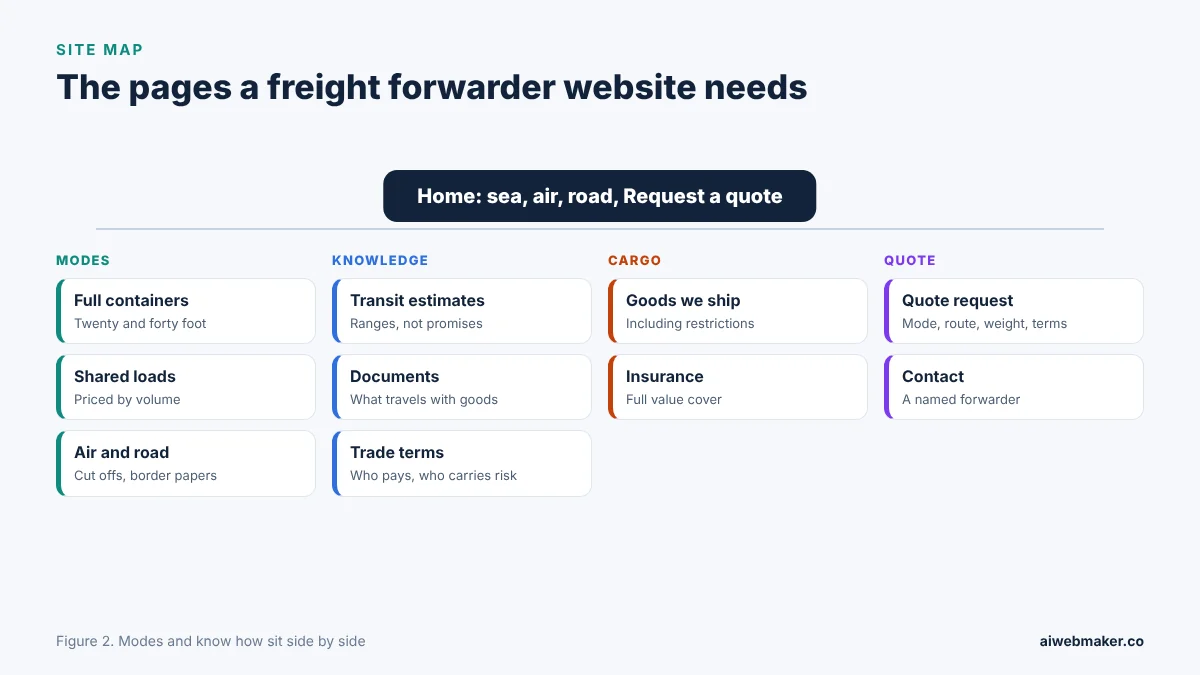
Split into four groups, the forwarder's site places modes, shipping knowledge, cargo types and quoting side by side, so a shipper can move between them without losing the thread. Meridian Freight Forwarding, the invented company behind our freight forwarder website example with a quote request and transit estimates, lists sea freight in full containers, shared container loads, air freight, road freight, export and import documents, and cargo insurance. A transit table gives each mode as an estimate rather than a promise, with notes on what typically causes delays. The process runs from sending details to clearance and delivery in five steps, and a documents section explains what is checked before the cargo moves. Its quote form asks for the mode, the goods, the origin and destination, the weight and size, the ready date, any dangerous goods and the delivery terms agreed with the supplier. That sequence lets a shipper brief the desk fully in a single message.
How do sea, air and road compare on time, cost and risk?
Sea, air and road freight differ in how they are charged, how long they take and what can delay them, and a forwarder's website should set the differences out plainly. Full container loads are priced per container and suit heavy or regular stock. Shared container loads are usually charged by volume or weight, whichever is greater, and take longer because cargo is grouped and split at each end. Air freight is charged on chargeable weight, the greater of actual and volumetric weight, so light but bulky goods can cost more than expected. Road freight across borders is priced per pallet or per load and depends heavily on border queues and driving hour rules. A comparison table helps shippers pick a mode before they ask for a quote.
| Mode | How it is usually charged | Typical pace | Common causes of delay |
|---|---|---|---|
| Sea, full container | Per container | Weeks | Port congestion, transhipment |
| Sea, shared container | By volume or weight, whichever is greater | Weeks, plus grouping time | Consolidation and splitting at each end |
| Air, standard | By chargeable weight | Days | Screening, size limits, capacity |
| Air, express | By chargeable weight, at a premium | A few days | Strict cut off times |
| Road, cross border | Per pallet or per load | Days | Border queues, driving hour rules |
What goes into a freight quote, line by line?
A clear freight quote separates the carrier's freight rate from the forwarder's own fees and from charges set by authorities, because shippers compare quotes line by line. Freight rates follow carrier pricing and change often, so quotes should carry a validity date. Surcharges for fuel, peak seasons or currency movements should be named, not buried in a single total. Origin and destination charges, such as terminal handling, belong on their own lines. Duties and import taxes are set by the destination country and are best shown as passed on at cost. The AI website builder for freight forwarders with a quote request form turns a forwarder's short account of its lanes and services into draft mode pages, a transit table and a quote request form, and every figure can be adjusted before the site goes live.
| Quote line | Who sets it | What the shipper should see |
|---|---|---|
| Freight rate | The carrier | The rate and how long it is valid |
| Surcharges | The carrier | Fuel, peak season or currency items named |
| Origin and destination charges | Ports, terminals, agents | Handling and delivery at each end |
| Forwarder's handling fee | The forwarder | A fixed fee agreed before booking |
| Documents and customs entry | The forwarder or a broker | Each set priced separately |
| Duties and import taxes | The destination authority | Passed on at cost, never marked up |
| Cargo insurance | The insurer | Premium based on insured value |
Which shipping documents cause the most delays?
Most avoidable delays start with a document, such as a value that does not match the invoice, a missing certificate or a vague description of the goods. The commercial invoice and packing list must agree with each other and with the cargo. A bill of lading or sea waybill covers ocean freight, while an air waybill covers air cargo and a consignment note covers road freight, for example the CMR note used widely in Europe. Certificates of origin matter when a trade agreement reduces duty, and wooden packaging may need treatment marks under international plant health standards. Dangerous goods require declarations prepared to each carrier's rules. A forwarder who checks every set before departure saves shippers days of waiting at the destination.
Who carries the risk under the agreed trade terms?
Risk and cost pass from seller to buyer at the point fixed by the trade terms in the sales contract. Most contracts use one of the Incoterms rules published by the International Chamber of Commerce for this. Terms such as EXW, FOB, CIF, DAP and DDP each place that point differently, and shippers often choose them without knowing who pays the freight or the insurance. A forwarder's website can explain the common options in plain words and quote to whichever terms the shipper has agreed. Carriers' liability for loss or damage is limited by international conventions and national law, often to a sum far below the value of the goods. Cargo insurance arranged for the full value closes that gap and can also matter when a vessel's owners declare general average and ask every cargo owner to share a loss. Explaining these points clearly shows that the forwarder protects the shipper's money as well as the goods.
How should customs, duties and dangerous goods be described?
Customs and duties should be described carefully, because they are decided by each country's authorities and not by the forwarder. Duty usually depends on the tariff classification of the goods, their value and their origin, and the importer generally remains responsible for what is declared. Many countries require a licensed customs broker to file entries, and a forwarder can coordinate one where needed. Dangerous goods, such as lithium batteries, aerosols and many chemicals, can travel only when declared, packed and labelled to the rules for each mode, and some are refused by airlines entirely. Restricted goods and sanctions rules also vary by country and can change quickly. Honest wording on these limits protects shippers from costly surprises and protects the forwarder from blame for rules it does not set.
What do importers type when they need a forwarder on a new trade lane?
Shippers searching for help usually type a mode and a lane, such as sea freight from a named country or air cargo to a city. Others type shared container shipping or customs clearance for imports. Some search by cargo, for example shipping furniture, machinery or batteries overseas. Each mode page and each regular lane deserves a heading that uses those exact phrases. A map entry with office hours, the address near the port or airport and the website link reaches shippers looking for a local desk. Reviews that mention clear quotes, smooth clearance and quick replies persuade more than any claim of global reach. Articles on trade terms, documents or seasonal capacity crunches bring shippers to the site before their next booking.
Pricing a forwarding desk's hosting, domain and articles
Hosting and a domain are all a forwarder pays for on a recurring basis, while a dozen trade lane articles written through AI credits total less than eight dollars. A desk with steady volumes keeps the total lowest by paying annually. A new forwarder may choose monthly payments while it builds regular lanes. Changing fees, lanes or transit estimates costs nothing extra. Below, the $189 plan sits on its own row as a benchmark only.
| Item | Yearly | Monthly |
|---|---|---|
| Hosting the freight forwarder pages | $119 | $228 over twelve months |
| Domain | Depends on the ending | Depends on the ending |
| Higher plan, for comparison | $189 a year | Not needed |
| Twelve trade lane articles at about $0.65 | About $7.80 | About $7.80 |
| Fee, lane and transit updates | No charge | No charge |
| Year before the domain | About $126.80 | About $235.80 |
Why do shippers abandon a forwarder's quote page?
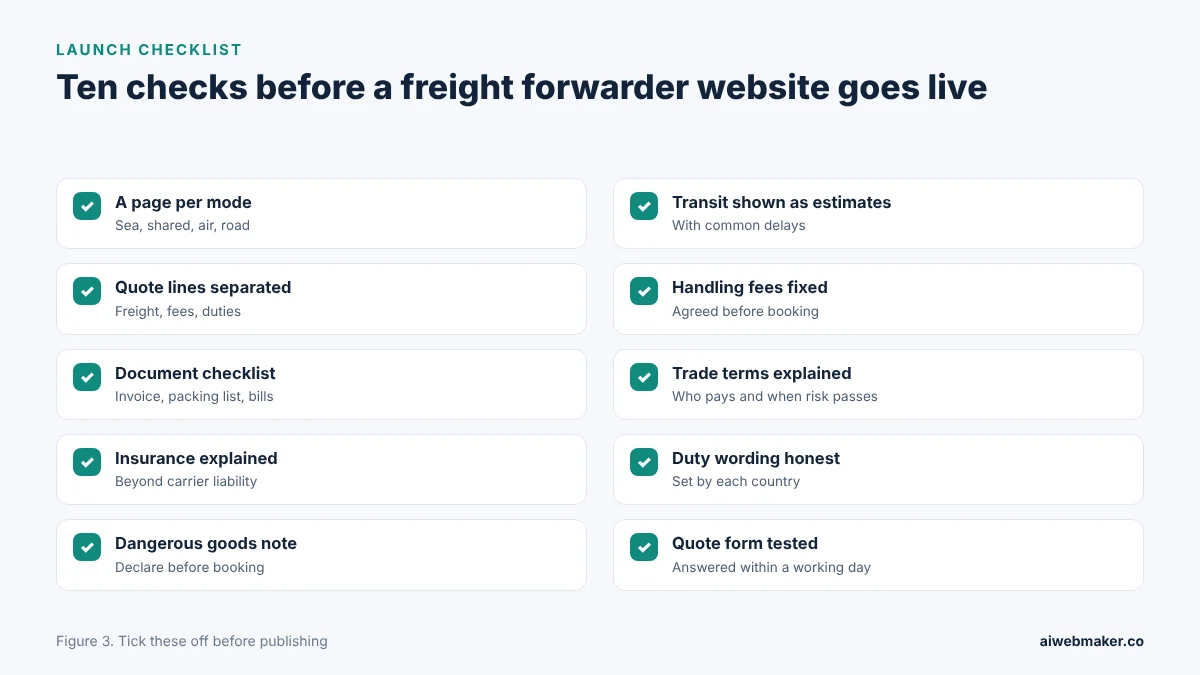
Shippers abandon a forwarder's website when transit times are presented as guarantees, because experienced importers know that schedules slip. A single all in price with no separate lines makes the quote impossible to compare. Silence about duties, documents or insurance suggests the forwarder will pass problems back to the shipper. A quote form that ignores cargo type, weight or trade terms promises a slow exchange of emails before any price arrives. Missing contact names make the desk feel like a call centre rather than a partner. The checklist graphic that comes next turns each of these weak spots into a check.
Frequently asked questions
Does a forwarder decide the import duty?
A forwarder does not decide import duty, because duty and import taxes are set by the customs authority of the destination country. The amount usually depends on the classification of the goods, their declared value and their origin. A forwarder can advise, coordinate a licensed broker and advance the payment where agreed. The importer generally remains responsible for the accuracy of the declaration. Saying this clearly on the website prevents misunderstandings when the duty bill arrives.
Why are transit times only estimates?
Transit times are estimates because carriers set and change their own schedules, and weather, port congestion, inspections and public holidays can all add days. Transhipment at busy hubs adds further uncertainty for sea freight. A forwarder can confirm the planned schedule at booking and report any change as soon as it happens. Publishing estimates as ranges, with common causes of delay, sets honest expectations. Shippers trust forwarders who say this plainly.
Is cargo insurance worth buying when the carrier is liable?
Cargo insurance is usually worth buying because a carrier's liability is limited by conventions and law, often to an amount well below the value of the goods. Some losses fall outside carrier liability altogether, and general average can require cargo owners to contribute even when their goods are undamaged. Insurance arranged for the full value covers these gaps. The premium is small compared with the value at risk for most shipments. A forwarder's website should explain this without pressuring the shipper.
Can lithium batteries be shipped by air?
Lithium batteries can often be shipped by air, but only when they are declared, packed, labelled and documented under the dangerous goods rules that airlines and authorities apply. Rules differ for batteries packed alone, packed with equipment or contained inside it. Some airlines refuse certain types entirely, and limits apply to quantity and charge level. Shippers should describe the goods exactly when requesting a quote. A forwarder who explains this in advance avoids cargo being stopped at the airport.
How many shipments repay a forwarder's year on the web?
The handling fee on a single container booking outweighs the $119 a forwarder spends hosting its site for twelve months. Billed monthly, the $19 is a fraction of one document fee. Every importer who books after reading a clear quote breakdown and an honest transit table is a lane that might have gone to a competitor. Separate quote lines, careful document advice and plain words on terms and insurance persuade shippers who have been burned before. Forwarders who keep lanes, fees and estimates current find that regular shippers stop shopping around. Repeat bookings arriving through the quote form are the measure that matters most.
Build your website in Minutes and get the AI Tools that work
Start Building Your Website →