Environmental Consultant Website Cost, From Desk Study to Proposal
Environmental consultancies host their site for $119 across a full year, or $19 monthly, and buy the domain separately. Covered: who commissions studies, study pages, survey seasons, lab results, proposals, permits, search and the yearly budget.
- No coding required
- Live in minutes
- Blog, SEO and chatbot tools included
Hosting an environmental consultancy's website takes $119 across a full year, while firms that like costs to track their commissions can opt for $19 monthly, and the domain is extra. Every study page, stage table and proposal form can be drafted, tested and redrafted in the AI Web Maker preview, and that stage carries no bill. One desk study fee covers that year many times over, so hosting is a rounding error in a consultancy's overheads. The real challenge is that clients rarely want an environmental study for its own sake; they commission one because a planner, a lender or a regulator has asked for it. A website therefore has to show, in minutes, which study meets which request, what it costs and how quickly the report arrives. The rest of this page deals with who commissions studies, the pages they expect, survey seasons, ground investigation results, proposals, honest permit wording, search and the yearly budget.
This article is part of our complete guide: Professional Services Website Builder.
What pushes a developer or council to commission a study?
Most environmental studies are commissioned because someone else requires them, such as a planning authority, a lender, an insurer or an environmental regulator. Housebuilders and developers need evidence on ground conditions, ecology and noise before an application can be decided. Property buyers and their lenders want to know whether past uses have left contamination that could cost money later. Factories, warehouses and farms need support with permits for discharges, emissions or waste. Councils and public bodies commission studies for their own schemes and often follow formal procurement rules. Each of these clients arrives with a deadline and a document that names what is needed, so the website should speak to that request directly.
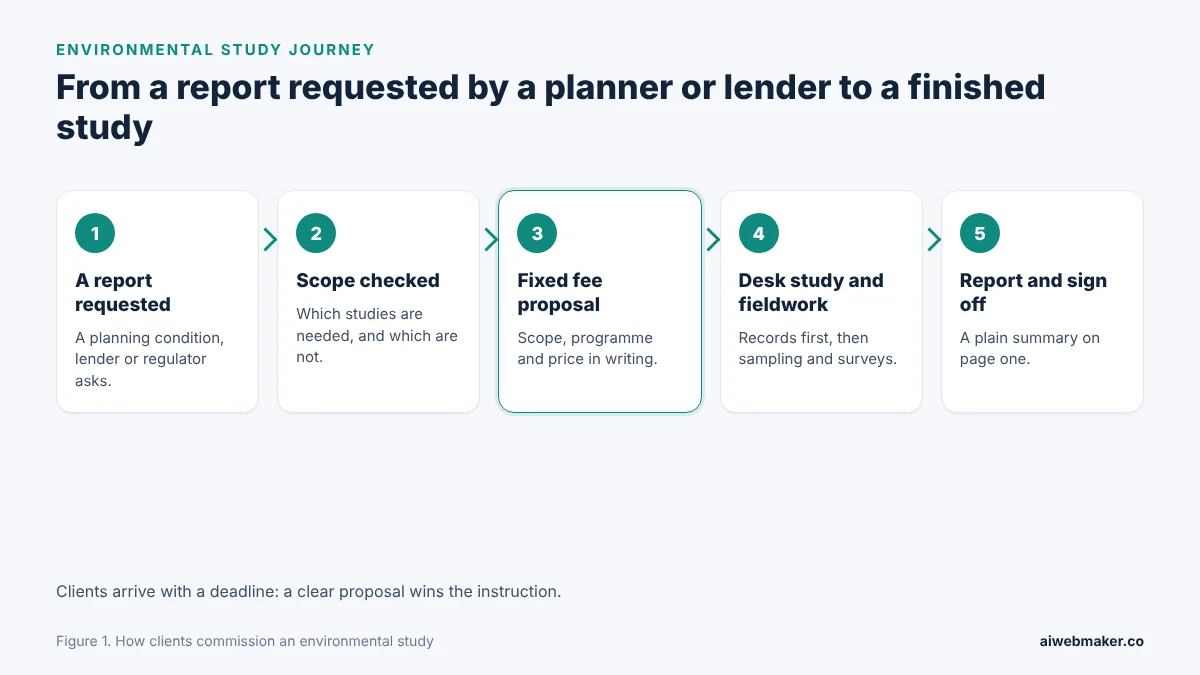
Moving from a requested report to final sign off, the five stages show where a consultancy's website does its heaviest lifting. The first contact usually comes with a planning condition, a lender's letter or a regulator's notice attached. Scoping follows, and clients value a consultant who says which studies are not needed as much as which ones are. The highlighted stage is the fixed fee proposal, because a clear scope, programme and price decide whether the commission goes ahead. Desk study and fieldwork then gather the evidence, and the report closes the loop with a summary the client can forward. A site that explains each stage plainly turns a nervous first call into a signed instruction.
Which study pages does an environmental consultancy need?
An environmental consultancy needs one page for each kind of study it offers, because clients search and commission them separately. Each study page should explain what the study answers, when it is usually asked for, what fieldwork is involved and what the report contains. A stages page helps clients who know their project stage but not the name of the study. A process page shows how a commission runs from scoping call to report. A reports page with a sample summary, and a proposal request page, complete the set.
| Page | Who reads it | What it should state |
|---|---|---|
| Desk study and site history | Buyers, lenders, developers | Records reviewed, typical turnaround, starting fee |
| Ground investigation | Developers, engineers | Trial pits, boreholes, sampling, laboratory testing |
| Ecology surveys | Developers, councils, farms | Habitats, protected species, survey seasons |
| Noise and air monitoring | Contractors, councils, neighbours | Baseline and construction monitoring, reporting |
| Permit and consent support | Factories, warehouses, farms | Applications and reports, with decisions left to the authority |
| Environmental management plans | Site teams, contractors | Dust, run off, waste and wildlife controls |
| Proposal request | Anyone ready to commission | Study, project stage, location, deadline |
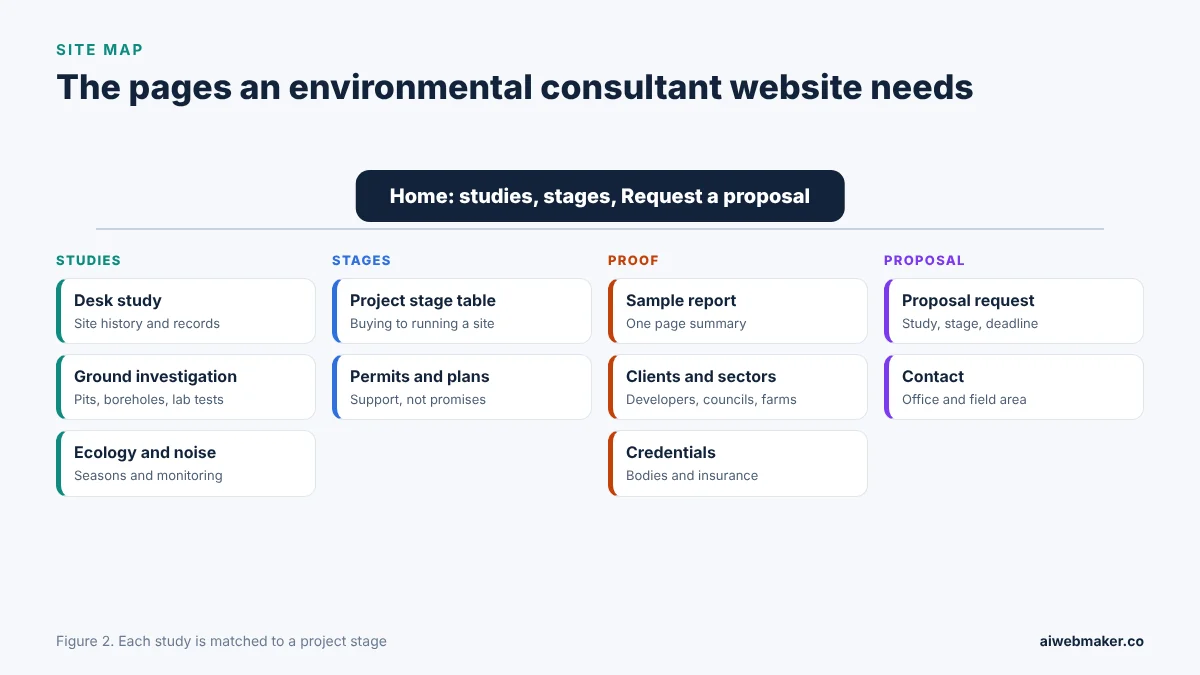
Four branches organise the consultancy site around a client's questions: which study, which stage, what the report looks like and how to get a price. Greenfield Environmental, the invented firm in our environmental consultant website example with a fixed fee proposal request, follows that order closely. Its assessments cover a desk study and site history, ground investigation, ecology surveys, noise and air monitoring, permit and consent support, and environmental management plans. A table matches each study to a project stage, from buying land through planning, groundworks and construction to running a site. The commission runs in five steps from a scoping call to a report, and every report opens with a one page summary in plain words. The proposal form asks for the study, the project stage, the site location and area, any deadline and what has been requested so far, which gives a consultant enough to price the work.
Which study fits each stage of a development?
Clients often know their project stage before they know which study answers it, so a stage table earns its place near the top of the site. Buying land or a building usually calls for a desk study of past uses, sometimes followed by a site walkover. A planning or zoning application may need ground, ecology and noise reports, depending on what the authority lists. Before groundworks, the evidence has to show that any contamination is understood and managed. During construction and operation, management plans, monitoring and permits take over. Because requirements differ between countries and between local authorities, the table should say that it shows a common pattern and that a scoping call confirms what applies.
| Project stage | What clients are usually asked for | Study that answers it |
|---|---|---|
| Buying land or a building | Evidence of past uses and possible contamination | Desk study, with a walkover if risks appear |
| Planning or zoning application | Ground, ecology and noise information | The surveys the authority lists, as one package |
| Before groundworks | Proof that contamination is understood | Ground investigation and a remediation strategy |
| During construction | Controls on dust, noise, run off and wildlife | Environmental management plan and monitoring |
| Running a site | Permits for discharges, emissions or waste | Permit applications and periodic reporting |
Why do ecology surveys follow the calendar?
Ecology surveys follow the calendar because many species can only be recorded reliably while they are active, breeding, nesting or flowering. A habitat survey can often be done for much of the year, but surveys for particular protected species usually fall within set seasonal windows. Bat activity surveys, breeding bird surveys and botanical surveys each have their own months, and those months shift with climate and latitude. Missing a window can push a planning application back by most of a year, which is why developers value consultants who warn them early. The website should explain this plainly and invite clients to book surveys before the season opens. Clear seasonal advice is one of the quickest ways a consultancy can save a client time and money.
| Survey type | Usual timing in temperate regions | Why timing matters |
|---|---|---|
| Habitat survey | Much of the year, best in the growing season | Plants and features are easiest to identify |
| Bat activity surveys | Warmer months when bats are active | Inactive bats cannot be recorded reliably |
| Breeding bird surveys | Spring into early summer | Nesting birds are present and protected |
| Amphibian surveys | Breeding season in ponds | Animals gather where they can be counted |
| Botanical surveys | When target plants flower | Many species are only identifiable in flower |
How should ground investigation results be explained?
Ground investigation results should be explained in terms of risk to people, water and buildings, not as a wall of laboratory numbers. Trial pits and boreholes show what lies beneath the surface, and samples go to a laboratory accredited for the tests involved. Results are compared with screening values that depend on the country and on the planned use of the land, so a figure that is acceptable for a car park may not be acceptable for gardens. Consultants often describe risk through a conceptual site model that links a source of contamination, a pathway and a receptor. Where risk is found, options range from leaving material in place under a clean cover layer to removal or treatment, agreed with the client and the regulator where required. A website that explains this approach in plain words shows clients the consultancy can translate science into decisions.
What should a fixed fee proposal set out?
A fixed fee proposal should set out the scope, the programme, the fee and the assumptions behind them, because clients compare proposals line by line. Laboratory testing is often charged at cost and is clearest on its own line, since the number of samples can change after fieldwork begins. Exclusions, such as access arrangements, traffic management or extra boreholes, prevent disputes later. Payment stages should follow the programme, with each stage invoiced as the work is delivered. The AI website builder for environmental consultancies with a proposal request form drafts study pages, a stages table and an enquiry form after the consultancy describes its services in a few lines, and the draft can be edited before launch. A website that explains how proposals work earns requests from clients who already understand what they will receive.
| Proposal element | What it should make clear |
|---|---|
| Scope | Which studies are included and which are not needed |
| Programme | Fieldwork dates, laboratory time and report delivery |
| Fee | A fixed figure for the agreed scope |
| Laboratory costs | Charged at cost, shown on a separate line |
| Assumptions | Site access, number of sampling points, season |
| Payment stages | Invoices tied to delivered stages of work |
What can a consultant honestly say about permits and approvals?
A consultant can say that it prepares complete, accurate applications and reports, but it cannot promise that a permit or planning approval will be granted. Decisions belong to the authority that issues them, and the rules differ between countries, regions and even individual councils. Claims of guaranteed approval mislead clients and can breach advertising and professional rules. Membership of a recognised professional body, relevant qualifications and professional indemnity insurance are proper signals of competence, where they apply. Confidentiality matters too, because site data and planning intentions are often commercially sensitive. Honest wording about what a consultant controls, and what it does not, builds the trust that repeat commissions depend on.
Which phrases do clients type when a planner asks for a report?
Clients searching under pressure type the name of the report they were asked for, such as phase one environmental site assessment or contaminated land survey. Others type bat survey for planning, noise impact assessment or permit application support. Many add their county, city or region, because fieldwork costs rise with distance. Each study page should repeat the client's own name for the study in its title and first paragraph. A map entry with office hours, field photos and the website address reaches clients who prefer a consultant nearby. Reviews from developers, architects and councils that mention turnaround and clear reports carry weight with similar clients. Articles explaining survey seasons, planning conditions or what to do when contamination is found bring steady visits from people about to commission.
How does the hosting line compare with one desk study fee?
Only two lines recur for an environmental consultancy, hosting and the domain, and twelve technical articles drafted with AI credits stay under eight dollars in total. A firm with steady commissions keeps the total lowest on annual billing. A new practice may favour twelve smaller payments while it wins its first clients. Adding studies, fees or project photos carries no extra charge. The dearer $189 plan appears only as a yardstick next to the two billing routes.
| Item | Yearly | Monthly |
|---|---|---|
| Hosting the environmental consultant pages | $119 | $228 over twelve months |
| Domain | Depends on the ending | Depends on the ending |
| Higher plan, for comparison | $189 a year | Not needed |
| Twelve survey and permit articles at about $0.65 | About $7.80 | About $7.80 |
| New studies, fees and field photos | No charge | No charge |
| Year before the domain | About $126.80 | About $235.80 |
Why do developers close a consultancy's site and ring a rival?
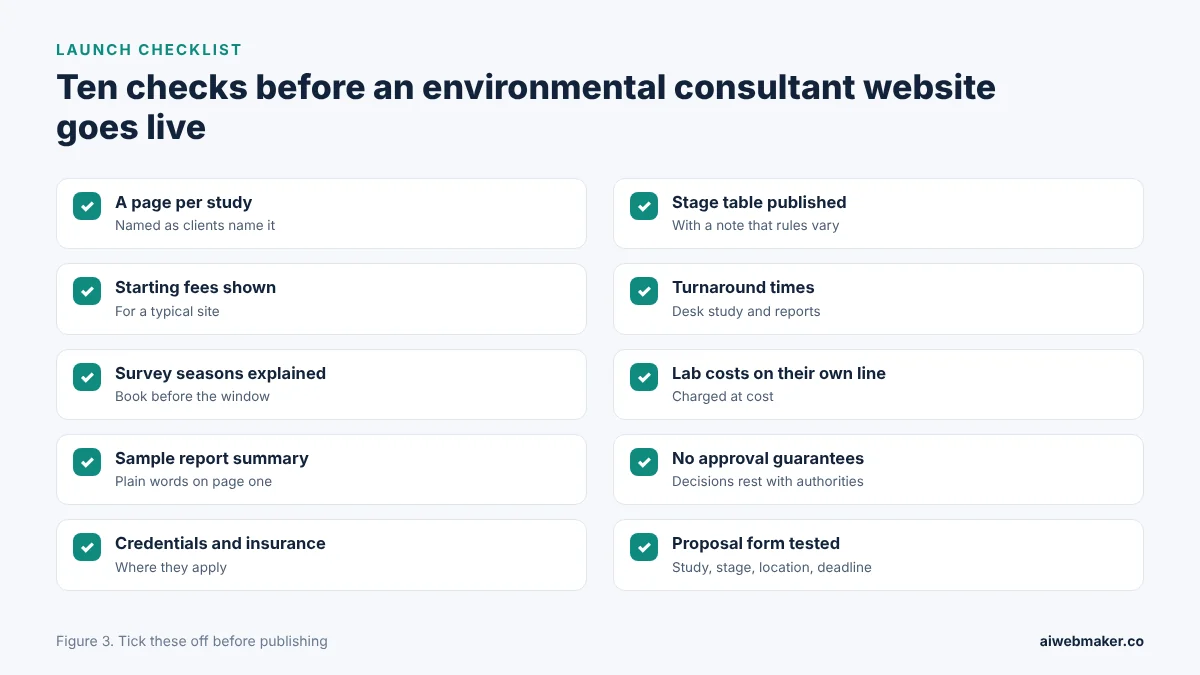
Developers abandon a consultancy's site the moment it is unclear whether the exact study their planner requested is on offer. Pages without starting fees or turnaround times make the firm seem slow or expensive. No mention of survey seasons suggests the consultant may let a window pass. Promises of guaranteed approval make experienced clients wary rather than reassured. A proposal form that asks nothing about the site, the stage or the deadline signals a generic response to come. These doubts disappear once the ten launch checks in the graphic below are ticked off.
Frequently asked questions
Who decides whether a permit or planning consent is granted?
No consultant can guarantee approval, because the decision belongs to the planning authority or regulator that issues the permit or consent. What a consultant can promise is complete, accurate evidence presented clearly and on time. The website should state this openly, ideally on each permit and planning page. Clients with experience of the process trust consultants who are honest about this boundary. Clear wording also protects the consultancy if a decision goes against the client.
Why can a missed survey season delay a project?
A missed survey season can delay a project because some protected species can only be surveyed while they are active or breeding. If the window passes, the survey may have to wait until the same months the following year. Planning authorities often need these results before they can decide an application. Booking surveys early, as soon as a site is under consideration, avoids that delay. Consultants who explain this on their website help clients plan realistic programmes.
Should laboratory costs be shown separately in a proposal?
Showing laboratory costs separately helps clients see what they are paying for and why the total might change. The number and type of samples often depend on what fieldwork reveals. A line stating that testing is charged at cost, with an estimate for the expected samples, is clear and fair. Clients comparing proposals can then compare consultancy fees on equal terms. Transparency on this point reduces disputes at the invoice stage.
Is a desk study enough when buying a property?
A desk study is often enough to show whether a property's past uses suggest a contamination risk, and many purchases need nothing more. If the desk study finds possible problems, a site walkover or a ground investigation may follow. Lenders and buyers' lawyers sometimes set their own requirements, which vary by country. The consultant should explain what the desk study can and cannot show. A clear answer helps buyers decide quickly and proportionately.
How many desk studies cover a consultancy's year online?
A single desk study fee pays for the $119 that hosts an environmental consultancy's website for a year many times over. With monthly billing, the cost of $19 is smaller than a sliver of one day's fieldwork. Every developer or council that commissions a study after reading a clear stage table brings work that might have gone to a rival. Plain study pages, honest seasonal advice and well structured proposals persuade clients who are under deadline pressure. Consultancies that keep their fees, seasons and sample reports current find that repeat clients return without shopping around. Proposal requests that arrive with the planner's letter already quoted show that the site is doing its job.
Build your website in Minutes and get the AI Tools that work
Start Building Your Website →