Cybersecurity Consultant Website Cost, Scoped Tests and Plain Reports
A security consultancy's pages stay up for twelve months on $119 of hosting, while $19 covers any single month, with the domain as an extra. Inside: buyers and their worries, pages, scoping and price, permission to test, reports, questionnaires and compliance, incidents, search and the budget.
- No coding required
- Live in minutes
- Blog, SEO and chatbot tools included
A cybersecurity consultancy's website draws on AI Web Maker hosting that totals $119 over twelve months, or comes in monthly portions of $19, and its domain is the one other line. The service pages, the scope table and the enquiry form may be drafted and walked through in the preview without a bill. A single health check for one client pays for the hosting many times over, so cost is the easy part. The hard part is that buyers in this market are wary of scare stories, unsure what a penetration test involves and nervous about letting an outsider look around their systems. A consultancy's site has to replace fear with scope, permission, fixed prices and reports a director can read in minutes. From here the guide takes in buyers, pages, scoping and price, permission to test, findings and reports, questionnaires and compliance words, incidents, search and the budget.
This article is part of our complete guide: Professional Services Website Builder.
Practice managers, finance directors and the customer questionnaire that started it
Companies with ten to a few hundred staff rarely employ a security specialist, so the first contact is often a director, an office manager or a finance head. Some arrive because a large customer sent a security questionnaire they cannot answer, others because an insurer asked questions before renewing a cyber policy. A near miss, such as a fake invoice that almost got paid or an account taken over, prompts many first calls. A smaller group needs a penetration test for a tender or a regulator. All of them want to know what will be checked, what it costs, whether it will disrupt the business and whether the consultant will make them feel foolish.
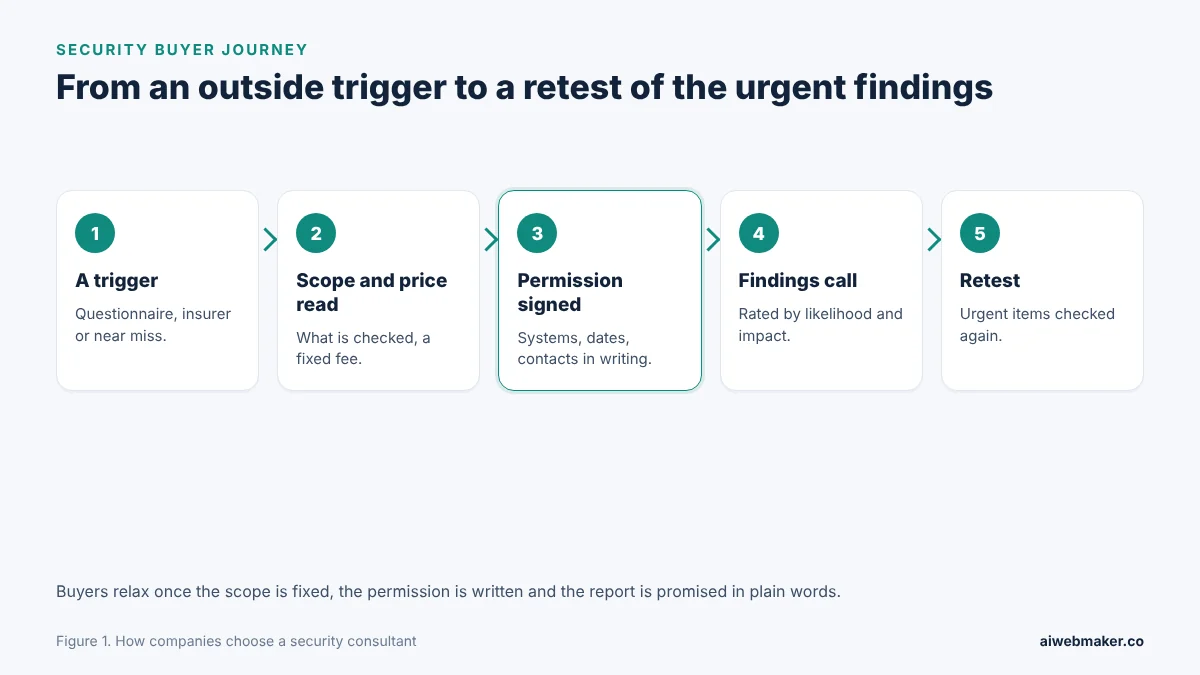
Written permission is the highlighted step, because nothing about a security check should begin without it. The journey usually starts with an outside trigger rather than a plan, which is why the home page should name those triggers. Buyers then look for a scope and a price they can take to a colleague or a board. After the check, a findings call that explains each issue by likelihood and impact matters more than the length of the report. A retest of the urgent items closes the loop and often leads to training or an ongoing arrangement.
Health checks, testing, training, plans and the enquiry form
A consultancy's site should be built around what a buyer can actually purchase, with each service explained in terms a director understands. The home page names the size of company served and the triggers that bring them, with a calm call to ask for a check. Service pages cover the health check, penetration testing, staff training, incident response plans, questionnaire help and an ongoing security lead. A page showing what a check looks at, and another with fixed prices, settle the pair of questions that come up on every first call. An enquiry form that warns against sending passwords, beside a phone number for live incidents, closes the route.
| Page | Buyer's question | What it should show |
|---|---|---|
| Home | Is this for a company like ours? | Company sizes served, common triggers, a calm tone |
| Services | What can we buy? | Health check, testing, training, plans, questionnaires |
| What we check | What will you look at? | Accounts, devices, email, backups, network edge, payments |
| Prices | What will it cost? | Fixed fees for an agreed scope, and what is extra |
| How it works | What happens, and when? | Scoping call, permission, the check, findings, retest |
| Enquiry and incidents | How do we start, or get help now? | A form without sensitive data, an incident phone line |
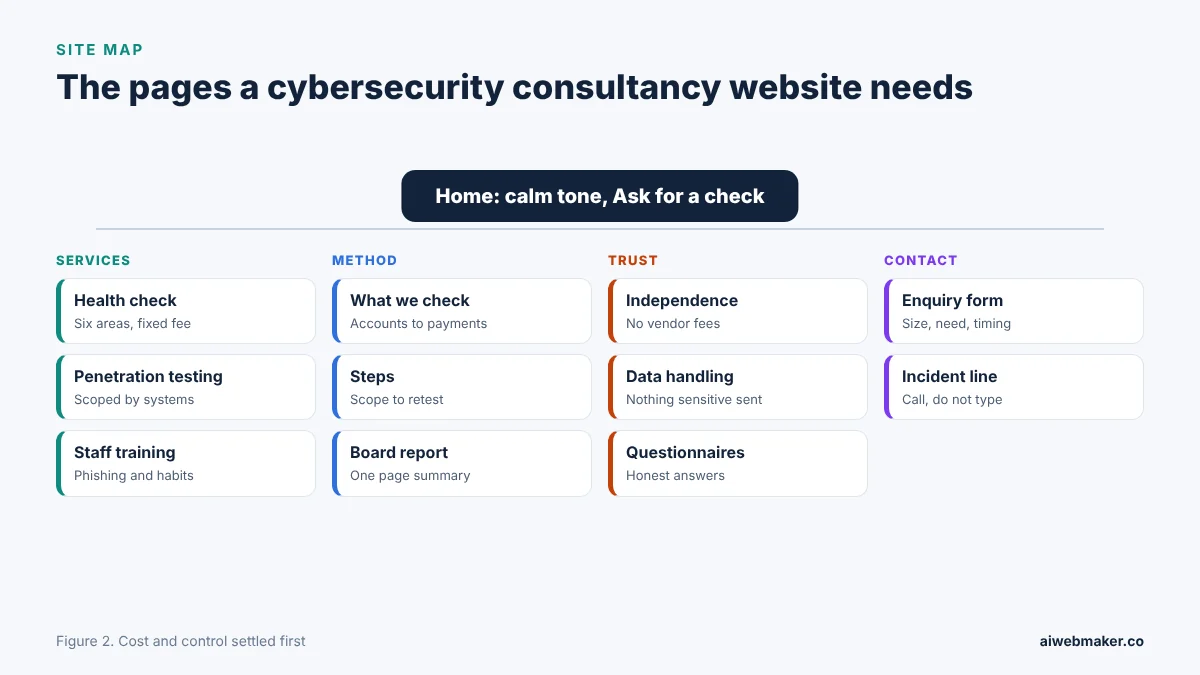
Prices and the permission step sit together in this plan, since a buyer wants cost and control settled before anything else. The services group lists the work, the method group shows the scope, the steps and the report, and the trust group covers independence, data handling and questionnaires. Lockstep Cyber Security, our invented sample, offers a Security health check, Penetration testing, Staff training, an Incident response plan, Questionnaire help and a Security lead on call. Its prices come as a Health check, a Health check and training and a Security lead on call, after sections on the board report and what a health check looks at. The cybersecurity consultant website example with fixed price checks and a board report ends with an enquiry form and a separate note for incidents happening now.
Scoping a test: what moves the price up or down
Security work is priced on scope, and a buyer who understands what moves the price can compare quotes fairly. A health check across accounts, devices, email, backups and payments can often be fixed for a company of a given size. Penetration testing varies far more, because each internet facing system, web application and user role adds testing time. Work outside office hours, to avoid disrupting staff, usually costs more and should be stated. Including a retest of urgent findings in the price shows the consultancy cares whether problems are actually fixed.
| Factor | Why it changes the effort | What the page should ask or state |
|---|---|---|
| Staff and devices | More accounts and laptops to review | A rough headcount on the enquiry |
| Internet facing systems | Each address or service is tested | A count agreed in the scope |
| Web applications | Testing behind a login takes days | Number of apps and user roles |
| Cloud services | Settings reviewed across accounts | Which services are in use |
| Testing window | Work out of hours costs more | Preferred days and times |
| Retest | Confirms the fixes worked | Whether it is included |
Permission in writing before anyone looks around
Testing systems without the owner's permission is against the law in most countries, so a security site should make written authorisation the first step of every engagement. The scope document names the systems, addresses, applications and dates, and a director with the authority to approve it signs before testing begins. Systems run by outside providers, such as hosted email or cloud services, may need their own permission or must follow the provider's published testing rules. It also helps to state the rule for fragile systems: the consultant stops and calls the named contact. Making permission visible tells buyers they are dealing with a professional rather than someone who simply enjoys breaking in.
Findings rated for directors, fixes written for the IT provider
A security report is only worth the money if the people who must act on it can understand it. The best reports open with a one page summary for directors, then list each finding rated by likelihood and impact, with step by step fixes for whoever runs the systems. Ratings need a plain explanation, so an office manager can tell an urgent problem from a tidy up. A findings call to walk through the report prevents panic over long lists of low ratings. Publishing a sample summary page, with invented findings, shows buyers exactly what they are paying for.
| Rating | What it usually means | Suggested response |
|---|---|---|
| Urgent | Likely to be exploited, with serious impact | Fix now, retest included |
| High | Serious if exploited, or easy to exploit | Fix within weeks |
| Medium | Real risk under some conditions | Plan into normal work |
| Low | Limited impact or unlikely | Fix when convenient |
| Good practice | Not a flaw, but worth improving | Note it for the roadmap |
Questionnaires, insurers and the word compliant
Security questionnaires from large customers and cyber insurers are now a common reason companies seek outside help, and they deserve a service page of their own. A consultant can help answer them truthfully, gather evidence and close gaps before the answers go back. Certification schemes and frameworks differ by country, for example Cyber Essentials in the United Kingdom, ISO 27001 internationally or SOC 2 reports often requested by American customers, and only the ones the consultancy genuinely supports belong on the page. A health check on its own does not make a company compliant with any law or standard, and saying so plainly builds credibility. Data protection rules vary by country, so the report can flag findings that may matter to a regulator without offering legal advice.
Live incidents, the enquiry form and what never goes into it
A company that believes it is under attack right now needs a phone number, not a form, and the site should say so above the enquiry fields. The incident note can describe first steps in general terms: keep affected machines powered on but disconnected from the network where possible, preserve logs, change passwords from a clean device and tell the insurer if a policy is in place. Some incidents must be reported to a regulator within set deadlines, for example within 72 hours for many personal data breaches in the European Union, so the page should prompt companies to check their local duties. The AI website builder for cybersecurity consultants and their scoped service pages drafts the service, scope, price and enquiry pages once the consultancy summarises what it does and for whom. Every page can then be checked in the preview, including the warning that passwords and network details must never be typed into the form.
Penetration testing near me and the searches directors type
Buyers type phrases such as cyber security consultant, penetration testing company or help with a security questionnaire, often adding a city or region. Some search for the trigger instead, typing what to do after a phishing email or how to answer an insurer's security questions. Service pages and articles that use those words meet buyers at the moment of worry. A map listing with an office address, hours and a phone line for incidents reassures buyers who want someone nearby. Reviews from directors that mention clear reports and no scare tactics persuade more than badges alone.
Test tools, insurance and the website: what a consultancy pays yearly
Testing tools, professional indemnity cover, certifications and training cost a security consultancy far more each year than its website. Its AI Web Maker hosting is $119 when settled once a year or $19 when spread across months, with the domain's cost tied to which of roughly 400 endings is registered. Twelve articles on phishing, backups and questionnaires, each drafted with about $0.65 of AI credit, total around $7.80. Updating prices or adding a service page costs nothing. A $189 row also appears, simply to show the alternative.
| Item | Yearly | Monthly |
|---|---|---|
| Hosting the security service pages | $119 | $228 over twelve months |
| Domain | Depends on the ending | Depends on the ending |
| Higher plan, for comparison | $189 a year | Not needed |
| Twelve phishing and backup articles at about $0.65 | About $7.80 | About $7.80 |
| Price and service page updates | No charge | No charge |
| Year before the domain | About $126.80 | About $235.80 |
Scare stories, hidden scope and other reasons directors close the page
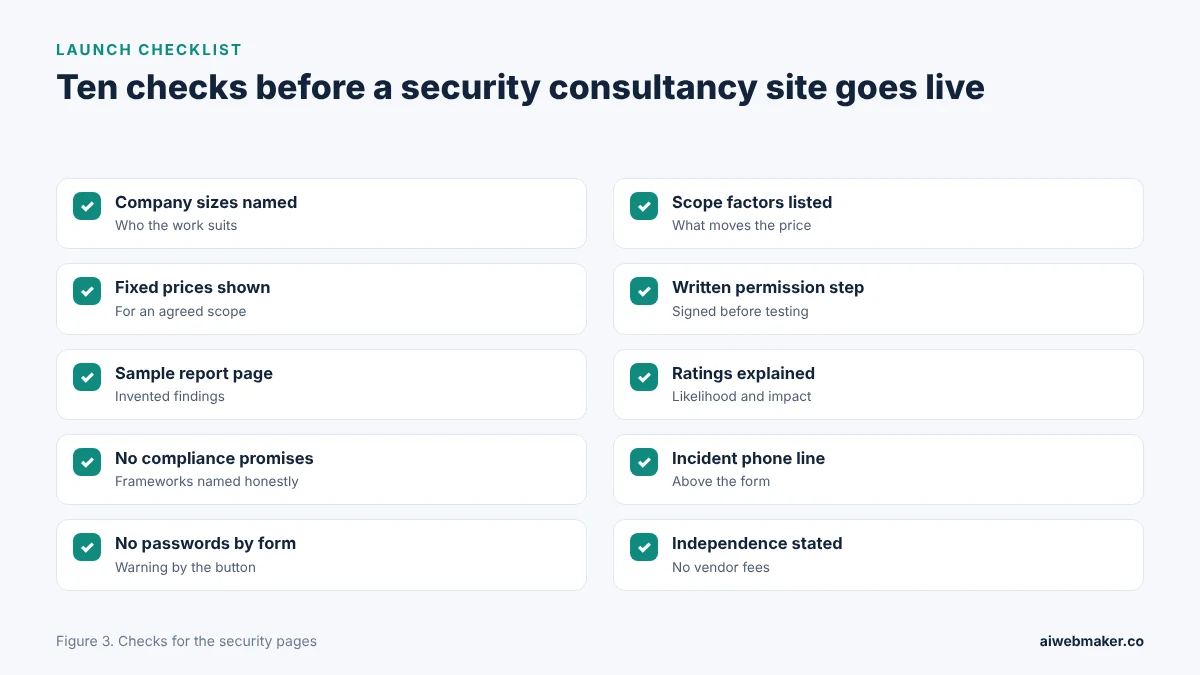
Directors leave a security site when it opens with frightening numbers and hooded figures, because fear without a plan feels like a sales tactic. A site with no idea of price makes them assume a check is beyond their budget. Promises that a company will be secure or compliant after one test sound untrue to anyone who has read about breaches. Forms asking for network details or passwords suggest the consultancy does not practise what it preaches. A matching fix for each doubt sits in the ten card checklist that follows.
Frequently asked questions
Will a penetration test slow down or stop our systems?
Professional testing is planned to avoid disruption, but any test carries some risk, so the scope should agree how fragile systems are handled. Testers often avoid techniques that could crash services unless the client agrees, and some tests run outside office hours. A named contact on the client's side can be called if anything behaves unexpectedly, and testing pauses until it is resolved. Backups should be checked before a test begins, as good practice rather than an expectation of trouble. Explaining this openly reassures buyers more than claiming a test carries no risk at all.
Do cybersecurity consultants sell software too?
Some consultancies resell security products and earn commission on them, while others stay independent and sell only advice and testing. Both models exist, but buyers deserve to know which applies, because commission can shape recommendations. An independent consultancy can say it takes no fees from vendors, so each recommendation is made on its merits. Where a consultancy does resell products, it can disclose the arrangement and offer alternatives. Being open about vendor money reassures buyers more than almost anything else on the site.
What happens if a serious problem is found during a test?
A serious finding, such as an exposed system or signs of an earlier intrusion, goes to the named contact at once rather than waiting for the report. The scope can set out how urgent findings are escalated and who decides whether to pause testing. Evidence of a real attack may turn the engagement into incident response, which can carry its own terms. Whether regulators or customers must be told turns on the country and on what kind of data was exposed. Stating this process on the site shows buyers that the consultancy will not sit on bad news.
Does a health check make a company compliant?
A health check shows where a company stands and what to fix, but it does not by itself make a company compliant with any law, regulation or standard. Compliance depends on the specific framework, the company's sector and the country it operates in. A consultant can map findings to a framework the client cares about and help prepare for a formal assessment where one exists. Legal questions about data protection duties belong with a lawyer. Being honest about this limit protects both the client and the consultancy.
One health check and the year of hosting it pays for
A single health check earns a security consultancy far more than its $119 of hosting for the year. Paid in monthly steps, the $19 is a rounding error beside one day of testing. Each director who arrives already knowing the scope, the price and the permission step turns a sales call into a scoping call. Questionnaire work and training often follow the first check, adding value the website helped start. A consultancy whose enquiries mention the plain reports and the incident line knows its pages are being read.
Build your website in Minutes and get the AI Tools that work
Start Building Your Website →