Selling Security Expertise Online: Cybersecurity Company Website Cost
Keeping a cybersecurity firm online takes $119 in yearly hosting, with a $19 monthly alternative and a domain in the company's name. Inside: buyers, services, test scoping and reports, frameworks, incident help, credentials, confidentiality, search and the yearly budget.
- No coding required
- Live in minutes
- Blog, SEO and chatbot tools included
Keeping a cybersecurity firm online takes $119 in yearly hosting, with a $19 monthly alternative, plus a domain registered in the company's name. Service descriptions, framework notes and team profiles can all be written and reviewed in AI Web Maker's preview before anything is billed. Calm, plain service descriptions can be judged on our security company website design sample, an invented firm whose pages, built in AI Web Maker, begin by finding the gap. One penetration test, or a single month of a monitoring retainer, outweighs that figure many times. The hard part is that security buyers are cautious by profession, and they judge a firm partly by how clearly and calmly its own website explains risk. They also need proof of skill from a firm that cannot name most of its clients. From buyers and service pages to scoping, frameworks, incidents, credentials, confidentiality, search and the yearly bill, each topic gets its own section below.
This article is part of our complete guide: Professional Services Website Builder.
Who buys security services, and what triggers the search?
Security services are usually bought after a trigger rather than out of curiosity, and the trigger shapes what the buyer reads. A failed audit, a customer's security questionnaire or a cyber insurance renewal sends a finance or operations manager looking for help with a specific requirement. A phishing incident or a suspicious login sends an owner or IT lead searching for urgent support. Technical buyers, such as IT managers and developers, look for testing depth, methods and certifications. Compliance leads look for experience with a named framework and a realistic timeline. A website that speaks to each trigger in the buyer's own words reaches the shortlist.
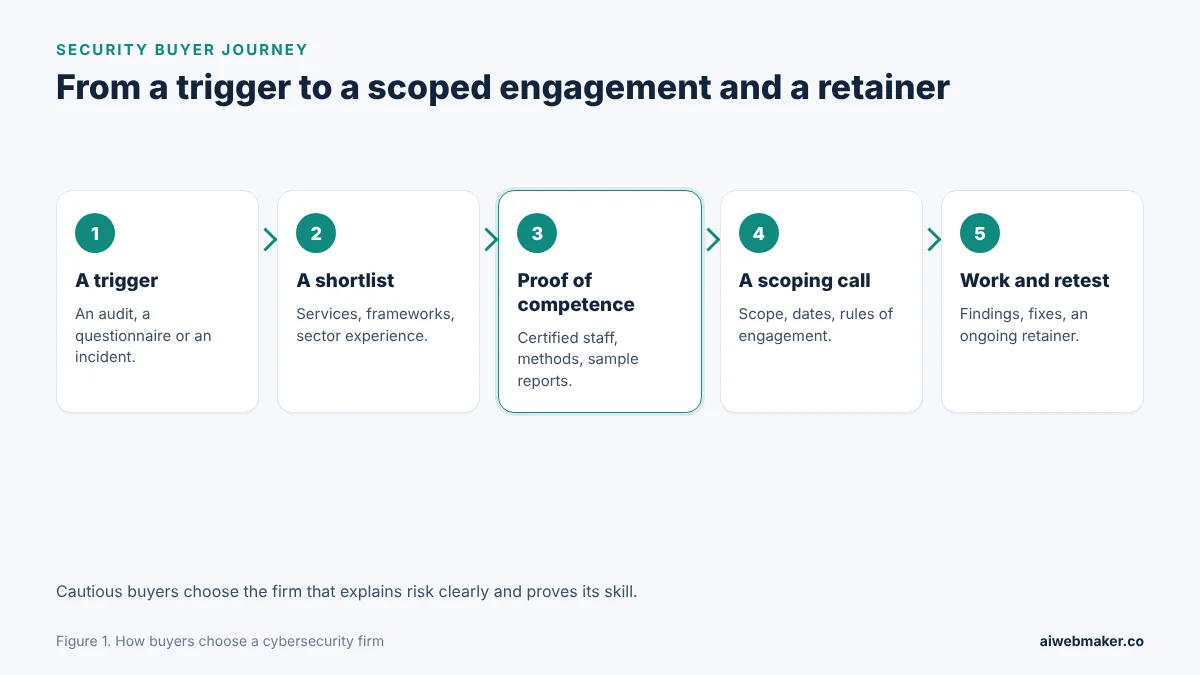
Security purchases begin with a trigger, and the highlighted third step shows where the decision is really made. A shortlist forms quickly from services, frameworks and sector experience. Proof of competence takes longer, as buyers check staff certifications, testing methods and, where available, a redacted sample report. A scoping call turns interest into a defined project with clear rules of engagement. The work itself, followed by a retest and often a retainer, decides whether the relationship lasts for years. A firm whose pages carry buyers calmly through that third step wins the call.
How should testing, monitoring and advisory work be grouped on the site?
Security services should be grouped by the buyer's problem and named in terms buyers recognise, with jargon kept for the detail. Testing services, such as penetration tests and vulnerability assessments, answer where the weaknesses are. Monitoring and managed detection answer who is watching, while incident response answers who helps when something goes wrong. Advisory work, such as framework readiness, policies and a part time security lead, helps firms meet obligations. Awareness training reduces the human risk behind many incidents. Each service line should state what the buyer receives, how long it usually takes and how it is scoped.
| Service | Buyer's question | What the page should explain |
|---|---|---|
| Penetration testing | Where could an attacker get in? | Scope types, methods, report, retest |
| Vulnerability assessment | Which known weaknesses do we have? | Scanning, prioritising, frequency |
| Monitoring and detection | Who is watching our systems? | Hours covered, response steps, reporting |
| Incident response | Who helps when we are attacked? | Contact route, first steps, retainer options |
| Framework readiness | How do we pass an audit? | Gap analysis, policies, timelines |
| Awareness training | How do we stop staff clicking? | Formats, simulated phishing, reporting |
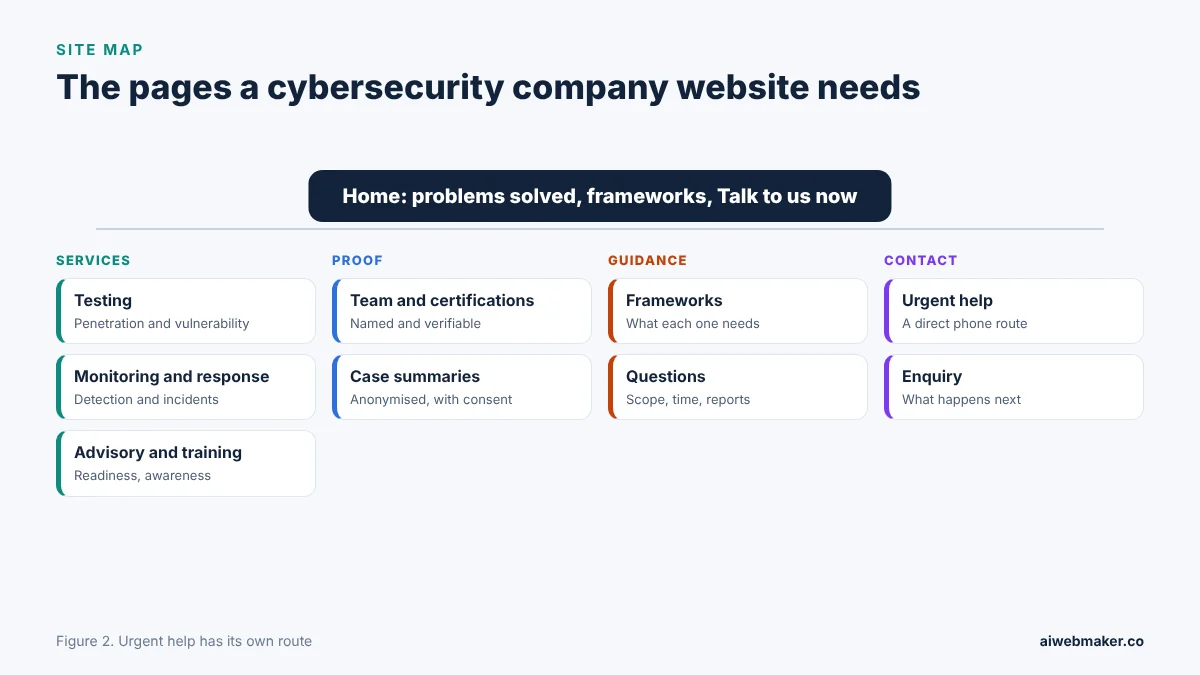
Proof and guidance sit beside the services in this plan, and urgent help has its own route so that a business under attack never fills in a long form. Shieldline Security Services, the sample firm in this guide, groups its work on a services page titled Cybersecurity services that protect your business, and its home page gives frameworks a section called Frameworks we help you work toward. The home page also describes the kinds of problems the firm solves, opens with a warning that attackers only need one gap and closes with a section for visitors who want to talk or need help now. Its about page covers the firm's story and mission, its experience and background and the routine of a typical client engagement, and a separate page answers common questions. The cybersecurity company website example with core services and framework support built its services, about, questions and contact pages in 47 seconds. Its contact page lists direct ways to reach the team beside an enquiry form that explains what happens next.
What should buyers know about scoping a penetration test and the report?
Buyers of penetration testing need to understand scope, rules of engagement and the report before comparing prices, because two quotes can describe very different work. Scope defines what is tested, such as external networks, internal systems, web applications, cloud accounts or mobile apps, and whether testers work with credentials. Rules of engagement set dates, hours, contacts and limits, and written authorisation from the system owner is essential, since unauthorised testing is illegal in most countries. The report should include a summary for managers, technical findings ranked by severity, evidence and clear remediation advice. A retest after fixes confirms that the problems are closed. Explaining these points shows buyers what a quality engagement looks like.
| Engagement element | What a buyer should expect |
|---|---|
| Scope | Systems, applications and accounts included, and what is excluded |
| Authorisation | Written permission from the system owner before testing starts |
| Rules of engagement | Dates, hours, contacts and any limits |
| Methods | Recognised methodologies and manual testing, not only automated scans |
| Report | Management summary, ranked findings, evidence, fixes |
| Retest | Confirmation that fixed issues are closed |
ISO 27001, SOC 2 and Cyber Essentials: how should framework support be described?
Frameworks matter because many buyers must meet a standard to win contracts, satisfy insurers or reassure customers. ISO/IEC 27001 is an international standard for information security management, and certification comes from accredited certification bodies rather than consultants. SOC 2 reports, common with buyers in North America, are issued by independent auditors from licensed accounting firms. Cyber Essentials is a scheme backed by the UK government, and the NIST Cybersecurity Framework is widely used as voluntary guidance in the United States and beyond. A consultancy should describe how it helps clients prepare, such as gap analysis, policies and evidence gathering, without implying it can certify anyone or holds certifications it lacks. Accurate framework language reassures the buyers who know these schemes best.
| Framework | What it is | How a consultancy can help |
|---|---|---|
| ISO/IEC 27001 | International standard for security management | Gap analysis, policies, audit preparation |
| SOC 2 | Independent report on security controls | Readiness review, control design, evidence |
| Cyber Essentials | UK government backed baseline scheme | Preparing for assessment, closing gaps |
| NIST CSF | Voluntary framework widely used in the United States | Mapping controls, roadmaps |
| PCI DSS | Rules for handling payment card data | Scoping, remediation, assessor preparation |
What should a business do in the first hours of a cyber incident?
An incident page should give a business under attack a direct phone route and calm first steps, not a sales pitch. Typical advice includes isolating affected devices from the network rather than wiping them, preserving logs and evidence, changing credentials from a clean device and contacting the cyber insurer early if a policy exists. Some laws set short reporting deadlines, for example 72 hours for notifying regulators about many personal data breaches under the GDPR in Europe, so legal advice may be needed quickly. Reporting to the police or a national cyber security agency is often recommended and sometimes required. The page should state the hours the firm can respond and what happens after the first call. Practical guidance shows competence at the moment it matters most.
Which staff certifications and methods convince technical buyers?
Technical buyers want to know who will do the work, so naming the team and their genuine certifications carries real weight. Certifications such as OSCP for penetration testers or CISSP for security management signal tested knowledge, while company accreditations such as CREST, in the markets where it operates, signal audited processes. Only current, genuinely held certifications should be listed, ideally with a way to verify them. Methods matter as much as badges, so describing a recognised methodology, the balance of manual and automated work and how findings are verified builds confidence. Years of experience, sector knowledge and published research or talks add depth. A team presented honestly is the firm's strongest proof of competence.
How can a security firm prove experience without naming clients?
Security clients often require confidentiality, so proof of experience has to be built without exposing anyone. Anonymised summaries that give the sector, the challenge, the work done and the result in general terms show depth without naming the client. Client logos and testimonials should appear only with written permission, and security buyers understand when they are absent. A redacted sample report, shared on request, lets technical buyers judge the quality of findings. Talks, articles and contributions to the security community demonstrate skill in public. Discretion shown on the website is itself evidence of how a new client's information will be treated.
How should an enquiry move from first contact to a scoped proposal?
Most security engagements begin with a short conversation, so the website should make that first contact easy and explain what follows. A typical path runs from enquiry to a scoping call, a written proposal with scope and price, signed authorisation and then the work itself. Explaining that path, with the usual time between steps, reassures buyers who have never bought security services before. Asking buyers not to send sensitive details, such as passwords or network diagrams, through the enquiry route protects them from the start. The AI website builder that security firms use for service, framework and enquiry pages drafts these pages once the firm sums up its work in a short note. A careful first step sets the tone for the whole engagement.
What do IT and compliance leads type when they need outside help?
Buyers looking for security help type the service or the requirement, with phrases such as penetration testing company, Cyber Essentials help, SOC 2 readiness, ISO 27001 consultant or incident response. A city or country often follows, so service and framework pages headed with those terms meet each search directly. Local buyers also check map listings, so the firm's entry should show office hours, the team and its web address. Reviews and testimonials, where clients allow them, carry particular weight in a field built on trust. Articles explaining frameworks, phishing risks or how to prepare for a test attract managers early in their search. Calm, expert writing makes the firm the name buyers remember when a trigger arrives.
What does the firm's website add to a year's overheads?
Across a year's overheads, the website is a two line entry, hosting and a domain, while twelve explainers on frameworks or phishing written with credits add roughly $7.80. Firms with steady retainers usually pay once a year. A newly founded consultancy might keep to monthly billing until contracts settle. Adding services, team certifications or new framework notes costs nothing extra. The table compares annual with monthly payment and includes the $189 tier as a yardstick.
| Item | Yearly | Monthly |
|---|---|---|
| Hosting the security firm's pages | $119 | $228 over twelve months |
| Domain | Depends on the ending | Depends on the ending |
| Higher plan, for comparison | $189 a year | Not needed |
| Twelve framework and phishing explainers at about $0.65 | About $7.80 | About $7.80 |
| Services, certifications and framework notes | No charge | No charge |
| Year before the domain | About $126.80 | About $235.80 |
What makes a cautious buyer doubt a security firm's site?
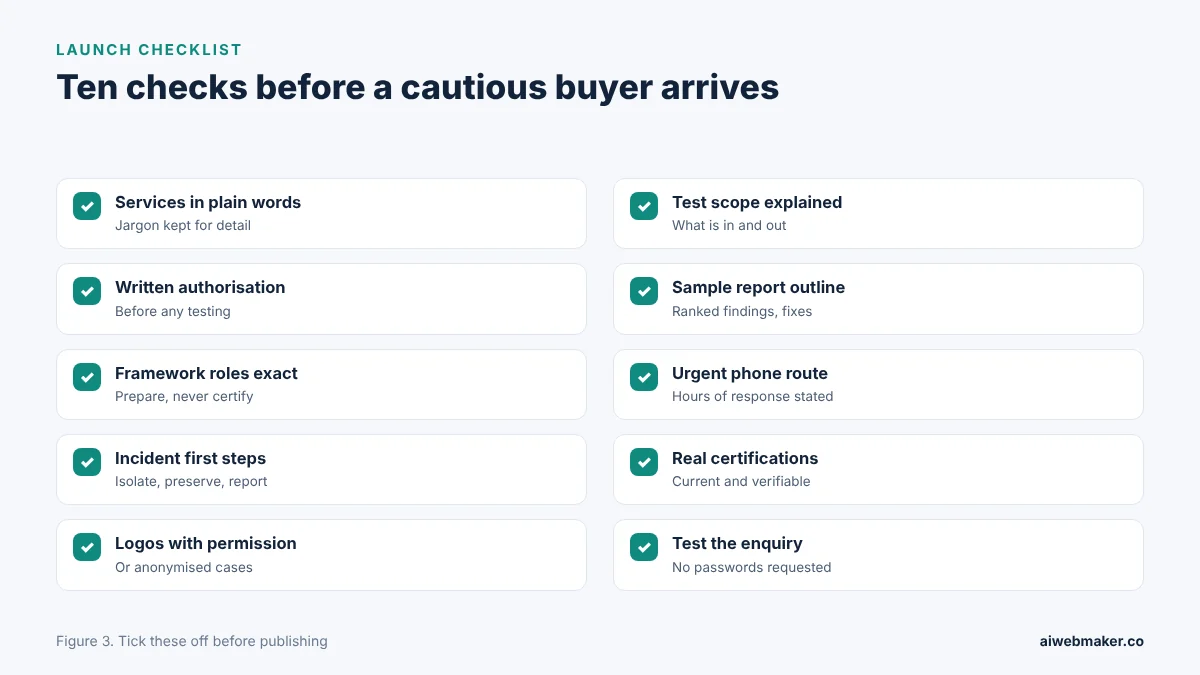
Cautious buyers doubt a security firm's site when it relies on fear, with dramatic warnings and no clear account of what the firm actually does. Vague claims of being certified, without naming the scheme or the body, raise immediate suspicion. A missing urgent contact route suggests the firm would be slow in a real incident. No information about the team leaves buyers unsure who would access their systems. Client logos that look borrowed or unverified damage trust further. The ten items in the coming figure keep these doubts off the shortlist.
Frequently asked questions
What determines how long a penetration test takes?
The length of a penetration test depends on its scope, from a few days for a small web application to several weeks for large networks or complex environments. Reporting adds time after testing ends, and a retest follows once fixes are made. A scoping call lets the firm estimate the duration accurately. The website can give typical ranges for common engagements while explaining that each quote follows scoping. Realistic timelines help buyers plan around audits and launches.
What is the difference between a vulnerability scan and a penetration test?
A vulnerability scan uses automated tools to find known weaknesses, while a penetration test uses skilled testers to exploit weaknesses and show what an attacker could achieve. Scans are faster, cheaper and suited to regular checks. Penetration tests go deeper, chain findings together and test business logic that scanners miss. Many organisations use both, with scans running often and tests after major changes or on a regular cycle. Explaining the difference helps buyers choose the right service for their need.
Can a consultancy certify a company for ISO 27001?
Certification to ISO/IEC 27001 comes from an accredited certification body, not from the consultancy that helps a company prepare. A consultancy can run a gap analysis, help write policies, set up controls and prepare the company for the audit. Some organisations offer both consulting and certification, but impartiality rules usually stop them doing both for the same client. The website should describe exactly which role the firm plays. Accurate language protects the firm and the client's audit.
Should a security firm publish client logos?
Client logos should only appear with written permission, and many security clients prefer not to be named at all. Anonymised case summaries by sector are often a better way to show experience. Where a client does agree, a short quote about the working relationship adds more than a logo alone. Buyers understand discretion in this field and may read it as a good sign. Respecting confidentiality in public is a promise kept before any contract is signed.
Does one penetration test fund the firm's site for years?
The fee for one penetration test typically dwarfs the $119 that keeps a security firm's website hosted all year. Paying monthly instead, a firm recovers the $19 in a small part of one consulting day. Each retainer won after a buyer reads the services, framework and team pages adds income month after month. Clear explanations, verifiable credentials and an obvious urgent route persuade cautious buyers more than any warning about hackers. Firms that keep their framework notes and team pages current show the attention to detail buyers expect. Being invited onto a shortlist by a buyer who arrived through search is when the site has clearly paid off.
Build your website in Minutes and get the AI Tools that work
Start Building Your Website →