Consulting Firm Website Cost and an Approach Page Buyers Forward
A consultancy's hosting comes to $119 for twelve months, or $19 monthly, with a domain added by its ending. Included: how buyers shortlist, the pages, engagement stages, fees, confidential case studies, the first call, the people, search and the yearly budget.
- No coding required
- Live in minutes
- Blog, SEO and chatbot tools included
A consultancy's website on AI Web Maker carries a $119 hosting charge for twelve months, or $19 monthly, with a domain added at the price of its ending. Partners can draft the approach page, the service descriptions and the case studies, then test them in the preview, without any invoice arriving. The way an engagement runs from scope to review is set out on our consulting firm website design sample, whose imaginary advisory firm was assembled with AI Web Maker. A single engagement, even a short diagnostic, is normally worth many years of that hosting. The challenge is that consulting is bought on judgement, by people who often have to justify the choice to a board or a budget holder. Those buyers read a firm's site several times before suggesting a call, and they forward it to colleagues who were never in the conversation. In order, the article covers how buyers shortlist, the pages, engagement stages, fees, case studies under confidentiality, the first call, the people, search and the budget.
This article is part of our complete guide: Professional Services Website Builder.
How do buyers shortlist a consultancy before the first call?
Buyers usually shortlist consultancies through referrals, past working relationships and searches on a specific problem, then use each website to test the names. A chief executive facing stalled growth reads differently from an operations director with a failing process or a board seeking an independent review. Each wants evidence that the firm has solved a similar problem in a similar organisation. They look for a method that sounds rigorous without being rigid, and for senior people who stay involved after the contract is signed. Procurement teams and finance directors may read later, checking fees, insurance and terms. A site that answers each reader lets the champion inside the client make the case without the firm in the room.
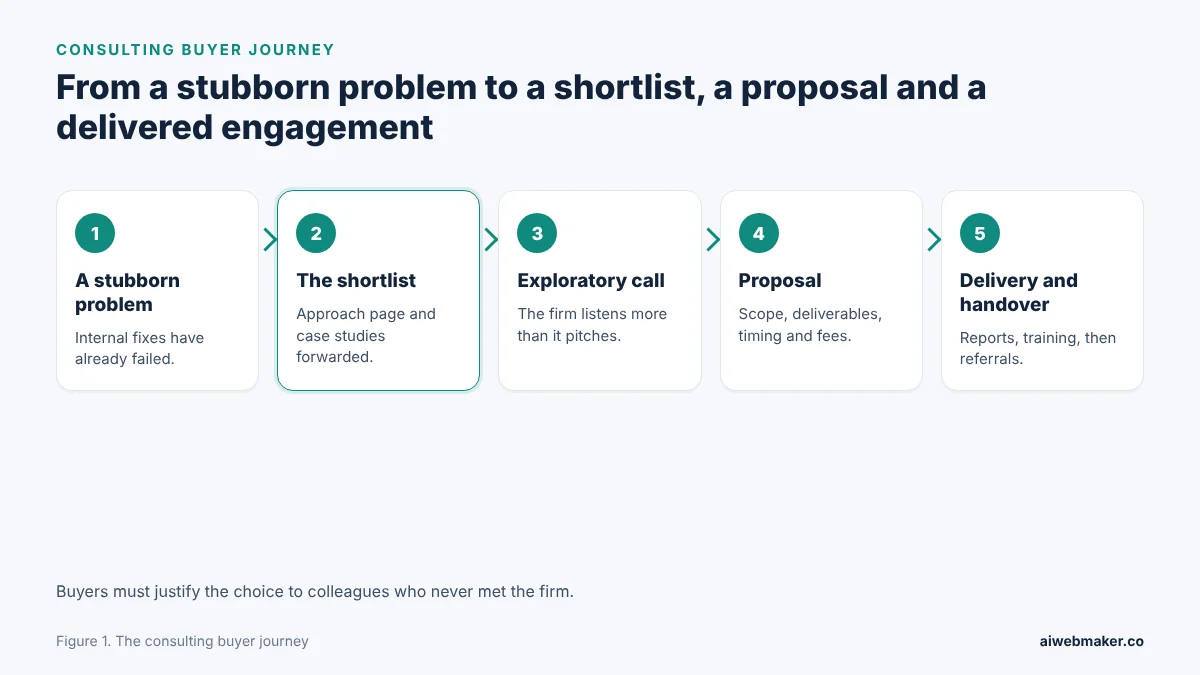
A stubborn problem starts the journey, often one that internal teams have already tried and failed to fix. The highlighted step is the shortlist, where the champion reads the approach page and case studies and forwards them to colleagues. An exploratory call follows, in which the firm listens more than it pitches. A written proposal sets out scope, deliverables, timing and fees, and it often goes through more than one revision. How the firm reports during delivery and leaves at handover shapes whether the client comes back. The website matters most at the shortlist, yet it keeps serving as a reference the buyer returns to at every later stage.
Which pages let a buyer argue the firm's case internally?
A consulting site needs pages a buyer can forward internally, each answering a question a colleague is likely to raise. The home page states the problems the firm solves and for whom. Service pages describe each kind of engagement, while a short guide helps visitors who are not sure which service fits. The approach page explains how an engagement runs, how progress is reported and what the client must contribute. Case studies and people pages prove experience, and insight articles show how the firm thinks. The contact page should offer a direct line to a senior person as well as an enquiry route.
| Page | Main reader | What it must prove |
|---|---|---|
| Home | The champion | That the firm understands this kind of problem |
| Services | Department heads | Scope and typical outputs of each engagement type |
| Not sure which fits | Undecided visitors | Common situations matched to services |
| Approach | Colleagues and sponsors | Stages, reporting and client commitments |
| Case studies | Sceptical seniors | Similar problems solved, described with permission |
| People | Every reader | Who will do the work, and their background |
| Contact | The champion | A named senior contact and the next step |
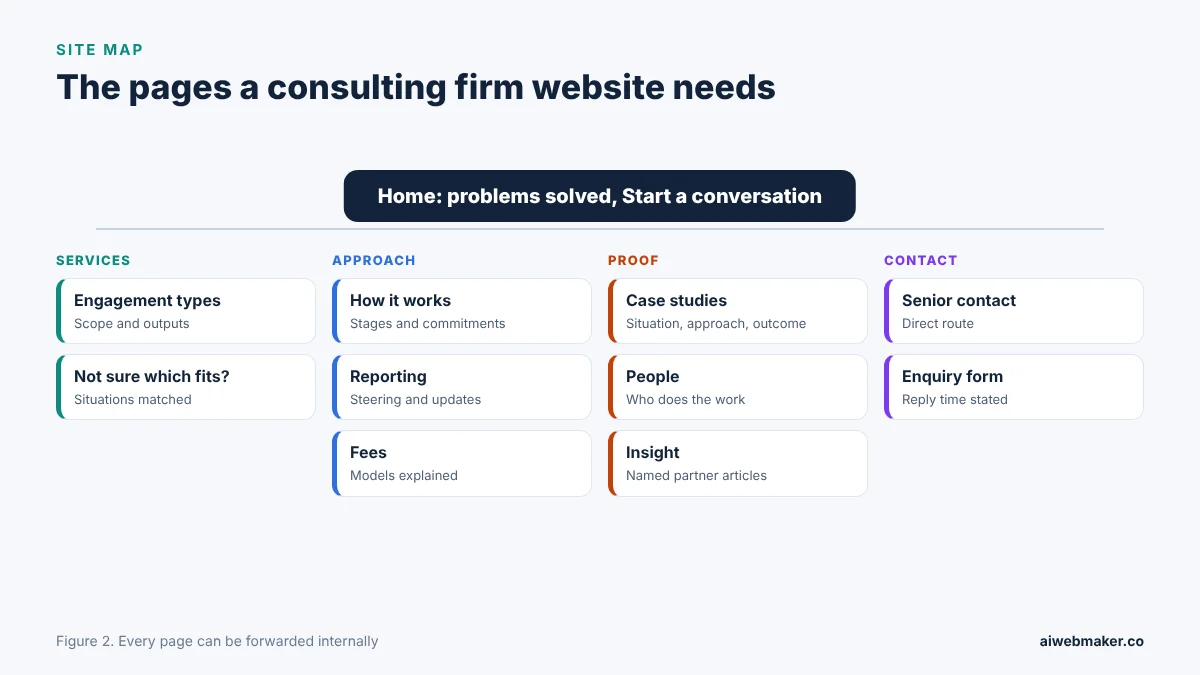
Branching from the home page, this plan gives services, approach, proof and contact equal weight, since buyers move between them several times. Services include a short guide for visitors unsure which engagement fits, and the approach branch covers stages, reporting and the client's own commitments. Our sample firm, Northpoint Advisory, devotes a whole page to its approach, covering how an engagement works, how the firm communicates and reports, and what to expect at each stage. Its services page speaks to visitors who are not sure which service fits before inviting them to discuss their needs, and its home page places examples of work alongside the people clients will work with. The contact page offers a direct contact route as well as an enquiry form, and the consultancy website example built around an engagement approach page took 39 seconds to build.
What happens at each stage of an engagement?
Every engagement passes through familiar stages, and naming them lets a buyer picture the work before committing budget to it. An exploratory call establishes the problem and whether the firm is the right fit. A diagnostic or scoping phase gathers data, interviews people and tests early hypotheses. The proposal or statement of work then fixes scope, deliverables, timing and fees. Delivery combines analysis, workshops and, where agreed, support with implementation, with regular steering meetings to keep sponsors informed. A deliberate handover, with documentation and training, leaves the client able to sustain the change without the firm.
| Stage | What happens | What the client receives |
|---|---|---|
| Exploratory call | Problem, context and fit discussed | An honest view of whether to proceed |
| Diagnostic | Data gathered, people interviewed | Findings and a recommended scope |
| Proposal | Scope, deliverables, timing and fees fixed | A statement of work to approve |
| Delivery | Analysis, workshops, implementation support | Progress reports and steering meetings |
| Handover | Documentation and training | Tools and skills to continue alone |
| Review | A check some months later | A view of what held and what slipped |
How are consulting fees structured, and how much should the site reveal?
Consulting fees follow a few recognisable structures, and explaining them helps buyers prepare a budget even when the firm prefers not to publish rates. Fixed project fees suit well defined scopes and give the client certainty. Daily or hourly rates suit work whose shape will change as findings emerge. Retainers suit ongoing advisory roles, such as a monthly strategy session with the leadership team. Some firms link part of the fee to measured outcomes, which needs a clear baseline and is restricted in certain regulated fields. A page that explains these models, and when the firm uses each, prepares buyers for the proposal and filters out budgets that would never fit.
| Fee model | How it works | Good fit when |
|---|---|---|
| Fixed project fee | One price for an agreed scope | Deliverables can be defined in advance |
| Daily or hourly rate | Time recorded against the work | Scope is likely to evolve |
| Retainer | A regular fee for ongoing access | The client wants a standing adviser |
| Phased fees | A paid diagnostic, then a separate delivery fee | The problem needs testing before scoping |
| Outcome linked | Part of the fee depends on measured results | A baseline is agreed and rules allow it |
How can case studies prove results without breaking confidentiality?
Case studies can prove results by describing the situation, the approach and the outcome while leaving out anything the client has not approved for publication. Many consulting clients sign confidentiality agreements, so naming them is often impossible. Describing the sector, the size of the organisation and the nature of the problem usually gives enough context. Outcomes should be stated honestly, with a baseline, a period and a fair account of what the firm contributed alongside the client's own team. Inflated figures are easy to spot for experienced buyers and can undo every other page. A few careful, verifiable studies persuade far more than a wall of logos.
What should a buyer know before the first call?
Before the first call, a buyer should know who will join it, how long it lasts, whether there is any charge and what happens afterwards. Senior buyers dislike uncertainty, so a line promising a reply within a stated time, followed by a call without obligation, lowers the barrier. The page can suggest what to prepare, such as a description of the problem and any constraints on timing or budget. A note that confidential details can wait until an agreement is signed reassures cautious readers. The AI website builder consultancies use to draft approach and service pages turns a short summary of the firm into first drafts of these pages, which partners then sharpen in the preview. Clear next steps make starting a conversation feel safe for someone with a reputation to protect.
Who will actually do the work, and how are conflicts handled?
Buyers worry that senior people sell the engagement and junior staff deliver it, so the site should say plainly who does the work. People pages with real photos, career histories and areas of expertise answer that worry directly. Solo consultants and small firms can describe the associates they bring in for larger projects and how quality is controlled. Conflicts of interest deserve a short statement, such as how the firm handles requests from competing clients in the same market. Advice in fields such as finance, law, tax or engineering may require licences or registration that vary by country, so firms working there should state what they hold. Openness about people and conflicts is itself evidence of the judgement buyers are paying for.
Which searches put a consultancy in front of a decision maker?
Decision makers rarely search for consultants in general, and look instead for help with a named problem. Typical phrases include supply chain consulting, pricing strategy consultant or change management support for hospitals. Service pages titled with those problem phrases meet the buyer at the moment of need. A regional consultancy gains from a map pin pointing straight at its services. Testimonials and reviews from clients, shared with permission, add weight to every other signal. Insight articles that take a clear position on a sector question, written by a named partner, attract the senior readers who commission work. Original thinking published steadily is how a consultancy becomes the name colleagues pass along.
What does the firm's website cost against its smallest engagement?
Hosting and the domain are the whole fixed cost, and a monthly insight article drafted with AI credits adds well under a dollar before a partner refines it. A consultancy with steady engagements saves most by paying for the twelve months together. A newly independent consultant may prefer to start monthly while the first proposals are out. Rewriting the approach page or adding case studies carries no charge. Both payment routes for the consultancy sit in the next rows, the $189 tier among them as a comparison only.
| Item | Yearly | Monthly |
|---|---|---|
| Hosting the consultancy pages | $119 | $228 over twelve months |
| Domain | Depends on the ending | Depends on the ending |
| Higher plan, for comparison | $189 a year | Not needed |
| Twelve insight articles at about $0.65 | About $7.80 | About $7.80 |
| Approach, case study and people updates | No charge | No charge |
| Year before the domain | About $126.80 | About $235.80 |
What makes a sponsor stop forwarding the link?
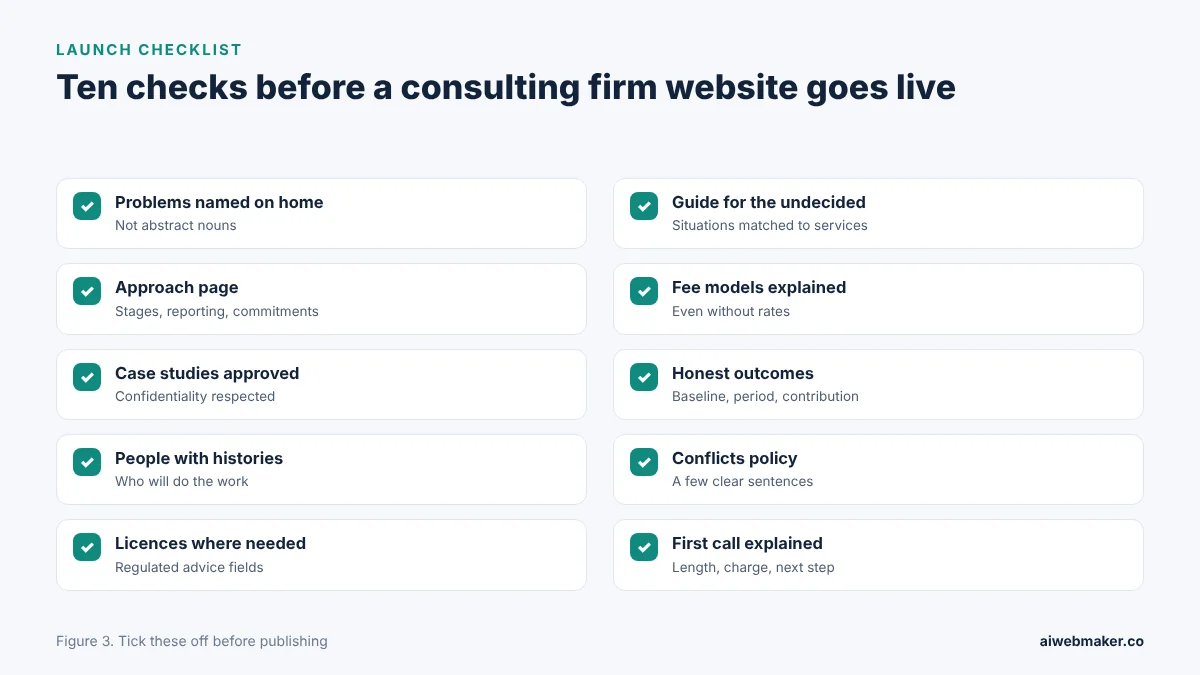
Sponsors stop forwarding a link when the home page reads like any other firm's, full of abstract nouns and no named problems. A missing approach page leaves colleagues unable to picture the engagement. Case studies with impossible numbers make a careful buyer doubt everything else on the site. People pages without photos or histories raise the fear of being handed to juniors. No direct route to a senior person makes the first step feel like entering a sales funnel. Each worry on that list has a matching line in the ten checks below.
Frequently asked questions
What should a statement of work contain?
A statement of work should set out the objectives, the scope, the deliverables, the timetable, the fees and the responsibilities of both sides. It should also say what is out of scope, because disputes usually begin at the edges. Reporting arrangements, such as steering meetings and progress reports, belong in it too. Many firms describe the structure of their statement of work on the approach page so buyers know what to expect. A clear document protects the relationship as much as the budget.
How do consultants handle conflicts of interest?
Consultants handle conflicts by checking new requests against existing clients, declining work that would compromise either side and disclosing any relationship that a client should know about. Some firms keep separate teams when serving competitors, while others simply decline. The website can describe the firm's policy in a few sentences. Clients in regulated sectors often need this confirmation before they can proceed. A visible policy reassures buyers that their information will be protected.
Can an independent consultant look as credible as a large firm?
An independent consultant can look just as credible by showing deep sector experience, a clear method and strong client evidence. Buyers often value working directly with the person who will do the work. A well described approach shows that a professional process sits behind one name. Naming trusted associates for larger projects answers concerns about capacity. Precision and focus frequently beat the broad promises of bigger firms.
How long should an exploratory call take?
Most exploratory calls run long enough to understand the problem and decide whether to continue, often well under an hour. The website should state the usual length and whether the call is charged. Buyers appreciate an agenda, such as the problem, the context and possible next steps. A short follow up note summarising the conversation shows professionalism. Respecting the buyer's time in the first call signals how the engagement will be run.
Does one engagement fund the consultancy's site for years?
One engagement, even a modest diagnostic, usually funds the $119 of yearly hosting many times over. Billed monthly instead, the $19 barely dents a single day's consulting fee. Every buyer who forwards the approach page, reads a careful case study and books a call can bring work worth years of hosting. A clear method, honest evidence and visible people win more first calls than polished slogans. Firms that keep publishing insight and adding case studies find that buyers arrive already half persuaded. Proposals requested by people the partners have never met are the plainest measure of what the pages achieve.
Build your website in Minutes and get the AI Tools that work
Start Building Your Website →