Community Centre Website Cost, Room Hire Rates and a Week of Clubs
A community centre covers hosting with one $119 payment each year, or $19 monthly, and buys a domain as well. Topics: who comes in, the pages, the timetable, room hire, hire rules, safeguarding, volunteers and accounts, search and the budget.
- No coding required
- Live in minutes
- Blog, SEO and chatbot tools included
Volunteer committees pay AI Web Maker $119 per hosting year for a timetable, rooms and an enquiry page, or $19 for each month on the monthly route, plus a domain. Nothing is charged while the committee drafts those pages and looks them over in the preview. A couple of evening bookings of the main hall bring in more than the year of hosting, so the cost hardly needs a vote. The harder job is serving very different visitors from one site: a parent looking for a toddler group, a family hiring the hall for a sixtieth, a retired engineer willing to volunteer and a funder checking the accounts. Each arrives with one question and leaves if the answer is buried under a long welcome letter. The guide moves through those visitors, the page list, the timetable, room hire and its rules, safeguarding, volunteers and accounts, search and the yearly sums.
This article is part of our complete guide: Professional Services Website Builder.
Toddler groups, hirers and volunteers: who opens a community centre site
A community centre website serves more kinds of visitor than almost any other local site, and each wants something different. Parents look for the toddler group, the homework club and the youth club, with days, times and ages. Hirers planning a party, a class or a committee meeting want room sizes, hourly prices and the rules on music and alcohol. Older residents and their families check the lunch club, the chair exercise class and whether every room is at street level. Would be volunteers want to know what they would actually do and how much time it takes, while funders and councillors look for evidence that the centre is well run. A home page that points each of them to the right place within one tap keeps all five groups from giving up.
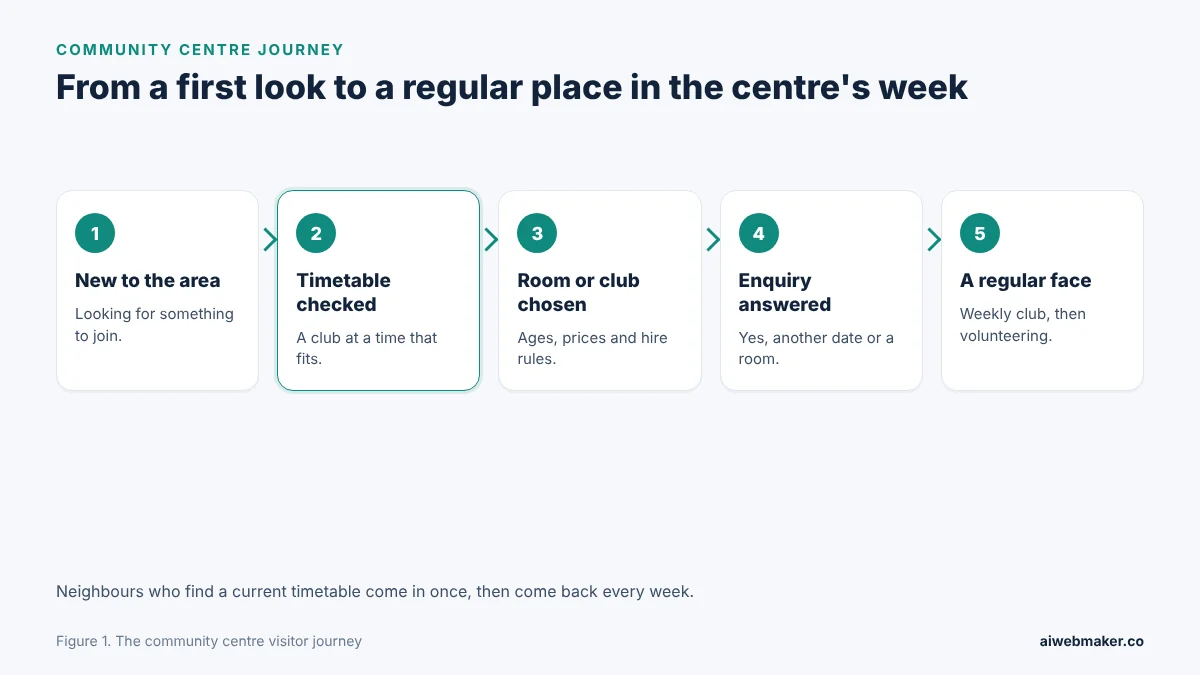
Starting with a neighbour who has just moved in, the steps end with that same person helping at the winter market. The step picked out in colour is the timetable, because most first visits start from a club held at a time that fits. A hirer follows a similar path, comparing rooms and rules before sending an enquiry. The reply, whether a yes, another date or a different room, decides whether the plan goes ahead. After a good first visit many people return weekly, and some begin to volunteer. Pages arranged in this order make the centre feel open before anyone walks through the door.
Timetable, rooms, volunteering, events: the pages behind an open door
The centre's pages should mirror the questions asked most often at the reception desk. A weekly timetable of clubs and classes comes first, because it is what regulars and newcomers check most. Room pages with capacities, hourly prices and photos serve hirers, and a hire rules page prevents arguments on the night. Clubs grouped by age help families find something for each member, and an events page shows the bigger dates on the green. A volunteering page and an about page covering governance, funding and accessibility complete the set. Built this way, the site answers in seconds what used to take a phone call during reception hours.
| Page | Who uses it | What it should include |
|---|---|---|
| What's on | Regulars and newcomers | Clubs by day and time, ages, contributions, term dates |
| Rooms | Party hosts, classes, groups | Capacity, hourly price, facilities, photos |
| Hire rules | Anyone booking | Deposit, finishing time, music, alcohol, cleaning |
| Clubs by age | Families | Under fives to over sixties, who leads each one |
| Volunteering | Neighbours with time | Roles, hours, training, a named contact |
| About and accounts | Funders, residents | Committee, annual meeting, accessibility, funding |
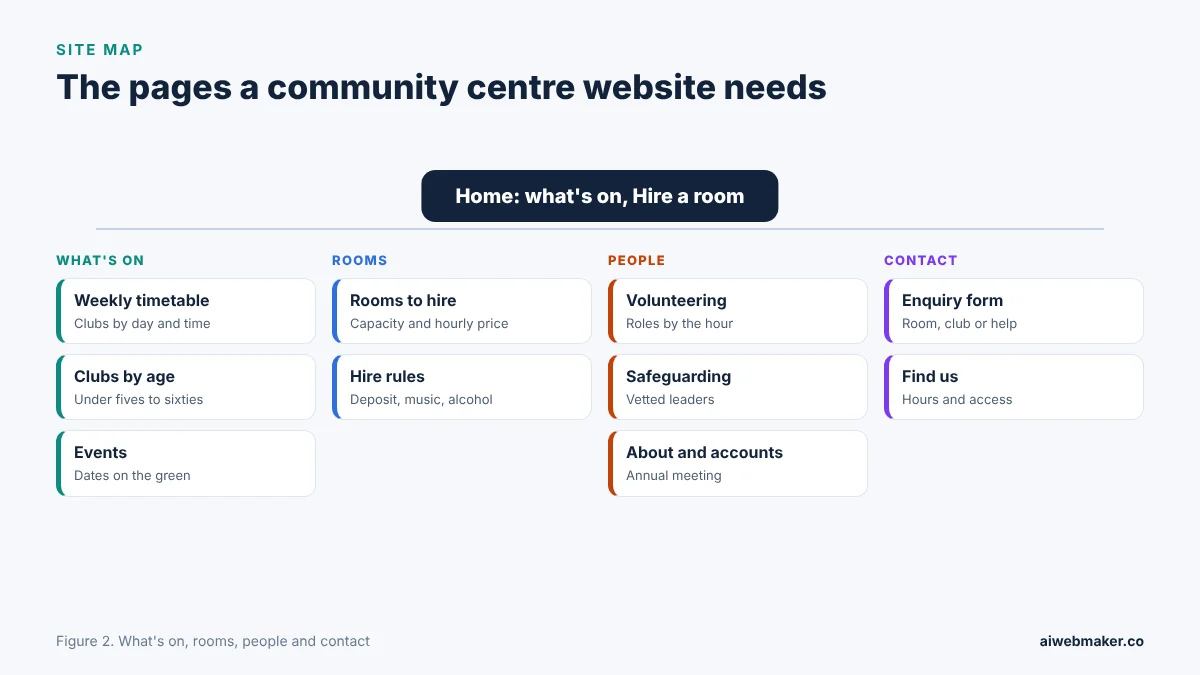
Beneath a home page offering what's on this week and a room enquiry, four groups carry the timetable, the rooms, the people and the ways in. Our sample, Riverside Community Centre, opens with a week of clubs that runs from a Monday toddler group to a Sunday community breakfast. It then prices four options, the main hall, the garden room, the meeting room and a children's party, and sets out a deposit, a finishing time and a rule on alcohol. Volunteering comes next, then clubs grouped for under fives, children, teenagers, adults, over sixties and everyone, with events on the green, photos and reviews after them. The community centre website example with a weekly timetable and room hire ends with questions and an enquiry form covering rooms, clubs and volunteering. Most centres can reuse that order, since it moves from everyday activity to the occasional booking.
A week of clubs that newcomers can read at a glance
The timetable is the most visited page on most centre sites, so it should be a simple table rather than a scanned leaflet. Each row needs the club, the day and time, who it is for and any contribution asked. Term breaks, holiday closures and changes at the start of each term should be noted above the table, with a date showing when it was last checked. Contributions written as small figures, with a note that nobody is turned away for being short, remove a barrier for families on tight budgets. Sessions for children should mention how many adults are present, which answers a question many parents hesitate to ask. A timetable kept current week by week is the warmest invitation a centre can offer.
| Timetable column | What to write | Why it helps |
|---|---|---|
| Club or class | A plain name, not an acronym | Newcomers know what it is |
| Day and time | Day of the week and start time | Easy to fit around work and school |
| Who it is for | Ages or audience | Families pick quickly |
| Contribution | The amount, or pay what you can | Removes the fear of cost |
| Leader | A volunteer, tutor or youth worker | Builds trust before a first visit |
| Booking | Drop in or ask first | Avoids a wasted trip |
Room hire by the hour, with capacities that match the floor
Hirers compare rooms on capacity, price and facilities, and the room page should show all three on each card. Seated and standing capacities differ, so both belong on the card for any hall used for parties. Facilities such as a stage, a sound system, a hearing loop, a kitchen hatch or doors to the garden help hirers picture the event. Package prices for common bookings, such as a children's party with setting up time included, save a round of questions. Lower rates for local charities and residents' groups should be mentioned, even if the figure is given on request. Clear cards turn a vague question into an enquiry with a date and a head count.
| Space | Typical bookings | Details hirers ask for |
|---|---|---|
| Main hall | Parties, dances, large meetings | Seated and standing capacity, stage, sound, kitchen |
| Smaller room by the garden | Classes, workshops, small celebrations | Light, sink, tables, access outside |
| Meeting room | Committees, support groups | Table size, screen, refreshments |
| Party package | Children's birthdays | Hours, setting up time, soft play, kitchen use |
| Regular weekly slot | Clubs and classes | Term pricing, storage, notice to cancel |
Deposits, finishing times and alcohol: hire rules and enquiries
Hire rules belong in plain view before anyone enquires, because the arguments that damage a centre's reputation usually start with a rule nobody read. A deposit that holds the date, with a clear promise about when it returns, reassures hirers and protects the hall. Finishing times, music limits for the neighbours and cleaning expectations should be listed in short lines. Rules on alcohol depend on the centre's own policy and on licensing law, which varies by country, so the page should say that alcohol needs agreement in advance. The AI website builder that community centres use for timetables and room enquiries drafts the rooms, rules and enquiry pages once the committee describes the building in a few sentences. Each enquiry then reaches the bookings volunteer, who can say yes, propose another date or room, or decline. Deposits and hire fees are settled between the centre and the hirer directly, with no share taken by the platform.
Safeguarding, accessibility and the adults in the room
Centres that run sessions for children, young people or vulnerable adults should explain how those sessions are kept safe, without burying the page in policy text. A short statement that leaders are vetted as local law requires, that children's sessions always have at least two adults present and that a named person handles concerns covers the essentials. Vetting schemes and safeguarding law are national or regional matters, so the wording should point to whichever rules govern the centre's own town. Accessibility deserves equal clarity: level entrances, an accessible toilet, a hearing loop, parking and seating for people who need a rest. Anyone needing something else, such as a quiet corner or a carer's seat, can be asked to say so on the enquiry. Plain, specific statements give parents and carers the confidence to walk in for the first time.
Volunteer roles measured in hours, and accounts anyone can read
Volunteers keep most community centres open, and a recruitment page works best when it describes roles in hours rather than in grand appeals. Listing real tasks, such as staffing reception, cooking a weekly lunch, mending at a repair cafe or helping with homework, lets people imagine themselves doing them. Saying that an hour a month is welcome, that training is given and that a named coordinator meets every newcomer lowers the barrier to offering. Funding belongs nearby, because volunteers and donors alike want to know where the money comes from and how it is spent. A short note on room hire income, session contributions, grants and donations, with the date of the open annual meeting, shows the centre answers to its neighbours. Because charity law and committee structures change across borders, the page should describe this centre's own constitution in its own words.
What neighbours type when looking for a hall or a club
Searches for a community centre split between activities and spaces, usually with the name of the area. Typical examples are toddler group near me, hall hire for a party, youth club or lunch club for older people. Club names and room names written out in full on their own pages give those searches something to match. Its map listing deserves building hours, reception hours, photos of the hall laid out for an event and a link back to the timetable. Reviews from hirers about a spotless kitchen and a prompt deposit refund, and from families about friendly clubs, help newcomers trust the place. Short articles about upcoming events, a new club or the story of a volunteer give local readers a reason to come back.
The centre's website bill, set against one evening's hall hire
A community centre's fixed website spending comes down to two lines, the hosting and the domain. Committees that set budgets annually usually find the yearly route simplest and cheapest. A newly formed group running a centre on a trial lease may want monthly payments until its funding is settled. Twelve event and club articles drafted with credits cost under eight dollars across the year. New clubs, term dates and room prices can be added at any time with no extra fee.
| Item | Yearly | Monthly |
|---|---|---|
| Hosting the community centre pages | $119 | $228 over twelve months |
| Domain | Depends on the ending | Depends on the ending |
| Higher plan, for comparison | $189 a year | Not needed |
| Twelve event and club articles at about $0.65 | About $7.80 | About $7.80 |
| New clubs, term dates and room prices | No charge | No charge |
| Year before the domain | About $126.80 | About $235.80 |
Why neighbours give up on a centre's website and ring instead
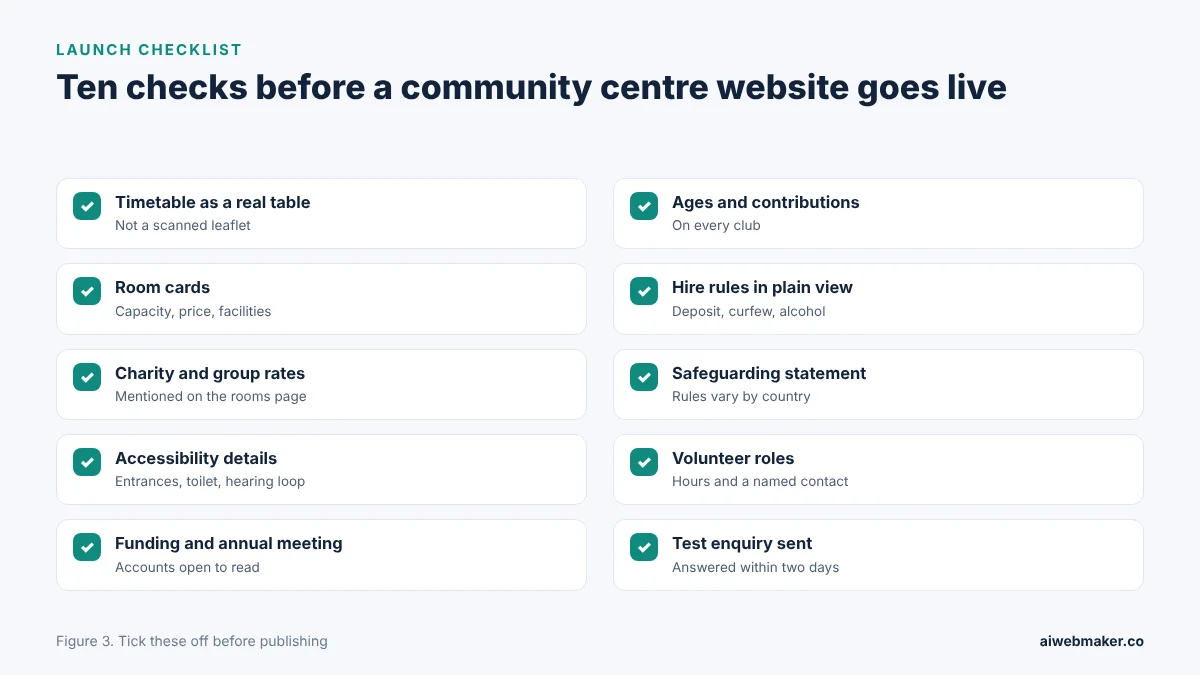
Neighbours give up when the timetable is a photo of last term's leaflet. Rooms listed without capacities or prices push hirers to ring during the few hours reception is staffed. Rules that appear only after a booking, such as a curfew or a ban on alcohol, cause disputes the centre then has to settle. Silence about accessibility keeps away the older residents and disabled visitors a centre most wants to welcome. A volunteering page with no named contact suggests offers of help will vanish into an inbox. Every one of those failures earns its own box on the launch checklist pictured next, ten boxes in all.
Frequently asked questions
Can anyone join the clubs at a community centre?
Most centre clubs are open to anyone in the stated age group, and many need no booking for a first visit. Some, such as tutored classes or groups with limited space, ask people to register first. The timetable should say which sessions are drop in and which need a word in advance. Contributions are often small, and many centres make clear that cost should never keep anyone away. Saying all this plainly encourages hesitant newcomers to try a session.
How far ahead should the main hall be reserved?
Popular weekend dates, especially in spring and summer, can go weeks or months ahead, while weekday evenings are often easier. The rooms page can give a rough guide to lead times without promising availability. Regular weekly slots are usually arranged term by term. Inviting hirers to enquire even at short notice keeps the hall busy on quiet nights. A rough guide helps party planners avoid disappointment.
Can hirers bring their own food and drink?
Many centres let hirers bring their own food and use the kitchen during the booking. Alcohol is a separate matter, because both the centre's policy and the licensing law where it operates apply, and those laws differ between countries. The hire rules page should state what is allowed and when permission is needed. Cleaning expectations for the kitchen belong in the same place. Clear rules let hirers plan the menu with confidence.
Why put the centre's yearly accounts and annual meeting online?
Publishing a short summary of income and spending shows residents, volunteers and funders that the centre is run carefully. Grant makers often look for evidence of good governance before they support a project. An open annual meeting, announced on the website, invites neighbours to ask questions and stand for the committee. Reporting requirements for charities and community groups vary by country, so the summary should follow local rules. Openness about money builds the trust that keeps donations and volunteers coming.
Two evenings of hall hire against a year of hosting
For most centres, a couple of evening hall bookings outweigh the yearly $119 of hosting. Paying month by month, a centre recovers the $19 from roughly one committee's evening in the meeting room. Every family that finds a club, every hirer who books after reading the rules and every neighbour who volunteers adds life to the building. A current timetable, honest room cards, plain hire rules and open accounts persuade people who might otherwise never come in. Committees that keep these pages fresh each term give the centre a front door that is open around the clock. New faces at the Monday toddler group and fresh names on the volunteer rota show the pages reaching the neighbourhood.
Build your website in Minutes and get the AI Tools that work
Start Building Your Website →