Car Import Website Cost and the Landed Cost Page Buyers Trust
An import agent's site costs $119 a year to host, or $19 in any month, and the domain is bought on its own. Covered: buyer fears, pages, landed cost, import rules, inspection, shipping methods, customs and plates, search and the budget.
- No coding required
- Live in minutes
- Blog, SEO and chatbot tools included
Car import agents host their websites on AI Web Maker at a yearly $119, or at $19 in each month they choose, and pick a domain whose ending decides its price. The process pages, the fee list and the landed cost table can be drafted, revised and viewed in the preview many times over, with no bill attached to any of it. A single imported car earns an agent far more than the year of hosting, often from the sourcing fee alone. The real challenge is trust, because buyers are asked to commit thousands to a car they cannot see, in a country they may never visit, under rules they barely understand. Duties, taxes, age limits and registration checks belong to the buyer's own country, and they can change while a car is at sea. What follows covers buyer fears, the pages an agent needs, landed cost, import rules, inspection, shipping, paperwork, search and the yearly sum.
This article is part of our complete guide: Professional Services Website Builder.
Why do buyers hesitate before sending money abroad?
Car import buyers hesitate because every stage involves money leaving their hands long before the car reaches their driveway. Enthusiasts hunting a particular model, families seeking better value, returning residents bringing a car home and small dealers all share the same core fears. They worry that the car may not exist, that its condition may be worse than the listing, or that hidden charges will appear at the port. Many have heard stories of cars that failed local checks and could not be registered at all. Others simply do not know which costs are fixed and which are guesses. An agent's website that answers these fears plainly gives careful buyers a reason to send a brief.
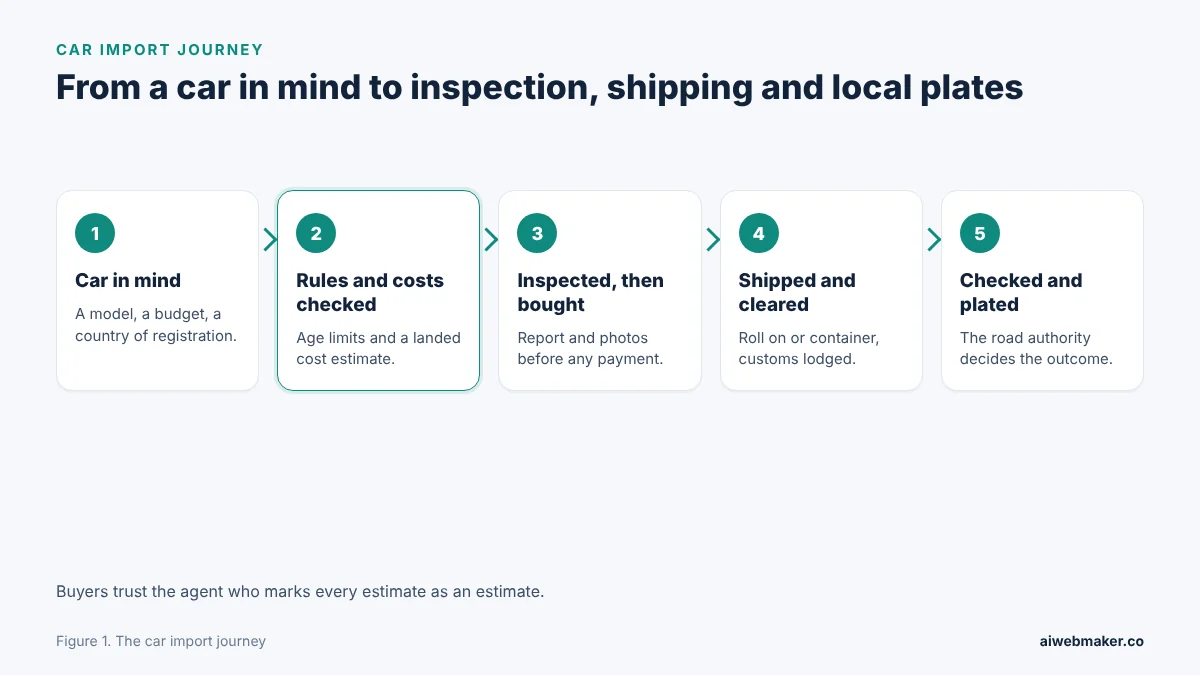
This journey runs from a buyer with a car in mind to the moment the plates are fitted at home. The marked step is the early check of rules and costs, because buyers decide here whether the agent is honest about what the import will really involve. Inspection comes before any purchase, and the report with photos lets the buyer walk away cheaply if the car disappoints. Shipping and customs follow, often the longest part of the wait. The final step depends on the buyer's own road authority, which decides whether and when the car is registered. Every step deserves a plain note saying who acts, how long it usually takes and which figures can move.
Process, fees, rules: the pages an import agent needs
An import agent needs pages that replace a buyer's leap of faith with evidence, step by step and cost by cost. The process page shows how a brief becomes a car with local plates. The fee page fixes the agent's own charges in writing, while the landed cost page lists every other line and who sets it. A rules page explains the limits that vary by country, and a gallery of recent arrivals shows that the work has been done before. A quote request starts the conversation with the details the agent actually needs. Together these pages make a complicated service feel organised and safe.
| Page | The buyer's question | What it should include |
|---|---|---|
| How it works | What happens, and when | Five steps from brief to plates, typical weeks |
| Fees | What the agent charges | Fixed fees per service, when each is paid |
| Landed cost | What the whole import may cost | Each line, who sets it, estimates marked |
| Import rules | Whether this car can come in | Age limits, steering side, emissions, checks |
| Recent arrivals | Whether the agent has done this | Cars by type, year and engine |
| Quote request | How to start | Car, budget, country of registration, timing |
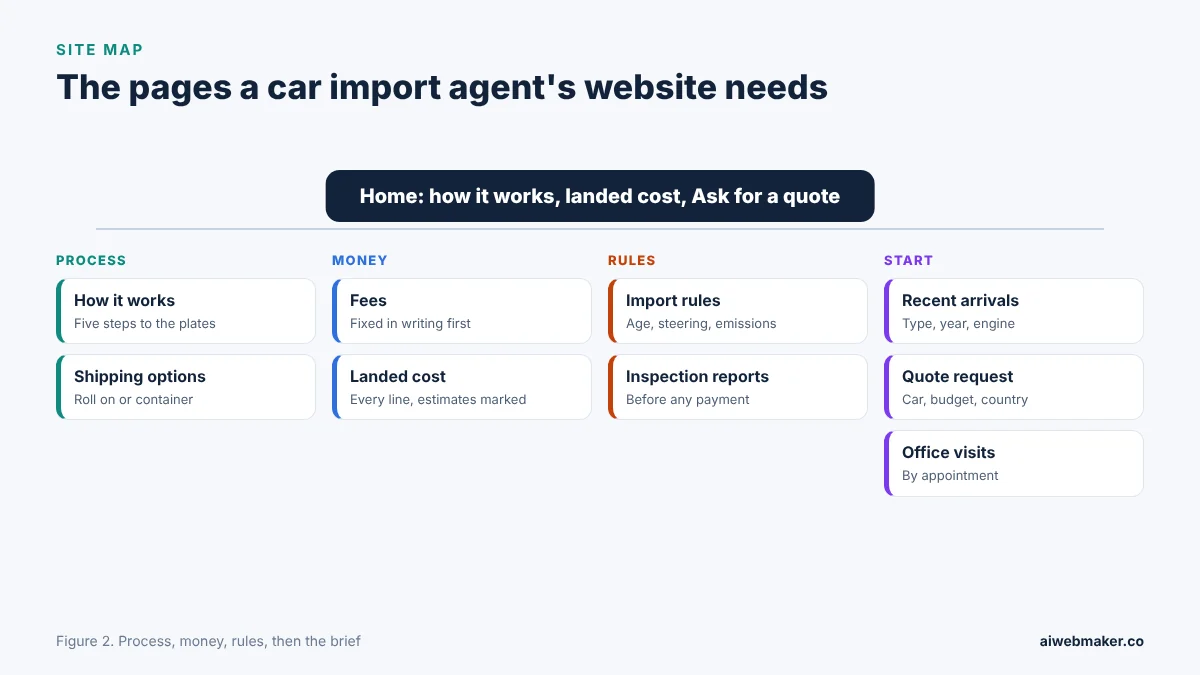
Beneath the home page, this site map arranges four groups in the sequence trust is built: process, money, rules and then the brief. Process pages hold the five steps and the shipping options, money pages hold fees and the landed cost table, rules pages hold country limits and inspection reports, and start pages hold recent arrivals, the quote request and office visits. Our sample agent, Portside Car Imports, offers sourcing and buying, inspection before purchase, shipping arrangements, customs paperwork, checks and registration, and a service for a car the buyer bought abroad themselves. Its single page sets out five steps, a fee list, a landed cost table with estimates marked and a dark section on rules that vary by country. The car import website example with a landed cost table and fixed fees then shows recent arrivals, reviews, questions and a quote form. That order mirrors how a cautious buyer reads, which is why it works for most agents.
Landed cost: every line, who sets it and what can move
The landed cost is the total a buyer pays to have the car registered at home, and a trustworthy agent lists every line separately. The purchase price is set by the seller or the auction, while the agent's own fee should be fixed in writing before the search starts. Inspection, shipping and insurance are quoted by third parties and confirmed at booking. Import duty and taxes are set by the buyer's customs authority and are final only at clearance, and exchange rates can also move between purchase and payment. Port storage can add charges if paperwork is late, so the page should mention it honestly. A table that marks each line as fixed or estimated prevents the shock that ruins many imports.
| Cost line | Who sets it | Fixed or estimated |
|---|---|---|
| Purchase price | The seller or the auction | Confirmed before payment |
| Agent's fee | The agent | Fixed in writing at the brief |
| Inspection | The independent inspector | Fixed per car |
| Shipping and insurance | The shipping line and insurer | Estimated, confirmed at booking |
| Import duty and taxes | The customs authority | Estimated, final at clearance |
| Checks and registration | The road authority | Estimated, depends on the car |
Import rules that differ by country: age, steering and emissions
Import rules are set by each country, and an agent's page should explain the common types of rule without pretending any one of them applies everywhere. Some countries limit the age of an imported car, while others restrict which side the steering wheel sits on. Many require cars to meet local emission and safety standards, which an older car may fail. Some ask for proof of conformity, modifications or specific tests before registration. A careful agent checks the rules for the country of registration before searching, and says plainly when a car is unlikely to qualify. That early honesty saves buyers from the most expensive mistake in the trade.
| Type of rule | What it can mean | When to check |
|---|---|---|
| Age limit | Cars older than a set age refused | Before the search begins |
| Steering side | Left or right hand drive restricted | Before shortlisting |
| Emissions and safety | Older cars may need work or fail | Before purchase |
| Conformity or approval | Paperwork or tests needed | Before shipping |
| Registration checks | Inspection by the road authority | After arrival |
Inspection before payment and protecting the buyer's money
An independent inspection before payment is the single strongest reassurance an import agent can offer. The inspector checks the body, the underside, the engine and the history papers, and sends photos and a written report. In some markets auction condition reports add useful detail, but they are not a substitute for an inspection made for the buyer. The buyer then decides with the report in hand, and the inspection fee is often the only cost of walking away at that stage. Payments should follow clear stages, with a statement showing every amount and its purpose. Explaining this sequence on the website tells buyers their money is never sent blind.
Roll on, roll off or container: explaining shipping choices
Shipping is usually the longest stage of an import, and buyers want to understand the options and the wait. Roll on, roll off shipping drives the car onto a specialised vessel and is often the simpler choice on busy routes. Container shipping places the car inside a sealed box, which adds protection and can carry spare parts. Marine insurance, collection from the seller and delivery to the port should be explained alongside the method. Transit times vary with the route, the sailing schedule and the port, so the page should give ranges rather than promises. Clear words on shipping keep buyers calm through the weeks when nothing seems to happen.
| Method | How it works | Usually suits |
|---|---|---|
| Roll on, roll off | Car driven onto a car carrier ship | Running cars on common routes |
| Shared container | Several cars in one container | Buyers wanting more protection |
| Sole container | One car in its own container | Classic or valuable cars, parts sent too |
Customs paperwork, checks and the day the plates arrive
Customs and registration are where the buyer's country takes control, and the website should say exactly what the agent does and what the authorities decide. The agent prepares and lodges the import declaration, with duty and tax estimated in advance and paid at the rates the authority applies. Afterwards the agent arranges whatever checks the road authority requires and files the registration paperwork. The authority, not the agent, decides the outcome and the timing, a point the page ought to state without hedging. The AI website builder for car import agents and their landed cost pages drafts the process, fee and rules pages once the agent describes its source markets and services in a few lines. Plain honesty about the final step is what turns a nervous enquiry into a signed brief.
What buyers type when they want a car from abroad
Buyers type phrases such as import a car from Japan, car import agent, import a used car, left hand drive import or car shipping to a named country. Pages that use those exact words, and name the source markets and destination countries the agent serves, meet these searches directly. A map listing that shows the office location, visiting by appointment and photos of recent arrivals helps buyers judge whether the agent is real. Reviews that mention accurate estimates and honest advice against a bad car carry unusual weight in this trade. Articles on age limits, shipping methods or what an inspection report covers attract buyers months before they commit. This kind of steady explanation makes the agent the reference buyers return to when they are ready.
An import desk's website, priced for twelve months
An import desk's website needs very little money: hosting by the year or month, a domain, and small sums in AI credits whenever articles are drafted. Agents with a steady flow of briefs tend to pay annually, and a desk in its first season can stay monthly while referrals grow. Twelve articles on import rules and shipping draw about $7.80 from the credit balance. New arrivals, revised fees and extra source countries can be added at no charge. In the table, the annual and monthly columns stand beside the $189 tier, which import desks can ignore unless they want a yardstick.
| Item | Yearly | Monthly |
|---|---|---|
| Hosting the import pages | $119 | $228 over twelve months |
| Domain | Depends on the ending | Depends on the ending |
| Higher plan, for comparison | $189 a year | Not needed |
| Twelve import rule articles at about $0.65 | About $7.80 | About $7.80 |
| New arrivals, fees and source countries | No charge | No charge |
| Year before the domain | About $126.80 | About $235.80 |
Which gaps make a buyer close an importer's site?
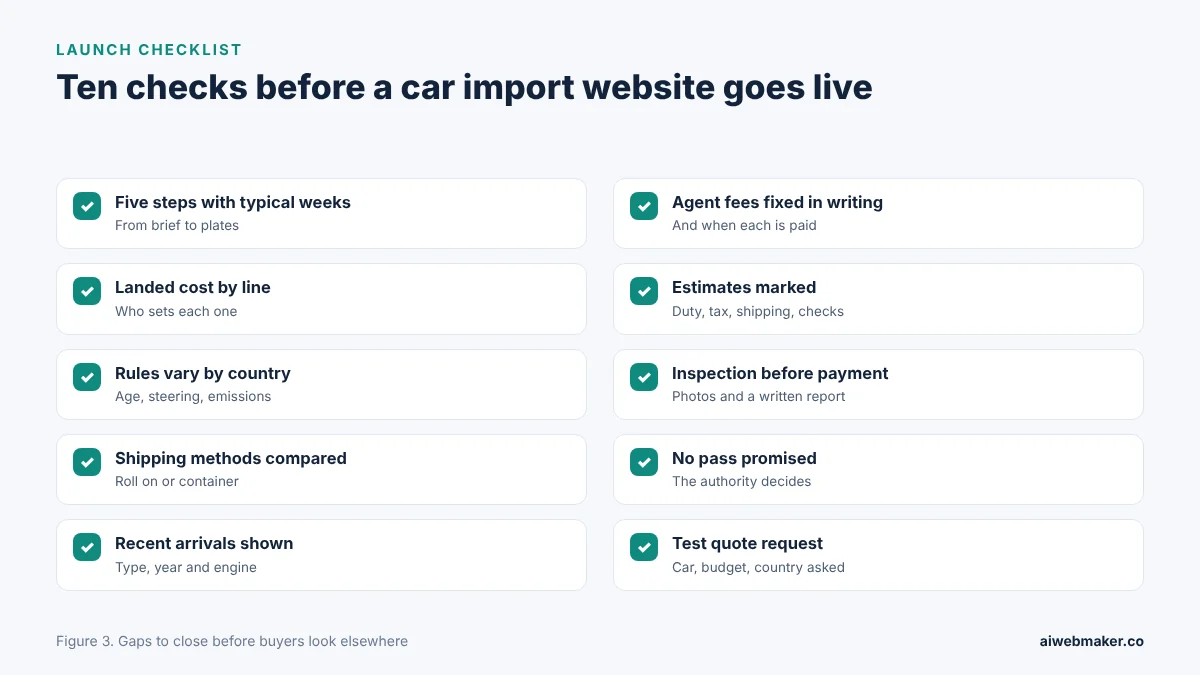
A buyer closes an importer's site when there is no landed cost breakdown, because a single total figure hides the lines that worry people most. Fees that are not fixed in writing look like an invitation to add charges later. Silence on age limits or steering rules suggests the agent has not checked the buyer's country. No mention of inspection before payment makes the whole service feel like a gamble. Promises that a car will certainly pass local checks are a warning sign rather than a comfort. Ten checks in the figure close these gaps before a buyer looks elsewhere.
Frequently asked questions
Can an importer promise the car will pass local checks?
No honest importer can promise that a car will pass the checks in the buyer's country, because the road authority makes that decision. An inspection abroad finds most problems, and an experienced agent can estimate how likely a pass is. The website should explain what could go wrong and what fixing it might involve. Buyers should be wary of anyone who guarantees registration. Clear, cautious wording on this point builds far more trust than bold promises.
From auction lot to local plates, how many weeks pass?
Many imports take a couple of months or more from the brief to the plates, and the sample agent quotes eight to fourteen weeks. The search, the sailing schedule, the time in port and the speed of local checks all make a difference. Cars already bought abroad can move faster, since the search stage is skipped. The website should give typical ranges and explain what causes delays. Realistic timings help buyers plan their transport in the meantime.
Is it safe to pay a seller abroad directly?
Paying an unknown seller abroad directly carries real risk, because recovering money across borders is difficult. Buyers should verify the seller, insist on an independent inspection and keep a clear paper trail of every payment. An agent with a fixed fee, a staged payment plan and inspection before purchase reduces that risk considerably. The website should explain exactly when each payment is due and what it secures. Careful buyers appreciate an agent who talks openly about fraud rather than ignoring it.
Can an agent handle a car the buyer already bought abroad?
Many agents take over a car the buyer has already bought, arranging collection, shipping, customs paperwork and registration. The sample agent lists this as its own service, priced from collection. The agent should still check the import rules for the buyer's country before the car is shipped. Paperwork from the purchase, such as the bill of sale and the export documents, will be needed. A clear page for this service brings in buyers who found the car themselves but dread the paperwork.
Why one sourcing fee already outweighs the hosting year
One imported car usually earns an agent more in sourcing and paperwork fees than a whole year of hosting plus the domain. Paid monthly, the $19 amounts to far less than a single inspection fee. Every brief that arrives after a buyer studies the landed cost table and the rules section is a buyer who already trusts the process. Fixed fees, marked estimates and honest words about local checks persuade careful buyers in a way glossy listings cannot. A steady line of briefs from people who already know their country's rules is the clearest return the agent can ask of its website.
Build your website in Minutes and get the AI Tools that work
Start Building Your Website →