Livery Yard Website Cost and Who Carries the Wheelbarrow Each Day
Duty tables, rate cards and turnout notes keep a livery yard online for $119 each year, or $19 in any stable month, plus a domain. Covered: owners, pages, who does what, weekly rates and extras, turnout, yard rules, waiting lists, search and the budget.
- No coding required
- Live in minutes
- Blog, SEO and chatbot tools included
For a livery yard, twelve months of website hosting cost $119, or $19 for a month taken alone, and the yard's web address costs extra, depending on which ending is chosen. Building the livery comparison, the price cards and the stable request in the preview leaves nothing on the yard's AI Web Maker bill. One horse on part livery for a single month pays the hosting year several times over. The hard part for a yard is that owners are choosing a home for an animal they love, often for years, and they compare yards on duties, turnout and rules long before price. A page that says full, part and DIY without explaining who does each job leads to arguments months later. Ahead come the owners, the pages, who does what, weekly rates and extras, turnout through the seasons, yard rules, waiting lists, search and the yearly sums.
This article is part of our complete guide: Pet Business Website Builder.
First horses, yard moves and box rest: the owners comparing livery yards
Owners compare livery yards when something in their horse's life changes, and each change brings its own questions. First time owners usually want full or part livery and plenty of experienced eyes on their horse. Riders moving yards compare turnout, the arena, hacking and the distance from home or work. Owners whose horse needs box rest after an injury look for a yard that will follow a vet's plan to the letter. Holiday livery attracts owners who travel and need a reliable short stay. Every one of them reads the duties table first, because who mucks out, who feeds and who turns out decides both the price and the owner's week.
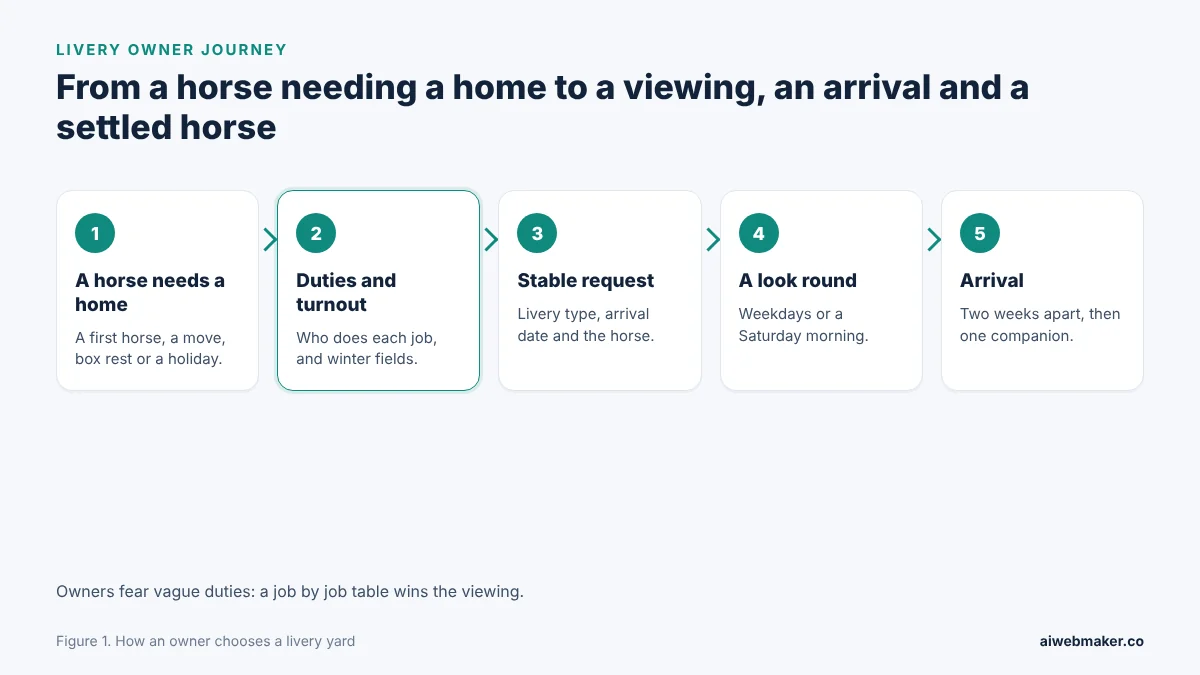
The second step of this path, where duties and turnout are compared, is where most owners shortlist or rule out a yard. It begins with a horse needing a home, whether a first purchase, a move, box rest or a holiday stay. In the highlighted step the owner checks who does each daily job and what happens to turnout in winter, since those two answers shape every week ahead. A stable request and a viewing follow, and a careful owner rarely commits without walking the yard. Arrival, a settling period and the horse joining the herd complete the path, and a smooth first month is what turns a new client into a long stay.
Liveries side by side, grazing and the yard board: what a livery site needs
A livery yard's pages should explain the daily routine as clearly as the owner would see it on the yard board. The comparison page sets out each daily job and who does it on full, part and DIY livery. Prices and extras come next, with weekly rates and the charge for each optional job. A turnout page explains the seasons, the groups and the arrangements for horses on restricted grazing. Yard rules, facilities and the stable request page complete the set, each answering a question that owners otherwise ask at the gate.
| Page | Owner's question | What it should state |
|---|---|---|
| Livery comparison | Who does each daily job | Jobs by livery type, hay and bedding |
| Prices and extras | What a week costs | Weekly rates, extras per job, stable size |
| Turnout | How much time out, and in winter | Seasons, groups, restricted grazing |
| Yard rules | How horses stay healthy | Isolation, papers, worming, vet and farrier |
| Facilities | Where to ride and store kit | Arena, hacking, wash bay, tack room |
| Stable request | How to secure a place | Livery, arrival date, viewing, waiting list |
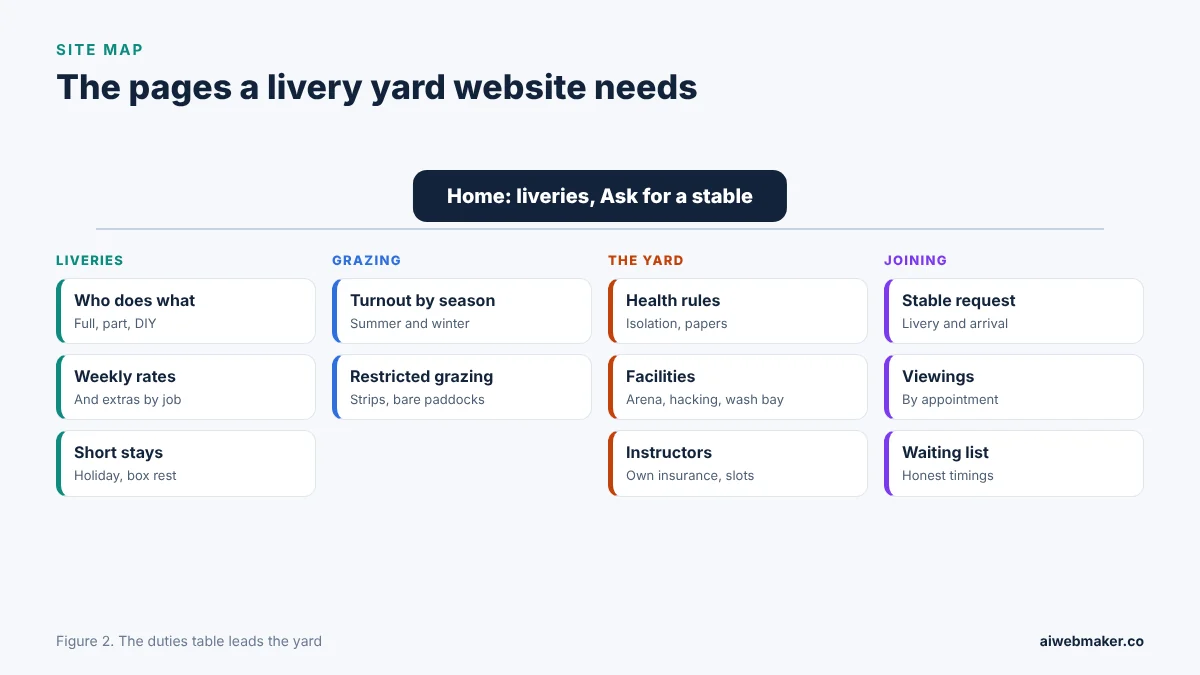
Liveries, grazing, the yard and joining make up this yard's four branches, with the duties table at the head of the first. Hollybrook Livery Stables, the sample yard, keeps 24 horses on full, part and DIY livery, with turnout across 40 acres, a floodlit sand arena and off road hacking from the gate. Its opening facts mention rubber matted stables of 3.6 by 3.6 m, fields rested in rotation and staff on the yard from 06:30 to 21:00. The livery yard website example comparing full, part and DIY duties prices DIY livery from $65 a week, part from $150, full from $255, and holiday or box rest stays from $32 a night. Turnout through the seasons, yard care rules, facilities, reviews, questions and a stable request follow, with directions for lorries on the narrow lane.
Who carries the wheelbarrow: full, part and DIY compared job by job
The difference between liveries comes down to who does each daily job, and a table is the only honest way to show it. Writing the jobs as rows and the liveries as columns leaves no room for the arguments that start when an owner assumes the yard will bring a horse in. The sample includes hay on every livery, supplies hard feed and bedding on full livery and expects part and DIY owners to bring their own. Its last check of water and rugs at 21:00 is done by the yard on every livery, which reassures DIY owners working late shifts. A note on each optional job, such as turn out by the yard for a DIY horse, links the table to the price list below it.
| Daily job | Full | Part | DIY |
|---|---|---|---|
| Morning feed and hay | Yard | Yard | Owner |
| Turn out and bring in | Yard | Yard | Owner, or the yard for $4 |
| Mucking out and bedding down | Yard | Yard on weekdays | Owner |
| Rugs changed for the weather | Yard | Yard | Owner |
| Evening feed and haynets | Yard | Owner | Owner |
| Holding for farrier and vet | Yard | Yard for $8 | Owner |
| Last check at 21:00 | Yard | Yard | Yard |
Weekly rates, extras by the job and the invoice in advance
Livery is priced by the week but usually invoiced by the month, and the page should say both to avoid surprises. The sample's weekly rates cover one horse in a standard stable with grazing, hay, arena use and the evening check, and horses over 16.2 hands take a large stable for $10 more a week. Optional jobs carry their own small charges, which lets owners build the care they need without jumping to a dearer livery. Livery is invoiced monthly in advance, a calendar month's notice in writing ends any regular livery, and short stays end on the agreed departure date. Payment goes to the yard directly, and short stays are paid on departure.
| Item | Sample price | Notes |
|---|---|---|
| DIY livery | From $65 a week | Stable, grazing, hay and arena |
| Part livery | From $150 a week | Mornings and weekday mucking out by the yard |
| Full livery | From $255 a week | All daily care, feed and bedding supplied |
| Holiday and box rest | From $32 a night | A vet's plan followed for box rest |
| Large stable | $10 a week extra | Horses over 16.2 hands |
| Exercise on full livery | $15 a session | By arrangement |
| Hand walking | $6 each time | Twice a day on box rest |
Turnout through the seasons and the ground beneath the fields
Turnout is the question owners ask most, and a truthful reply rests on the yard's soil, its acreage and the weather. The sample turns every horse out daily from April to October, in small settled groups with mares and geldings kept apart, and walks the fencing each morning before the first horse leaves. When its clay turns soft in November, turnout moves to half days and two all weather paddocks so the winter fields can recover. Horses prone to laminitis, or on restricted grazing for any reason, get a strip of their own or a bare paddock, as the owner and their vet decide. The yard says plainly that horses cannot live out all year there and that hardy types may suit a yard offering grass livery instead.
| Season or case | Turnout in the sample | Why |
|---|---|---|
| April to October | Daily, in settled groups | Fields rested in rotation |
| From November | Half days, two all weather paddocks | Clay ground poaches when wet |
| Restricted grazing | A strip or a bare paddock | As owner and vet decide |
| New arrivals | A separate paddock for two weeks | Then one companion before the herd |
Health rules, passports and the horse that is unwell at night
A shared yard needs a few firm health rules, and writing them in general terms protects every horse without pretending to be veterinary advice. The sample keeps every new arrival in a separate stable and paddock for two weeks, so a cough or infection shows before the horse meets the herd. Vaccination records and identity papers are kept on file, and what is required varies by country; horses in Britain and across the European Union, for example, need an equine identity document, while other places set different rules. Worming follows a plan built on regular egg counts, arranged with owners and their vets, and owners book their own farrier and equine dentist. When a horse is unwell the yard calls the owner first and then the vet, acting on a form signed on arrival if the owner cannot be reached, and it never treats a horse beyond basic first aid.
Waiting lists, viewings and the stable request
Good yards fill up, so the stable request page has to handle waiting lists as gracefully as offers. The sample promises a reply within two working days, offering a stable, a time to look round or a place on the waiting list, and it admits that full livery fills quickly in autumn. Viewings run by appointment on weekdays and Saturday mornings, and nothing is agreed until a stable is offered. Owners may bring their own instructor if a slot is booked on the yard board and the instructor has their own insurance, while stallions are not taken and youngstock over two years old come by arrangement. The AI website builder that drafts livery comparisons and stable request pages puts the duties table, the price cards and the request section together once the yard owner writes a few lines about stables, grazing and services. Every figure can then be edited in the preview until it matches the yard board exactly.
Part livery near me and DIY livery with an arena: searches by care and distance
Owners look for livery by the care they want and the distance they can drive. They type part livery near a town, DIY livery with a floodlit arena, full livery with hacking or winter turnout for a laminitic pony. Pages that name each livery type, the arena and the turnout arrangements give those searches precise words to match. A map listing with directions for lorries, photos of the stables and fields, and the office hours helps owners plan a viewing. Reviews mentioning rugs never going missing or a box rest plan followed carefully carry more weight than photos of a sunny paddock. Articles on preparing a horse for a yard move or managing winter turnout keep the yard visible all year.
What hosting the yard's pages adds up to over a year
Across the seasons, a livery yard's website needs only its hosting and its web address, while a dozen horse care articles on turnout or rugging take roughly $7.80 of AI credits. A yard with every stable let and a waiting list spends least by paying $119 up front. A newly opened yard still letting its stables can keep to $19 monthly until the liveries fill. Changing a weekly rate, a turnout note or the duties table carries no charge. The $189 tier is printed beside them for comparison and nothing more.
| Item | Yearly | Monthly |
|---|---|---|
| Hosting the livery yard pages | $119 | $228 over twelve months |
| Domain | Depends on the ending | Depends on the ending |
| Higher plan, for comparison | $189 a year | Not needed |
| Twelve horse care articles at about $0.65 | About $7.80 | About $7.80 |
| Rate, turnout and duty updates | No charge | No charge |
| Year before the domain | About $126.80 | About $235.80 |
Vague duties and no winter turnout: why owners drive on to another yard
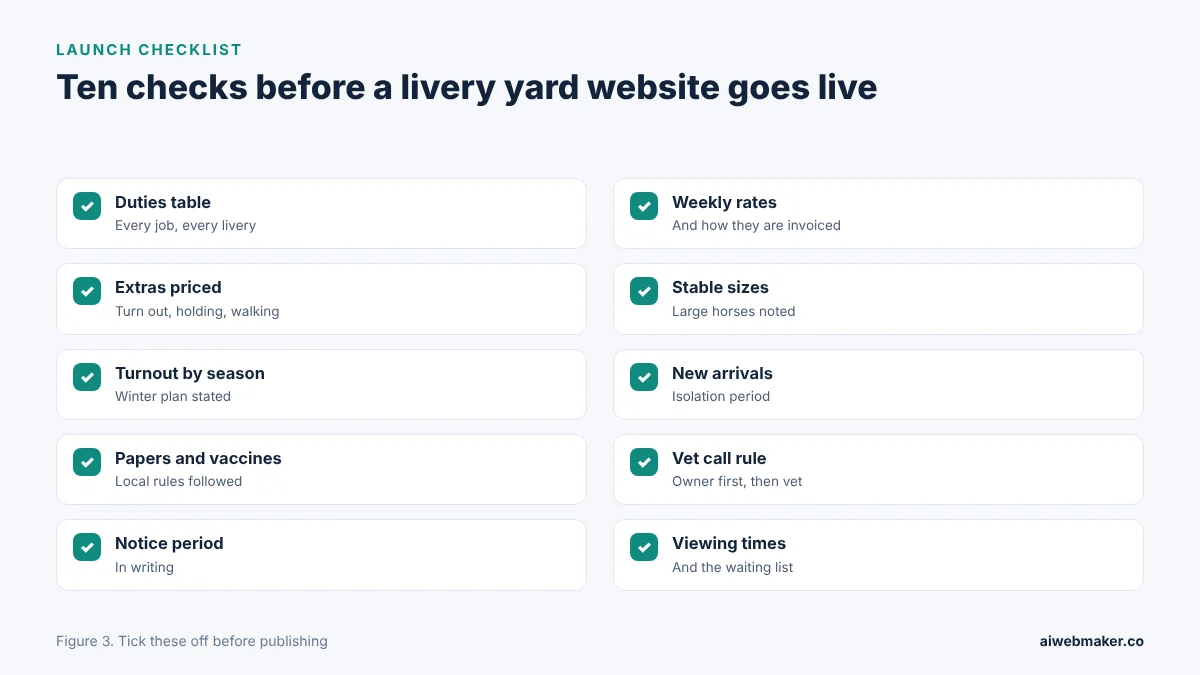
Owners drive on to another yard when the page lists full, part and DIY livery but never says who does which job. No word on winter turnout makes them assume the worst for a horse that hates standing in. Prices without the extras leave them guessing at the true monthly bill. Silence on isolation, papers and the vet call raises fears about a yard where illness spreads or decisions are made without them. Photos of an empty arena say little about the horses' daily lives. The launch card below answers each of these doubts in ten short lines.
Frequently asked questions
What separates part livery from full livery?
On full livery the yard does all the daily care, while on part livery the work is shared between the yard and the owner. Typical part livery covers mornings and some weekday jobs, leaving evenings and weekends to the owner. The exact split differs from yard to yard, which is why a job by job table matters. Feed and bedding are often supplied on full livery and brought by the owner on part. Owners should read the table carefully before choosing.
Can a horse live out all year on livery?
Some yards offer grass livery where hardy horses live out all year, while others bring every horse in during winter. The answer depends on the ground, the acreage and the type of horse. The sample cannot keep horses out through winter because its clay poaches badly in the wet. A yard that explains its reasons helps owners find the right place even when it is elsewhere. Honest answers prevent unhappy moves later.
Who decides when the vet is called for a livery horse?
The owner usually decides whenever the yard can reach them. Many yards ask owners to sign a form on arrival naming their vet and saying what the yard may agree to if the owner cannot be reached. Beyond basic first aid, yard staff should not treat a horse themselves. The page should explain the yard's own arrangement plainly. Clear rules here prevent difficult conversations at the worst moment.
How much notice is usual when leaving a livery yard?
Notice periods vary between yards and countries, and a calendar month in writing is a common arrangement. The sample asks for one calendar month for DIY, part and full livery. Holiday and box rest stays end on the agreed departure date, with any extra night charged. Owners should check the notice period before moving in, since it affects planning. Stating it on the page avoids disputes when plans change.
One horse on part livery for a month, and the yard's website year is covered
A single month of part livery for one horse brings in several times the $119 that hosts the yard's pages for a year. Billed monthly instead, the $19 costs less than five turn outs by the yard for a DIY horse. Owners who find a yard that does exactly what its table promises tend to stay for many years and recommend it at shows and in tack shops. A clear duties table, honest turnout rules and prices with every extra listed persuade careful owners more than any aerial photo. A viewing request that arrives already naming the right livery shows the pages have done the explaining before the gate opens.
Build your website in Minutes and get the AI Tools that work
Start Building Your Website →