Patent Attorney Website Cost and Why Inventors File Before They Pitch
Patent and trade mark practices spend $119 hosting their site through the year, or $19 whenever the monthly invoice arrives, with the domain purchased on top. Covered: who calls, the pages needed, protection types, secrecy before filing, the route to grant, stage fees, confidential enquiries, search and what the year online costs.
- No coding required
- Live in minutes
- Blog, SEO and chatbot tools included
Patent and trade mark practices keep a website live for $119 of yearly hosting, or $19 a month for those who prefer smaller bills, and the domain is extra. The protection pages, the stage fee table and the confidential enquiry form are drafted and tried out in the AI Web Maker preview, with no fee from the platform for any of it. One trade mark filing or a single search report pays for the whole year with plenty to spare. The difficulty is that inventors and founders often arrive with something precious and fragile: an invention that loses its novelty the moment it is shown in public, or a brand name they have already started using. A website has to teach them to stay quiet until filing, explain which protection fits and show what each stage costs, without inviting them to reveal secrets in a form. The sections that follow are about who calls, the pages needed, protection types, secrecy before filing, the route to grant, stage fees, confidential enquiries, search and the yearly budget.
This article is part of our complete guide: Website Builder for Law and Accounting Firms.
Which inventors, founders and brand owners call a patent attorney?
Patent attorneys hear from people who have made something new or built a name worth protecting, usually when a launch, an investor or a copycat forces the question. Solo inventors arrive with prototypes and sketches, often unsure whether anything can be protected. Startup founders need rights moved into the company before investors arrive. Established manufacturers file steadily for new products and parts, while university research teams need advice before publishing. Brand owners want their name, logo or packaging registered before a rival takes it. Each group looks for clear advice on which protection fits, what it costs and how to keep the invention confidential.
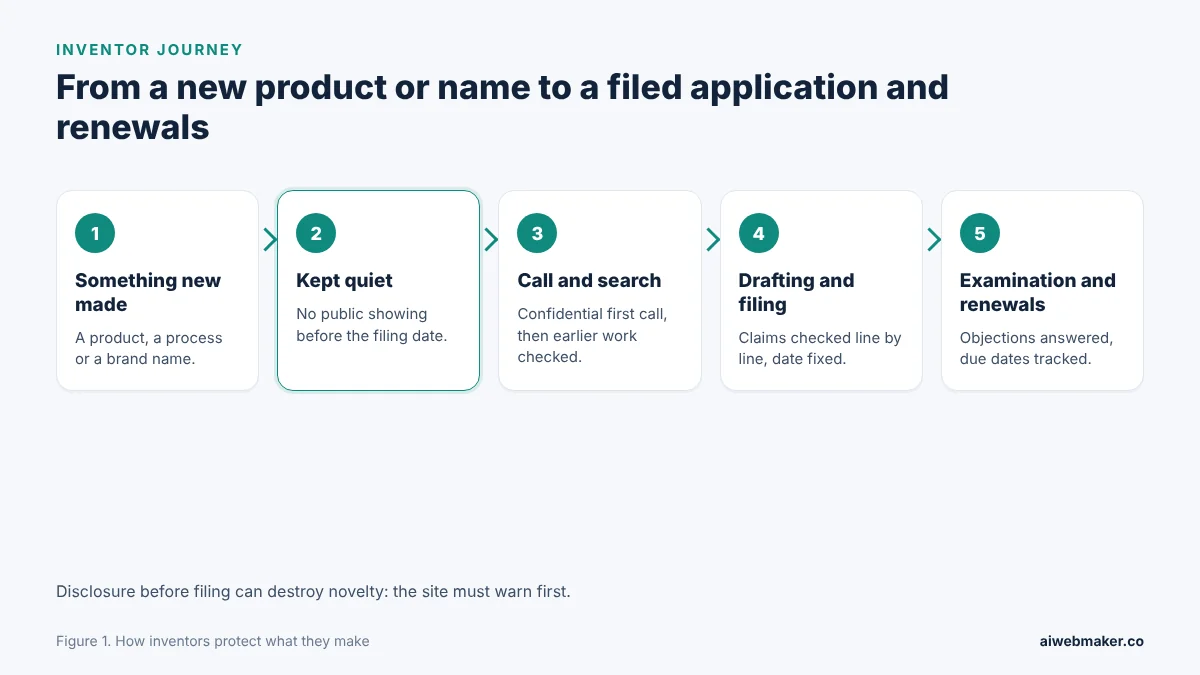
Following an inventor from a working prototype to a granted right with renewals on the calendar, the five steps show where a practice website does most of its work. The trigger is usually a deadline, such as a trade fair, a funding pitch or a planned launch. The highlighted step is staying quiet until filing, because a public disclosure before the filing date can destroy novelty in most countries. A confidential first call and a search follow, and only then does drafting begin. Filing fixes the date, examination tests the claims against earlier work, and renewals keep the right alive for years. A website that guides visitors through these steps in order prevents mistakes that no attorney can undo later.
What should an intellectual property practice publish before the first call?
An intellectual property practice should publish a page per protection type, a page on secrecy before filing, a clear process and a stage fee table. Patents, trade marks, registered designs, searches, licences and disputes each attract different clients with different questions. A before you file page may do more good than any other, since it prevents the costliest early mistake. Process and fields pages then cover the route to grant and the technical areas the attorneys know. A confidential enquiry page that asks only for plain lines completes the set.
| Page | Who reads it | What it should state |
|---|---|---|
| Patents | Inventors, engineers, founders | What qualifies, drafting, claims, filing |
| Trade marks | Brand owners | Availability searches, classes of goods and services |
| Registered designs | Product designers | Protection for shape and appearance |
| Searches and opinions | Anyone before spending | Earlier patents and publications, clearance |
| Before you file | Everyone with something new | Disclosure risks, confidentiality habits |
| Fees by stage | Budget holders | Attorney fees, official fees, translations |
| Confidential enquiry | Anyone ready to start | What to protect, public yet or not, countries |
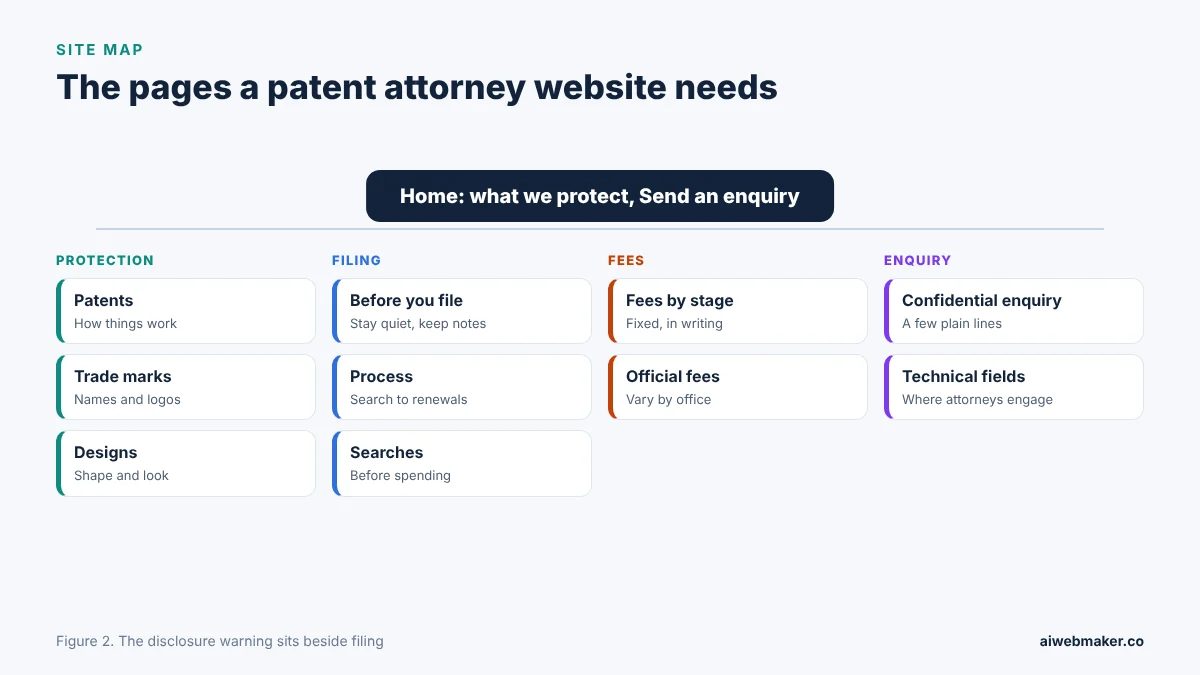
Grouped in four branches, the patent practice site runs from protection types to filing, then fees, then a safe way to make contact. Brightmark Patents, the invented practice behind our patent attorney website example with a confidential enquiry form, protects patents, trade marks and registered designs and also offers searches and opinions, licences and assignments, and help with objections and disputes. A section titled around pitching, posting and selling explains why an invention shown in public before filing may no longer be patentable. The process runs in six steps from a confidential first call through search, drafting, filing and examination to decision and renewals, and a fee table prices each stage with official fees listed as extra. A list of technical fields shows where the attorneys can engage with detail. Its enquiry form covers what needs protecting, any public showing so far, the countries of sale and a short outline, and it warns visitors to keep the inner workings for the meeting.
Patent, trade mark, design or secret: which protection fits?
The right protection depends on what makes a product valuable, and many products need more than one kind. A patent protects how something works, provided it is new, not obvious to a skilled person and capable of industrial use, though what qualifies differs between countries. A trade mark protects the name, logo or slogan customers recognise, registered for particular classes of goods and services. A registered design protects the shape and look of a product, separate from how it functions. Copyright usually arises automatically in most countries, and trade secrets last as long as they are kept confidential. A table setting these out side by side helps visitors see which questions to bring to the first call.
| Protection | What it covers | How it is obtained | How long it can last |
|---|---|---|---|
| Patent | How a product or process works | Application and examination | Commonly up to twenty years, with renewal fees |
| Trade mark | Names, logos, slogans | Registration in chosen classes | Renewable, often in ten year periods |
| Registered design | Shape and appearance | Registration | Varies by country, with renewals |
| Utility model | Smaller technical improvements | Registration, in some countries only | Shorter than a patent |
| Copyright | Creative works and software code | Arises automatically in most countries | Long, varying by country |
| Trade secret | Confidential know how | Kept secret by the owner | As long as secrecy holds |
Why must an invention stay private until the filing date?
An invention must stay private until the filing date because most countries refuse a patent for anything already made public, even by the inventor. A trade fair demonstration, a video online, a crowdfunding page or a conference talk can all count as public disclosure. A few countries allow a short grace period, but the rules are narrow and differ from place to place, so careful attorneys never plan around them. Details should be shared only with people bound by confidentiality, ideally under a written agreement, and inventors should keep dated notes, sketches and test results. Once a first application is filed, most countries allow twelve months to file abroad while keeping the earlier date, under the international priority rules. Explaining this plainly on the website protects inventors from the single most expensive mistake they can make.
How does an application move from search to grant and renewals?
A patent application usually moves through search, drafting, filing, publication, examination and grant, and the whole route often takes several years. A search of earlier patents and publications before drafting helps decide whether the idea still looks new and where the claims should focus. Drafting produces the description, drawings and claims, which define the limits of the rights and should be checked line by line by the inventor. After filing, many applications are published around eighteen months from the earliest date, and an examiner then compares the claims with earlier work and raises objections. International routes, such as a single application under the Patent Cooperation Treaty, can delay decisions on individual countries while the invention is tested in the market. Granted patents stay in force only while renewal fees are paid, so a practice that tracks due dates for clients offers real value.
How should stage fees and official fees be separated?
Stage fees and official fees should be separated because clients need to see what the attorney charges and what each patent or trade mark office charges on top. Fixed fees for defined stages, such as a first call, a search with an opinion, drafting and filing, an examination reply or a trade mark filing, help inventors budget. Official fees differ by country and by office and are usually passed on at cost. Translations for filings abroad and fees for local attorneys in other countries should be quoted separately. A written estimate for the full route, including likely renewals, gives founders figures they can share with investors. A clear fee table is often the page that turns a nervous inventor into a client.
| Stage | Who charges | What the client should see |
|---|---|---|
| First call | The practice | Length and a fixed fee |
| Search with opinion | The practice | Turnaround and what the report covers |
| Drafting and filing | The practice, plus the office | Attorney fee and official filing fee apart |
| Examination replies | The practice | Fee per reply, approval before sending |
| Filing abroad | Practice, local attorneys, offices | Quote before the priority year ends |
| Translations | Translators | Quoted separately by language |
| Renewals | The office, plus any handling fee | Due dates and amounts in advance |
How should a confidential enquiry be worded for inventors?
A confidential enquiry should ask inventors for a few plain lines, never for the secret details of how the invention works, because the form is not yet a confidential meeting. The questions can cover what the visitor wants to protect, whether it has been shown in public, where they plan to sell it and the company involved, if any. A note that sending the form does not create a client relationship, and that a conflict check comes first, sets the right expectations. A promised reply time, such as within two working days, stops inventors chasing several practices at once. The AI website builder for patent practices with a confidential enquiry form turns a short outline from the attorneys into draft protection pages, a stage fee table and an enquiry form. The partners can then reword any line in the preview before publishing.
Which protection questions do inventors and founders search for?
Inventors and founders usually search with a question or a task, such as how to patent an invention, trade mark registration or patent attorney near me. Founders often add words such as startup or investor, while brand owners add the name of a market or country. Every protection page should mirror these searches in its title and first lines. Inventors who want to bring a prototype along often find the practice through its map entry, which should show hours, the street address and the site link. Reviews that mention clear explanations, honest advice about weak ideas and predictable fees carry the most weight. Articles on disclosure risks, trade mark classes or the cost of protecting a product abroad attract visitors months before they file.
Next to one search report, how large is the hosting line?
A patent practice's website costs only hosting and a domain each year, and twelve articles on intellectual property drafted with AI credits stay near $7.80 in total. A practice with steady filings spends the least by paying annually. A newly qualified attorney setting up alone may choose monthly billing at first. Editing fees, fields or protection pages carries no extra charge. The $189 option is listed for comparison alone.
| Item | Yearly | Monthly |
|---|---|---|
| Hosting the patent attorney pages | $119 | $228 over twelve months |
| Domain | Depends on the ending | Depends on the ending |
| Higher plan, for comparison | $189 a year | Not needed |
| Twelve intellectual property articles at about $0.65 | About $7.80 | About $7.80 |
| Fee, field and protection page updates | No charge | No charge |
| Year before the domain | About $126.80 | About $235.80 |
What makes an inventor hesitate to contact a patent practice?
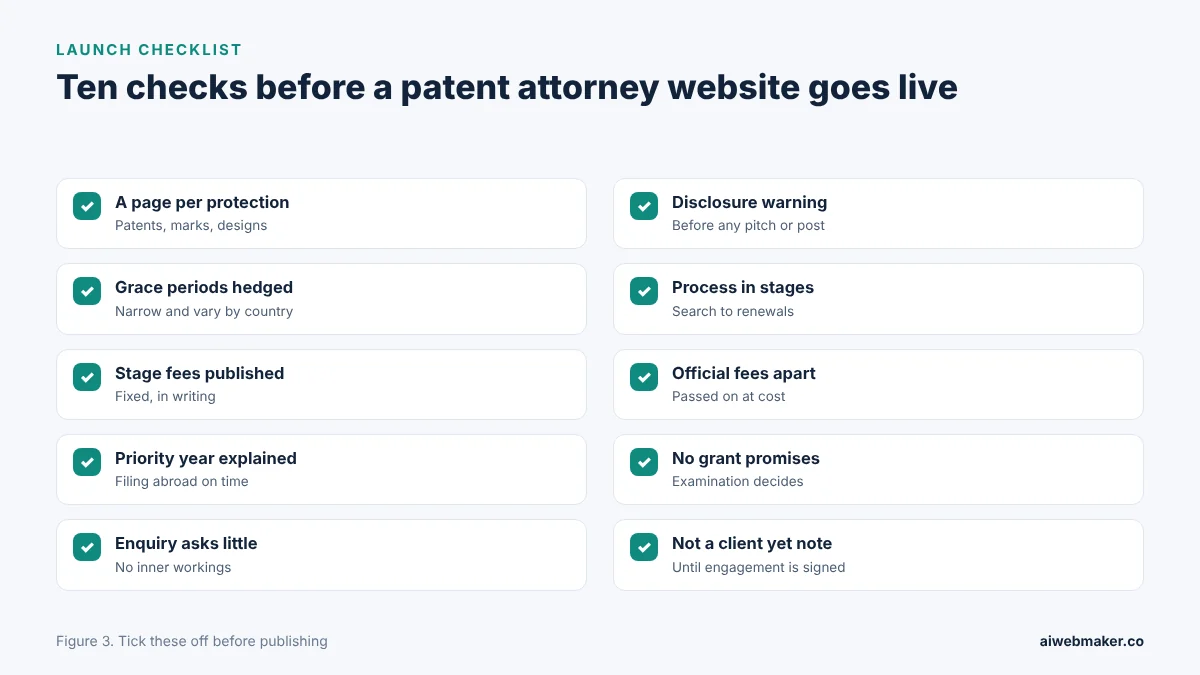
Inventors hesitate when a practice's website gives no hint of cost, because they fear that protecting an idea will cost more than it earns. Pages full of legal language make the process feel closed to anyone without a law degree. No warning about public disclosure suggests the practice may not protect them from their own early mistakes. An enquiry form that asks for a full technical description feels unsafe before any confidentiality is in place. Promises that every idea can be patented make experienced founders suspicious. The ten checks pictured in the launch graphic remove each of these hesitations.
Frequently asked questions
Can an idea on its own be patented?
An idea on its own generally cannot be patented, because patents protect specific inventions rather than concepts. To qualify, an invention must usually be new, not obvious to a skilled person and capable of being made or used. What qualifies differs between countries, especially for software and business methods. A search and an opinion before drafting show whether the core of the invention still looks new. Sometimes another kind of protection, such as a design or a trade mark, fits better. A good attorney says so honestly.
Is a conversation with a patent attorney confidential?
Conversations with a patent attorney are usually treated as confidential from the first call, although professional confidentiality rules differ by country. Many practices sign a non disclosure agreement before discussing technical detail. The enquiry form should still ask only for a brief outline, keeping the inner workings for the meeting. Inventors should avoid sharing details with anyone else until an application is filed. A clear confidentiality note on the website reassures cautious visitors.
How long does it take for a patent to be granted?
A patent often takes several years to be granted, and the wait differs widely by country and field of technology. The application is pending throughout, and the product can usually be marked patent pending where local rules allow it. Examination may bring objections that need replies, each adding time. Nobody can promise that a patent will be granted or how broad the claims will be. An honest estimate at the start helps founders plan.
Does a trade mark registration cover every country?
A trade mark registration usually covers only the country or region where it is granted, so brands selling abroad need protection in each market. International systems, such as the Madrid route for trade marks, can simplify filing in many countries through one application. Each country still examines the mark under its own rules. Availability searches in each market should come before filing, because someone else may already hold a similar mark. A website that explains this helps brand owners plan their expansion.
Does one search report or filing settle the practice's hosting for a year?
A single trade mark filing or one search report earns a patent practice more than the $119 it pays to keep the website hosted for twelve months. A single first call fee also dwarfs the $19 of a monthly bill. Each inventor who files before pitching, after reading a clear disclosure warning, is a client protected from losing their rights. Plain explanations, stage fees and a safe enquiry form persuade founders who fear both cost and leaks. Practices that keep fees, fields and guidance current become the attorneys that incubators and investors recommend. Enquiries that arrive with the public disclosure question already answered show the website is teaching visitors well.
Build your website in Minutes and get the AI Tools that work
Start Building Your Website →