Insurance Agency Website Cost, Cover Pages and the Claims Promise
For an insurance agency, AI Web Maker hosting is a $119 yearly charge or $19 a month, with the domain on top. Inside: who shops for cover, plain cover pages, agency status, quote requests, renewals, claims help, disclosures, search and the yearly budget.
- No coding required
- Live in minutes
- Blog, SEO and chatbot tools included
For an insurance agency, AI Web Maker hosting is a $119 yearly charge or $19 a month, with the domain priced by the ending chosen. Drafting cover pages and testing every link in the preview runs up no bill, so the wording can be checked against the policies the agency actually places. Cover pages of this kind can be studied in place on our insurance agency website design sample, a fictional agency whose site AI Web Maker produced with claims help up front. One household that moves its car and home cover to the agency and keeps renewing usually repays that hosting many times over. The challenge is that comparison sites rank on price, while an agency's real value, advice and help at claim time, stays invisible until something goes wrong. The site's job is to show that value before it is needed, within disclosure and advice rules that differ between countries. The guide moves through who shops with an agent, the pages needed, plain cover wording, agency status, quote requests, renewals, claims, search and the yearly budget.
This article is part of our complete guide: Website Builder for Law and Accounting Firms.
Who shops for cover through an agent rather than a comparison site?
People choose an agent over a comparison site when the risk feels complicated, the stakes feel high or a past claim went badly. A household buying its first home wants to know whether the building, the contents and liability are all covered. A landlord with several properties needs cover that a standard home policy will not provide. Business owners face a long list of possible covers, from public liability to stock, vehicles and staff, and want someone to separate the essential from the optional. People whose premium has jumped at renewal start shopping around, often for the first time in years. All of them judge an agency on plain explanations, named people and visible help at claim time.
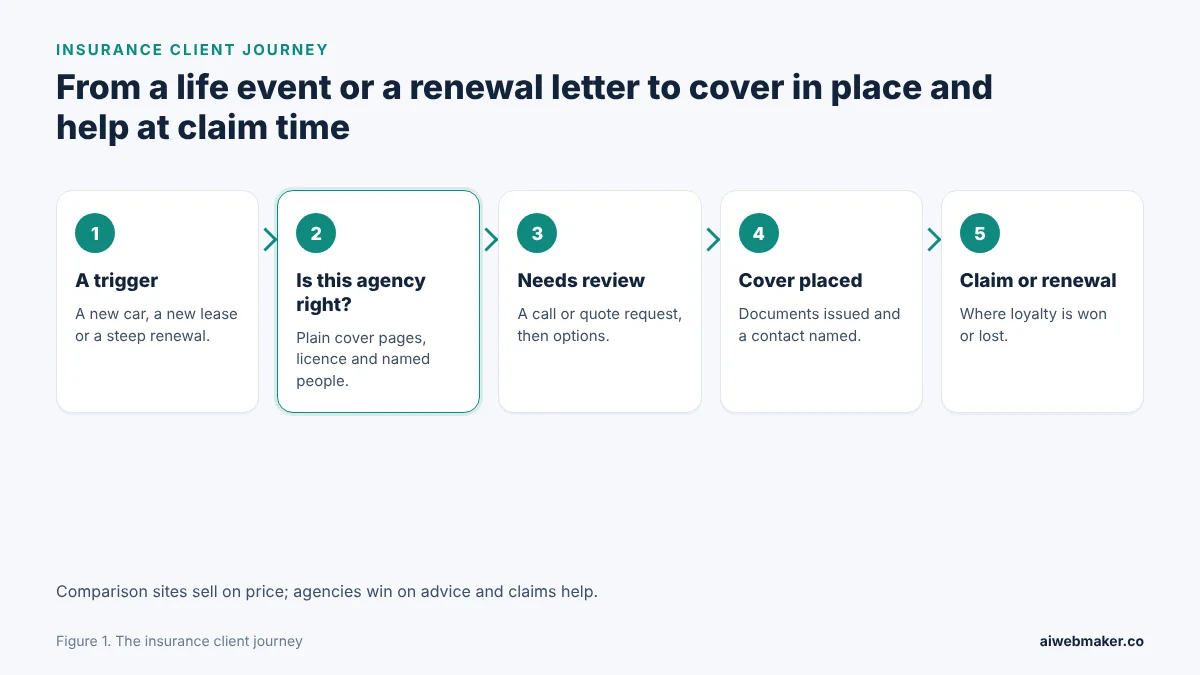
The path pictured starts with a trigger, such as a new car, a new lease or a renewal letter carrying an unwelcome figure. A search follows, and the highlighted step is the moment the visitor decides whether this agency understands the situation and is properly authorised. A quote request or call leads to a review of needs and a look at options from the insurers the agency works with. Cover is placed, documents are issued and the client learns who to call. The real test comes later, at claim time or renewal, when loyalty is won or lost. Pages that serve each of these stages keep the relationship alive long after the first policy.
Which pages take a visitor from first search to a placed policy?
An agency site needs a page for each family of cover, plus pages that explain how the agency works and how it is regulated. Personal lines, such as car, home, renters and travel cover, attract different searches from commercial lines such as liability, property and fleet. A how it works page sets out the path from enquiry to policy start and explains what happens at renewal. A claims page describes the help the agency gives without promising any outcome. The about page carries the people, the agency's status and its regulatory details. Each page should point to a named person, because insurance is still bought from people.
| Page | Visitor question | What it should state |
|---|---|---|
| Personal cover | Is everything the household owns covered? | Car, home, renters and travel, with typical exclusions |
| Business cover | What does my business need? | Liability, property, vehicles and staff, noting that legal requirements vary |
| How it works | What happens after a first enquiry? | Needs review, options, placing, documents, renewal |
| Claims help | Who helps when something goes wrong? | First steps, the agency's role, the insurer's decision |
| About and regulation | Is this agency legitimate? | Status, licence or registration, complaints route |
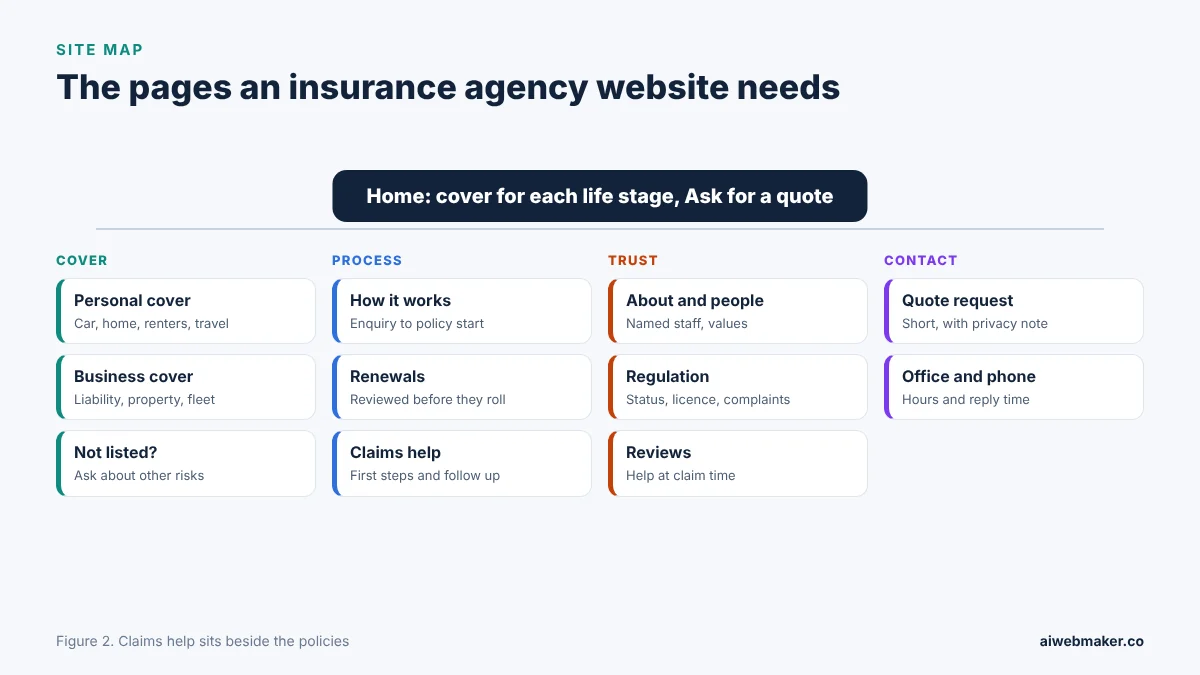
Pictured as a tree, the agency's pages split into cover, process, trust and contact, with claims help sitting beside the policies rather than buried at the bottom. Cover pages explain each policy family in plain words, and process pages carry the steps from enquiry to renewal. Our sample agency, Shelterpoint Insurance, has a page on the cover it offers, with a section on what is typically covered and what to check, plus a note for anyone needing something not listed. Its home page speaks to cover for every stage of life and helps visitors pick the level of protection that fits, while another page runs from enquiry to policy start, explains how the agency supports clients making a claim and answers common questions. The about page sets out accreditations and regulatory information beside the agency's story, values and people. The insurance agency website example with plain language cover pages produced those four pages, contact form included, in 50 seconds.
How can cover be explained without drifting into personal advice?
Cover can be explained in general terms on a website, while personal recommendations belong in a conversation, because many regulators treat advice on a specific policy as a regulated activity. Each cover page can describe what is typically included, what is commonly excluded and what to check in any policy wording. A line stating that the page is general information, and that the agency will review each person's needs, keeps the distinction clear. The exact boundary between information and advice depends on local rules, so a compliance adviser or the regulator's guidance should settle the wording. Clear general guidance builds confidence without promising what a policy will pay.
| Term | Plain meaning | Why it matters |
|---|---|---|
| Premium | The price paid for the policy | Monthly payment can cost more than yearly in some markets |
| Excess or deductible | The part of a claim the policyholder pays first | A higher excess lowers the premium but raises the cost of a claim |
| Sum insured | The most the insurer will pay for a property or item | Setting it too low can reduce a claim payment |
| Limit | A cap on a particular kind of claim | Valuables and cash often carry lower limits |
| Exclusion | Something the policy does not cover | The most common cause of disputed claims |
Broker, independent agent or tied agent: what should the site disclose?
Visitors deserve to know whose interests an intermediary represents, and in many countries regulators require that status, along with how the agency is paid, to be disclosed. Legal meanings of broker and agent shift between jurisdictions, so the site should describe the arrangement plainly instead of leaning on the label. An agency that compares several insurers can say so, while an agency tied to one insurer should be equally clear. Payment by commission from insurers, by fees from clients or by both should be explained before anyone buys. The licence or registration number, the name of the regulator and the complaints route belong on the about page and in the footer. Open disclosure turns a legal duty into evidence of honesty.
| Status | Who the intermediary acts for | What the site should state |
|---|---|---|
| Broker | Usually the client, choosing among insurers | That it compares insurers, and how it is paid |
| Independent agent | Several insurers that appoint it | Broadly which insurers it can place with |
| Tied or captive agent | One insurer or one group | That it offers that insurer's products only |
| Any intermediary | Its regulator and its clients | Licence or registration, complaints route, data use |
What should a quote request ask for, and what should it leave out?
A quote request should collect just enough to start a useful conversation, and leave sensitive details for a secure exchange later. The page can tell visitors which details help, such as the type of cover, the renewal date, what is to be insured and any recent claims. It should discourage sending identity numbers, bank details or medical history through a website message. A short privacy note beside the request explains how the details are used and stored, in line with the data protection rules where the agency operates. The AI website builder insurance agencies use to draft cover and quote pages produces a first version of these pages after the agency summarises its lines of business in a few sentences, and every claim on them can be checked in the preview. A request that feels safe to send is one that actually arrives.
Why do renewals deserve a page of their own?
Renewal is the moment an agency either proves its worth or loses a client to a cheaper headline price. A renewal page can explain that the agency reviews each policy before it renews, checks whether the sum insured still matches reality and asks about changes in circumstances. Many clients do not realise that a new extension, a new driver or a home business may need to be declared, and the rules on what must be disclosed vary by country. When premiums rise, the page can describe how the agency looks at alternatives without promising a lower figure. A visible renewal routine turns a yearly risk into a yearly reason to stay.
What does claims support from an agency actually involve?
Claims support means guiding the client through each step, while the insurer, not the agency, decides whether and how much to pay. The page should say so plainly, because overpromising here damages trust when it matters most. Describing the agency's help, such as explaining first steps, assisting with the notification and following up on progress, makes the promise concrete. Where an independent complaints body or ombudsman exists, the page can name it and explain when to use it. Honest claims guidance is the strongest argument an agency can make against buying cover alone.
| Claim stage | What the client does | How the agency can help |
|---|---|---|
| Straight after the loss | Makes things safe and limits further damage | Explains first steps and who to call |
| Reporting | Notifies the insurer promptly | Helps with the claim notification |
| Evidence | Keeps photos, receipts and damaged items | Says what evidence insurers usually ask for |
| Assessment | Meets an assessor if the insurer sends one | Follows up on progress and delays |
| Decision | Receives the insurer's decision | Explains the outcome and the complaints route |
Which searches bring cover seekers to a local agency?
Cover seekers type phrases such as insurance broker near me, landlord insurance, business insurance for contractors or home insurance after a claim. Cover pages titled in the same words people type are the ones that surface for those searches. Office hours, a pin on the map and a link through to the cover pages help people who still like to sit across a desk. Reviews that mention help during a claim are worth far more than reviews about price, so the agency should ask for them after a claim is settled. Articles on what to insure after buying a home, how an excess works or what public liability covers answer the questions people search before they are ready to buy. Patient, accurate writing gradually makes the agency the local reference point for cover questions.
How does the yearly website bill compare with a single commission?
The bill has two fixed parts, hosting and a domain, and twelve cover guides drafted with credits add under eight dollars. An agency with a mature book of business spends least when it clears all twelve months in a single payment. A newly licensed agent building a book of clients may prefer the monthly route while commissions start to arrive. Updating cover descriptions, regulatory details or staff photos is not charged. Yearly and monthly payment appear next to each other in the rows that follow, and the $189 tier is included for reference alone.
| Item | Yearly | Monthly |
|---|---|---|
| Hosting the agency pages | $119 | $228 over twelve months |
| Domain | Depends on the ending | Depends on the ending |
| Higher plan, for comparison | $189 a year | Not needed |
| Twelve cover guide articles at about $0.65 | About $7.80 | About $7.80 |
| Cover, staff and disclosure updates | No charge | No charge |
| Year before the domain | About $126.80 | About $235.80 |
What sends a visitor back to the comparison site?
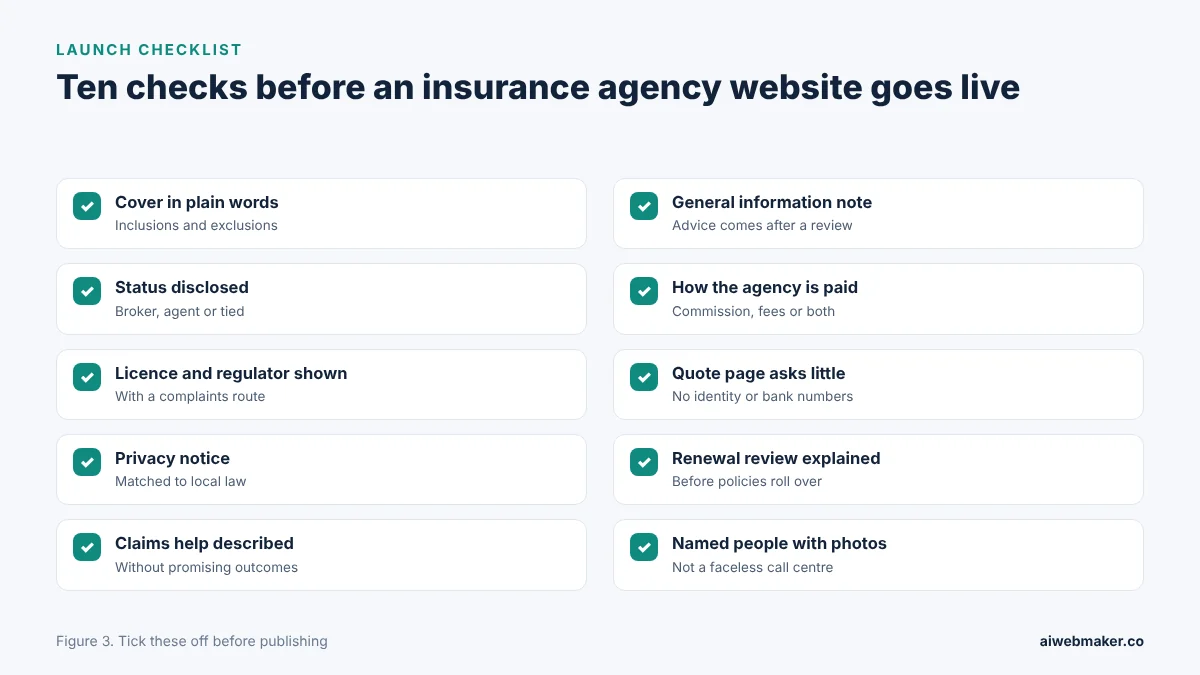
Visitors return to comparison sites when an agency's pages are full of jargon they cannot decode. No sign of a licence or regulator makes a cautious buyer wonder whether the agency is legitimate. A quote page that demands personal details before explaining why feels intrusive. Silence on claims help removes the main reason to use an agent at all. Stock photos and no named staff make the agency look like an anonymous call centre. Ten fixes for doubts like these fill the launch list that follows.
Frequently asked questions
Can an agency show example premiums on its website?
Example premiums can mislead, because each price depends on personal details, and some regulators restrict how prices are advertised. A safer approach is to explain the factors that move a premium, such as the excess chosen, the sum insured, the location and claims history. If the agency does show examples, they should be clearly labelled as illustrations and not offers. Visitors gain more from understanding the drivers than from a single figure. Explaining price honestly prepares people for the quote they will actually receive.
What is the difference between an excess and a premium?
The premium is the amount paid for the policy, while the excess, called a deductible in some countries, is the part of each claim the policyholder pays. Choosing a higher excess usually lowers the premium, but it makes each claim more expensive for the client. Some policies carry separate excesses for different kinds of claim. A short worked example on the cover page helps visitors see the trade off. Clear definitions reduce disappointment when a claim is settled.
Does buying through an agent cost more than buying direct?
Buying through an agent does not necessarily cost more, because many agents are paid by commission from insurers, and some insurers sell only through intermediaries. Some agencies also charge a fee, which should be disclosed before the client commits. The value lies in advice, a wider choice of insurers and help when claiming. Rules on disclosing commission and fees vary by country, so the site should follow local requirements. Transparency on payment lets visitors judge the value for themselves.
How should personal details from a quote request be handled?
Personal details from a quote request should be used only to prepare the quote, stored securely and kept no longer than necessary. The privacy notice should explain who sees the information, whether it is shared with insurers and how visitors can ask for it to be deleted. Data protection laws differ between countries, so the notice should match the agency's own obligations. Sensitive details are better collected later through a secure channel. Careful handling of information is part of the service clients are paying for.
How many renewing households repay the agency's year online?
One household that places its cover with the agency and renews typically repays the $119 of hosting several times over. Under monthly billing, that same client covers the $19 easily, month after month. Each family or firm that reads a plain cover page, checks the licence and then requests a review brings income that may return at every renewal. Plain explanations, visible regulation and honest claims help persuade more visitors than any headline price. Agencies that keep cover pages and disclosures current become the place neighbours send each other. When renewals start arriving from clients who first met the agency online, the hosting has long since been repaid.
Build your website in Minutes and get the AI Tools that work
Start Building Your Website →