Immigration Lawyer Website Cost, Stage by Stage Before Any Filing
Immigration lawyers can keep a practice website running on $119 per year, or on $19 billed each month, while the domain is registered as its own line. Inside: who calls, the pages, stage fees, outside costs, rule changes, regulated advice, employers, search and yearly sums.
- No coding required
- Live in minutes
- Blog, SEO and chatbot tools included
Immigration lawyers can keep a practice website running on $119 per year, or on $19 billed each month, while the domain is registered as its own line. Stage pages, case types and the case review page can go through as many preview drafts as the firm likes, and not one of those drafts reaches an AI Web Maker invoice. A single case review covers the year, and one family reunion case covers many. The real difficulty lies elsewhere: visitors are often anxious, sometimes far away, sometimes reading in a second language, and they have heard stories of advisers who took money and filed nothing. Rules and government fees also move several times a year, so yesterday's page can mislead today's reader. The ground covered runs from callers and pages to stage fees, outside costs, rule changes, regulated advice, employers, search and the yearly budget.
This article is part of our complete guide: Website Builder for Law and Accounting Firms.
Who contacts an immigration firm, and what deadline do they carry?
Immigration clients rarely arrive without a date hanging over them. Skilled workers and their employers come with a job offer and a start date. Students arrive with a course place and a term that will not wait. Partners, children and parents separated by a border want to know how long reunion will take and what proof is needed. People whose permission is about to expire need to extend or switch before a deadline, and those refused need to act within a short review or appeal window. Many contact the firm from another country and another time zone, which is why a clear written answer often matters more than a phone call.
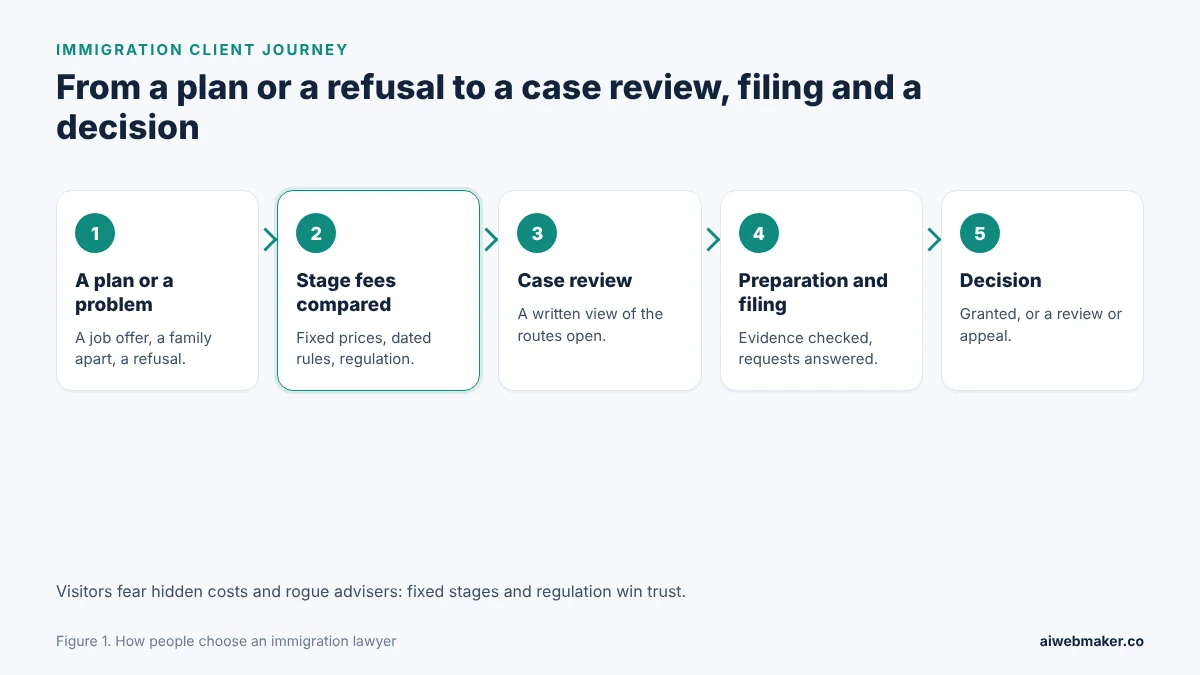
A plan or a problem opens the five steps, and the shaded one, the fees for each stage compared, is where most visitors decide which firm to trust. The trigger may be a job offer, a family member abroad or a refusal letter with a date on it. Next the visitor compares firms, looking for fixed prices, a dated rules check and some sign that the adviser is properly regulated. A case review follows, ending in a written view of the routes open. Preparation and filing come next, with requests for more evidence answered along the way. A decision closes the journey, or opens a review or appeal if it goes the wrong way.
Which pages turn a visa question into a case review?
An immigration site needs pages that answer cost, route and trust before anyone asks, because visitors far away cannot easily drop in. A stages page sets out what each step covers and costs, while a cases page describes the routes by purpose rather than by official names that vary between countries. A rules page explains how changes are tracked and dated. A languages note tells visitors which languages are spoken and how interpreters and translations work. A case review page with a deadline field completes the set, so urgent matters rise to the top.
| Page | Visitor's question | What it should state |
|---|---|---|
| Fee stages | What will each step cost? | Scope and fixed fee per stage, stop after any |
| Cases by purpose | Is my situation covered? | Work, study, family, residence, appeals, employers |
| Outside costs | What else must be paid? | Government fees, translations, medical checks |
| Rules checks | Is this advice current? | Date of each check, changes explained |
| Languages | Can someone explain in my language? | Languages spoken, interpreters, translations |
| Case review | Where does a case begin? | Deadline, countries involved, meeting type |
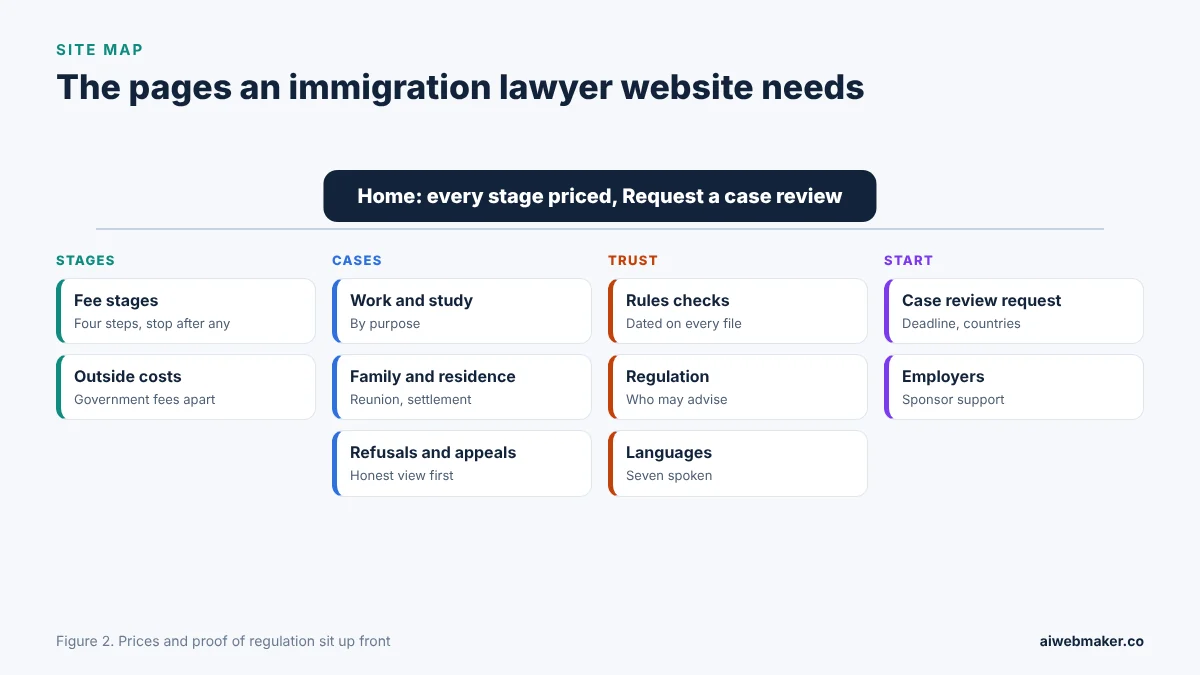
Stages, cases, trust and the case review make up the four columns, each kept short enough for a phone. Crossings Immigration Law, the invented firm in the immigration lawyer website example with fixed fee stages, promises that every stage of a case is priced before it starts. Its table lists four stages, a case review, preparation, filing and follow up, and a review or appeal, each with a fixed fee and the right to stop after any of them. Six case types follow: work and business, study, family reunion, residence and settlement, refusals with reviews and appeals, and support for employers. A split section explains that rules are checked and dated on every file, and a row of chips names seven languages spoken in the office. The case review form asks what the case concerns, any deadline, the country the visitor lives in, the country the case involves and the language for meetings. Each element answers a worry that visitors from abroad bring with them.
Why do fixed stage fees suit immigration work?
Stage fees suit immigration work because clients can see the cost of each step before committing, and many are paying from savings or wages earned in another currency. A case review at a fixed price lets the client learn their options without signing up for the whole case. Preparation, the heaviest stage, covers the evidence list, statements, forms and a full check before filing. Filing and follow up covers submission and requests for more evidence, while a review or appeal is priced only if a decision goes wrong. Clients who can stop after any stage feel in control. The AI website builder that drafts immigration pages with stage fees and case types writes first drafts of these pages once a lawyer summarises the practice, and each fee note can be adjusted in the preview.
| Stage | What it covers | Fee shape to publish |
|---|---|---|
| Case review | A meeting, a read of the papers, a written view | Fixed fee |
| Preparation | Evidence list, statements, forms, final check | Fixed fee by case type |
| Filing and follow up | Submission, extra evidence requests | Fixed fee |
| Review or appeal | Grounds, papers, a hearing where allowed | Fixed fee after an honest view |
| Employer support | Sponsor records, compliance visits | Annual fee |
Which costs sit outside the lawyer's fee?
Many immigration clients are shocked by costs they did not know existed, so the site should separate the firm's fee from everything else. Each country sets its own application fees and revises them often, and some add a health charge or a biometrics fee. Documents in other languages usually need certified translations, and some routes need medical examinations, police certificates or proof of funds held for a set time. Travel to an interview or a biometrics appointment adds further cost. The page should list these in general terms and point readers to the official government source for current amounts rather than quoting figures that may change. Clients who see the full picture early rarely feel misled later.
| Cost | Who sets it | What the page should say |
|---|---|---|
| Application fees | The government of the country | Change often, check the official source |
| Health or biometrics charges | The government, in some countries | Whether the route requires them |
| Certified translations | Translators | Needed for documents in other languages |
| Medical checks | Approved clinics, where required | Which routes and countries need them |
| Police certificates | Authorities in each country lived in | Lead times can be long |
How should a site handle rules that change several times a year?
Immigration rules, fees and processing times change often, sometimes with little notice, so an immigration site must show readers how current its information is. Every guide and route page should carry the date it was last checked. A rules page can explain that a lawyer checks current requirements before preparing each application and notes the date on the file. When a change takes effect, the firm can publish a short dated article on what it means and whether open cases are affected. Processing times should be described as estimates published by the authorities, never as promises from the firm. Dated pages protect readers from advice that was right for a friend last spring but is wrong today.
How can a site warn against unregulated advisers without frightening anyone?
Unregulated advisers cause real harm in immigration, so a firm's website should explain calmly who may give advice and how to check. In the United States, only licensed attorneys and accredited representatives of recognised organisations may give immigration legal advice, and so called notarios who claim otherwise are a long standing problem. In the United Kingdom, immigration advisers who are not solicitors or barristers must be registered with a government regulator. Rules differ in every country, so the site should name its own regulator, give the registration number and say which countries its lawyers may advise on. It must never promise that a visa will be granted, since decisions rest with the authorities. Transparency about regulation reassures visitors who have been warned to be careful.
What changes when an employer pays for a worker's case?
Employer cases bring a second client into the room, and the website should explain whose lawyer the firm is before work begins. Employers sponsoring staff from abroad usually carry their own duties, such as keeping records, reporting changes and preparing for compliance visits. Some countries bar employers from passing certain sponsorship costs on to the worker, so the fee page should not suggest otherwise. Where an employer pays for the worker's application, the firm should say who receives advice and what happens if their interests diverge. An annual support fee suits employers with a steady flow of hires. Clarity about roles keeps both the company and the worker confident.
Which visa phrases do people type, often in a second language?
People search for their situation rather than a profession. They type phrases such as spouse visa lawyer, work permit for nurses, visa refused what next, student visa extension or immigration lawyer near me. Route pages titled in those words, naming the destination country and the city where the office sits, meet those searches directly. Many visitors search in their own language, so key pages in the languages spoken at the office can widen reach where the firm can advise in them. On the map listing, opening hours, any evening or video slots and the website link deserve equal care. Reviews mentioning clear fees and honest advice after a refusal carry weight. Dated articles on rule changes bring back readers each time the rules move.
Is the hosting bill bigger than one stage fee?
Beyond hosting and the domain, an immigration firm's site asks for almost nothing, with twelve dated rule change notes on AI credits near $7.80. A firm with steady casework spends least by paying once a year. A lawyer launching a new practice might lean on monthly payments until referrals arrive. Editing fees, languages or rules notes is never billed. The table lines up both billing routes, adding the $189 tier for nothing more than contrast.
| Item | Yearly | Monthly |
|---|---|---|
| Hosting the immigration practice pages | $119 | $228 over twelve months |
| Domain | Depends on the ending | Depends on the ending |
| Higher plan, for comparison | $189 a year | Not needed |
| Twelve dated rule change articles at about $0.65 | About $7.80 | About $7.80 |
| Fee, language and rules updates | No charge | No charge |
| Year before the domain | About $126.80 | About $235.80 |
Why does an anxious applicant close the page and keep searching?
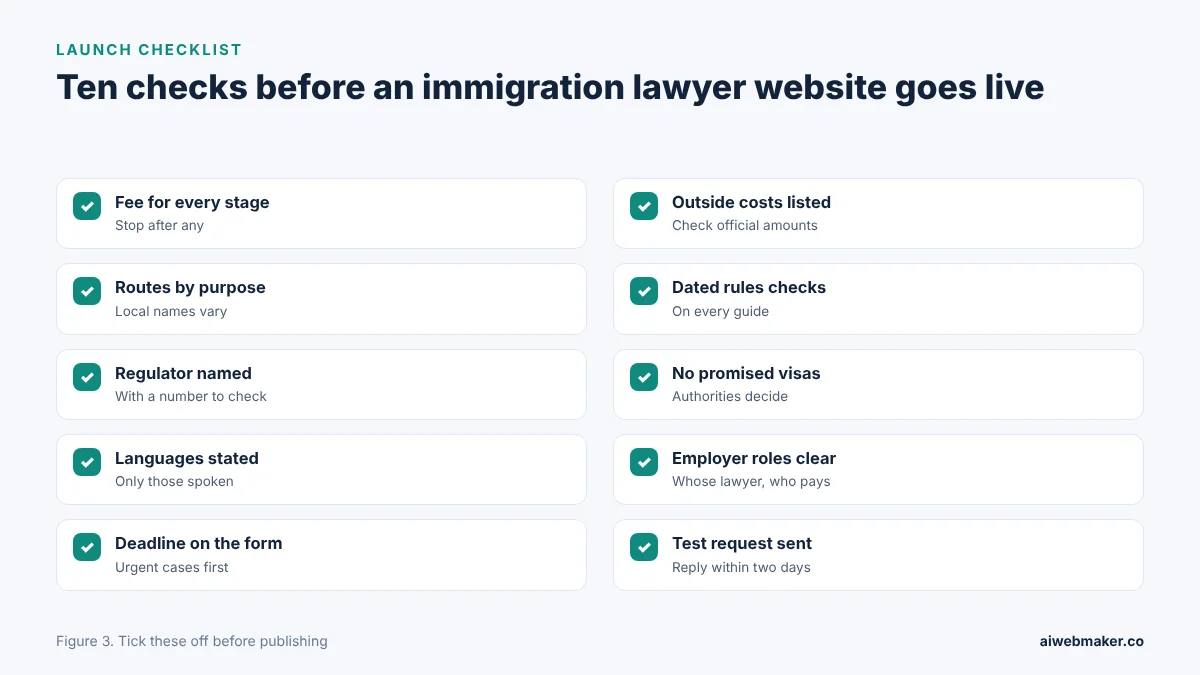
An anxious applicant closes the page when no fees appear, because uncertainty about cost is the fear that follows them through every step. Pages that promise approval sound exactly like the advisers they were warned about. No sign of regulation, or no registration number to check, leaves careful visitors unsure whether the firm may act at all. Undated guidance makes people wonder whether the rules have changed since it was written. A case review form that ignores deadlines suggests the firm does not understand how close their date may be. The panel underneath turns those doubts into ten launch checks for an immigration site.
Frequently asked questions
Can an immigration lawyer guarantee that a visa will be granted?
No lawyer can guarantee a visa, because decisions belong to the immigration authorities and depend on the rules, the evidence and sometimes discretion. Professional rules in many countries forbid lawyers from promising outcomes, and regulators treat such promises seriously. What a firm can offer is a careful application, an honest view of the risks and clear advice if a decision goes wrong. A website that says this plainly earns more trust than one that hints at certainty. Visitors who are promised a result elsewhere should treat it as a warning sign.
Why are government fees kept out of the fixed fee?
Government fees are set by each country, change often and are paid to the authorities rather than to the firm. Including them in a fixed fee would mean repricing every time the government changes them. Showing them separately also lets clients see exactly what they are paying the lawyer for. A short note telling readers to confirm the current amount with the official government source prevents nasty surprises. Separate lines keep the firm's prices stable and honest.
Should an immigration site be translated into clients' languages?
Translating key pages helps when the firm can genuinely advise in those languages, because clients understand fees and steps better in their first language. Translations should match what the office can deliver, since a page in a language nobody speaks raises false hopes. Fee pages and case review instructions are the most useful to translate first. Legal terms should be checked carefully, since official names differ between countries. Honest language support is one of the strongest signals an immigration firm can send.
What happens if the rules change after an application is filed?
The effect depends on how the change was made and when it takes effect, since some changes protect applications already filed and others do not. A firm should check the transitional arrangements and explain the impact to each affected client in writing. The website can describe this process in general terms without predicting how any change will play out. Dated articles on major changes help clients understand where they stand. Prompt, honest updates keep trust intact when the rules move.
How quickly does one case review repay the hosting?
One fixed fee case review usually returns more than the $119 an immigration firm needs to stay hosted for twelve months. Firms on the monthly plan cover the $19 within a small part of that same review. Every family reunion or work case that starts with a visitor who trusted the stage fees is worth many years of hosting. Stage prices, dated rules checks, named regulation and honest limits persuade people who have heard stories of advisers who vanished. Firms that keep their rules notes and outside cost lists current become the name communities pass on. Case review requests that arrive with the deadline and both countries filled in prove the pages are steering people well.
Build your website in Minutes and get the AI Tools that work
Start Building Your Website →