Estate Planning Attorney Website Cost and Plain Words on Wills
Hosting an estate planning attorney's site takes $119 per year, or $19 at each month end, plus the domain. Covered: life events that bring clients, packages, documents, capacity and signing, home visits, cross border estates, search and the yearly budget.
- No coding required
- Live in minutes
- Blog, SEO and chatbot tools included
Keeping an estate planning attorney's website online takes $119 across twelve months, or $19 at each month end for practices spreading the cost, plus the domain. The package pages, the document guides and the meeting request can be drafted and polished on screen, and AI Web Maker bills nothing for that preparation. One single will fee covers the whole year several times over, so price is not the obstacle. The obstacle is that most people know they should make a will and keep putting it off, because the subject is uncomfortable, the process feels opaque and they fear an open ended legal bill. A wills website has to make the next step feel small, clear and fairly priced, while staying careful about the law. This article walks through the life events that bring clients, packages, the documents in a full plan, capacity and signing, home visits, cross border estates, search and the yearly budget.
This article is part of our complete guide: Website Builder for Law and Accounting Firms.
Which life events send families to a wills and estates lawyer?
Families usually come to a wills lawyer after a life event that makes the future feel real, such as a new baby, a marriage, a house purchase or a diagnosis. Parents of young children want guardians named, while blended families worry about stepchildren and second partners. Older clients often want powers of attorney in place before they are needed, alongside an updated will. Business owners and people with property abroad need more complex planning. Executors arrive after a death, looking for steady guidance on what to do first. Each group wants to know the price, the steps and whether the lawyer will explain things in plain language.
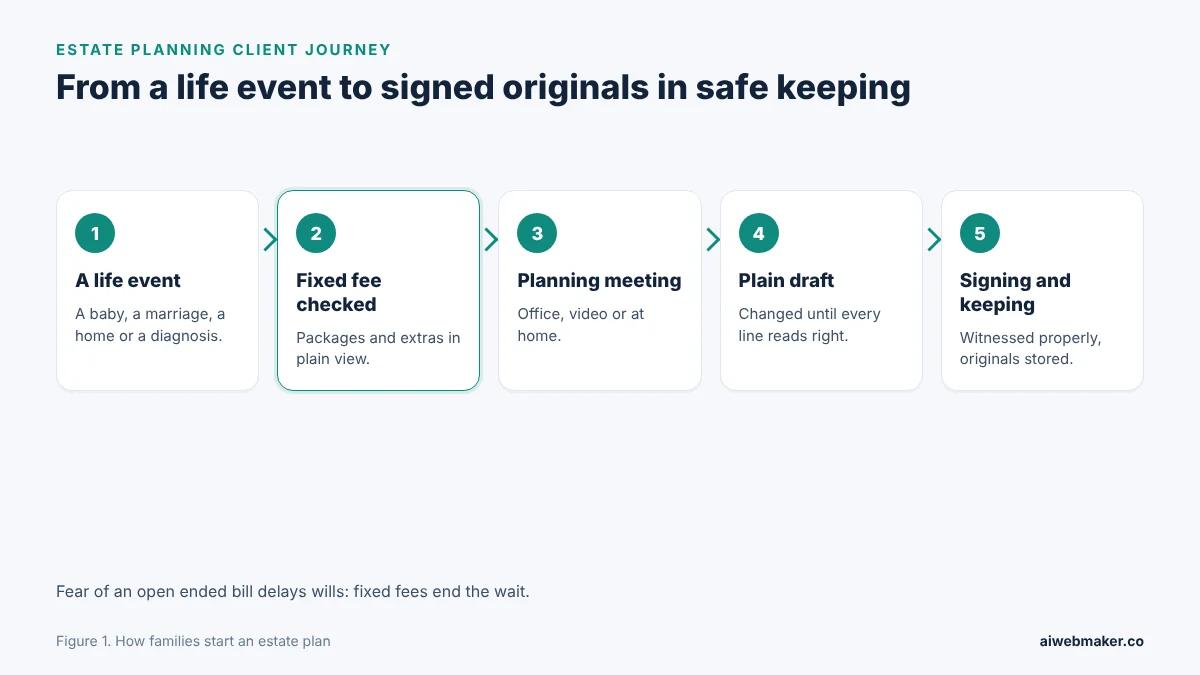
Tracing a client from a prompting life event to signed originals in safe keeping, the five stages show why clarity matters at every turn. The trigger is usually personal and emotional, which is why the website's tone matters as much as its content. Highlighted in the middle sits the fixed fee check, since fear of an open ended bill is the most common reason people delay. A planning meeting, at the office, by video or at home, then gathers the family details and wishes. A plain draft follows, changed until it reads right, and the supervised signing and safe keeping complete the process. A website that makes each stage visible helps hesitant clients finally act.
What should a wills practice publish, document by document?
A wills practice should publish fixed fee packages, a page for each document it writes and the steps from first meeting to signing. Separate pages for wills, powers of attorney, trusts, guardians for children, letters of wishes and help for executors let visitors find their own situation quickly. A home visits page reassures older or less mobile clients that they will not need to travel. A list of what to bring to the first meeting takes the fear out of preparation. An enquiry page that asks only for what is needed to suggest a package completes the structure.
| Page | Who reads it | What it should state |
|---|---|---|
| Packages | Everyone comparing cost | Fixed fees, what is included, what is quoted separately |
| Wills | Individuals and couples | Executors, gifts, guardians, plain wording |
| Powers of attorney | Older clients and their children | Money and health decisions, local names and forms |
| Trusts | Parents, carers, homeowners | Purpose, trustees, how rules are set |
| Help for executors | Families after a death | First steps, what to gather, when to ask for help |
| Home visits | Older or less mobile clients | Distance covered, hospitals and care homes |
| Enquiry | Anyone ready to start | What to put in place, where to meet |
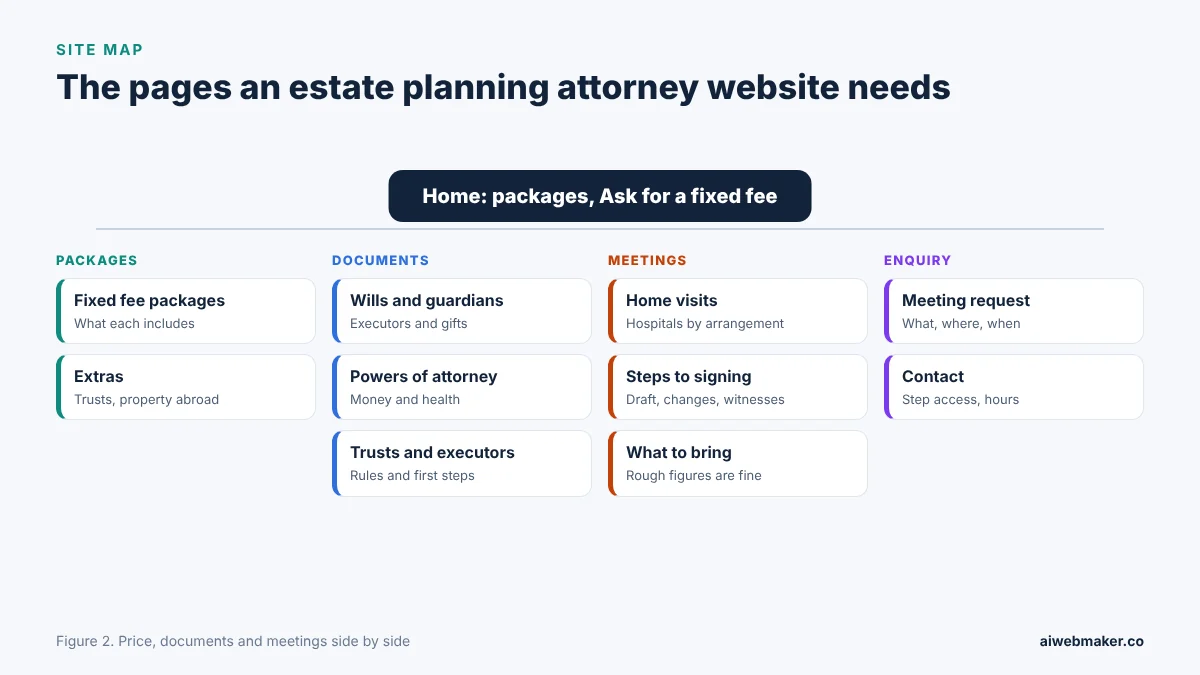
Grouped into four branches, the wills site lets a visitor move from price to documents to meetings without feeling pushed. Hollis Wills and Estates, the invented firm behind our estate planning attorney website example with fixed fee packages and home visits, offers three packages: a single will, wills for a couple, and wills with powers of attorney. It writes wills, powers of attorney, trusts, guardians for children, letters of wishes and help for executors, each described in a sentence or two of plain language. A home visits section explains that part of every meeting is spent alone with each person, and five steps run from a planning meeting through a plain draft, changes and a supervised signing to safe keeping of the originals. A list of what to bring removes the worry about exact figures. The enquiry form asks what the visitor wants to put in place, where they would like to meet and which days suit, and nothing more personal.
How should fixed fee packages for wills and powers of attorney be presented?
Fixed fee packages should be presented with the price, what is included and what would be quoted separately, because hidden extras are the main fear behind delayed wills. A package can include a planning meeting, a plain draft, changes until it reads right, a supervised signing and safe keeping of the originals. Trusts, property in another country and business interests are often quoted after the first meeting, which should be stated beside the packages. Any official fee for registering a power of attorney varies from country to country and deserves its own line. A note that the fee is confirmed in writing before work starts removes the last reason to wait. Clear packages turn a vague intention into a booked meeting.
| Package element | What clients should see | Why it matters |
|---|---|---|
| Planning meeting | Length and where it can happen | Removes fear of the first step |
| Draft in plain words | Typical time to receive it | Sets expectations on pace |
| Changes | Whether included in the fee | Prevents surprise charges |
| Supervised signing | Who witnesses and how | Avoids invalid wills |
| Safe keeping | Where originals are stored | Families know where to look |
| Extras quoted separately | Trusts, property abroad, business assets | Honest about complex cases |
| Official fees | Registration costs where required | Varies by country |
Which documents make up a complete estate plan?
A complete estate plan usually combines documents that take effect at different times, and a website should explain the difference in plain words. A will takes effect after death and names executors, beneficiaries and, for young children, guardians. A power of attorney works during life, letting a trusted person make decisions about money, or about health and care, if the client cannot. Trusts can protect a family home, a young child or a relative who needs lifelong support. Pensions and life insurance often pass by their own nominations rather than through the will in many systems, so those forms deserve a check. A letter of wishes, kept privately beside the will, can cover funeral wishes, keepsakes and digital accounts.
| Document | When it takes effect | What it does |
|---|---|---|
| Will | After death | Names executors, gifts and guardians |
| Power of attorney for money | During life, when needed | Lets someone manage finances |
| Power of attorney for health | During life, when needed | Lets someone make care decisions where the law allows |
| Trust | During life or after death | Holds assets under set rules for beneficiaries |
| Pension and insurance nominations | After death | Directs those funds, often outside the will |
| Letter of wishes | After death, guidance only | Explains choices and personal wishes |
Why do capacity, witnessing and time alone with each client matter?
Capacity, witnessing and time alone with each client matter because a will can be challenged if any of them is in doubt. A careful lawyer confirms that the client understands what they own, who might expect to benefit and what the will does, and may ask for a medical opinion where capacity could be questioned. Speaking with each person on their own for part of the meeting is a quiet check that the wishes are truly theirs, without pressure from relatives. Signing and witnessing rules differ by country and state, and in some places a witness who also benefits can lose the gift. Supervised signings avoid these traps. Explaining this routine on the website reassures families rather than offending them, because it shows the lawyer protects the will they are paying for.
How can home visits and accessible meetings be offered online?
Home visits and accessible meetings should be offered clearly, because many clients are older, unwell or caring for someone and cannot easily travel. The page can state the distance covered, whether hospitals and care homes are visited by arrangement and whether large print drafts are available. Level access to the office and video meetings widen the choice further. The enquiry form should ask only what the client wants to put in place, where they would like to meet and which days suit. The AI website builder that drafts wills pages, packages and a meeting enquiry turns a lawyer's brief account of the practice into draft package, document and meeting pages. The lawyer then adjusts each package, document page and meeting option in the preview before anything is published.
What happens when property, family or tax crosses a border?
When property, family or tax crosses a border, a single will may not be enough, and the website should say so honestly. Property abroad may be governed by the law of the country where it sits, whatever the client's home will says. Some countries apply forced heirship rules that reserve shares of an estate for children or spouses. Inheritance and estate taxes vary widely, and some countries have none, so the site should avoid general tax promises and invite clients to raise these points at the first meeting. In many civil law countries notaries play a central role in wills and estates, and a lawyer elsewhere may work alongside them. Clear signposting on cross border cases shows clients that the practice knows its limits.
Which will and trust phrases do families search for?
Families searching for help usually type plain phrases such as make a will near me or power of attorney lawyer. Others search for wills for couples, a living trust attorney or estate planning for blended families. Many add their town or region, since they expect to meet in person. Each document page should mirror that everyday wording in its title and opening paragraph. Older clients who prefer to visit in person rely on the map entry, so it should list office hours, step access and the website link. Reviews that mention kindness, clear explanations and fixed fees carry more weight than reviews that praise speed alone. Articles on choosing guardians, what happens without a will or when to update a plan reach readers long before they decide to act.
Why is the hosting bill the smallest line in a wills practice?
Each year a wills practice renews two things, its hosting and its domain, while twelve family planning articles bought with AI credits come to roughly $7.80 in total. A firm with steady instructions spends least by paying annually. A lawyer starting out alone may choose to pay month by month. Adjusting packages, fees or document pages adds no cost. Listed beneath, the $189 plan serves purely as a benchmark.
| Item | Yearly | Monthly |
|---|---|---|
| Hosting the estate planning pages | $119 | $228 over twelve months |
| Domain | Depends on the ending | Depends on the ending |
| Higher plan, for comparison | $189 a year | Not needed |
| Twelve family planning articles at about $0.65 | About $7.80 | About $7.80 |
| Package, fee and document updates | No charge | No charge |
| Year before the domain | About $126.80 | About $235.80 |
What makes families put off their will again after visiting a site?
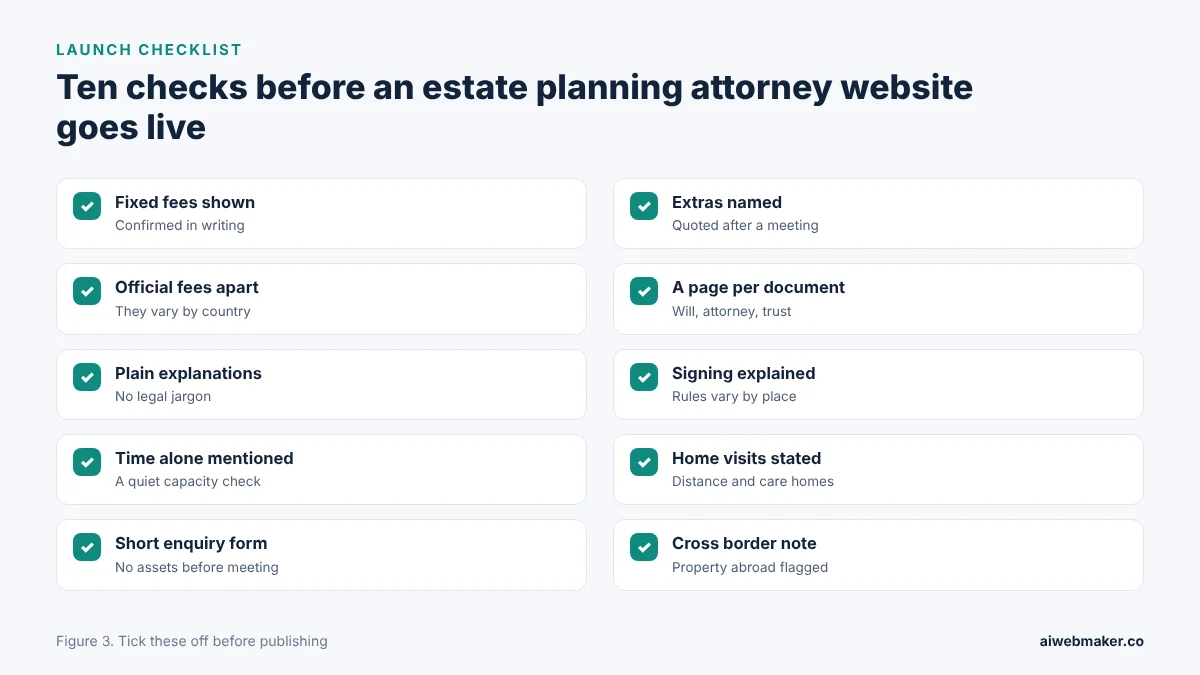
Families put off their will again when a website shows no fees, because an unknown bill gives them one more reason to wait. Legal jargon and long paragraphs make the subject feel heavier than it is. No mention of home visits leaves older clients wondering how they would manage the trip. Enquiry forms that ask for assets and family details before any meeting feel intrusive. Silence about what happens at signing makes the process seem mysterious. Ten simple launch checks, shown next, keep hesitant visitors moving towards a meeting.
Frequently asked questions
Is a homemade will legally valid?
A homemade will can be valid if it meets the signing and witnessing rules where the person lives, and those rules differ by country and state. Problems often arise from small details, such as a witness who also benefits, unclear wording or a missing signature. A will that fails these rules may leave the estate to pass as if there were no will. Professional drafting reduces the risk of costly disputes. The website can explain this without pressuring visitors.
What happens to an estate when there is no will?
When someone dies without a valid will, the law of the place decides who inherits, usually in a fixed order of relatives. That order may not match the person's wishes, and unmarried partners or stepchildren can be left out entirely in some places. Administering the estate can also take longer and cost more. A will lets people choose their own beneficiaries and executors. Explaining this gently on the website often prompts visitors to act.
How is a will different from a power of attorney?
A will takes effect after death and directs how the estate is distributed. A power of attorney works during life, letting a trusted person act for someone who cannot make decisions, and it ends on death. The names, forms and registration rules for powers of attorney differ between countries and states. Most people benefit from having both documents in place. The website should explain the difference in a few clear sentences.
When should an existing will be reviewed?
An existing will should be reviewed after a marriage, a separation, a new child or grandchild, a move to another country or a major purchase such as a home. In some places marriage or divorce changes how an earlier will is treated, so a review is essential at those moments. A check every few years catches changes in family circumstances or the law. Executors and guardians may also need replacing as people age. A short note on the website about these review moments brings clients back at the right time.
How many single wills cover the practice's year online?
A single will written for one client earns a practice several times the $119 that keeps its website hosted for twelve months. The $19 monthly route disappears inside a fraction of one planning meeting. Every family that books after seeing a clear package and a gentle explanation of the steps is a will that might otherwise never have been written. Plain language, fixed fees and visible care around capacity and signing persuade hesitant clients better than any slogan. Practices that keep packages and guidance current become the name families pass to friends and parents. Meeting requests that mention a specific package show visitors arrive already decided.
Build your website in Minutes and get the AI Tools that work
Start Building Your Website →