Employment Lawyer Website Cost for Firms Serving Staff and Employers
An employment law practice hosts its site on $119 yearly, or on $19 monthly, with the domain chosen separately. Covered: who calls, pages for both sides, time limits, fees, settlements, conflict checks, professional rules, search and annual sums.
- No coding required
- Live in minutes
- Blog, SEO and chatbot tools included
An employment law practice keeps its website hosted on $119 for the year, or on $19 monthly if it prefers overheads in small pieces, and the domain is chosen separately. Pages for employees and for employers, the fee table and the enquiry form are written and revised in the preview, and none of those revisions appear on an AI Web Maker bill. A single fixed fee first call or contract review covers the year, so the hosting bill is not the hard decision. The hard part is that most people reach an employment lawyer in a stressful week, often with a meeting or a deadline only days away, while employers arrive wanting to avoid a claim they can already see coming. A website has to calm both groups, explain the time limits and show the fees before anyone shares a confidential detail. Ahead: who calls, pages for both sides, time limits, fees, settlements and grievances, conflict checks, professional rules, search and the yearly budget.
This article is part of our complete guide: Website Builder for Law and Accounting Firms.
Which workers and employers call an employment lawyer, and at what moment?
Employees and workers reach for an employment lawyer when something has just happened, such as a dismissal, a redundancy letter, a disciplinary invitation or a settlement offer with a deadline. Others call after months of unpaid overtime, holiday pay disputes or treatment they believe is discriminatory. Employers call earlier, when they are planning a restructure, facing a difficult dismissal or receiving a grievance they need to investigate fairly. HR teams often need contracts and handbooks reviewed when the law changes. Each group looks for clear signs that the firm understands their side, explains deadlines and states costs in writing. The firm whose website answers those concerns first is usually the one that receives the call.
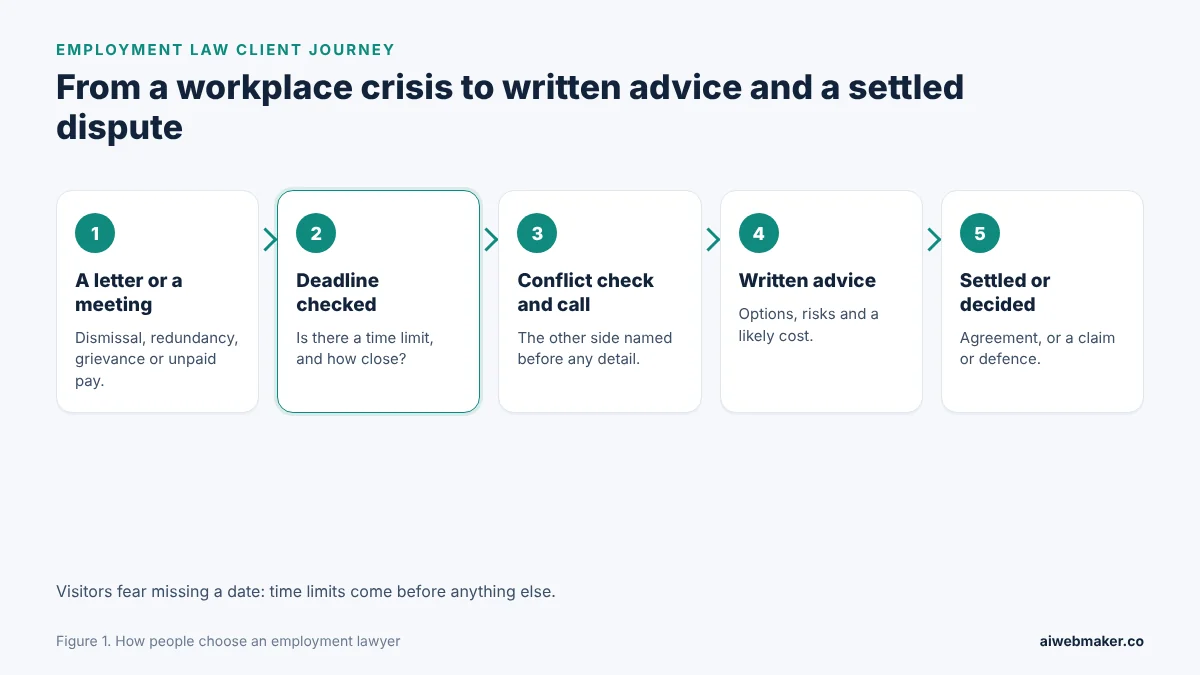
Starting with a workplace crisis and ending with a settled dispute, the five steps show where a firm's website earns trust and where it loses people. The trigger is usually a letter, a meeting or a payslip that does not add up. The highlighted step is the deadline check, because time limits for some claims are short and visitors need to know quickly whether they must act now. A conflict check and a first call follow, then written advice that sets out options, risks and likely costs. Negotiation settles many disputes long before any hearing, and only the rest go on to a claim or a defence. A website that supports each step keeps anxious visitors moving rather than freezing.
How should one site serve both employees and employers?
A firm that advises both sides should give employees and employers separate service lists, because each group reads the site with different fears and different words. Employees look for dismissal, redundancy, discrimination, pay and settlement agreements, while employers look for contracts, handbooks, fair processes, investigations and claim defence. A time limits section helps both, since deadlines run against claimants and respondents alike. A fees page with fixed fees and hourly rates, a process page and an enquiry page that starts with a conflict check complete the structure. A short note that the firm never acts for both sides of the same dispute reassures everyone.
| Page | Side | What it should state |
|---|---|---|
| Dismissal and redundancy | Employees | Fair reasons, fair process, options if either was missing |
| Pay, hours and holiday | Employees | Unpaid wages, overtime, holiday pay, payslip checks |
| Settlement agreements | Employees | What is given up, what is gained, independent advice |
| Contracts and handbooks | Employers | Documents written for the law where staff work |
| Fair dismissal and redundancy | Employers | A process planned step by step and in writing |
| Workplace investigations | Employers | Independent findings and recommendations |
| Time limits | Both | Why dates matter and when to call |
| Fees | Both | Fixed fees, hourly rates, estimates in writing |
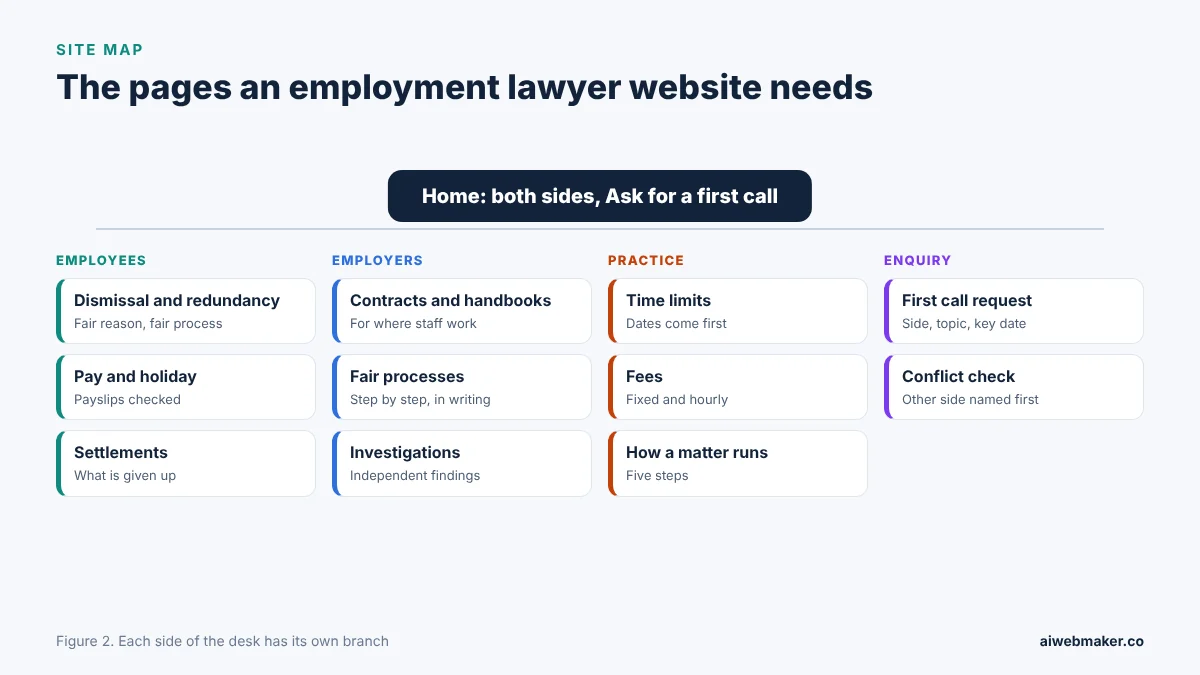
Divided into four branches, the employment law site puts employees, employers, the practice itself and the enquiry side by side so neither group has to read the other's pages. Fairwork Employment Law, the invented firm behind our employment lawyer website example for employees and employers, lists six services for people at work, from dismissal and redundancy to grievances and disciplinary meetings, and six for employers, from contracts and handbooks to defending claims. A time limits section sits early on the page, ahead of a five step process that runs from a conflict check through a first call, written advice and negotiation to a claim or defence. The fees table separates fixed fees for defined work from hourly rates for disputes, and a list of workplaces shows the sectors the firm knows. The enquiry form asks which side the visitor is on, the topic, the name of the other side for the conflict check, any key date and a private email address. That order lets a worried visitor find the right side of the desk within seconds.
Why do time limits belong near the top of the page?
Time limits belong near the top because a missed date can end a claim before anyone hears the facts, and many visitors do not know that deadlines exist. In many countries, claims about dismissal or discrimination must be started within a few months, and some systems require a conciliation step first, as with early conciliation before most tribunal claims in Great Britain. The exact period depends on the country, the kind of claim and sometimes the date of the last incident. Employers face deadlines too, since a response to a claim usually has to be filed within weeks of the papers arriving. The website should not state one country's limits as universal, but it should urge visitors to check the date in their first call. Plain advice on keeping letters, payslips and notes of meetings helps visitors protect their position from day one.
| Deadline | Who it affects | What the page should say |
|---|---|---|
| Starting a claim | Employees and workers | Often a few months, varying by country and claim |
| Conciliation before a claim | Both sides, where required | Some systems need this step before any claim |
| Responding to a claim | Employers | Usually weeks from receiving the papers |
| Appeals inside the workplace | Both sides | Internal appeal periods set by policy or contract |
| Settlement offers | Employees | Offers often carry their own response dates |
How can fixed fees and hourly rates be set out for workplace disputes?
Employment law fees work best when defined tasks carry fixed fees and open ended disputes carry an hourly rate with written estimates at each stage. A first call, a contract or handbook review, settlement agreement advice and a dismissal process for an employer can all be priced in advance. Disputes are harder to predict, so an hourly rate with a fresh estimate before each stage keeps clients in control. Court or tribunal fees, where they exist, differ by country and should be shown as separate from the firm's fees. Some visitors have legal expenses insurance attached to a home or car policy, or support from a trade union, and the page can suggest checking those first. Conditional or contingency fee arrangements are allowed in some countries and restricted in others, so any mention must follow local rules.
| Work | How it is often charged | What the client should see |
|---|---|---|
| First call | Fixed fee | Length of the call and what it covers |
| Contract or handbook review | Fixed fee | Documents included and turnaround |
| Settlement agreement advice | Fixed fee | Whether the employer contributes, where usual |
| Dismissal process for an employer | Fixed fee | Steps covered, letters drafted |
| Workplace investigation | Quoted after scoping | Interviews, report, timescale |
| Claims and defences | Hourly, estimated by stage | Estimate before each stage of work |
What should settlement and grievance pages explain?
Settlement and grievance pages should explain the process in plain words, because visitors arriving there are often frightened or angry and need to understand their options before they act. A settlement agreement is a contract in which an employee gives up certain claims in exchange for a payment or other terms. In some countries the law requires independent legal advice before such an agreement is binding, and employers often contribute towards that advice. A grievance page can describe how to put a complaint in writing, what an investigation usually involves and how appeals work. A disciplinary page can explain how to prepare for a hearing and whether a companion may attend under local rules. Calm, accurate guidance on these pages often decides which firm a visitor trusts with the next step.
How do conflict checks and confidentiality shape the enquiry form?
Conflict checks and confidentiality shape the enquiry form because a firm must confirm it is not acting for the other side before a visitor shares anything sensitive. The form should therefore ask for the name of the other party first, along with which side the visitor is on, the topic and any key date. A note advising visitors not to use a work device or a work email address protects employees whose messages may be monitored. The page should also state that sending an enquiry does not make the firm the visitor's lawyer until terms of engagement are signed. The AI website builder that drafts employment law pages and a conflict check enquiry turns a firm's short outline of its services into draft pages for both sides, a fee table and an enquiry form. Every word can then be checked by the firm in the preview before the site goes live.
Which professional rules limit what a law firm's website may claim?
Professional rules for lawyers differ between countries and regulators, but most restrict misleading claims, promises of results and the way past successes are described. An employment law website should never suggest that a claim will succeed, because outcomes depend on the facts, the law and the tribunal or court. Titles such as specialist or expert are regulated in some places, so they should be used only where permitted. Fee information may have to meet transparency rules set by the regulator. A clear note that the website offers general information rather than legal advice protects visitors and the firm. Checking every page against the regulator's guidance before launch is part of building a trustworthy practice online.
Which dismissal and pay questions do people type late at night?
People searching for employment advice usually type their problem rather than the profession, such as unfair dismissal advice, redundancy pay, settlement agreement solicitor or holiday pay claim. Employers type phrases such as disciplinary process advice, staff handbook review or employment contract lawyer. Each service page should carry the visitor's own wording in its heading, along with the region the firm serves. Shift workers often ring before or after work, so the map entry should show office hours and a direct number beside the website link. Reviews that mention clear advice on deadlines and honest fee estimates carry particular weight in this field. Short guides on the first steps after a dismissal letter, or on answering a grievance, reach visitors at the very moment they need help.
Where does the hosting bill sit next to one fixed fee first call?
Two charges recur for an employment law site, hosting and the domain, and a year of monthly workplace rights articles from AI credits comes to about $7.80. Firms with a settled caseload save by paying for hosting once a year. Newly qualified lawyers setting up alone might spread the cost monthly instead. Updating fees, services or time limit guidance carries no charge. The $189 plan sits in the table purely for comparison.
| Item | Yearly | Monthly |
|---|---|---|
| Hosting the employment lawyer pages | $119 | $228 over twelve months |
| Domain | Depends on the ending | Depends on the ending |
| Higher plan, for comparison | $189 a year | Not needed |
| Twelve workplace rights articles at about $0.65 | About $7.80 | About $7.80 |
| Fee, service and guidance updates | No charge | No charge |
| Year before the domain | About $126.80 | About $235.80 |
Why does a worried employee close one firm's page and open another?
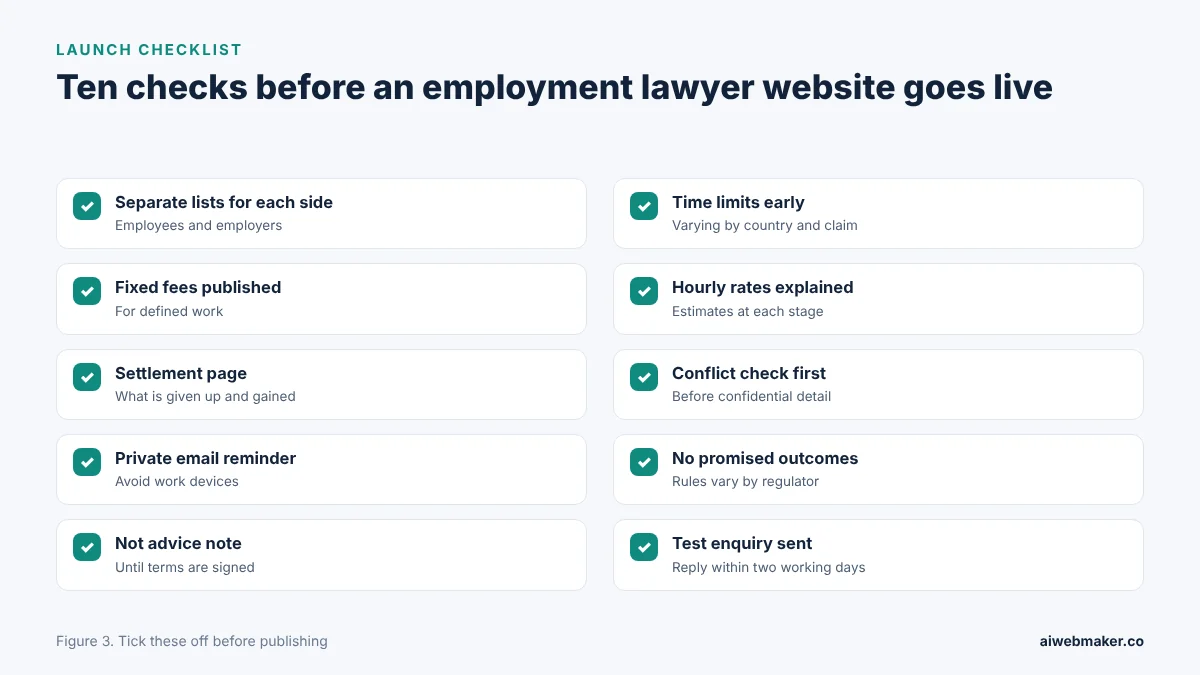
A worried employee closes a firm's page when there is no sign of time limits, because they fear losing their claim while they read. Pages written only for employers make employees assume the firm is on the other side. No fees, or vague phrases about competitive rates, make the first call seem like a gamble. An enquiry form that asks for detail before any conflict check feels careless with confidential information. Promises of guaranteed compensation make careful readers suspicious rather than hopeful. Ten launch checks in the next graphic put each of these worries to rest.
Frequently asked questions
Can one firm advise both employees and employers?
A firm can advise employees and employers, provided it never acts for both sides of the same dispute. A conflict check before any confidential information is shared makes sure of this. Many firms find that advising both sides gives them a better understanding of how disputes unfold. The website should explain the policy clearly so neither group feels uneasy. Professional rules on conflicts vary by country and must always be followed.
How soon after a dismissal should someone get advice?
Someone who has been dismissed should get advice quickly, because time limits for some claims are short and can start from the date of dismissal or the last incident. In some countries a conciliation step must happen before a claim can begin, and it has its own timing. Gathering letters, contracts, payslips and notes of meetings early helps the lawyer give useful advice. Waiting to see what happens can close options that were open at the start. A website that says this plainly may save a visitor's claim.
Is it safe to send an enquiry from a work email?
Sending an enquiry from a work email or work device is usually unwise, because employers may be able to read messages on their systems. A private email address and a personal phone are safer for any message about a dispute at work. The enquiry form can remind visitors of this before they write. The firm should also explain how it stores and protects enquiry details. Small reminders like this show visitors that the firm takes confidentiality seriously.
Does an employee need advice before signing a settlement agreement?
In some countries, a settlement agreement is binding only if the employee has received independent legal advice before signing it. Elsewhere advice may not be required by law but is still strongly sensible, because the employee usually gives up the right to bring certain claims. Employers sometimes pay part or all of the cost of that advice. The lawyer will explain what the agreement covers and whether its terms are fair. Taking advice before signing protects the employee's position.
How many first calls cover an employment practice's year online?
One fixed fee first call or a single contract review brings in more than the $119 an employment law firm pays to host its site across the year. Paying by the month, a firm covers the $19 with a few minutes of billed advice. Each employee or employer who calls after reading clear time limits and fees is a matter that might otherwise have gone to a rival. Honest deadlines, published fees and a careful conflict check persuade visitors who are frightened, angry or cautious. Firms that keep guidance, fees and services current become the name colleagues and HR teams recommend. Enquiries that arrive with the key date already noted show the site is guiding people well.
Build your website in Minutes and get the AI Tools that work
Start Building Your Website →