Criminal Lawyer Website Cost and the Number Families Ring at 2am
A criminal defence site is hosted for the year at $119, or at $19 if the firm settles monthly, and a domain is picked alongside. Topics: callers, the pages, the night line, fees by stage, family calls, interview outlines, advertising limits, search and annual sums.
- No coding required
- Live in minutes
- Blog, SEO and chatbot tools included
Twelve months of hosting for a criminal defence site come to $119, or $19 if the firm settles monthly, and a domain is picked alongside. The stage pages, interview outline and fee notes can be written, read aloud and rewritten in the preview with no AI Web Maker invoice behind them. One police station attendance pays for the year. What makes defence work different is the moment of contact: a mother calling at two in the morning, a man holding a letter inviting him to a voluntary interview, a client with a court date on Monday. None of them will browse, and most will judge the firm by whether the phone number is visible and whether anyone answers. Covered here: who calls, the pages, the night line, fees stage by stage, family callers, interview pages, advertising limits, search and the yearly budget.
This article is part of our complete guide: Website Builder for Law and Accounting Firms.
Who rings a criminal defence firm, and from where?
The person who needs a defence lawyer is often not the person who finds the website. A family member searches on a phone after an arrest, knowing only that someone was taken away and perhaps which station. People invited to a voluntary interview search days ahead, worried and unsure whether they need a lawyer at all. Those already charged look for someone to stand beside them at a first hearing that may be a week away. A smaller group, convicted and sentenced, looks for an honest view on whether an appeal has grounds. Each caller wants the same three things fast: a number, a person who answers and a sense of what it will cost.
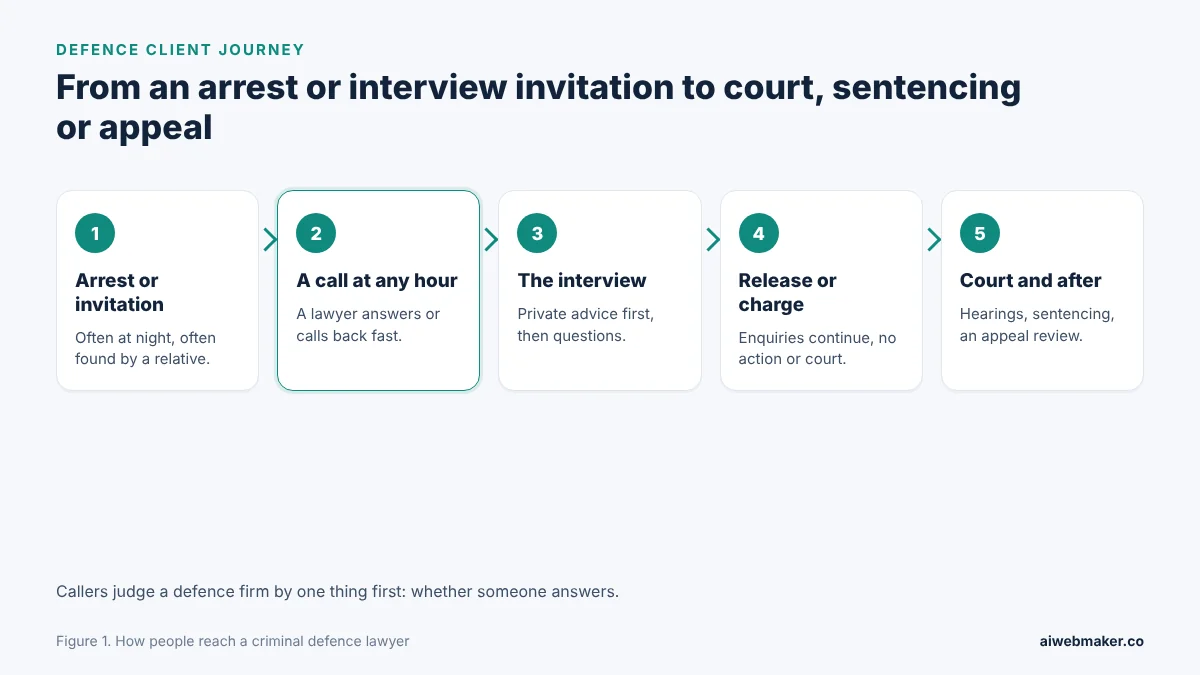
An arrest or an invitation starts the five stages, and the coloured second stage, the call at any hour, is where a defence firm earns or loses the case. Everything after depends on a lawyer being reached before questioning begins. At the interview, the lawyer hears the client's account in private and learns what the police have disclosed. The fourth stage is the outcome of the interview: release while enquiries continue, no further action or a charge. Court hearings, sentencing and sometimes an appeal follow for those charged. A defence website that makes the second stage effortless, even for a frightened relative, has done most of its job.
What must a defence site show within ten seconds of loading?
A criminal defence site must show the phone number and the hours it is answered before anything else, because many visitors arrive in the middle of a crisis. A short banner for arrests happening now can sit above the fold, with a promise of when a lawyer calls back. Below it, an outline of what usually happens at a police interview calms people who have never been in one. Service pages follow the stages of a case, from the station to an appeal, with fees explained for each. A page for people calling about someone else, and a message form for matters that are not urgent, complete the structure.
| Page | Who reads it | What it should state |
|---|---|---|
| Urgent banner | Families after an arrest | The number, and when a lawyer calls back |
| Interview outline | People invited or arrested | General steps, with rights varying by country |
| Stages of a case | Clients and families | Station, first hearing, preparation, trial |
| Sentencing and appeals | People convicted | An honest written review first |
| Calling for someone | Relatives and friends | What to have ready, what can be shared |
| Fees and public funding | Everyone | Fees by stage, and when funding may apply |
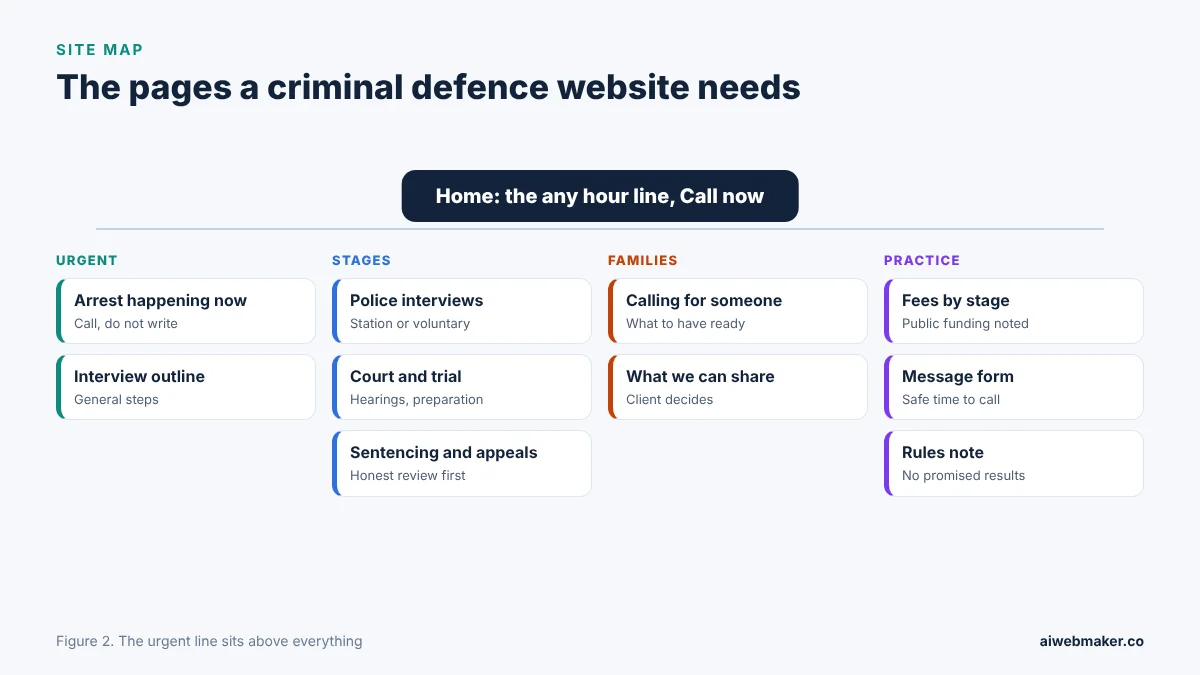
Here the night line is the trunk, and stages, families and the practice grow from it as branches. Harrow and Vance Defence, the fictional firm in the criminal lawyer website example with a line answered at any hour, opens with the advice to talk to a defence lawyer before the interview and a clock stating that the line is answered at any hour. An urgent strip promises a lawyer answers or calls back within 20 minutes, even when the caller does not know which station is involved. Five steps outline a typical police interview, followed by six services: police interviews, first court hearings, preparing a defence, trials, sentencing and appeals. A table tells relatives what helps when calling for someone else, from a full name and date of birth to any medicines. The message form asks who needs help, where things stand and a safe time to call, while urging anyone dealing with an arrest happening now to phone instead. A caller can scroll the whole page in about a minute.
Why does the night line earn more than any other page?
The night line earns more than any page because most criminal work begins outside office hours, when arrests and interviews happen. A firm that answers at three in the morning meets clients before rival firms open their doors. Staffing that line costs money, usually through a rota of lawyers on call, so the website should state what callers can expect, such as a callback within set minutes. The number belongs in the header, the urgent banner, the contact block and the map listing, written in full so it can be read aloud to a relative. Weekend and holiday cover should be stated rather than implied. A visible, honest promise about the line is the firm's strongest advertisement.
How should defence fees be set out from the station to an appeal?
Defence fees are easiest to understand when each stage of a case carries its own price or its own route to a written quote. Police station attendance and a first hearing are predictable enough for fixed fees, while preparation and trials depend on the evidence and are better quoted in writing. Public funding changes the picture in many countries, through legal aid, duty lawyer schemes or public defenders, and eligibility rules vary widely. In England and Wales, for example, advice at the police station is publicly funded for everyone who asks, while court work depends on a means and merits test. In some places private fees are held in a client account until earned, under local rules. Bail money, fines and court costs are not the lawyer's fees, and saying so clears up a common confusion.
| Stage | Common fee shape | What the page should explain |
|---|---|---|
| Police station attendance | Fixed per attendance, or publicly funded | Whether funding may apply where the firm works |
| First court hearing | Fixed fee | Bail applications included or not |
| Preparing a defence | Quoted in writing | Experts, witnesses and evidence review |
| Trial | Quoted, often by day or as a set fee | Who will speak in court |
| Sentencing | Fixed fee | References and mitigation prepared |
| Appeal review | Fixed fee for a written view | Honest advice on grounds first |
What can relatives be told when they ring on someone's behalf?
Relatives calling on someone's behalf can usually be told much less than they hope, because the lawyer's duty of confidence runs to the person held, not to the caller. The website should explain this gently before the call, so families are not hurt by it later. Useful details to have ready include the person's full name, date of birth, where they were taken, what officers said and any medical needs custody staff should know. After that, updates depend on what the client allows the firm to share. For matters that are not urgent, a short message form with a safe time to call protects people who share a phone or a home. The AI website builder that drafts defence pages around an any hour phone line produces the stage pages, interview outline and family page once the firm describes its practice, and every line can be reread in the preview before going live. Clear guidance for families turns a panicked call into a useful one.
| What the caller has | Why it helps |
|---|---|
| Full name and date of birth | Confirms where the person is held |
| The station or area | Saves time tracing them |
| What officers said | Hints at the allegation and stage |
| Medicines or health needs | Custody staff can be told |
| A number to call back | Updates within what the client permits |
How can an interview page inform without turning into advice?
An interview page should describe the usual shape of a police interview in general terms and tell readers to take private legal advice before answering any question. Rights at interview differ sharply between countries. People held in the United States, for example, are told of a right to remain silent and to have a lawyer present, while in England and Wales the caution warns that failing to mention something later relied on in court may harm the defence. The page should explain that whether to answer, give a written account or decline to comment is a decision made with a lawyer on the facts. It can also describe how interviews are recorded and when a lawyer may pause them. Explaining the process without scripting the answers keeps the page useful and safe.
Which promises must a defence firm's website never make?
A defence firm's website must never promise an acquittal, a dropped charge or a lighter sentence, because no honest lawyer can predict what a court will decide. Bar rules in many countries forbid misleading claims, and some restrict how past results may be described, so a list of wins needs checking against local rules first. Titles such as specialist are regulated in some jurisdictions. The firm should state that everyone it represents is presumed innocent until a court decides otherwise, and it should never name clients or describe their cases without clear consent. Readers who might act alone on a page deserve a closing reminder that general information never replaces advice.
What do families type into a phone after an arrest?
Families and suspects search in plain, urgent words, such as arrested what happens next, police interview lawyer, criminal lawyer near me, bail hearing tomorrow or appeal a conviction. Stage pages titled in those words, each naming the city or court district the firm covers, meet them where they search. The map listing should show the any hour number prominently and state when the office is staffed, because many people tap the number straight from the map. Reviews in this field are rare and sensitive, so clients who choose to write should never be asked to mention an offence or an outcome. Short articles on what a voluntary interview is, what happens at a first hearing or how to find someone after an arrest reach readers at the moment of need.
What does the website cost against one police station attendance?
Recurring web costs for a defence firm stop at hosting and a domain, while twelve guides on interviews and hearings drafted with credits total about $7.80. A practice with steady station work can pay once and spend the least. A lawyer just starting a defence practice may find twelve payments of $19 easier during the first months. Changes to fees, stages or on call details never raise the bill. Monthly and yearly billing are both set out below, with $189 shown only for reference.
| Item | Yearly | Monthly |
|---|---|---|
| Hosting the criminal defence pages | $119 | $228 over twelve months |
| Domain | Depends on the ending | Depends on the ending |
| Higher plan, for comparison | $189 a year | Not needed |
| Twelve interview and court guides at about $0.65 | About $7.80 | About $7.80 |
| Fee, stage and on call updates | No charge | No charge |
| Year before the domain | About $126.80 | About $235.80 |
Why does a frightened caller ring the next firm instead?
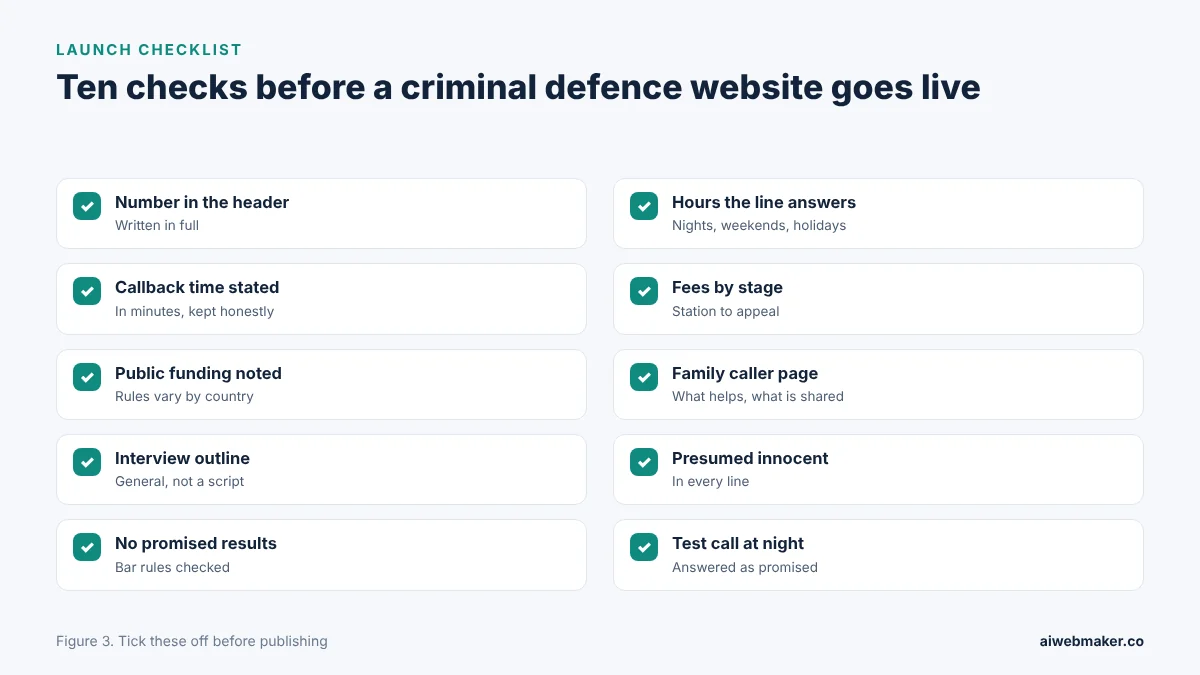
A frightened caller tries the next firm when the number hides at the bottom of the page or shows office hours only. A site that talks about winning cases sounds like marketing to a parent whose son is in a cell. No word on fees leaves people fearing an unaffordable bill at the worst moment, and no mention of public funding leaves eligible callers paying when they may not need to. A form asking for details of the allegation feels unsafe to anyone sharing a computer. Relatives who cannot find what to have ready waste the first minutes of the call. Ten launch checks for defence sites, pictured next, meet each of those fears before the caller hangs up.
Frequently asked questions
Can a defence firm list the cases it has won?
That depends on the professional rules where the firm practises, and those rules vary between countries, states and bar regulators. Some allow past results with a clear note that each case turns on its own facts, while others restrict them heavily. Naming clients or describing identifiable cases also needs consent and may break confidence. A safer approach is to describe the kinds of work the firm does and the stages it covers. Careful wording protects former clients and keeps the firm within its regulator's guidance.
Who pays when legal aid or a public defender is available?
Where public funding applies, some or all of the cost is met from public money, and the client pays nothing or a contribution set by the scheme. Eligibility depends on the country, the stage of the case and often the person's means and the seriousness of the charge. A private firm should say plainly whether it takes publicly funded work and check eligibility on the first call. People who do not qualify can still be offered fixed fees by stage. Honest guidance on funding builds trust even with callers who end up elsewhere.
Should client reviews mention the charge or the result?
Reviews for a defence firm should focus on how the client was treated, such as being reached quickly, kept informed and spoken to with respect. Mentioning a charge can identify a person and follow them for years in search results. Mentioning a result can look like a promise to the next reader and may breach local advertising rules. The firm can gently ask reviewers to leave those details out. A review about calm, clear support says everything a frightened reader needs.
What should a defence site say about bail?
A defence site can explain in general terms that bail, or release while a case continues, may come with conditions, and that the rules differ by country. It should make clear that any money a court requires is separate from the lawyer's fees. The first hearing page can say whether an application for release is included in the fee. Families often confuse bail with fines or legal costs, so a plain sentence prevents worry. Accurate, general guidance helps families prepare for the first hearing.
How few attendances repay a defence firm's hosting?
A single police station attendance, privately funded, usually bills well beyond the $119 hosting fee a defence practice meets each year. Paid monthly, the $19 is a sliver of one first hearing fee. Every family member who rings the number at night instead of the next firm on the map is a case the website has won before the office opens. A visible night line, fees set out by stage and honest guidance on interviews and funding persuade people at the worst moment of their lives. Firms that keep the on call details and fees accurate become the number people save in their phones. Night calls that start with a name, a date of birth and a station show the family page has already done its work.
Build your website in Minutes and get the AI Tools that work
Start Building Your Website →