Bookkeeping Website Cost and the Monthly Close Clients Can Picture
AI Web Maker bills $119 to keep a bookkeeping practice online for twelve months, or $19 per month, plus the domain. Covered here: the owners who hand over their books, catch up work, the monthly close, fees, software access, scope limits, search and the yearly budget.
- No coding required
- Live in minutes
- Blog, SEO and chatbot tools included
AI Web Maker bills $119 to keep a bookkeeping practice online for twelve months; a practice preferring smaller amounts pays $19 per month instead, plus whatever its chosen domain ending costs. Writing the service pages and fee notes, then reading them back in the preview, produces no bill at all. One monthly client repays that sum within weeks, so the hosting line is rarely what holds a practice back. The harder task is persuading an owner to hand over bank feeds, receipts and payroll records to someone found through a search. Catch up work is the focus of the bookkeeping website example, an invented practice's AI Web Maker site and a sensible place to see how that trust can be earned on screen. Owners who have fallen behind feel embarrassed, and they want a bookkeeper who clears the backlog without judgement. Clients, pages, catch up work, the monthly close, fees, software access, the limits of the role and the yearly budget are covered in turn.
This article is part of our complete guide: Website Builder for Law and Accounting Firms.
Who hands their books to a bookkeeper, and what tips the decision?
Owners hand over their books at predictable moments, and each moment brings its own worry about cost, access and embarrassment. A sole trader facing a first tax return often finds a year of receipts unsorted in a drawer or an inbox. A company that has just hired staff needs payroll run correctly, and the owner no longer has evenings to spare. Some owners arrive because their accountant has asked for cleaner records before the year end work can begin. Others are leaving a bookkeeper who stopped replying, while club treasurers want someone who understands restricted funds. Across all of these groups, familiarity with their software, clear fees and a believable routine decide who gets the call.
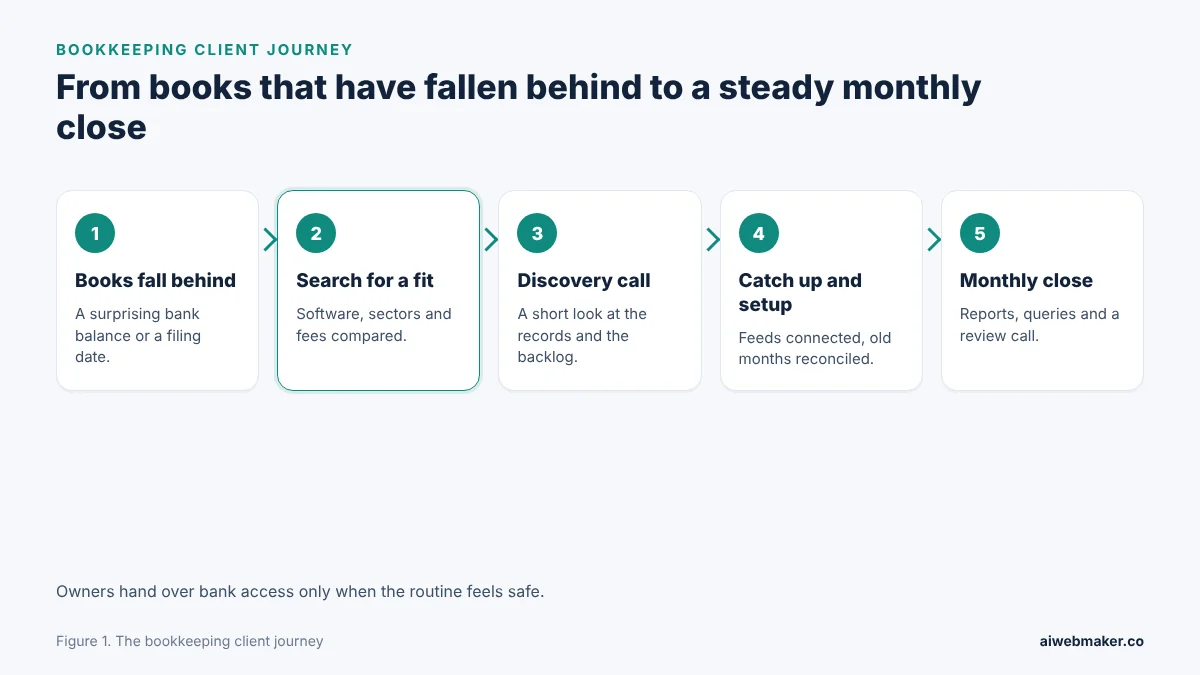
Five stages run from the first sign of trouble to a routine the owner no longer thinks about. Books fall behind first, usually noticed when a bank balance surprises the owner or a filing date looms. The search that follows is where the website does its heaviest work, because owners compare software, sectors and fees before contacting anyone. A short discovery call and a look at the existing records lead to a proposal that separates catch up work from the monthly fee. Clean up and setup come next, with bank feeds connected and old transactions reconciled. Once the monthly close settles into a rhythm the owner stops worrying, and that relief is the reason clients stay for years.
Which pages carry an owner from search to a signed proposal?
Only a handful of pages are needed, provided each one settles a particular doubt. The home page names the situations the practice handles, from a backlog of unreconciled months to payroll for a first employee. Service pages separate catch up work, monthly bookkeeping and payroll, since owners search for each in different words. The about page carries the person behind the practice, the software certifications held and the sectors served. Every page should end with a clear route to an enquiry, because a worried owner acts while the worry is fresh.
| Page | The doubt it answers | Detail that settles it |
|---|---|---|
| Home | Can this person handle my mess? | Named situations, such as twelve months behind |
| Catch up bookkeeping | How bad is too bad? | How backlogs are scoped and priced |
| Monthly bookkeeping | What arrives each month? | Close date, reports and a review call |
| Payroll | Will my staff be paid correctly? | Pay run frequency, payslips and filings where required |
| How it works | What happens after an enquiry? | Discovery call, proposal, setup and first close |
| About | Who will see my records? | Name, photo, software certifications and sectors |
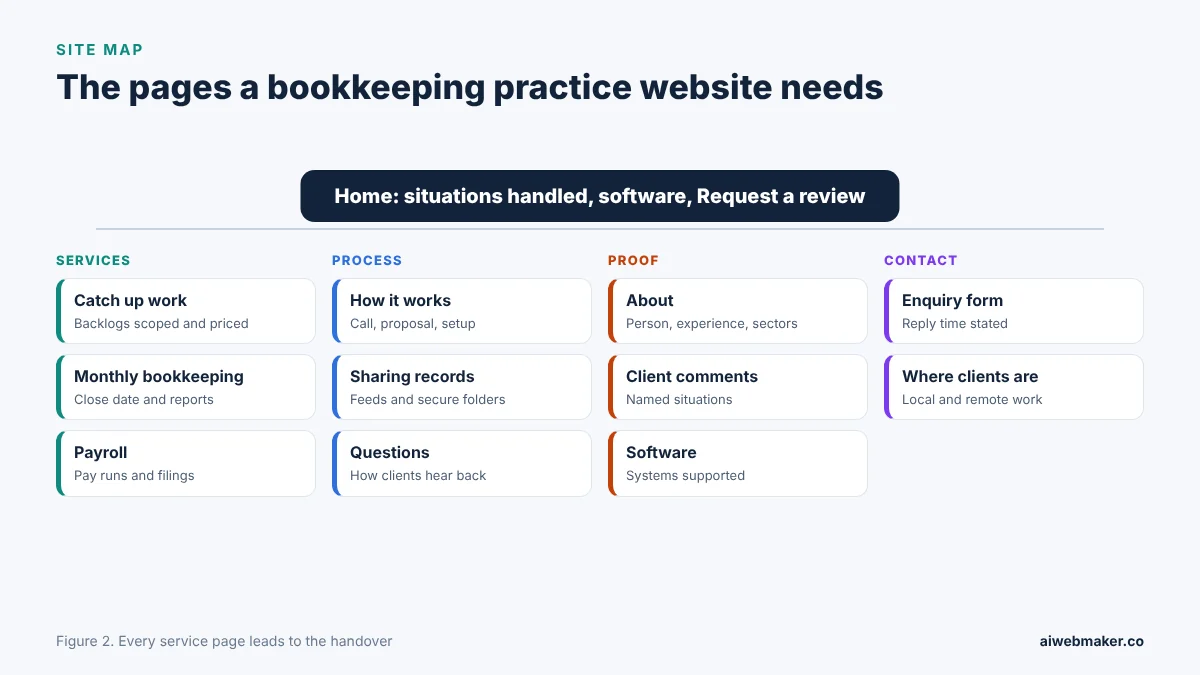
The plan pictured here hangs services, process, proof and contact beneath the home page, one branch for each kind of doubt an owner carries. The process branch explains the handover and how questions are handled between closes, while proof sits on the about page with the software named. Our sample practice, Balanced Books Bookkeeping, opens its home page on how messy books cost time and money, then lists what it takes on and the typical situations it handles. Its services page covers what it does, who it suits and how the work is arranged, and a separate page walks from first contact to getting started, including how often clients hear from the bookkeeper. The about page explains who runs the practice, its experience and where it works, and the bookkeeping practice website example with a monthly routine page took 49 seconds to build, enquiry form included.
Why does catch up work need its own page and its own price?
Catch up work is a different job from monthly bookkeeping, and blending the two on one page confuses owners and undercuts the practice. A backlog might be three months of unmatched bank lines or two years of records that were never entered at all. Many practices quote catch up work as a fixed project after a short review, because open hourly estimates frighten owners who already feel behind. The page can describe the steps, from gathering statements to reconciling each account and flagging items the owner must explain. Promising a calm process without judgement matters as much as the price, since shame keeps many owners from asking for help at all.
| Scoping question | Why it changes the quote |
|---|---|
| How many months are behind? | Sets the volume of transactions to process |
| How many bank, card and loan accounts exist? | Each one is reconciled separately |
| Which software, if any, holds the records? | A migration or fresh setup adds time |
| Were receipts and invoices kept? | Missing paperwork means more queries to the owner |
| Is payroll or sales tax involved? | Earlier filings may need correcting by a qualified person |
| Is a filing date close? | Rush work may be priced differently |
What happens inside a monthly close?
A monthly close turns raw bank activity into figures an owner can trust, and describing it plainly is the strongest sales copy a bookkeeper has. Transactions arrive through bank feeds and are categorised against the chart of accounts. Each bank and card account is reconciled so the books match the statements exactly. Sales invoices and supplier bills are checked, and overdue customer balances are flagged for the owner to chase. Receipts are matched to spending, with a short list of queries sent for anything unexplained. A profit and loss report, a balance sheet and a brief note on anything unusual close the month on a stated date. Owners who see these steps written down understand what the monthly fee buys.
| Close step | What the bookkeeper does | What the owner provides |
|---|---|---|
| Bank feeds | Imports and categorises transactions | Access to the accounts concerned |
| Reconciliation | Matches the books to each statement | Statements for accounts without feeds |
| Receivables | Reviews unpaid sales invoices | Decisions on chasing or writing off |
| Receipts | Matches receipts to card and bank spending | Photos or copies of receipts |
| Queries | Lists anything that cannot be explained | Short answers, ideally within days |
| Reports | Sends the monthly figures with notes | Time for a brief review call |
How are bookkeeping fees usually set, and what can the page say?
Bookkeeping fees are usually set by the volume and complexity of transactions rather than by the hour, and the page should explain which drivers apply. A fixed monthly fee for an agreed range of transactions gives owners a predictable cost and the bookkeeper a predictable workload. Tiers based on the number of bank accounts, invoices or employees on payroll let owners see where they fit. Catch up work, year end support for the accountant and one off projects can sit outside the monthly fee and be quoted separately. A clear fee page filters out owners who expect a full accounting service at a bookkeeping price.
| Fee approach | How it is set | Where it fits |
|---|---|---|
| Fixed monthly package | An agreed range of transactions and accounts | Steady trading businesses |
| Tiered packages | Steps by transaction volume or headcount | Practices serving many sizes of client |
| Fixed project fee | Quoted after a review of the backlog | Catch up and clean up work |
| Hourly rate | Time recorded and billed | Occasional queries and unusual tasks |
| Add ons | Priced per pay run or per filing | Payroll, sales tax records and extra reports |
Which software and bank access arrangements should the site spell out?
The site should name the accounting software the practice works in, because owners already on one system want to keep it and those on none want a recommendation. Cloud platforms let a bookkeeper join as a separate user, so passwords are never shared, and bank feeds show transactions without any power to move money. Receipt apps and encrypted file transfer cover paperwork that does not arrive through a feed. Data protection rules differ between countries, so the privacy notice should reflect the law where the practice and its clients operate. The AI website builder bookkeepers use to draft service and handover pages turns a few lines about the practice into draft pages, and the bookkeeper corrects any wording about software or access in the preview. Spelling out access before the first call turns a security worry into a reason to proceed.
Where does bookkeeping end and accounting or tax advice begin?
Bookkeepers record, reconcile and report, while statutory accounts, tax returns and tax advice may need qualifications or registration that vary from country to country. Owners rarely know where that line sits, so the website should draw it. A practice can say that it prepares clean records for the client's accountant and works alongside them at the year end. Where the bookkeeper is also qualified or registered for certain filings, the page should state which ones and under which body. In some countries bookkeepers fall under anti money laundering supervision and must confirm who a client is before work starts, and explaining that check avoids surprise. Professional memberships and indemnity insurance, where held, belong beside this explanation. A clear boundary protects client and practice alike, and it signals exactly the professionalism owners hope to find.
What do owners type when their books need rescuing?
Owners hunting for help enter phrases such as bookkeeper near me, catch up bookkeeping, bookkeeping for contractors or a software name followed by the word bookkeeper. Placing those phrases in the headings of the matching service pages makes the fit obvious to search engines and readers alike. A map listing with the practice's hours, its service area and a link to the site brings in nearby owners, even when the work itself happens remotely. Reviews that mention a tidied backlog, quick replies or a calm year end are the most persuasive, so asking satisfied clients for them should be routine. Articles on keeping receipts for a bookkeeper, preparing for a year end or choosing accounting software reach owners months before they are ready to hire. Useful writing makes the practice the name owners remember when the drawer of receipts finally overflows.
What does a year of hosting, domain and articles add up to?
Only two lines are fixed, hosting and the domain, while a monthly article drafted with AI credits barely registers on the statement. Practices with a settled client list pay the smallest total by clearing the whole year at once. A bookkeeper who has just left employment may rather spread the cost into twelve smaller bills while the client list grows. Changing fees, adding a service or updating the software list adds nothing at all. The ledger below sets annual against monthly billing, and the $189 tier appears there only as a yardstick.
| Item | Yearly | Monthly |
|---|---|---|
| Hosting the bookkeeping pages | $119 | $228 over twelve months |
| Domain | Depends on the ending | Depends on the ending |
| Higher plan, for comparison | $189 a year | Not needed |
| Twelve record keeping articles at about $0.65 | About $7.80 | About $7.80 |
| Fee, service and software updates | No charge | No charge |
| Year before the domain | About $126.80 | About $235.80 |
Why do owners close a bookkeeper's site and keep doing their own books?
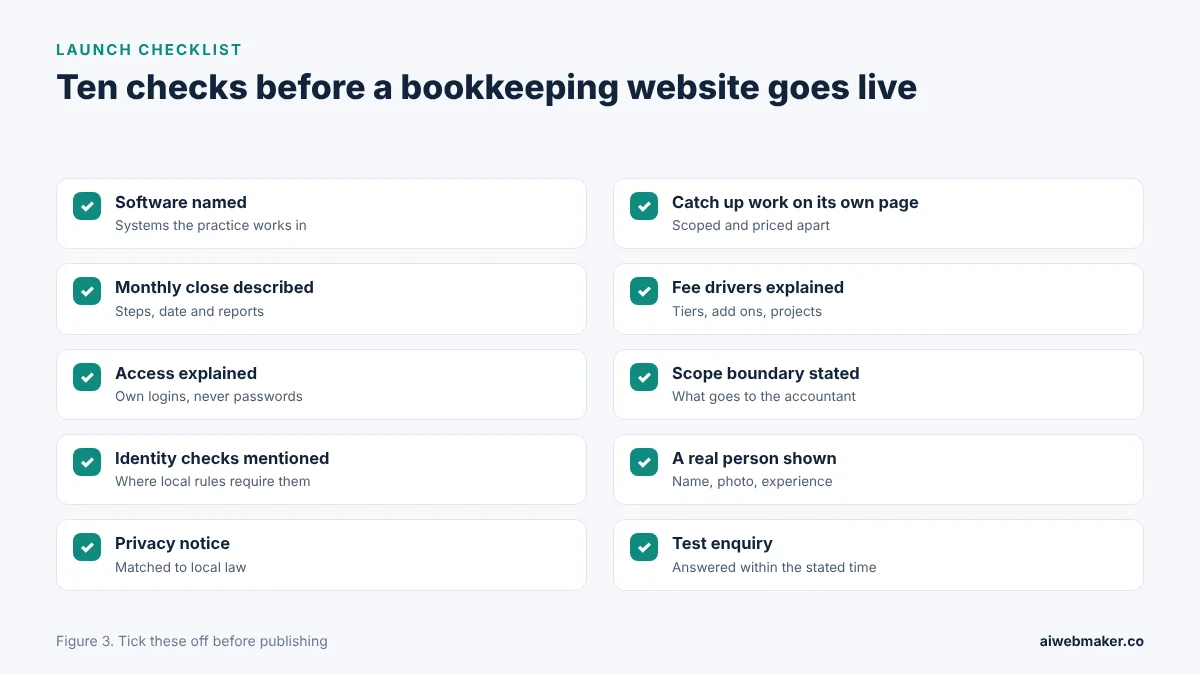
Owners close the tab when the site never names the software they use, because switching systems sounds like more work rather than less. A page with no hint of fees suggests an open ended bill, which is exactly what a struggling owner fears. Silence on how records are shared makes the handover sound risky. No face or name behind the practice leaves owners wondering who will see their bank statements. Vague scope, with no word on whether tax filings are included, sends them to an accountant instead. The launch list pictured next pairs every one of those gaps with a fix.
Frequently asked questions
Can a bookkeeper file tax returns for clients?
Whether a bookkeeper may file tax returns depends on the country, the type of return and the bookkeeper's own qualifications or registration. In some places bookkeepers commonly handle routine filings such as payroll submissions, while income tax returns are reserved for registered professionals. The website should state plainly which filings the practice handles and which it passes to an accountant or tax adviser. General website text is not tax advice, and the site can say so in a sentence. A precise statement protects everyone and builds trust with the accountants who refer clients.
How far behind can books fall before a catch up project is needed?
A backlog longer than a month or two is usually handled as a separate catch up project, because the work no longer fits inside a normal close. Transaction volume and the state of the paperwork matter more than the calendar. A bookkeeper can review the records and quote a fixed price for bringing them current. Once the backlog is cleared, the monthly fee begins. Owners who understand this structure in advance feel far less anxious about asking for help.
Does a remote bookkeeper need the owner's bank password?
A remote bookkeeper should never need the owner's bank password, and the website should say so in plain words. Accounting software connects to banks through feeds, and many banks offer read only or accountant access. Cloud accounting systems let the owner invite the bookkeeper as a separate user, with permissions that can be removed at any time. Documents can travel through a secure shared folder or an encrypted transfer service. An owner who reads this before the first call is far more likely to go ahead.
What should an owner gather before a first call with a bookkeeper?
Before a first call, an owner can gather recent bank and card statements, the name of any accounting software in use and a rough idea of monthly transactions. Copies of the last accounts or tax return help the bookkeeper understand the business. A note of how many staff are paid and whether the business is registered for sales tax shapes the proposal. Owners do not need tidy records to start the conversation. Saying so on the site removes the embarrassment that delays so many enquiries.
How many monthly clients does it take to cover the year online?
A single monthly client usually covers the $119 of hosting within weeks, long before the year is out. On monthly billing, one retainer covers the $19 many times over from its very first invoice. Every owner who recognises their own backlog on the catch up page and asks for a review adds income that can last for years. Named software, clear fees, an honest boundary with accountants and a believable monthly routine carry most of the argument. A steady trickle of review requests from owners who arrived through search shows the pages are earning their place.
Build your website in Minutes and get the AI Tools that work
Start Building Your Website →