Bankruptcy Lawyer Website Cost and the Calm Pages Debtors Read First
A bankruptcy practice can host its whole site for $119 across twelve months, or pay $19 monthly, choosing the domain on top. The guide walks through who calls, the pages, debt routes, fees in arrears, deadline letters, directors, the first call form, search and the yearly sums.
- No coding required
- Live in minutes
- Blog, SEO and chatbot tools included
A bankruptcy practice can host its whole site for $119 across twelve months, or pay $19 on each monthly bill, with the domain chosen on top. Drafts of the route table, fee cards and first call page can be reworked on screen before launch, and AI Web Maker bills none of it. One debt options review earns the year back several times over. Trickier still, people in debt avoid help for months and arrive ashamed, sometimes days before a hearing. Debt adverts and outright scams chase them too, so they read every lawyer's page with suspicion. What follows covers who calls, the pages, routes compared honestly, fees for people in arrears, deadline letters, directors, the first call form, search and the yearly budget.
This article is part of our complete guide: Website Builder for Law and Accounting Firms.
Who reaches for a debt lawyer, and what finally makes them call?
Four groups reach a bankruptcy and insolvency practice, and each arrives with a different fear. Households come after a job loss, an illness or years of borrowing to cover bills, and many have avoided their post for months. Sole traders carry business debts that are often legally their own, so a failing shop or van round can threaten the family home. Company directors arrive when cash runs short and suppliers start pressing, usually worried about personal guarantees. Creditors form the fourth group, since a business owed money by an insolvent customer needs help lodging a claim. What tips any of them into calling is nearly always a letter with a date on it.
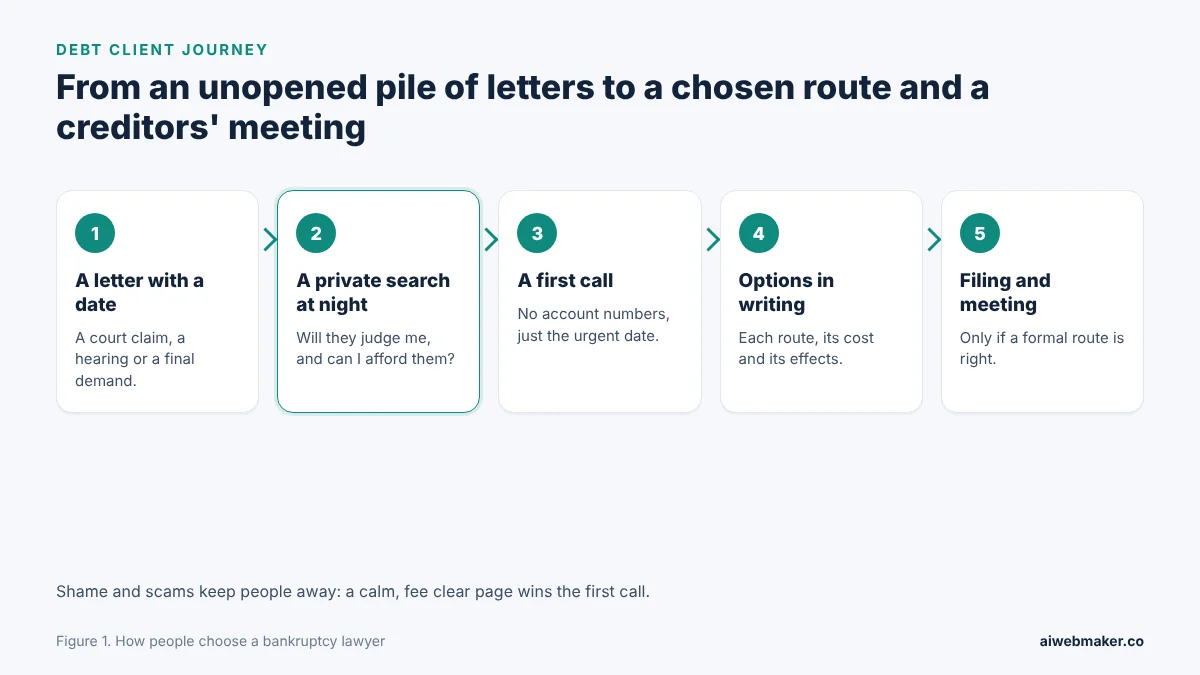
Five stages run from the pile of post to the creditors' meeting, and the shaded one is where most debt practices win or lose the person. A letter with a date forces the issue, often after weeks of avoidance. Then comes a private search late at night, wondering whether a lawyer will judge them or cost too much. A first call with no fee, where a firm offers one, and a form that asks for no account numbers lower both barriers at once. Written options follow, then a decision in the client's own time, and only some cases reach a filing. Every page should shrink the next stage a little for the person reading it.
Which pages carry a debt practice from the first letter to the filing?
A bankruptcy practice needs fewer pages than a general law firm, but each one must work harder, because a reader in debt will not dig through menus. A routes page compares the options open where the firm practises, and a help page splits the work for people, sole traders, directors and creditors. A letters page tells visitors which documents to bring and which usually carry deadlines. A fees page sets out fixed prices and keeps court and official fees on their own lines. A first month page and a short form complete the set. Together they let a frightened visitor see the whole path before making a single phone call.
| Page | Main reader | What it must make clear |
|---|---|---|
| Routes compared | Anyone in debt | Each option, who it may suit, what it changes |
| People and sole traders | Individuals | When business debts become personal ones |
| Company directors | Directors | Duties once insolvency looms, guarantees |
| When you are owed | Creditors | Lodging a claim and following the process |
| Fees | Everyone | Fixed fees, official fees apart |
| First call | Everyone | What to share, and what never to send |
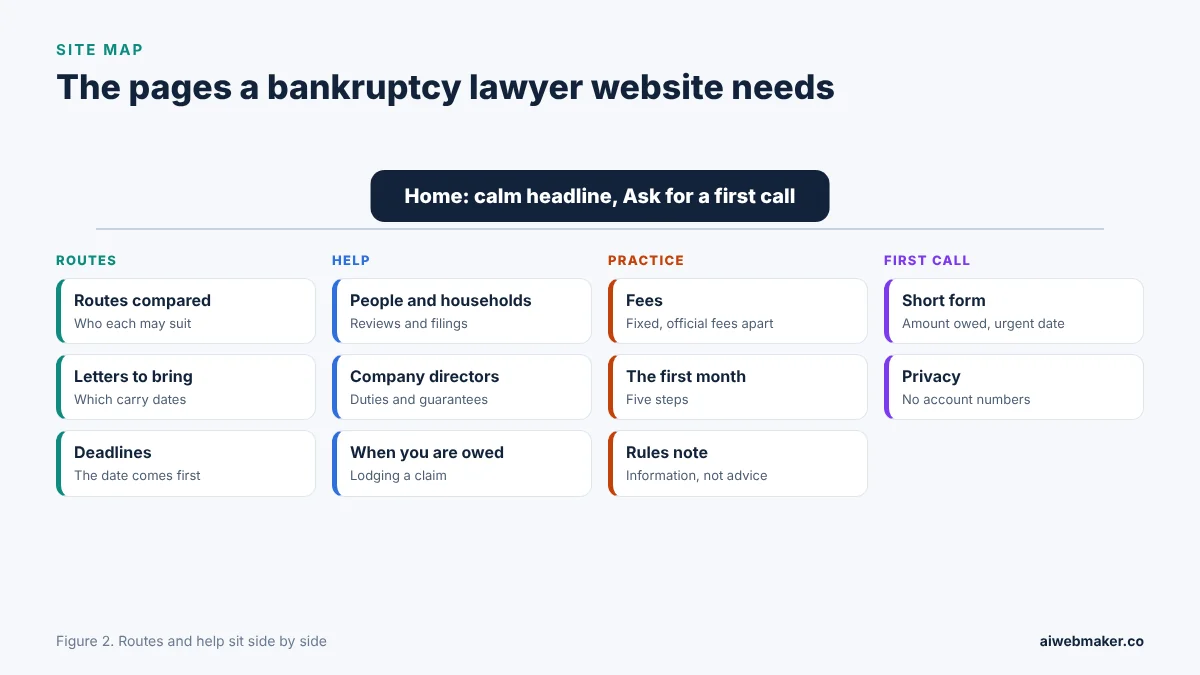
Four branches hold the practice together on this plan: the routes, help by type of client, the practice itself and the first call. Fresh Ledger Insolvency Law, the invented firm behind the bankruptcy lawyer website example with a calm first call form, opens by saying debt is a problem to solve rather than a verdict on the person. Chips then list the letters people bring, from final demands to personal guarantees, opened or not. A table compares five routes, from an informal arrangement to closing a company. Six service cards cover a debt options review, a personal bankruptcy filing, repayment plan proposals, company directors, creditor meetings and help for businesses that are owed. A five step first month leads to a form asking roughly how much is owed and the date on the most urgent letter, never an account number. That order mirrors a good first meeting, which keeps visitors reading.
How can debt routes be compared without pushing one?
Debt routes should sit side by side, because most visitors have heard of only one option, usually from an advert or a friend. The names differ by country: in the United States consumers meet Chapter 7 liquidation and Chapter 13 repayment plans, while in England and Wales people hear about debt relief orders, individual voluntary arrangements and bankruptcy. A table keeping the general shape of each route, with local names in plain words, helps readers anywhere. Every row should say roughly how long the route lasts, what it may put at risk and which debts it may leave untouched. Some debts, such as certain fines, student loans or family support payments, are often treated differently from ordinary borrowing, so the page should say that local rules decide. Admitting that some people need no formal route at all shows the firm is on the reader's side.
| Route type | Local names, for example | Often lasts | What to weigh |
|---|---|---|---|
| Informal arrangement | Debt management plans | Until repaid | Creditors may withdraw |
| Formal repayment plan | Chapter 13 in the United States, IVAs in England and Wales | Often three to five years | Fees, a fixed term, a public record |
| Low asset relief | Debt relief orders in England and Wales | Often around a year | Strict income and asset limits |
| Personal bankruptcy | Chapter 7 in the United States | Months to years, by country | Assets sold, some debts survive |
| Company rescue or closure | Administration, Chapter 11, liquidation | Depends on the case | Directors' conduct is reviewed |
How do people already in arrears pay a debt lawyer?
Nearly every debt client asks about fees first, because paying a lawyer while behind on bills feels absurd. Predictable work suits fixed fees quoted in writing, such as an options review, a personal filing or attendance at a creditors' meeting. Some systems shape the timing: for example in the United States, fees for a liquidation case are commonly collected before filing, while part of a repayment plan's legal fee is often paid through the plan with court oversight. Court and official fees are set by each country and belong on their own line. Where legal aid, reduced official fees or a non profit debt adviser could help, a short note pointing to them is worth adding. A fees page that spreads payments where the rules allow earns trust long before the first call.
| Work | Common fee shape | What the page should add |
|---|---|---|
| Debt options review | Fixed fee, often after a first call | What the written summary covers |
| Personal filing | Fixed fee, timing set by local rules | Official fees shown separately |
| Repayment plan proposal | Fixed fee, sometimes partly through the plan | What happens if the plan fails |
| Creditors' meeting | Fixed fee | Preparation included |
| Claims for creditors | Fixed fee or hourly | That no return is promised |
Which letters start a clock the site should warn about?
Some debt letters carry deadlines measured in days, so the site should tell visitors which papers to mention first. A court claim form usually allows only a short period to respond before judgment can be entered without a hearing. A repossession hearing, an enforcement agent's notice or a winding up petition against a company changes what the lawyer must do this week. In England and Wales, for example, a statutory demand leaves a narrow window to apply to set it aside, while other countries use different notices with their own periods. Rather than quoting one country's numbers as universal, the page should ask visitors to note the date on the most urgent letter. Saying plainly that the date comes first saves people from losing options while they gather courage.
What must company directors read before the cash runs out?
Directors need their own page because, once a company may be insolvent, the law in many countries expects them to put creditors' interests first. Trading on and taking customer deposits with no reasonable prospect of avoiding insolvency can expose a director to personal liability, as with wrongful trading rules in the United Kingdom. Personal guarantees signed for leases, loans or supplier accounts can turn a company's failure into a household problem. Disqualification, staff wages and company tax debts worry them too. The page should explain these risks generally and stress that a director and the company are advised separately, since their interests can differ. Early advice usually leaves more options open, and the page should say so twice.
What should a first call form ask, and what must it never ask?
People in debt are prime targets for scams, so a first call form should ask for very little and say what it will never request. Useful questions cover who the visitor is, roughly how much is owed, the date on the most urgent letter and the best time to talk. Account numbers, card details, passwords and identity documents should never be requested through the website, and the form should state this openly. A note that the form opens a conversation, not a lawyer and client relationship, sets honest expectations under local professional rules. The AI website builder that drafts a debt practice's routes, fees and first call page prepares the pages after the firm outlines its work briefly, with every line editable in the preview until the wording feels right. A short form with a stated reply time turns a frightened visitor into a booked conversation.
What do people in arrears type into a search box at midnight?
People in arrears rarely search for an insolvency lawyer by title. They type the problem instead, such as stop a house repossession, Chapter 13 or Chapter 7, can bailiffs take my car or my company cannot pay its debts. A page for each problem, titled in the reader's words and naming the region or state served, meets those searches directly. Office hours, any evening or video appointments and the website link belong on the map listing too, since many of these searches happen at night. Reviews are scarcer because clients value privacy, so writers are thanked, never pressed, and shown by initials. Short articles on whether a pension, a car or a tenancy is at risk reach visitors weeks before they would ring a firm.
Where does hosting sit beside one debt options review?
Only two lines recur for a debt practice, the hosting and the domain, while a year of monthly debt guides drafted on credits totals near $7.80. Paying the hosting in one yearly sum gives the lowest total for a firm with a settled caseload. Somebody opening an insolvency practice alone might spread it monthly until the first matters close. Later edits to fees, routes or office hours bring no extra charge. The $189 tier is set beside both routes in the table purely to compare.
| Item | Yearly | Monthly |
|---|---|---|
| Hosting the insolvency practice pages | $119 | $228 over twelve months |
| Domain | Depends on the ending | Depends on the ending |
| Higher plan, for comparison | $189 a year | Not needed |
| Twelve debt guidance articles at about $0.65 | About $7.80 | About $7.80 |
| Fee, route and hours updates | No charge | No charge |
| Year before the domain | About $126.80 | About $235.80 |
Why does a frightened debtor close one firm's page?
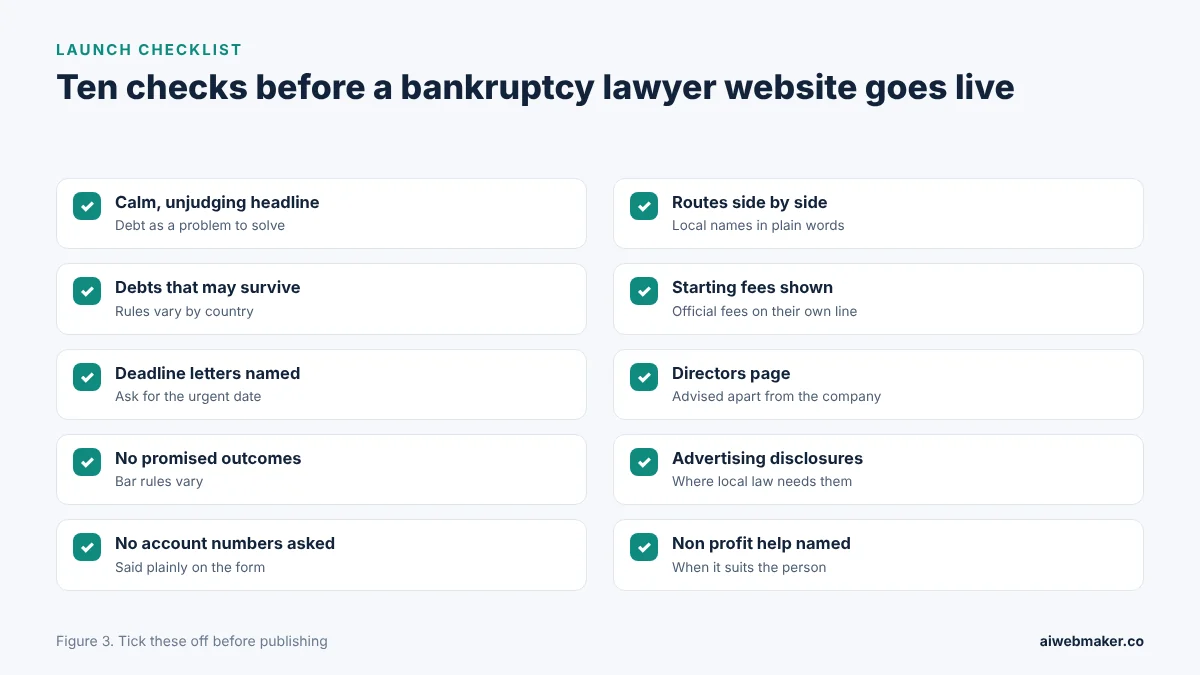
A person in debt leaves a lawyer's site the moment it feels like a sales pitch, especially one promising that every debt will vanish. Pages with no fees make the first call seem like another bill they cannot afford. A form asking for account numbers looks exactly like the scams they have been warned about. Unexplained jargon about petitions and dividends makes readers feel foolish. No mention of deadlines leaves them believing they can wait another month. The ten checks in this launch graphic close each of those exits before a reader slips away.
Frequently asked questions
Is it wise to put filing fees on a debt practice's page?
Showing starting fees helps people in debt, because fear of an unaffordable bill is often what keeps them from calling. A starting figure for a review, a filing and a repayment proposal lets a visitor plan, while a note explains what can change the final price. Court and official fees should sit on a separate line, since the firm does not set them. Where the rules allow fees to be spread across several months, saying so removes a major barrier. Clear figures also filter out enquiries that a non profit adviser would serve better.
Can the website promise that debts will be written off?
No, because nobody can know what a route will achieve before reviewing the person's debts, income, assets and local law. Bar and regulator rules in many countries forbid promising outcomes, and titles like specialist are restricted by some regulators. Federal law in the United States, for instance, classes many firms that help consumers file as debt relief agencies and requires a set disclosure in their adverts. The page can explain what each route is designed to do and leave the specific answer to written advice. A line saying the site is general information, not legal or financial advice, protects reader and firm alike.
Do reviews work when most debt clients want privacy?
Reviews can work, but a debt practice should expect fewer of them than other firms and should never pressure anyone to write one. Many clients prefer that nobody knows they took advice, so initials and a short context, such as household debt review, respect that wish. Some regulators restrict testimonials for law firms, so the local rules come first. Any published review needs a note that each case differs. A handful of honest comments, gathered gently, does more than a wall of stars.
When should a firm point a visitor to a non profit debt adviser?
A firm should point visitors to a non profit adviser when their debts are modest, their situation is simple or they cannot afford legal fees. In many countries charities and government backed services give debt advice at no charge, and some can arrange formal solutions themselves. A practice that names them openly gains a name for honesty, and advisers remember it when a case needs a lawyer. The firm can still offer a first call to help the person decide which door is right. Sending someone to the right help is part of good debt advice.
What does one debt options review return on the year online?
A single options review, priced as a fixed fee, covers the $119 that keeps a bankruptcy practice online for twelve months. Firms paying $19 monthly recover it from a sliver of one creditors' meeting attendance. Every filing that starts with a visitor who felt unjudged on the routes page is a client the debt adverts did not reach first. A calm headline, an honest route table and fees a person in arrears can plan around persuade people who have avoided help for months. Current fees and deadline guidance make a practice the one local advisers name. First calls that open with the urgent date already noted mean the pages have done half of the first meeting.
Build your website in Minutes and get the AI Tools that work
Start Building Your Website →