Accounting Firm Website Cost, With Fee Pages That Win Retained Clients
An accounting firm's website costs $119 for a year online, or $19 per month, plus a domain. Inside: who looks for an accountant, services, fees, onboarding, switching, deadlines, credentials, specialisms, search and the yearly budget.
- No coding required
- Live in minutes
- Blog, SEO and chatbot tools included
An accounting firm's website costs $119 for a year online, or $19 per month for a practice that prefers to match costs to monthly fees, and a domain is bought alongside. No invoice arrives from AI Web Maker while partners draft the service pages, fee explanations and onboarding steps. One retained client on a monthly fee covers the year many times over, so cost is not what holds a firm back. What holds many firms back is a website that lists services in jargon and says nothing about fees, process or who will actually do the work. Ledgerline Accounting, an invented practice, does the opposite: the accounting firm website design AI Web Maker generated for Ledgerline explains onboarding and how quotes are worked out. Business owners choosing an accountant want to know whether the firm understands their kind of business, what it will cost each month and how painful switching will be. The sections ahead cover the pages that answer those questions and turn visitors into long term clients.
This article is part of our complete guide: Website Builder for Law and Accounting Firms.
Who looks for an accountant online, and what do they want?
People look for an accountant online at moments of change or pressure, and each group wants different reassurance. A new sole trader wants simple help with bookkeeping and a first tax return. A growing company wants payroll, management accounts and advice on cash flow. An established business unhappy with its current accountant wants to know how easy switching will be. Individuals with rental income or complex tax affairs want someone to take the worry away before a deadline. Charities and clubs need accounts prepared or examined to the standards that apply to them. A website that speaks to each group in plain words wins more first calls.
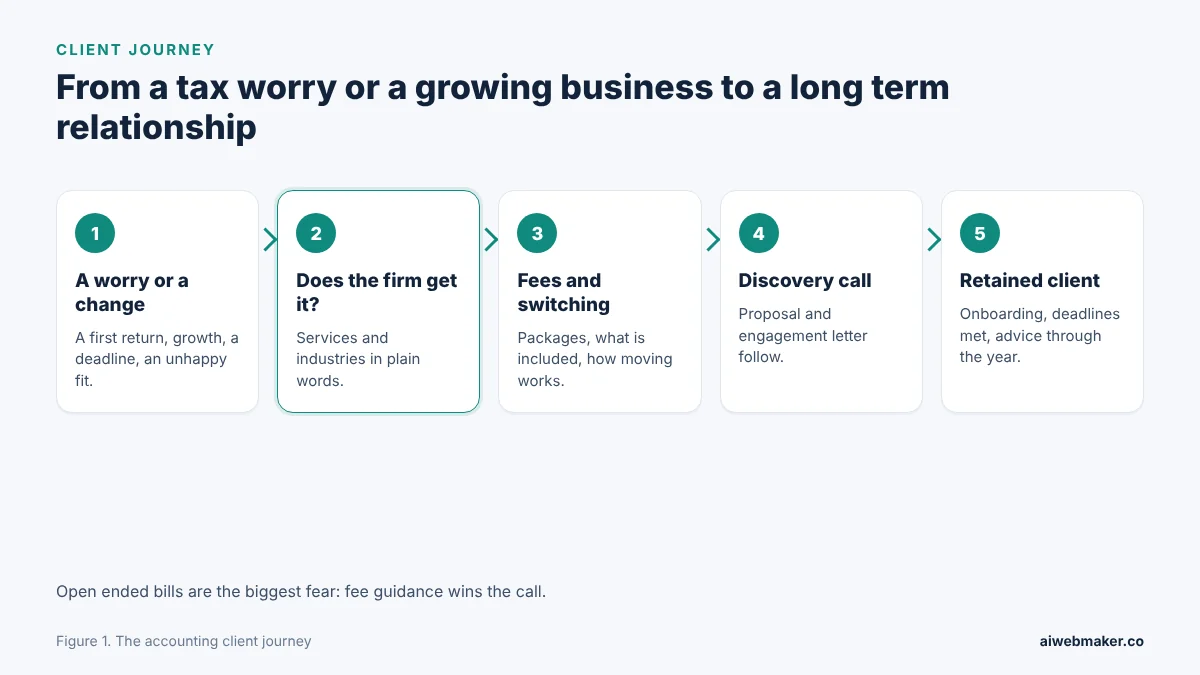
The figure maps the path from a nagging worry about tax or growth to a retained relationship. Most visitors start by checking whether the firm works with businesses like theirs. Fee guidance comes next, because open ended bills are the biggest fear people have about accountants. A discovery call or meeting follows, where the firm learns about the business and proposes a package. Onboarding, including identity checks and access to records, then leads to regular work through the year. Each page should carry visitors one step closer to that relationship.
How should compliance and advisory services be laid out?
Each accounting service that clients search for should have its own page, written in plain language and focused on the outcome for the client. Bookkeeping pages can explain how records are kept up to date and which software the firm supports. Year end accounts and tax returns cover the core compliance work. Payroll and sales tax or value added tax returns are recurring services with fixed deadlines. Advisory work, such as cash flow forecasting, budgeting and planning for growth, shows the firm can add value beyond compliance. Every page needs a line on the clients it fits best and how it links to related work.
| Service | Who it suits | What the page should explain |
|---|---|---|
| Bookkeeping | Busy owners and growing firms | Software supported, frequency, deliverables |
| Year end accounts | Companies and partnerships | What is prepared, timescales, filing |
| Personal tax returns | Individuals, landlords, sole traders | Information needed, deadlines |
| Payroll | Employers of any size | Pay runs, payslips, filings |
| Sales tax or value added tax | Registered businesses | Return frequency, record keeping |
| Management accounts | Owners wanting monthly figures | Reports included, review meetings |
| Advisory | Growing businesses | Cash flow, budgets, planning sessions |
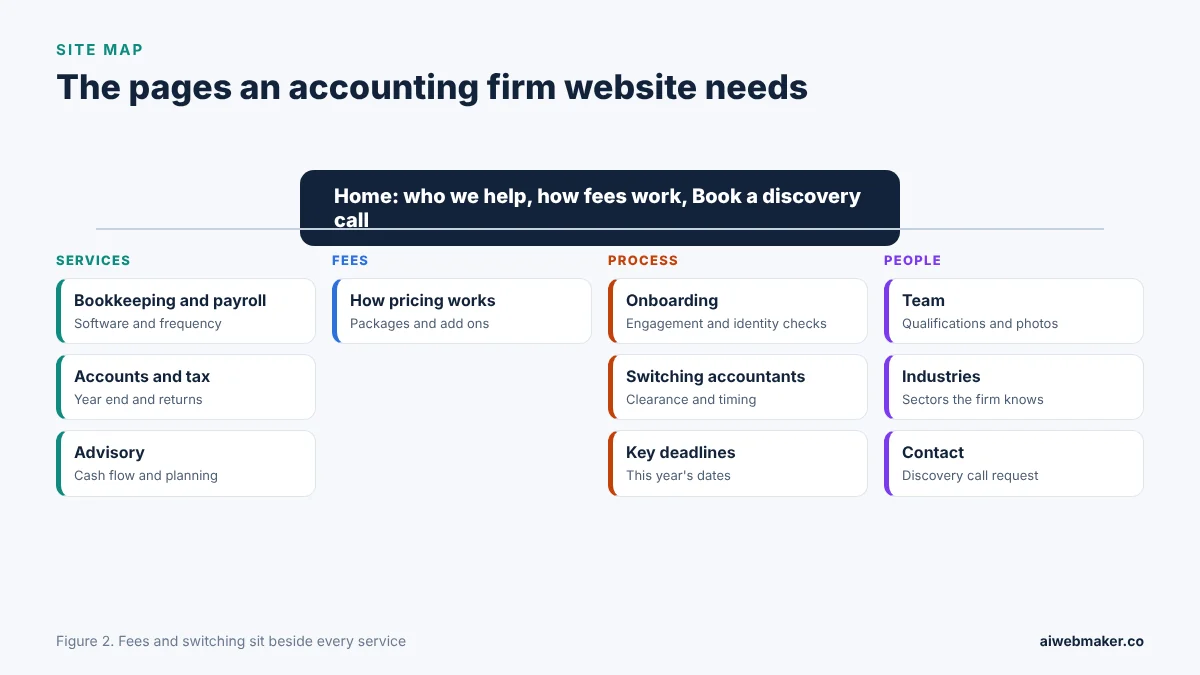
In the site map pictured here, an accounting firm's pages fall into services, fees, process and people. Service pages cover bookkeeping, accounts, tax, payroll and advisory work. Fee pages explain how pricing works and how services combine into packages. Process pages set out onboarding, switching accountants, deadlines and how clients share documents. People pages introduce the team, their qualifications and the industries the firm knows well. Our sample firm, Ledgerline Accounting, explains on its services page how pricing works and how services can be combined, without publishing a rigid fee list, and the accounting firm website example with a how it works page was produced in 47 seconds.
What should prospective clients learn about fees?
Fee pages work when they describe the charging method and offer typical ranges or starting points, because prospective clients assume the worst when a firm says nothing. Fixed monthly fees for an agreed package are popular, because they spread costs and remove the fear of surprise invoices. Packages can be priced by the size of the business, the number of transactions or the services included. Advisory work and one off projects may be quoted separately or charged by the hour. The page should explain what is included in each package and what would cost extra. Clear fee guidance turns hesitant visitors into discovery calls.
| Fee model | How it works | Typical use |
|---|---|---|
| Fixed monthly fee | An agreed package paid each month | Bookkeeping, accounts and tax together |
| Annual fixed fee | One price for the year's compliance | Accounts and returns for simple businesses |
| Tiered packages | Bronze, silver, gold style levels | Different sizes of business |
| Hourly or project fee | Time based or quoted per project | Advisory, investigations, one off work |
| Add ons | Extra services priced separately | Payroll, extra returns, catch up work |
What does onboarding a new accounting client involve?
Onboarding a new client involves several steps that the website should explain, because a smooth start sets the tone for the whole relationship. A discovery call or meeting explores the business, its records and its goals. The firm then sends a proposal and an engagement letter setting out services, fees and responsibilities. Anti money laundering rules in many countries require accountants to verify a client's identity and, for companies, the people who own or control them. Access to accounting software, bank feeds and previous records follows, and a professional clearance request goes to the previous accountant where one exists. The AI website builder that accounting firms use for discovery call requests assembles this request route, with service and fee pages, from the partners' own summary of what the practice does.
| Onboarding step | What happens | What the client should know |
|---|---|---|
| Discovery call | Business, records and goals discussed | Length and whether it is charged |
| Proposal | Services and fees set out | What is included and excluded |
| Engagement letter | Formal agreement | Responsibilities on both sides |
| Identity checks | Verification required by law in many places | Documents needed and why |
| Access and records | Software, bank feeds, prior accounts | How records are shared securely |
| Clearance | Contact with the previous accountant | That the firm handles it |
How easy is it to switch accountants?
Switching accountants is usually easier than clients expect, and a dedicated page explaining the process removes a major barrier. Many business owners stay with an accountant they are unhappy with because they fear disruption, lost records or missed deadlines. The page can explain that the new firm contacts the previous accountant for the information it needs, often called professional clearance. Timing matters, and the best moment to switch is usually soon after a year end or a filing, though it can happen at any time. The firm can promise to check upcoming deadlines immediately so nothing is missed. A clear switching page brings in clients who were waiting for permission to move.
Why should a firm publish key deadlines?
A firm should publish key deadlines because they are what clients worry about most, and a clear calendar demonstrates expertise. Tax return dates, payment deadlines, payroll filings and sales tax returns vary by country and by the type of business. A page listing the main deadlines that apply to the firm's clients, updated each year, attracts searches from people who suddenly realise a date is close. Each deadline can link to the service that helps meet it. Reminders sent to clients by email or through the firm's own systems keep the relationship active. Deadline pages are among the most visited pages on many accounting websites.
What proves an accountant is qualified and regulated?
An accountant should show professional qualifications, membership of recognised accountancy bodies and the regulatory details that apply where the firm works. Designations such as CPA, ACCA, CA or membership of a national institute tell clients the accountant has passed rigorous exams and follows a code of ethics. Some services, such as audit or certain tax representation, are restricted to licensed or registered professionals in many countries. Professional indemnity insurance reassures clients that mistakes are covered. Team profiles with photos, qualifications and areas of expertise make the firm feel personal. Accurate credentials matter especially in a field built on trust.
Is specialising in an industry worth showing online?
Specialising in an industry is well worth showing online, because business owners prefer an accountant who already understands their sector. A firm that works with restaurants, builders, landlords, medical practices or creative businesses can describe the specific challenges it knows well. Industry pages can explain common tax issues, useful software and typical margins for that sector. Case studies, shared with client consent, show real results. Specialist pages also attract searches such as accountant for contractors or accountant for landlords. Depth in a few industries often beats a long list of generic services.
How do business owners find an accountant in search?
Business owners find accountants through searches such as accountant near me, bookkeeping services, accountant for sole traders or tax return help, often followed by a town. Echoing those exact words in service and industry headings helps the right owners land on the right page. Google explains that the same search fundamentals apply to its AI features in search, so clear, helpful pages that answer real questions remain the best approach. Articles on deadlines, expenses and tax changes attract readers who often become clients. A complete map listing with accurate hours and reviews helps local searches. Firms that publish steadily become the trusted voice for their area or industry.
What does an accounting firm spend on its website annually?
The whole recurring bill is hosting plus a domain, since tax updates drafted with credits cost loose change. A firm with a steady client base pays least through yearly billing. An accountant launching a new practice may prefer monthly payments. Updating services, fees or deadlines adds nothing to the bill. Yearly and monthly routes sit below with the $189 tier.
| Line item | Annual payment | Monthly payments |
|---|---|---|
| Hosting the firm's pages | $119 | $228 for the year |
| Domain for the firm | Priced by the ending | Priced by the ending |
| Higher plan, for comparison | $189 a year | Not needed |
| Twelve tax update articles at about $0.65 | About $7.80 | About $7.80 |
| Service, fee and deadline updates | No charge | No charge |
| Year before the domain | About $126.80 | About $235.80 |
Why do business owners leave an accountant's website without calling?
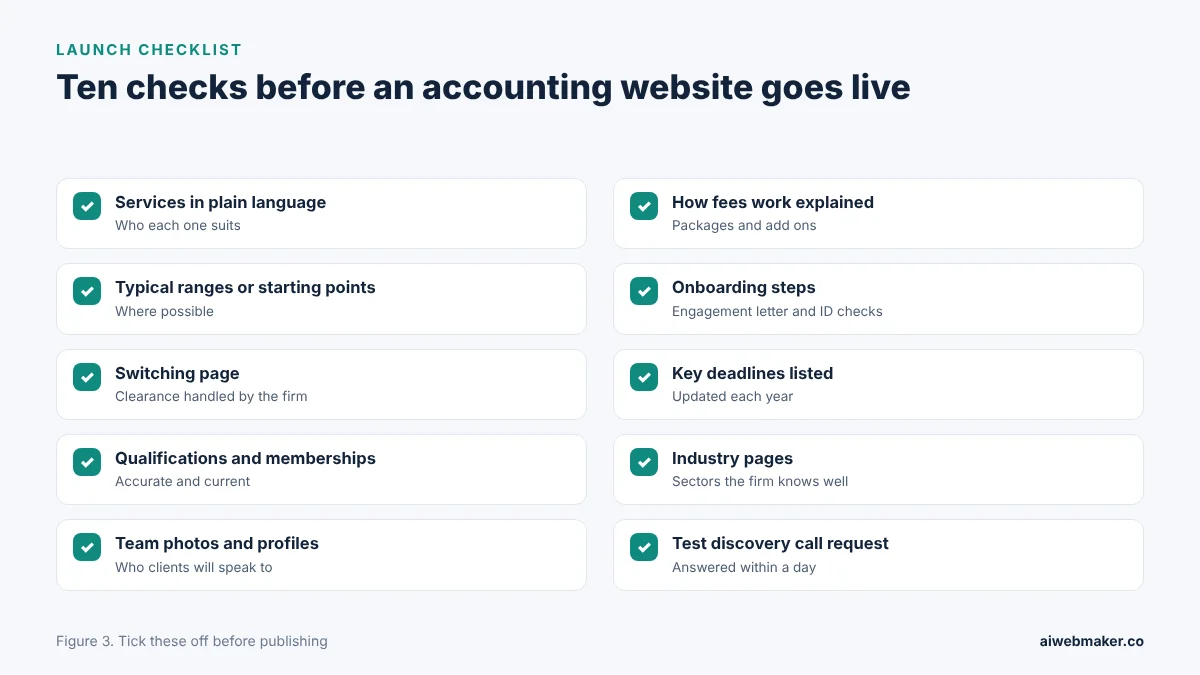
Business owners leave without calling when the services are written in jargon they do not understand. Silence on fees makes them fear an open ended bill. No mention of switching suggests the move will be painful. A team page without photos or qualifications makes the firm feel anonymous. No sign of understanding their industry sends them to a specialist competitor. Each concern is answered by one of the ten checks drawn below.
Frequently asked questions
Are fixed monthly fees now the norm for accountants?
Many business owners now expect fixed monthly fees, because they spread costs and remove the fear of surprise invoices. The website can show typical packages and what each includes. Advisory and one off work can still be quoted separately. A fixed fee also makes it easier for clients to ask questions without worrying about the clock. Clear packages often decide which firm a business chooses.
What does switching accountants involve?
Switching accountants usually involves signing an engagement letter with the new firm, completing identity checks and allowing the new firm to contact the previous accountant for records. The new firm then reviews upcoming deadlines and takes over the work. Most switches cause little disruption when handled properly. The website can explain the steps and the best timing. Clear guidance encourages unhappy clients to make the move.
Why do accountants ask for identity documents?
Accountants in many countries must verify their clients' identity under anti money laundering rules, and for companies they must also identify the people who own or control them. The website can explain which documents are needed and why. These checks protect clients and the firm. Most can be completed quickly, often online. Explaining them in advance avoids surprise during onboarding.
Can an independent accountant compete online with larger firms?
An independent accountant can compete well online by being clearer, more personal and more specialised than larger firms. A friendly team page, transparent fees and pages focused on specific industries often appeal more than a big brand. Prompt replies to enquiries make a strong impression. Helpful articles on local deadlines and common questions build authority. Many clients actively prefer a smaller practice where they speak to the same person every time.
Does one retained client pay for the accounting website?
One retained client on a monthly fee typically pays for the year's $119 hosting several times over. For monthly payers, one client's monthly fee covers the $19 with plenty left. Each business that stays for years after reading a clear fee page and a calm switching guide adds steady, recurring income. Plain language, honest pricing and visible credentials persuade more owners than any list of services. Firms that keep deadlines and fees current become the obvious choice in their area or industry. Year on year growth in retained clients tells the firm its website is working.
Build your website in Minutes and get the AI Tools that work
Start Building Your Website →