Worktop Website Cost for Fitters Who Template, Cut and Seam Stone
Hosting a worktop fitter's site costs $119 a year or $19 a month, plus a domain. The guide moves from how buyers compare stone, quartz and timber to templating, cut outs, joints, silica dust, search and the yearly sum.
- No coding required
- Live in minutes
- Blog, SEO and chatbot tools included
Hosting a worktop fitter's site on AI Web Maker is one fixed charge, $119 across twelve months or $19 for each live month, with the domain on top. No bill arises while pages are drafted, photos are swapped and each screen is tested in the preview, so the whole site can be finished before the firm spends anything. One fitted kitchen, even a short straight run of oiled oak, covers the hosting many times over. The harder task is that a worktop is a slow and anxious purchase, made once in a decade by people who cannot picture a slab in their own kitchen. Buyers compare surfaces for weeks, worry about seams and heat marks, and rarely understand why no fitter will give a firm price until the base units are fixed. What follows covers how those buyers choose, the pages a fitter needs, templating, priced extras, joints, silica dust, search and a costed year.
This article is part of our complete guide: Home Services Website Builder.
How do kitchen buyers settle on a worktop surface?
Kitchen buyers usually settle on a surface in stages, starting long before anyone measures, while the cabinets and the layout are still being planned. The first stage is broad comparison, when a buyer weighs stone against quartz, porcelain and timber on looks, heat, stains and the price per metre run. The second is handling real pieces, because a swatch under showroom lights rarely matches the same material beside a north facing window. Many buyers are steered by a kitchen fitter, a builder or a designer, so the website is also read by trades deciding whom to recommend. A fitter whose pages follow these stages is the one still open in the browser when the buyer is ready for a quote.
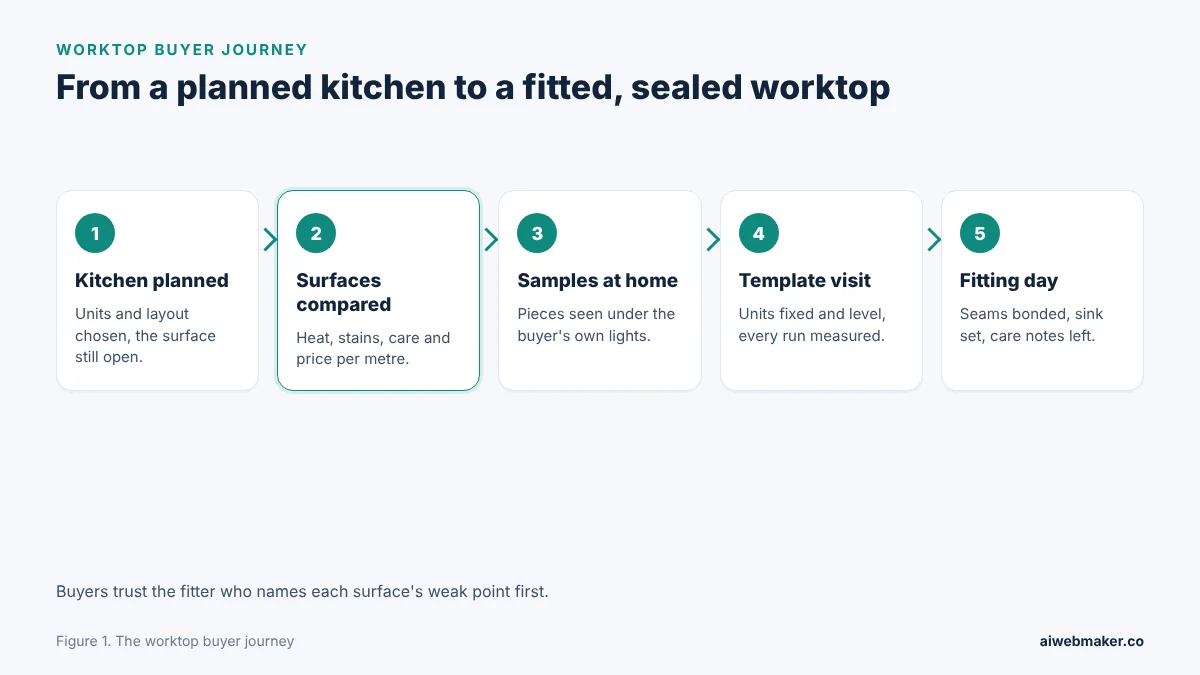
Read from left to right, the five steps run from a kitchen on paper to a finished surface with care notes left on the counter. The comparison step is marked because it is where most buyers either trust a fitter's advice or drift to a showroom that seems to know more. Borrowed samples come next, and they often reverse a decision that looked final on a screen. The template visit only makes sense once the base units are fixed and level, which is the point many buyers do not expect. Fitting day closes the path, and a tidy seam with the sink already set in place is what earns a review and the next referral from a kitchen fitter. Each step therefore needs a page, or a clear section, that moves the buyer gently towards the next one.
What belongs on a worktop site, from swatches to the quote form?
A worktop site needs fewer pages than many trades, but each one must answer a question that buyers otherwise ring the workshop to ask. The material pages carry the most weight, because they decide which surface reaches the quote at all. The process page explains templating, workshop time and fitting day, while an extras page prices the cut outs and edges that catch people out. A gallery of finished kitchens proves the seams and the edges, and the quote request gathers what an estimator needs. Together these pages turn a nervous browser into a buyer who arrives at the template visit already informed.
| Page | What the buyer is checking | What it should hold |
|---|---|---|
| Materials | Which surfaces the firm cuts | Granite, quartz, marble, porcelain, oak, walnut, one honest line each |
| Comparison | How each surface copes with daily use | Heat, stains, care and a starting price per metre run |
| Fitting process | When things happen and who does them | Quote, template visit, workshop days, fitting day, aftercare |
| Extras | What is added to the metre rate | Sink and hob cut outs, drainer grooves, upstands, edges, removal |
| Samples | Whether pieces can be seen at home | Loan period, slab viewing for natural stone |
| Quote request | How to start | Surface, layout, run lengths, whether units are fitted |
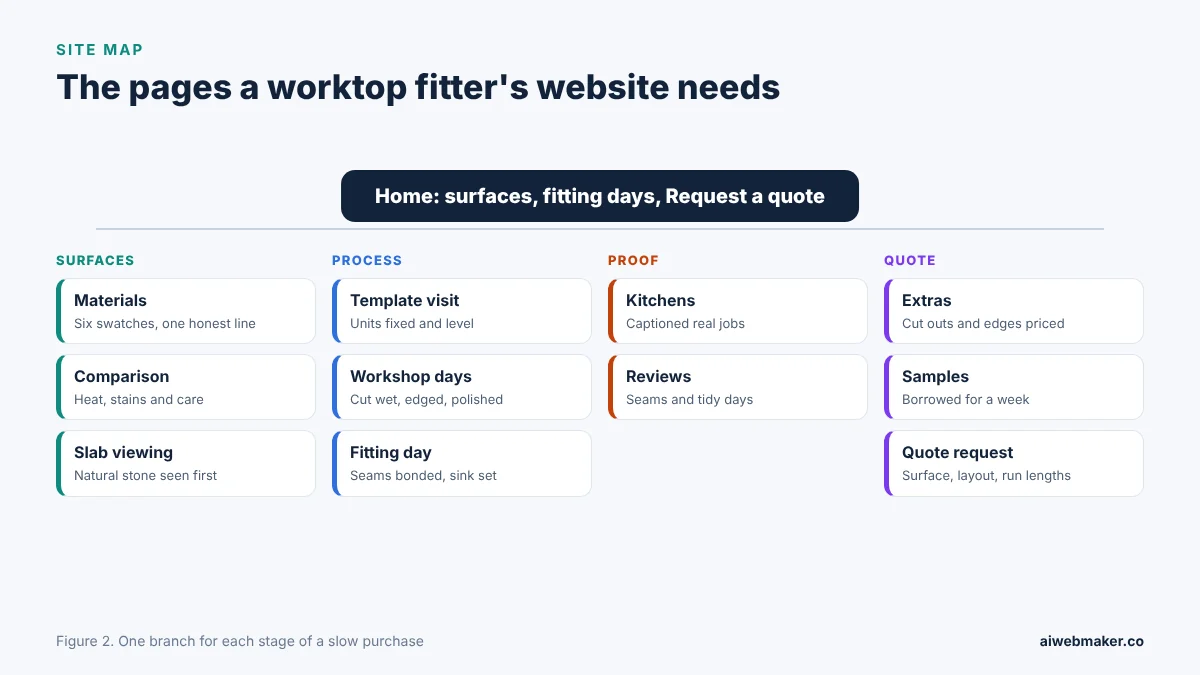
Under the home page, this site map splits into four branches, and each branch serves a single stage of a slow purchase. Surfaces hold the swatches and the comparison, process holds templating, workshop time and fitting day, proof holds kitchens and reviews, and the quote branch holds extras, samples and the request. Our sample firm, Slab and Seam Worktops, keeps all of this on one long page that runs from six swatches to a comparison table, a five step process and a priced list of extras. Those extras are the undermount sink cut out, the hob cut out, drainer grooves, upstands and splashbacks, edge profiles and the removal of old worktops. The worktop website example that prices every cut out and edge profile then closes with sample loans, recent kitchens, questions and a quote request. A fitter can follow that order closely, because it mirrors the way a kitchen actually comes together.
Why can a fitter only quote firmly after the template visit?
A fitter can only quote firmly after templating because a worktop is cut to the kitchen as built, not to the kitchen as drawn. Walls are rarely straight, corners are rarely square and base units can sit a few millimetres away from the plan. The template captures every run, every wall and the exact positions of the sink, the hob and the tap holes, using rigid templates or a digital measuring device. Overhangs, joint positions and the line of any upstand are agreed on site with the homeowner, which prevents arguments on fitting day. If the units move after templating, the tops will not fit, so the page should say plainly that the units must be fixed and level first.The sample allows seven to ten working days in the workshop between the template and fitting day, and saying so turns the wait for a firm price into a step buyers understand.
| Stage | What happens | What the buyer should prepare |
|---|---|---|
| Rough quote | Estimate from run lengths and the chosen surface | Rough sizes, the layout, the sink and hob type |
| Template visit | Every run measured and joints agreed | Units fixed and level, sink and hob on site |
| Workshop | Slab cut, edged, polished and drilled | Final choice of edge and upstands |
| Fitting day | Tops lifted in, seams bonded, sink set | Clear access, old tops removed or booked for removal |
| Aftercare | Care notes and any sealing | Trivets, cleaning products that suit the surface |
How should cut outs, edges and upstands be priced?
Cut outs, edges and upstands should be priced as separate lines, because the metre rate rarely covers the hours they add in the workshop. An undermount sink needs a polished opening and a support method that an inset sink does not, so it costs more to make. Hob cut outs are cut to the maker's template, ideally with rounded inside corners that resist cracking around the heat. Edge profiles range from a slightly eased square to bevels, half rounds and thicker mitred fronts, and each one changes the finishing time. Listing these extras with starting prices lets buyers trim the specification before the quote, instead of disputing the invoice afterwards.
| Extra | What it involves | Why the price varies |
|---|---|---|
| Undermount sink cut out | Opening cut and polished, sink fixed beneath | Sink size, bowl count, support method |
| Hob cut out | Opening cut to the maker's template | Hob size, corner radius, surface hardness |
| Drainer grooves | Shallow grooves with a fall to the sink | Number of grooves and their length |
| Upstands and splashbacks | Strips or panels cut from the same slab | Height, length and number of sockets to cut |
| Edge profiles | Shaping and polishing the front edge | Profile style and total edge length |
| Old worktops removed | Lifting and taking away the old tops | Material, weight and disposal rules |
Joints, slabs and overhangs: what buyers want explained
Joints worry buyers more than almost anything else, so a fitter's page should explain them before the template visit raises the subject. Slabs come in fixed sizes, which means long runs, L shapes and wide islands often need at least one joint. A skilled fitter places that joint where it is least visible and least stressed, away from the sink and the hob, and bonds it with resin tinted to the surface. Veined marble and some quartz patterns can be matched across the joint, while busy granite tends to hide it well. Deep overhangs on islands and breakfast bars may need brackets or a hidden frame, and the safe distance depends on the material and its thickness. Honest notes on joints and supports turn a common fear into a detail buyers trust the fitter to handle.
How should a fitter talk about silica dust and engineered stone?
A fitter should talk about silica dust openly, because cutting stone and engineered quartz releases a fine dust that can seriously harm the lungs of the people doing the work. Responsible firms cut wet in the workshop under dust extraction, and they avoid dry cutting in the customer's kitchen wherever possible. Rules on engineered stone differ widely between countries, and some have restricted or banned engineered stone products, so buyers should check what applies where they live. A fitter's page can describe its own practice, such as wet cutting and extraction, while leaving medical and legal questions to the proper authorities. The AI website builder for worktop fitters who quote from templated runs drafts the surface, process and quote pages once the fitter writes a few lines about its materials, workshop and towns. Clear words on dust, set out on those pages, show that the firm cares about its cutters as well as its customers.
Which search phrases bring quartz and granite buyers to a fitter?
Buyers type phrases such as quartz worktops, granite countertops, oak worktops, kitchen worktop fitting or worktop templating, and many add their town or district. Both spellings matter, because some countries say worktop and others say countertop, so the material pages should use both naturally. On the map listing, the workshop address, Saturday sample hours and photos of finished kitchens catch buyers who want to see slabs in person. Reviews that mention invisible seams, tidy fitting days and accurate templating carry more weight than vague praise. Articles on sealing granite, oiling oak or choosing between an undermount and an inset sink attract buyers months before they need a quote. Steady writing of this kind makes the fitter the name buyers already know when the kitchen order is placed.
The fitter's annual bill, from hosting to care articles
Hosting makes up most of a worktop fitter's annual bill, and the domain adds whatever its chosen ending costs. Fitters with steady work usually prefer one yearly payment, while a new workshop may like the flexibility of a monthly bill. Credits for twelve articles on surfaces and care total about $7.80 over the year. Adding new kitchens, changing a price per metre or listing a new material costs nothing extra. Below, the two billing routes appear in parallel columns, and the $189 tier is listed only as a reference point.
| Item | Yearly | Monthly |
|---|---|---|
| Hosting the worktop pages | $119 | $228 over twelve months |
| Domain | Depends on the ending | Depends on the ending |
| Higher plan, for comparison | $189 a year | Not needed |
| Twelve surface care articles at about $0.65 | About $7.80 | About $7.80 |
| New kitchens, materials and prices | No charge | No charge |
| Year before the domain | About $126.80 | About $235.80 |
What sends a kitchen buyer to another fitter's page?
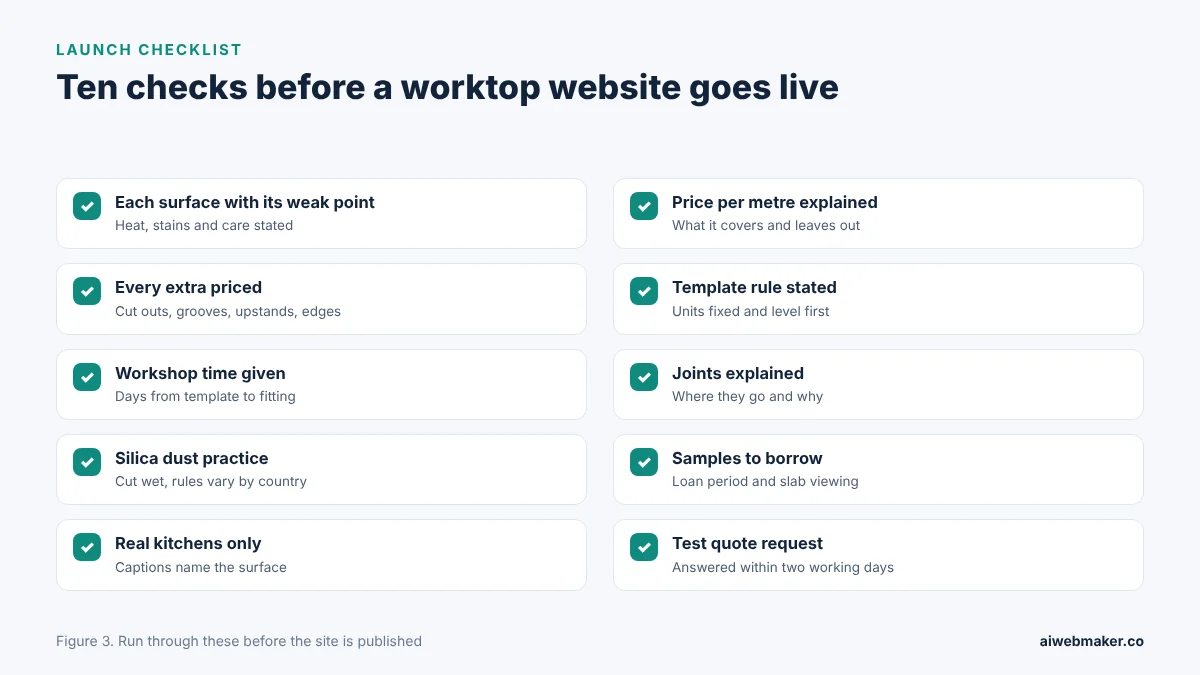
A kitchen buyer leaves fastest when the site shows swatches but says nothing about heat, stains or care. Hidden extras are the next problem, because a metre rate without cut out prices looks like a trap. Silence about joints makes buyers fear a visible seam across the island. No word on when templating happens leaves them unsure whether to call now or after the cabinets arrive. Stock photos of kitchens the firm never touched undo any trust the words have built. Ten checks covering these gaps appear in the figure, and each one takes only minutes to put right.
Frequently asked questions
Can a worktop be templated before the base units are fixed?
Templating before the units are fixed is a false saving, because a top cut to cabinets that later move will not fit. Most fitters ask for the base units to be fixed, level and screwed together, with the sink and hob on site. Some will give a rough quote from the plans, which helps the buyer budget while the kitchen is built. The firm price follows the template visit, when every run is measured as it really stands. Stating this rule on the website saves wasted visits for both sides.
Is a visible joint a sign of poor fitting?
A joint is not a sign of poor fitting, since slabs come in fixed sizes and many kitchens are larger than one slab. Poor fitting shows in a joint placed beside the sink, a lip between the two pieces or a resin colour that does not match. A good fitter agrees the joint position at the template visit and explains why it sits where it does. Patterned surfaces can sometimes be matched across the line so that it almost disappears. Buyers who understand this judge a fitter on the quality of the joint rather than its existence.
Is a price per metre run useful to buyers, or misleading?
A price per metre run is useful when the page explains what it includes and what it leaves out. Most metre rates cover a standard depth, a standard edge and fitting, while cut outs, upstands and special edges are added on top. Natural stone prices also follow the slab chosen, so a starting figure is more honest than a fixed one. A short worked example, such as a straight run with one sink and one hob, helps buyers estimate their own kitchen. Clear terms make the metre rate a starting point instead of a promise.
How should oak and walnut worktops be cared for?
Oak and walnut tops need oiling soon after fitting and then every few months, more often near the sink. Standing water and hot pans leave marks, so trivets and a quick wipe after washing up are good habits. Light scratches can usually be sanded and oiled away, which is one reason timber appeals to people who like a surface that ages. The fitter's care notes should name the type of oil and how often to apply it. A page that explains this keeps timber buyers happy for years after the fitting day.
Why one straight oak run already settles the hosting bill
A single straight run of oak, fitted with one sink cut out, usually earns a fitter more than the yearly hosting and the domain together. On the monthly route, the price of one cut out alone tends to clear several months of the $19 bill. Every stone kitchen won after a buyer studies the comparison table adds the kind of job that keeps the workshop saw busy for days. Honest notes on heat, joints and dust, together with priced extras, persuade buyers in a way a glossy brochure cannot. A diary of template visits booked by people who already chose their surface online is the plainest proof the site is earning its keep.
Build your website in Minutes and get the AI Tools that work
Start Building Your Website →