Tree Service Website Cost, Arborist Credentials and Storm Work
A tree service puts $119 towards a year of website hosting, or $19 on a monthly bill, and buys a domain as well. Topics: who hires an arborist, service pages, pruning terms, removals and stumps, storm work, permissions and wildlife, credentials, search and the yearly cost.
- No coding required
- Live in minutes
- Blog, SEO and chatbot tools included
For a tree service, a full year of AI Web Maker hosting is $119, or $19 on a monthly bill for crews that prefer it, with the domain bought as well. Climbers can write their pages, add photos of finished crowns and look over each screen in the preview before AI Web Maker asks for a cent. A single large removal usually pays for many years of that hosting. Pruning and felling pages can already be seen on the tree service business website design, an invented arborist firm's AI Web Maker sample, so the trade's tricky terms are easy to judge in context. The real challenge is that tree work is dangerous, expensive to get wrong and almost impossible for a homeowner to judge, since few people can tell a careful crown reduction from damaging topping until the tree starts to decline. A tree service website has to prove skill, insurance and safe working while explaining the work in words a homeowner understands. Ahead are who hires an arborist, the service pages, pruning terms, removals and stumps, storm work, permissions and wildlife, credentials and the quote visit, search and the yearly bill.
This article is part of our complete guide: Home Services Website Builder.
Who calls a tree surgeon, and what do they check first?
Tree work customers range from anxious homeowners to property managers with long lists of trees, and they all check for proof before anything else. Homeowners usually call because a tree has grown too large, blocks light, overhangs a roof or looks unsafe after a storm. Property managers, schools and councils need surveys, scheduled pruning and written risk assessments. People buying or selling a house sometimes need a tree checked for a report or a mortgage lender. Neighbours in a dispute over overhanging branches want calm, accurate advice about what can legally be cut. Before any of them call, they look for qualifications, insurance and photos of real work done safely.
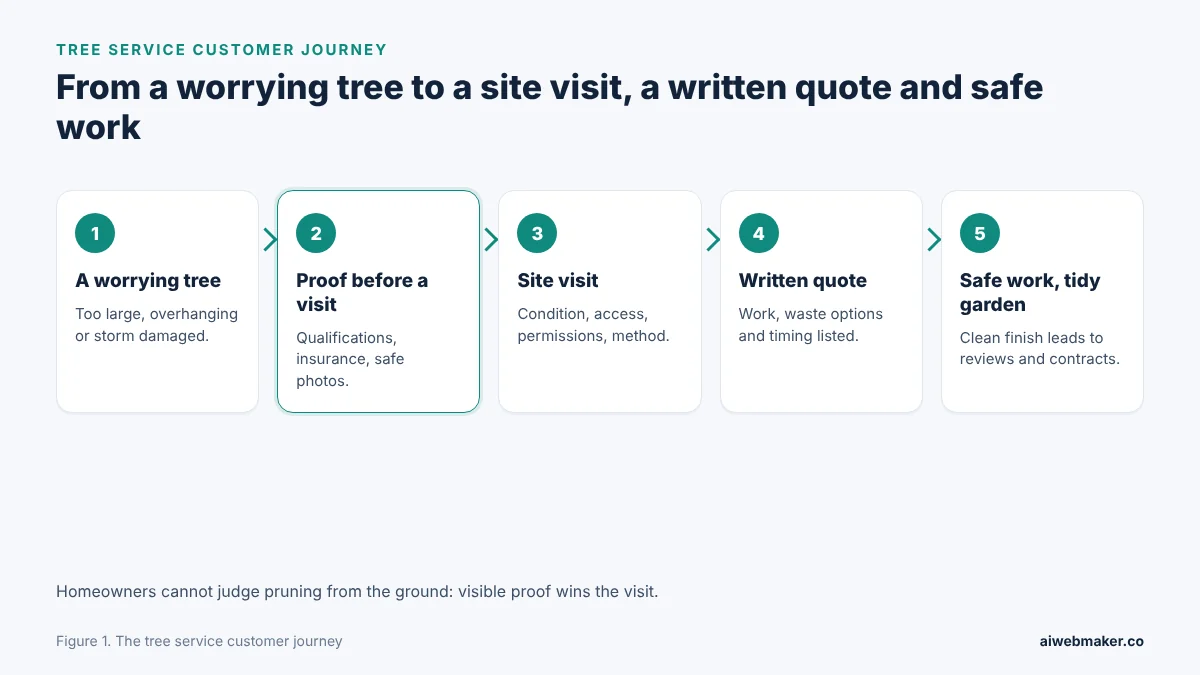
The second stage of this path carries the most weight, because a homeowner will not let a crew near a tree beside the house without evidence of skill and cover. A worrying tree, a storm or a planning need starts the search. Qualifications, insurance and photos of careful work decide which crews are asked to visit. The site visit then looks at the tree's condition, access, permissions and the safest method. The work itself, and how cleanly the garden is left, decides whether reviews and referrals follow. Each page of a tree service website should move a customer one stage further along this path.
Pruning, felling, stumps and storms: the service pages
Tree work covers very different jobs, so each main service needs its own page or clear section with honest detail about method and timing. Pruning and crown work form the steady core of most arborists' diaries. Removals and sectional dismantling bring larger jobs where safety and access dominate. Stump grinding, hedge work and storm call outs each attract their own searches. Tree surveys and health checks serve property managers, buyers and anyone worried about a particular tree. The table below shows what each page should cover.
| Service | When it is needed | What the page should explain |
|---|---|---|
| Crown reduction and thinning | Trees too large or too dense | How much is removed and why, recovery |
| Crown lifting | Low branches over paths or drives | Clearance height, effect on the tree |
| Deadwood removal | Dead or weak limbs overhead | Safety benefit, how often it is needed |
| Felling and sectional dismantling | Dead, dangerous or unwanted trees | Rigging, access, protection of property |
| Stump grinding | After removal | Depth, chippings, replanting nearby |
| Storm and emergency work | Fallen or hanging limbs | How to reach the crew, what to do meanwhile |
| Tree surveys | Buyers, managers, worried owners | What is checked and the report provided |
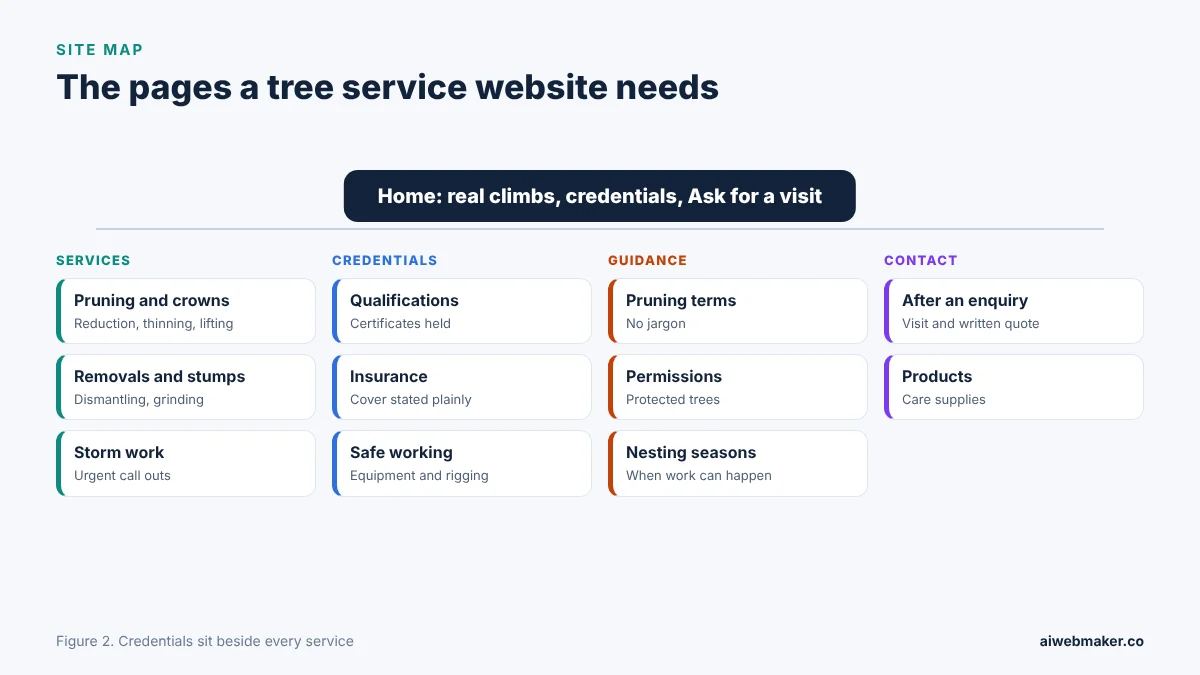
Pulled together into one structure, a tree service site rests on four groups: services, credentials, guidance and contact. Service pages carry pruning, removals, stumps and storm work, each with photos. Credential pages show qualifications, insurance and safe working practice. Guidance pages explain pruning terms, permissions and nesting seasons. Our sample business, Tall Oak Tree Care, runs on three pages, with its about page giving qualifications and insurance a heading of their own next to the story of how it started. The services page describes the tree work it carries out and the properties and jobs it takes on, adds a part on tree care products and supplies backed by a handful of items for sale, and the contact page explains what happens after an enquiry beside the ways to reach the crew; the tree service website example with qualifications and insurance up front took 57 seconds to build.
Pruning terms explained without jargon
Pruning terms confuse most homeowners, and a plain explanation on the website stops customers asking for the wrong work. Crown reduction shortens branches back to suitable growth points, reducing height and spread while keeping the tree's natural shape. Crown thinning removes selected inner branches to let light and wind through. Crown lifting removes lower limbs to clear paths, drives or windows. Topping, which cuts the main stems back to stubs, is widely discouraged by arborists because it weakens trees and causes dense, poorly attached regrowth. Many arborists follow published standards, such as BS 3998 in the United Kingdom or ANSI A300 in the United States, and naming the standard used shows customers the work is done properly.
| Term | What it means | Why owners ask for it |
|---|---|---|
| Crown reduction | Branches shortened to growth points | Less height and spread, natural shape kept |
| Crown thinning | Selected inner branches removed | More light, less wind resistance |
| Crown lifting | Lower limbs removed | Clearance over paths, drives, windows |
| Deadwooding | Dead and dying wood taken out | Safety over gardens and roofs |
| Pollarding | Regular cutting back to set points | Traditional management of certain species |
| Topping | Stems cut back to stubs | Widely discouraged as harmful |
Removal, sectional dismantling and stump grinding
Removing a tree near a house is rarely a matter of felling it in one piece, and the website should explain how the crew works safely in tight spaces. Sectional dismantling takes the tree down piece by piece, with branches and sections lowered by ropes and rigging so nothing falls onto roofs, fences or lawns. Larger jobs may need a crane or an aerial platform, and road closures or permits can be required where a tree overhangs a street. Customers also need to know what happens to the timber, chippings and stump afterwards. Stump grinding removes the stump below ground level, though major roots usually remain and slowly decay. A clear list of options after felling helps customers choose and compare quotes properly.
| Option after removal | What it involves |
|---|---|
| Timber taken away | Logs and branches removed and recycled |
| Logs left on site | Cut to length for firewood or wildlife piles |
| Chippings left | Spread as mulch on beds or paths |
| Stump left standing | Cut low, sometimes left for habitat |
| Stump ground out | Ground below the surface, chippings backfilled |
Storm damage and emergency call outs
Storm damage brings the most urgent calls a tree service receives, and the website should help frightened customers stay safe while help is on the way. The first message should be to keep people and pets well away from fallen or hanging limbs, which can shift without warning. Anything touching or near power lines must be treated as live, and the electricity network operator or emergency services should be called before anyone approaches. Customers should photograph damage for their insurer before work starts, as long as they can do it from a safe distance. A clear phone number and a realistic response time matter more on this page than anywhere else. Calm, safety first guidance turns a frightening night into trust in the crew that arrives.
Permissions, protected trees and nesting birds
Many trees cannot simply be cut down or pruned without checking the rules, and those rules vary widely between countries and local authorities. In the United Kingdom, for example, trees covered by a preservation order or standing in a conservation area need consent or notice before most work. Some cities elsewhere require permits before removing trees above a certain size. In many countries it is an offence to disturb active bird nests, which affects when hedges and trees can be cut. Trees on boundaries raise questions between neighbours, and trees near power lines are often managed by the network operator. A page setting out these checks shows customers the crew will keep them on the right side of the law.
| Check before work | Why it matters | Who to ask |
|---|---|---|
| Protected tree status | Unapproved work can bring penalties | The local planning or tree office |
| Local removal permits | Some cities control removals | The city or municipal authority |
| Nesting birds and wildlife | Active nests are often protected | Local wildlife guidance, the arborist |
| Boundary ownership | Neighbours have rights too | Both owners, deeds or surveys |
| Nearby power lines | Serious electrical danger | The electricity network operator |
Credentials, insurance and the quote visit
Credentials and insurance belong on every tree service website, because the work is high risk and one mistake can damage a house or injure someone. Certification schemes differ between countries, from the International Society of Arboriculture credential to national chainsaw and climbing certificates, so the crew should list what it holds and what each covers. Liability insurance, and employer cover where the law requires it, should be stated plainly, with proof available on request. The quote visit should be explained too, including who comes, what is checked and when a written quote follows. The AI website builder that tree surgeons use for their services and credentials pages drafts the services, about and contact pages after the crew explains its work in a short paragraph. Visible proof and a clear visit process are what move a cautious homeowner from searching to booking.
What people type when a tree leans the wrong way
People looking for tree work type phrases such as tree surgeon near me, tree removal, stump grinding, crown reduction or emergency tree service, often with their town. A service page headed with each of those phrases gives search engines a clear match and gives the visitor the answer they came for. Real photos of climbers at work and correct hours on the map listing, with the site linked, catch the urgent searches after a storm. Reviews mentioning careful rigging, a tidy garden and a fair quote reassure the next customer more than any badge. Articles on when to prune fruit trees, how to spot a dangerous tree after a storm or what a preservation order means attract homeowners long before they book. A tree service that explains its craft online becomes the obvious call when a big job arrives.
A tree surgeon's website budget in round numbers
A tree service site carries two recurring costs, hosting and the domain, plus about $0.65 for any seasonal article an arborist drafts with AI credits. A busy crew keeps the bill smallest with yearly billing. A climber setting up alone may prefer to pay month by month through the first winter. Adding services, new photos or a fresh insurance certificate never raises the hosting price. Below, the tree surgeon's two billing options sit in one table, with the $189 tier added as a yardstick.
| Item | Yearly | Monthly |
|---|---|---|
| Hosting the tree service pages | $119 | $228 over twelve months |
| Domain | Depends on the ending | Depends on the ending |
| Higher plan, for comparison | $189 a year | Not needed |
| Twelve tree care articles at about $0.65 | About $7.80 | About $7.80 |
| New services, photos and certificates | No charge | No charge |
| Year before the domain | About $126.80 | About $235.80 |
Missing details that send homeowners to another crew
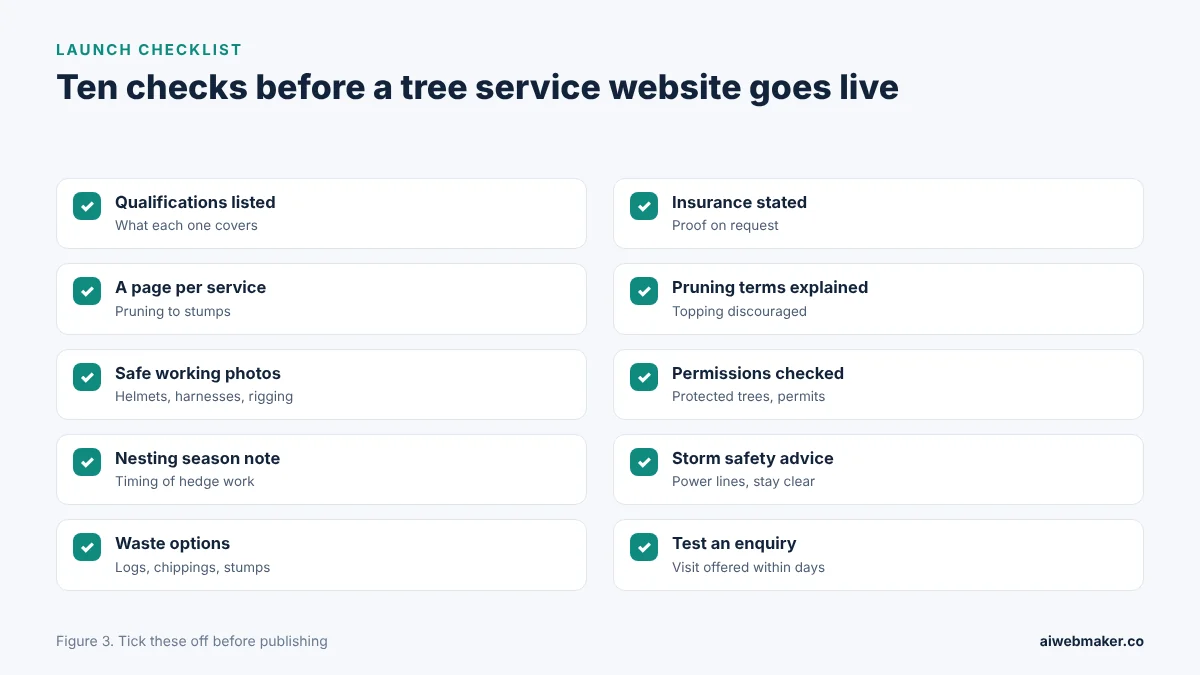
Homeowners move on to another crew when a tree service website shows no qualifications or insurance. Photos of risky shortcuts, such as climbers without helmets or chainsaw trousers, alarm anyone who knows what safe tree work looks like. Using the word topping as if it were normal pruning tells informed customers the crew may harm their tree. No mention of permissions or nesting seasons leaves careful owners worried about breaking the rules. A storm page without safety advice or a phone number fails people at their most anxious moment. Ten checks for a tree service site, pictured below, close these gaps before launch day.
Frequently asked questions
Does a tree need permission before it is cut back?
Some trees need permission before they are pruned or removed, depending on where they stand and the rules of the local authority. Protected trees, trees in conservation areas and large trees in some cities are common examples. Nesting birds can also restrict timing, even where no permit is needed. A reputable arborist checks these points before quoting and can often handle the application. The website should say that the crew checks permissions, without promising any particular outcome.
Can the logs and chippings be left on site?
Logs and chippings can usually be left on site if the customer wants them, and the website should list this as an option. Logs cut to length make useful firewood once seasoned, and wildlife piles support insects and fungi. Chippings make good mulch for beds and paths. Leaving material on site can sometimes reduce the price, since disposal takes time and money. Clear options help customers decide before the quote is written.
Is it safe to remove a tree close to a house?
Removing a tree close to a house can be done safely by a trained crew using sectional dismantling, ropes and rigging. The tree is taken down in controlled pieces, lowered rather than dropped near roofs, fences and windows. Larger or more awkward trees may need a crane or an aerial platform. Homeowners should never attempt this work themselves, especially near power lines or buildings. A website that explains the method calms understandable worries.
When is the best time of year to prune a tree?
The best time to prune depends on the species, its health and local wildlife rules, so the arborist should advise for each tree. Many deciduous trees are pruned in late autumn or winter, when they are dormant and their shape is easy to see. Some species, such as cherries and plums, are often pruned in summer to reduce the risk of disease. Nesting seasons can limit work on hedges and trees in spring and early summer in many countries. Honest timing advice protects the tree and the customer.
One removal can carry the hosting for years
One medium removal generally earns a tree service more than the $119 it costs to keep the site online for a year. A single stump grinding job covers several months of the $19 plan. Every pruning contract from a school, landlord or council that finds the credentials page adds steady work through the quieter months. Honest pruning terms, visible insurance and calm storm advice give homeowners reasons to trust a crew they have never met. Crews that photograph each job safely keep that proof fresh season after season. A diary full of planned crown work between the storm call outs is the sign of a tree service website doing its job.
Build your website in Minutes and get the AI Tools that work
Start Building Your Website →