Snow Removal Website Cost, Season Contracts and Honest Arrival Times
Through summer and winter, a snow crew's pages stay up on a $119 yearly plan, or a monthly $19, with a domain added at its ending's rate. Covered: clients, pages, contracts, snow nights, salt and grit, logs and rules, price requests, search and the yearly sums.
- No coding required
- Live in minutes
- Blog, SEO and chatbot tools included
Through summer and winter, a snow removal crew's pages stay up on AI Web Maker for a yearly $119 or a monthly $19, with a domain added at its ending's rate. Drafting the season plans, the call out list and the salt guide, then checking them in the preview, costs the crew nothing on any AI Web Maker bill. One driveway contract for a single winter normally pays for the year of hosting. Demand is the awkward part, because it arrives all at once on the first heavy night of snow, and customers then judge a crew on whether it keeps its word. A site that sets out contract terms, honest arrival times and how each surface is treated wins the households and site managers who plan ahead. What follows covers the clients, the pages, contracts and pricing, snow nights, salt and grit, logs and rules, requests, search and a yearly budget.
This article is part of our complete guide: Home Services Website Builder.
Early commuters, shopkeepers and site managers: who signs up for snow clearing
Snow removal customers fall into clear groups, and each one needs a different promise. Households who leave early for work, older residents who should not be shovelling and families with a steep drive want the drive clear before they need the car. Shop and office owners need a safe entrance and path before staff and customers arrive. Property and facilities managers want car parks cleared, salted and recorded, because a slip on their site can become a claim. Some customers only call once a storm has already hit and need a one off clear. All of them want to know when the crew will come, what it will do and how the price is worked out.
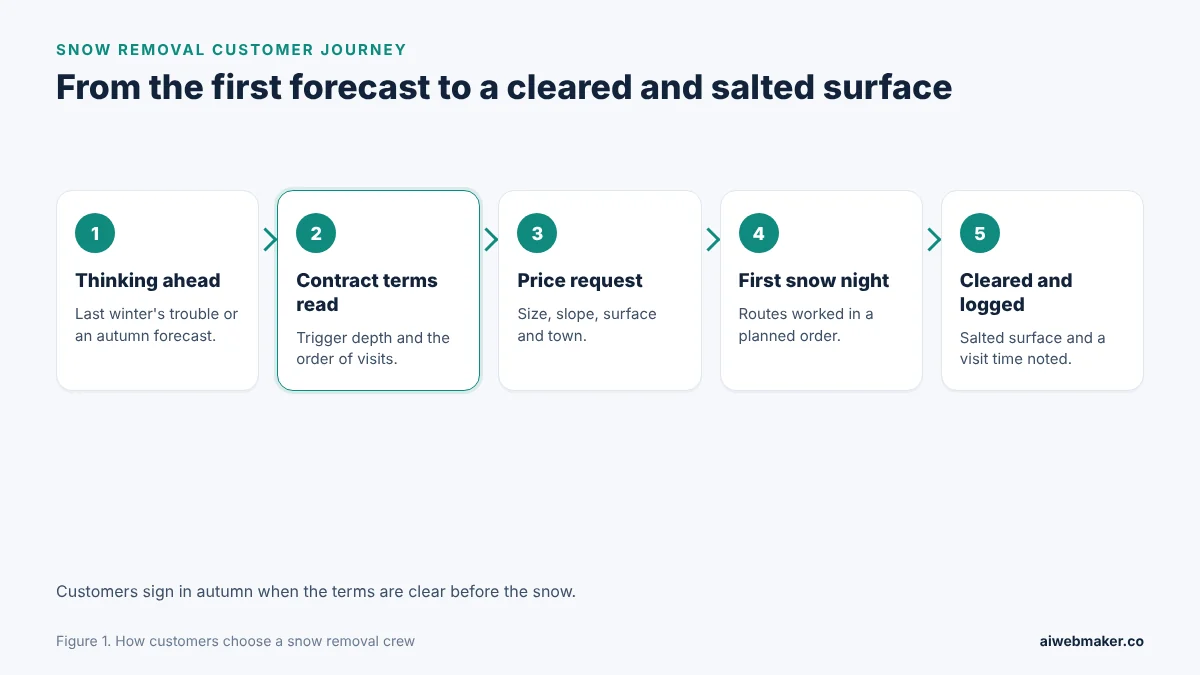
The path to a signed contract usually starts in autumn, long before the first flake. A customer first thinks ahead after last winter's trouble or a forecast warning. The highlighted stage is reading the contract terms, especially the trigger depth and the order of visits, because those decide whether the drive is clear before work. A price request based on size, slope and surface follows, then the first snow night. The final stage, a cleared and salted surface with a note of the visit time, is what keeps the customer for the next season.
Season plans, call outs and the other pages a snow removal site needs
A snow removal site works best when contracts and one off jobs are separated clearly, because their terms differ. Season contract pages cover home driveways, shop and office fronts and car parks. A call out page lists one off clears and extras such as salting runs, hauling snow away, hand clearing of steps and porch edges. A page on what happens on a snow night and a salt and grit guide answer the questions customers ask every winter. A request route for season prices and call outs completes the site.
| Page or section | What the customer asks | What it should explain |
|---|---|---|
| Home driveway contract | Will the drive be clear before work? | Trigger depth, visit order, price basis |
| Shop or office front | Safe before opening time? | Early visits, salting, path widths |
| Car park contract | Cleared and recorded? | Ploughing, piles, logs, salting |
| One off call outs | Can someone come now? | Order taken, timing, price |
| Extras | Steps, porches, hauling? | Hand work, low roof edges, removal |
| A snow night | What actually happens? | Routes, storms, delays |
| Salt and grit | Will it harm my surface? | Products, surfaces, plants and pets |
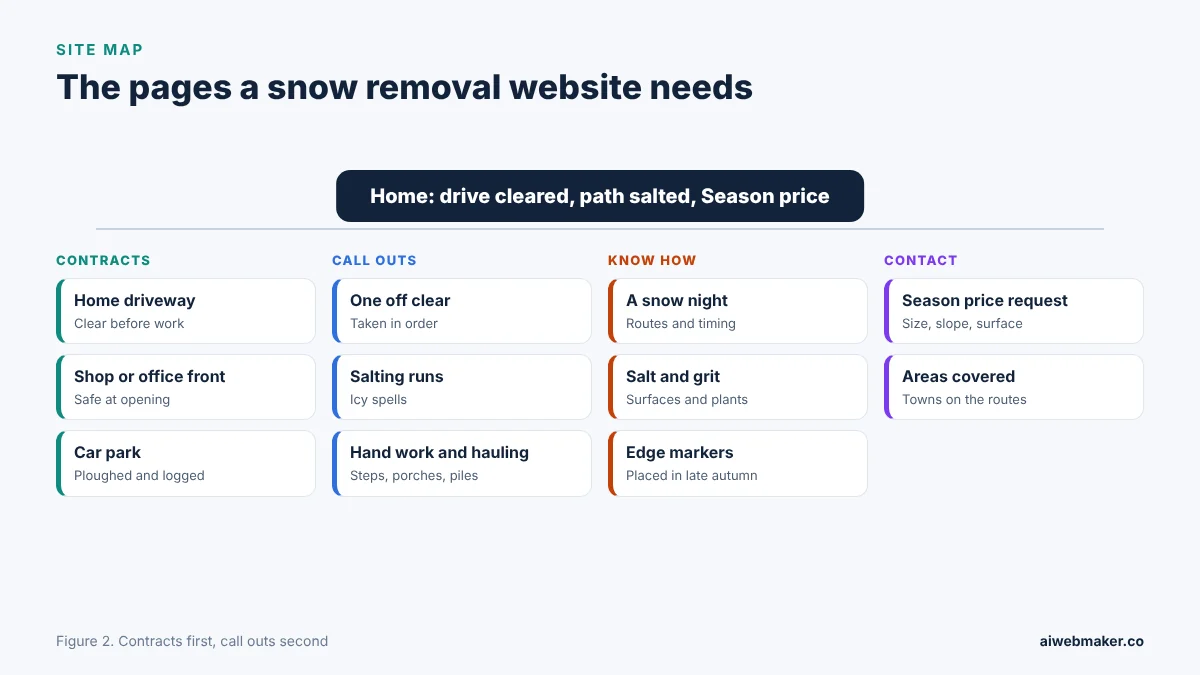
The diagram splits the site into contracts, call outs, winter know how and contact. Contract pages hold home driveways, shop and office fronts and car parks. Call out pages carry one off clears, salting runs and hauling, with hand work for steps and porches. The sample service for this trade, Clearpath Snow Services, offers season contracts for a home driveway, a shop or office front and a car park. One off call outs and extras follow, covering a one off driveway clear, salting and gritting runs, snow hauled away, steps and narrow paths by hand, porches and low roof edges, and edge markers set out. The snow removal website example with season contracts and a salt guide also explains what happens on a snow night and ends with a request for a season price or a call out.
Season contracts, per visit pricing and the trigger depth
Contract terms are the heart of a snow removal business, and customers rarely understand them until they are written out plainly. A season contract charges a fixed fee for the winter, often paid in instalments, and covers every qualifying snowfall. Per visit pricing charges each time the crew attends, which suits customers who expect light winters. The trigger depth, the amount of snow that sets off a visit, should be stated in the contract and on the page. Prices depend on the size of the area, its slope, the surface and how far it sits from an existing route. Clear terms prevent the classic argument about why the crew did or did not come.
| Pricing model | How it works | Often suits |
|---|---|---|
| Season contract | One fee for the winter, in instalments | Households and businesses wanting certainty |
| Per visit | A charge each time the crew attends | Light snow areas, occasional users |
| Per salting run | A charge per treatment | Paths and car parks in icy spells |
| One off call out | Priced when booked | Customers without a contract |
| Hauling away | By the load or the hour | Sites where piles have nowhere to go |
What happens on a snow night, and arrival times that can be trusted
Customers cope with waiting far better when they know how a snow night works. Crews usually start once the trigger depth is reached and work through routes in a planned order, with early opening businesses and steep drives often first. Heavy storms may need repeat visits, and the crew may clear an access path first and return to finish later. Call outs from non contract customers are generally taken in order once contract routes are done. Arrival times should be given as honest windows rather than promises, because traffic, drifting and breakdowns all affect them. A site that explains this openly turns frustration into patience on the worst nights of the year.
Rock salt, grit and gentler melts for different surfaces
Customers worry about what goes on their drive, their plants and their pets' paws, so a short guide to treatments earns trust quickly. Rock salt melts ice well in moderate cold but becomes less effective as temperatures drop much further. Grit, or sand, adds grip without melting and suits very cold spells or surfaces where salt is unwelcome. A salt and grit mix balances melting with traction on busy paths. Gentler ice melts cost more but are kinder to new concrete, natural stone and planted borders. A crew that keeps salt off lawns and tells customers when a surface needs a gentler product shows care that customers notice.
| What is spread | Works best | Worth knowing |
|---|---|---|
| Rock salt | Moderate cold, roads and drives | Harms plants and some surfaces |
| Grit or sand | Very cold spells, grip on ice | Does not melt, needs sweeping later |
| Salt and grit mix | Busy paths and car parks | Melts and grips together |
| Gentler ice melt | New concrete, stone, near plants | Higher cost, used sparingly |
Service logs, liability and local rules on clearing paths
Commercial customers often care as much about records as about the clearing itself, because a fall on an icy path can lead to a claim. A service log noting the date, time, conditions, work done and treatment used, ideally with photos, protects both the crew and the client. Rules on who must clear public footpaths in front of a property vary widely, and some cities set deadlines after snowfall, so customers ought to look up the local rule for their street. Insurance cover for the crew's own work should be mentioned plainly. Work on porches and low roof edges needs care and the right equipment, and higher roofs are best left to specialists. Clear words on records and rules reassure the site managers who sign the larger contracts.
Season price requests and a builder that drafts a winter crew's pages
A season price request should gather the area's size, surface, slope and town, along with any notes the crew should know, such as narrow gates or parked cars. The page can explain that prices are confirmed in writing and that edge markers are set out before the ground freezes. Payment terms, such as instalments for a season, are best agreed directly with the office and stated plainly. The AI website builder that drafts snow removal pages with season plans writes the contract cards, call out list and salt guide once the crew outlines its routes and services, and adjusting the draft in the preview carries no charge. Publishing the season price page in autumn gives customers time to sign before the first storm. A clear request route fills the routes before the snow arrives.
Phrases people type when the first snow is forecast
People search for snow removal near me, snow plowing, driveway snow clearing, salting and gritting, commercial snow removal or gritting service, nearly always with a town. Spelling and vocabulary vary, with plowing common in North America and ploughing or gritting common in the United Kingdom, so pages can use the words local customers use. Searches surge on the first night of snow, which is why a site that has been live and indexed since autumn is far better placed than one built in a hurry. A map listing with the area covered, winter hours and photos of cleared car parks attracts urgent calls. Reviews mentioning reliable early visits and careful salting persuade other households. Autumn articles on season contracts and edge markers catch the customers who plan ahead.
A winter crew's website budget for the whole year
Only two charges come back every year for a snow crew's site, hosting and the domain name, and a dozen winter advice articles cost about $7.80 in AI credits. Crews with established routes pay least on the $119 yearly bill, which keeps the site visible through summer. A new operator can begin at $19 a month. Changing season prices, adding a service or updating photos costs nothing further. Both billing routes share the next table, and the $189 line appears purely as a yardstick.
| Item | Yearly | Monthly |
|---|---|---|
| Hosting the snow removal pages | $119 | $228 over twelve months |
| Domain | Depends on the ending | Depends on the ending |
| Higher plan, for comparison | $189 a year | Not needed |
| Twelve winter clearing articles at about $0.65 | About $7.80 | About $7.80 |
| Season price, service and photo updates | No charge | No charge |
| Year before the domain | About $126.80 | About $235.80 |
Gaps that leave a customer stuck behind a snowed in gate
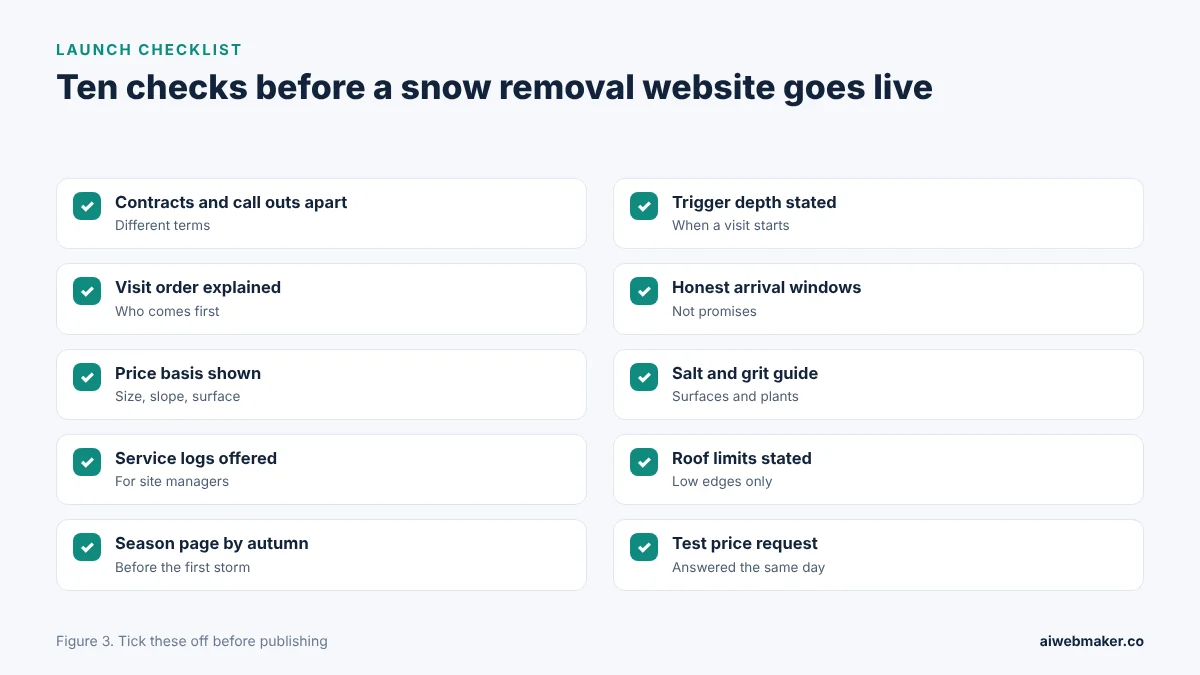
Customers move to another crew when a snow removal website gives no trigger depth, because they cannot tell when anyone will come. Vague promises of first thing visits for everyone sound impossible and usually are. No word on salt and surfaces worries owners of new drives and stone paths. Missing service logs lose the site managers who need records for insurance. A site that only appears in winter, with no season price route in autumn, misses the customers who plan ahead. Ten checks, drawn below, close every one of them before the season starts.
Frequently asked questions
What snowfall depth starts a contract visit?
The trigger depth is set in each contract, and it varies by crew, customer and region. Lower trigger depths mean more visits and usually a higher price, while higher ones suit customers who can cope with a light covering. Salting may be triggered separately by ice or forecasts rather than depth. The website should state the standard trigger and how customers can choose a different one. A clear trigger prevents most disputes over missed visits.
Can a plough blade damage block paving or gravel?
A plough blade can scrape or lift block paving and push gravel onto lawns if it is not set up carefully. Crews often use rubber edges, raised blade settings or hand tools on delicate surfaces. Edge markers set out before the ground freezes help operators avoid kerbs, borders and lawns. The website should explain how different surfaces are handled and what customers should mention when they request a price. Care with surfaces is one of the main reasons customers renew.
Is clearing snow from roofs part of the job?
Most snow removal crews clear only porches and low roof edges that can be reached safely from the ground or a short ladder. Higher or steeper roofs carry serious fall risks and are best left to specialists with the right equipment and training. Heavy snow loads and ice building up at the eaves can damage roofs, so owners who notice them should seek advice. The website should state exactly which roof work the crew does and which it does not. Clear limits protect both workers and customers.
What happens to the season fee in a winter with little snow?
A season contract usually stays the same however much snow falls, which gives both sides certainty. In a light winter the customer pays for readiness and fewer visits, while in a heavy one the crew carries the extra work. Some contracts include a cap on visits or a different rate beyond a certain number, and the terms should say so. Per visit pricing suits customers who would rather pay only when it snows. Explaining the trade off honestly helps each customer choose the right option.
Driveway contracts needed to carry the hosting year
A single driveway contract for one winter generally earns more than $119, the cost of hosting a snow removal crew's site all year. On the monthly route, $19 is a small part of one call out fee. Every shop front, car park and household that signs in autumn after reading the season terms adds routes the site helped fill. Honest arrival windows, clear trigger depths and careful salting earn more trust than dramatic photos of ploughs at night. Crews that keep the site live in summer and update prices before autumn meet customers while they are still planning. A full contract list before the first forecast shows the pages are doing their winter work early.
Build your website in Minutes and get the AI Tools that work
Start Building Your Website →