Skip Hire Website Cost, From Size Cards to Permits and Collection Day
A skip or dumpster hire site is hosted for $119 yearly or $19 in any month, with the domain bought separately by its ending. Inside: how hirers pick a size, pages, day rates, banned waste, permits, access, recycling, search and costs.
- No coding required
- Live in minutes
- Blog, SEO and chatbot tools included
Hosting for a skip yard's website is billed by AI Web Maker as one $119 payment per year, or $19 in any month a yard prefers, and its domain is extra. Arranging the size cards, the banned list and the request page costs nothing while it happens in the preview, so the yard pays only once the site goes public. A single builder's skip, delivered and collected once, usually brings in more than that whole year of hosting. The real difficulty lies elsewhere, because most hirers do not know what a yard of waste looks like, how heavy soil is, which items are refused or whether the street needs a permit. Those gaps cause the phone calls, the wrong sizes, the overweight charges and the disputes that eat into a yard's margin. Each section that follows tackles one of them, from sizing and day rates to banned waste, permits, recycling, search and the bill itself.
This article is part of our complete guide: Home Services Website Builder.
Who books a skip, and what do they weigh up first?
Skip hirers come in recognisable types, and each type arrives with a slightly different worry. Homeowners clearing a garden, a loft or a kitchen want to know the size, the price for the days and whether the skip fits on the drive. Renovation clients and their builders need a skip that can be swapped as it fills, often more than once a week. Landlords and families clearing a whole house care about bulky items, mattresses and furniture that some yards refuse. A website that answers the size, the total price and the rules in that order wins most of these hirers without a call.
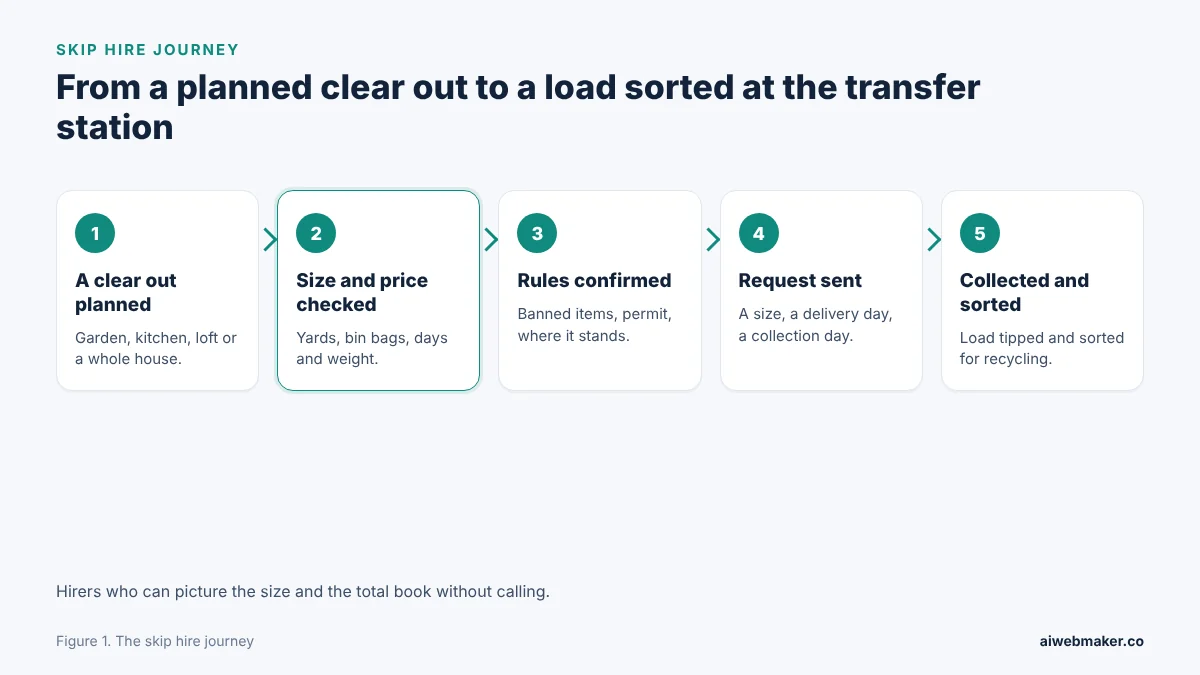
Left to right, the path in this figure runs from a planned clear out to a load tipped and sorted at the transfer station. The marked step is the size and price check, because that is where most hirers decide whether a yard understands their job. Rules come next, and a hirer who discovers late that the skip needs a permit or that a fridge is refused often starts again elsewhere. Collection and sorting finish the hire, and a skip that arrived on boards and left on time is what earns the review. A page that serves each step in turn spares the yard most of the calls it would otherwise take.
Sizes, banned waste, permits: the pages a hire yard needs
A hire yard needs a small set of pages, each built around a question that otherwise arrives by phone before seven in the morning. The size page carries the most traffic, because size and price are the first two things every hirer checks. A size guide by job turns the same information around for people who know their task but not the volume. The banned list and the permit page prevent the two most common disputes on collection day. Together they let a hirer book with confidence and arrive at collection day without surprises.
| Page | Question it settles | What it should include |
|---|---|---|
| Sizes and day rates | How big, and what it costs | Yards and cubic metres, bin bags, first day price, extra days, weight limit |
| Size guide by job | Which skip suits this job | Garden, bathroom, kitchen, soil, house clearance, renovation |
| Banned waste | Can this item go in | A plain list, the reason, where it goes instead |
| Road permits | Can the skip stand on the street | Who applies, the fee, lamps and cones |
| How the hire works | What happens and when | Request, confirmation, filling level, collection |
| Hire request | How to book | Size, kind of waste, two dates, placement, access notes |
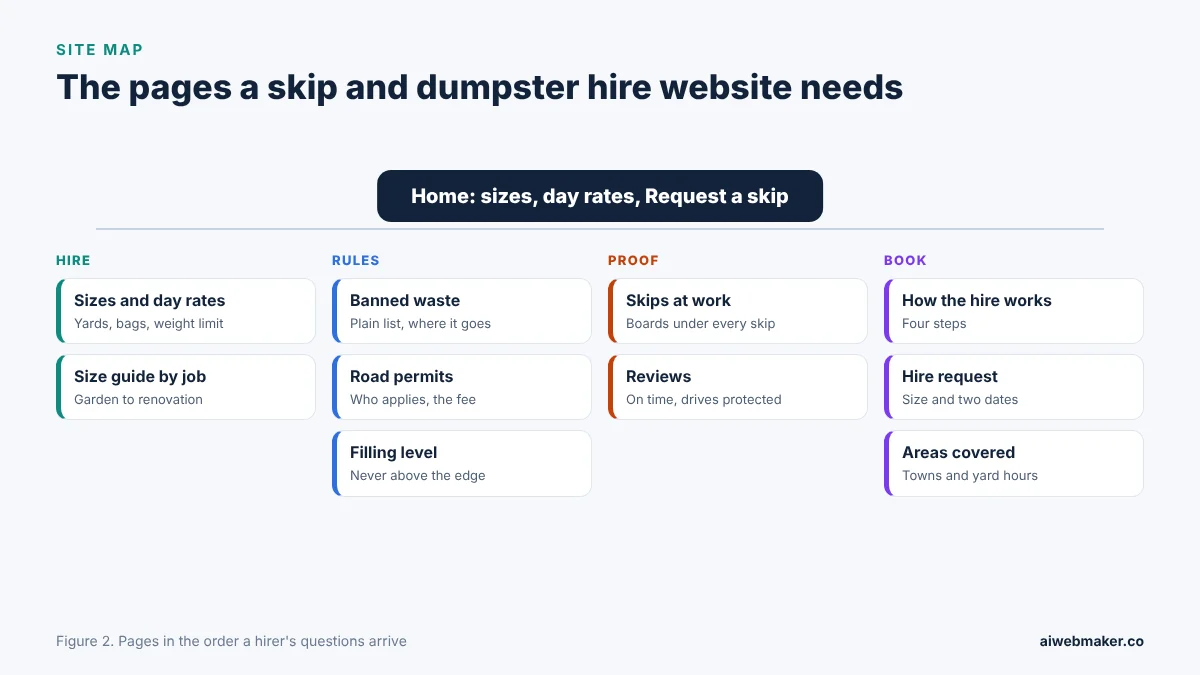
Hanging below the home page, the four groups in this site map follow the order in which a hirer's questions arrive. The hire group holds the size cards and the job guide, the rules group holds banned waste, permits and the filling level, the proof group holds photos and reviews, and the booking group holds the steps, the request and the areas covered. Our sample yard, Bin Day Skip Hire, fits all of it onto one page that offers a mini skip, a midi skip, a builder's skip and a roll off dumpster, each priced by size and by the day. Below the cards sit a table matching jobs to skips, a plain list of what cannot go in, a road permit section and four steps from request to sorting. The skip hire website example with day rates and a road permit section ends with reviews, questions and a hire request that asks for a delivery day and a collection day. The same order works for most yards, because it matches the way a hire actually unfolds.
Yards, cubic metres and bin bags: making sizes easy to picture
Skip sizes only help hirers when they are translated into something a person can picture, such as bin bags, a bathroom or a garden. Many markets measure skips in cubic yards, others in cubic metres, and one cubic yard is roughly three quarters of a cubic metre. In North America roll off dumpsters are usually sold in larger steps, often described by their yardage, while European yards rely on smaller skips for domestic work. Weight matters as much as volume, since a skip full of soil or rubble passes its weight limit long before it looks full. A size table that pairs volume with weight and a typical job prevents most wrong bookings.
| Size | Rough volume | Rough bin bags | Usually suits | Weight caution |
|---|---|---|---|---|
| Mini skip | About 2 yards, 1.5 m³ | 20 to 25 | Garden clear outs, small bathrooms | Soil loaded level only |
| Midi skip | About 4 yards, 3 m³ | 35 to 45 | Kitchen strip outs, soil and rubble | Heavy waste fills the limit fast |
| Builder's skip | About 8 yards, 6 m³ | 60 to 80 | Renovations, house clearances | Heavy waste half way at most |
| Roll off dumpster | About 20 yards, 15 m³ | Bulky, light waste | Large clearances, building sites | No soil or rubble |
Day rates, extra days and overweight charges, priced openly
Skip prices are built from a few parts, and a page that shows each part openly avoids most arguments when the invoice arrives. The base price usually covers delivery, collection, the first day or hire period and disposal of mixed waste up to a stated weight. Extra days are added at a daily rate, which should appear on the same card as the base price. Overweight loads and items that need separate handling are charged on top, ideally with the amount explained before collection rather than after. Permit fees, wait and load visits and exchanges of a full skip for an empty one each deserve a line of their own. Hirers who can work out the total themselves book faster and dispute less.
| Charge | When it applies | How the page should show it |
|---|---|---|
| Base price | Every hire | Delivery, collection, first day and disposal up to the weight limit |
| Extra days | Hire runs past the first period | A daily rate printed on each size card |
| Overweight | Load passes the weight limit | Charged at cost, explained before collection |
| Separate handling | Items that cannot be tipped with mixed waste | Priced on request, never added without warning |
| Road permit | Skip stands on the street | Fee shown on the quote before the hirer agrees |
| Exchange | A full skip swapped for an empty one | Price per swap on the same visit |
What must stay out of the skip, and why rules differ
A banned list protects lorry crews, sorting staff and the ground beneath the transfer station, so it belongs near the prices rather than in the small print. Asbestos, paint and solvents, oil and fuel, batteries, gas bottles and aerosols, fridges and freezers, screens, fluorescent tubes, tyres, chemicals and medical waste are the usual entries. What counts as hazardous, and how it must be handled, varies by country and region, so the page should say the list follows the rules where the yard operates. In some countries the person producing the waste stays responsible for handing it to a properly licensed carrier, which makes visible licence details reassuring. A plain list with a note on where each item can go instead turns refusals into helpful advice.
Road permits, boards and lorry access at the drop point
A skip that cannot stand on private land usually needs a permit from the council or road authority, and hirers rarely know who applies or how long it takes. Rules, fees and waiting times differ by country and by council, so the page should promise to check the address rather than quote one rule for everyone. Access deserves equal care, since a skip lorry needs width, height and a firm surface, and overhead cables, low trees or a narrow gate can stop a delivery. The AI website builder that skip yards use for size, permit and request pages drafts those pages once the yard writes a few lines about its skips, day rates and towns. A hirer then sends a request with the dates, the yard confirms it, moves it or turns it down, and payment is settled directly with the customer while the platform keeps no share.
Where the waste goes after the lorry leaves
Hirers increasingly ask what happens to their waste, and a short honest answer sets a careful yard apart from a cheap one. Most loads go to a transfer station, where metal, wood, rubble, cardboard and green waste are separated and sent on for recycling. Only what cannot be recovered goes on to disposal, and the share varies with the load and the local facilities. Any recycling figure on the website should be one the yard can evidence, not a round number borrowed from elsewhere. A clear account of the sorting gives environmentally minded hirers a reason to choose the yard.
The phrases behind skip and dumpster searches
Hirers type phrases such as skip hire near me, mini skip hire, 8 yard skip, roll off dumpster rental or skip permit, often with a town attached. Both terms matter, since skip is the common word in some countries and dumpster in others, so the size pages should use the local word and mention the other once. On the map listing, the yard address, early opening hours and photos of skips on boards help hirers judge whether the firm is local and careful. Reviews that mention on time delivery, protected driveways and prompt collection count for more than a row of stars. Useful answers published steadily make the yard the first name hirers recall when the clear out begins.
Twelve months of skip pages, costed line by line
Hosting forms the core of a yard's website bill, with the domain as the one other fixed outlay. Established yards usually take the yearly route, while a newly opened depot may like a smaller monthly payment as it builds a customer list. Twelve guides on sizes and waste rules come to about $7.80 in AI credits for the year. Changing a day rate, adding a size or naming a new town costs nothing more. Both billing routes are compared in the columns below, and the $189 tier sits there purely for reference.
| Item | Yearly | Monthly |
|---|---|---|
| Hosting the skip hire pages | $119 | $228 over twelve months |
| Domain | Depends on the ending | Depends on the ending |
| Higher plan, for comparison | $189 a year | Not needed |
| Twelve sizing and waste articles at about $0.65 | About $7.80 | About $7.80 |
| New sizes, day rates and towns | No charge | No charge |
| Year before the domain | About $126.80 | About $235.80 |
Why do hirers close a skip site and phone a rival yard?
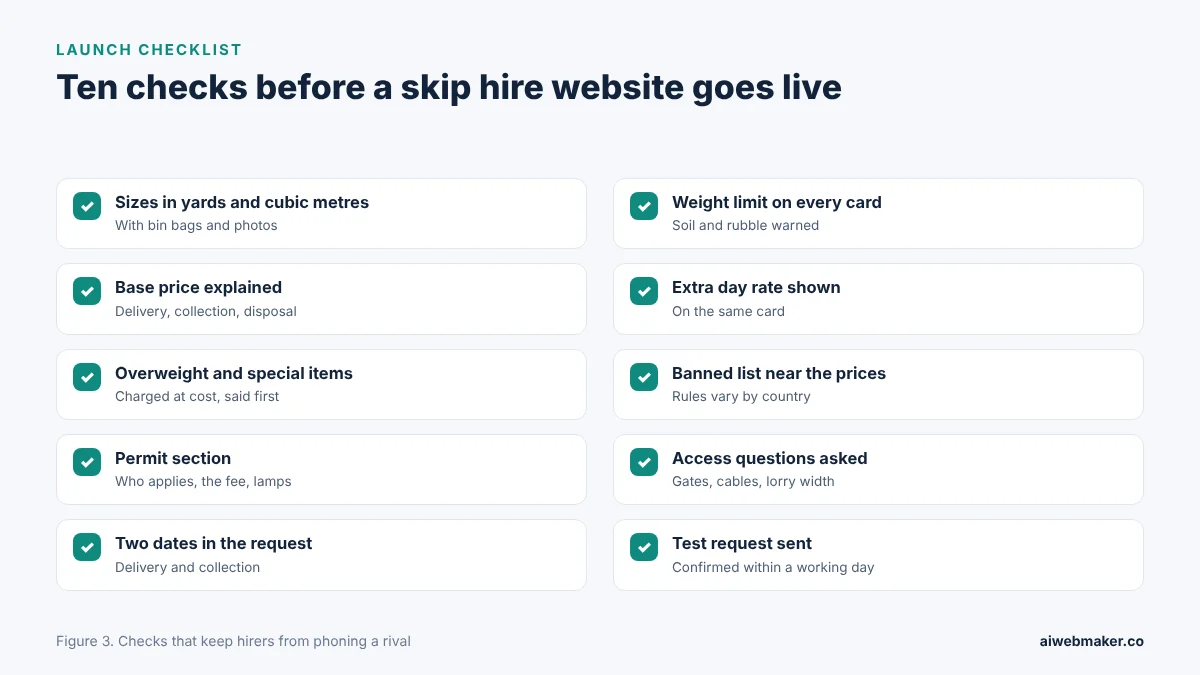
Hirers abandon a skip site when sizes appear only as yards with no bin bags, jobs or photos to make sense of them. A price with no mention of extra days or weight limits looks like a trap waiting at collection. Missing words on banned items leave people unsure whether the old fridge can go in. Silence about permits worries anyone without a driveway. A request route that asks for one date instead of two hints that the yard has not thought about collection. The figure turns those gaps into ten quick checks, each worth ticking before a hirer gives up and reaches for the phone.
Frequently asked questions
Can other people throw rubbish into a hired skip?
Passers by and neighbours do sometimes add their own rubbish to a skip left on the street, and the hirer may end up paying for it. Placing the skip on the drive, behind a gate or within sight of a window reduces the risk. Filling the skip quickly and booking collection as soon as it is full helps too. Banned items added by someone else can still cause a refusal, so hirers should check the load before collection. A yard that warns about this on its website looks after its customers before trouble starts.
What happens when a skip is filled above the top edge?
An overfilled skip cannot be lifted or carried safely, so most drivers ask for it to be levelled before they load it. Waste can fall onto the road during the journey, which creates danger and possible fines. The hirer may have to wait while the extra waste is removed, or pay for a second skip. Filling level with the top edge is the simplest rule, and it belongs on the size page and in the confirmation. Clear guidance saves an awkward conversation on the doorstep.
Is a skip or a roll off dumpster better for a house clearance?
A roll off dumpster suits a large clearance with bulky, light waste such as furniture, carpets and cardboard, provided there is room for the lorry to place it. A builder's skip fits more drives and streets, and it can be exchanged when full. Heavy waste, such as rubble from a renovation, usually belongs in smaller skips. The right answer depends on access, the mix of waste and how quickly the house must be cleared. A size guide by job lets hirers make this choice on their own.
Who applies for the permit when the skip stands on the road?
In many places the hire firm applies for the permit, because it knows the process and the authority's waiting time. Some authorities expect the hirer to apply, and the rules, fees and lead times differ by country and by council. The website should say clearly who applies and that the fee appears on the quote. Lamps, markings and cones are usually part of the permit conditions. A hirer who knows this in advance can plan the start date around it.
One builder's skip on one drive covers the hosting
A single builder's skip, hired for a few days, normally earns a yard more than a full year of hosting costs. One mini skip hired for a single day is worth several of the $19 monthly payments. Every renovation client who books repeat exchanges after reading the size guide adds a steady run of lorry work. Clear sizes, open day rates, a plain banned list and honest notes on permits persuade hirers who would otherwise ring three yards. Lorries leaving before seven with requests that arrived overnight are a good sign the site is working for the yard.
Build your website in Minutes and get the AI Tools that work
Start Building Your Website →