Roof Repair Website Cost, Told Through Leaks, Tarps and Photo Reports
Water through a ceiling at midnight is when a roof repair site earns its keep, and hosting it is a $119 yearly line or a $19 monthly line, the domain priced apart. Read on for callers, pages, leak finding, tarps, photo reports, urgency, patch or replace advice, search and hosting arithmetic.
- No coding required
- Live in minutes
- Blog, SEO and chatbot tools included
Water through a ceiling at midnight is the moment a roof repair site earns its keep. Hosting that site is a $119 yearly line or a $19 monthly line, and the domain carries a price set by its ending. While the crew drafts its repair pages and looks them over in preview, no charge arises. A single leak finding visit with a small fix on the spot brings in more than the annual hosting. The real difficulty is that homeowners cannot see their own roof, so they must trust a stranger who says what is wrong and what it will cost. Covered below: the callers, the pages, leak finding, tarping, photo reports, urgency rankings, honest patch or replace advice, search and a yearly budget.
This article is part of our complete guide: Home Services Website Builder.
Buckets on the landing: who calls a roof repair crew
Roof repair calls usually begin with a drip, a stain or a gust of wind that sent tiles into the garden. Some homeowners have water coming through a light fitting and want someone tonight. Others have watched a brown patch spread across a bedroom ceiling for weeks and finally want it traced. Buyers ask for an inspection before completing a purchase, and owners ask for one after a storm or ahead of winter. Landlords call on behalf of tenants, often wanting photos they can see without visiting. Each of them wants the leak found, the repair priced before it starts and proof that the work was really done.
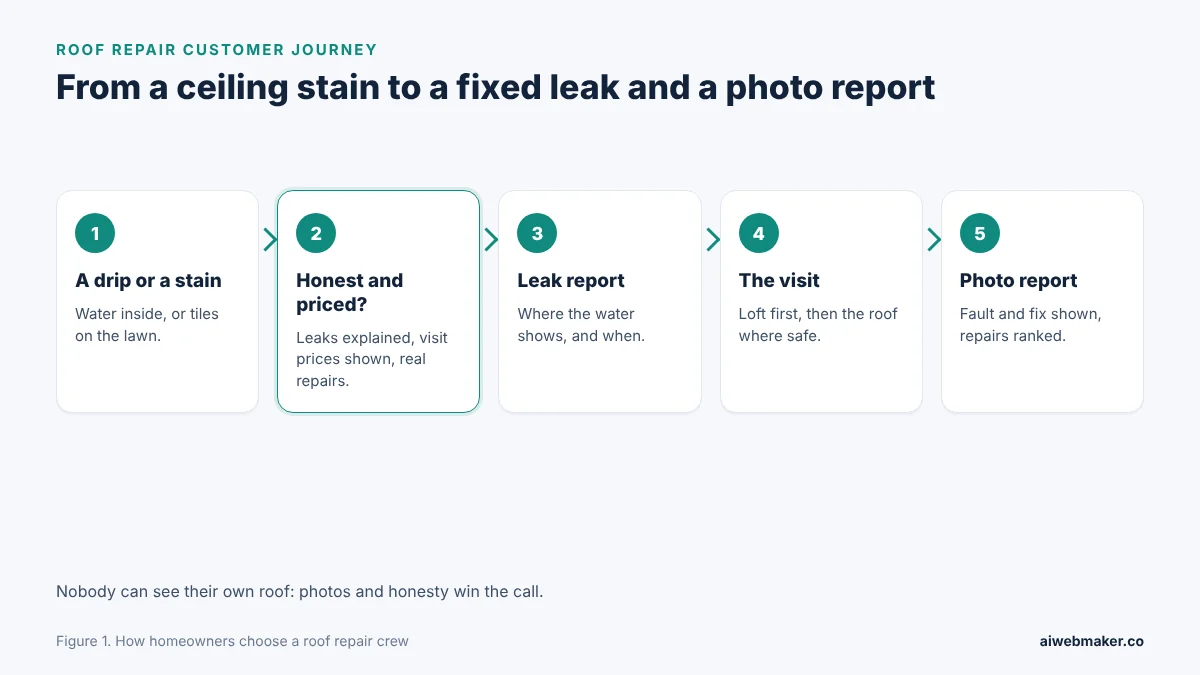
A drip starts this journey and a set of photos ends it, and the card in between decides who gets the call. The first card is the sign of trouble, from a stain to slipped tiles on the lawn. In the highlighted card the homeowner checks whether the crew explains leaks honestly, prices visits in advance and shows real repairs rather than stock roofs. Reporting the leak follows, with a description of where water shows and when. The final cards cover the visit itself and the photo report that shows the fault and the fix, which is what most homeowners forward to a partner, a landlord or an insurer.
Leak visits, tarps and repairs: the pages a repair crew publishes
A roof repair site should be built around the three ways a crew comes out, then around the repairs it makes every week. A safety strip at the top tells people what to do while water is coming in. Separate sections for a leak finding visit, an emergency tarp and a full inspection explain what each includes and what it costs to start. A table that reads ceiling stains helps homeowners describe their problem accurately. Repair cards for tiles, flashing, ridges, valleys, roof windows and flat roof patches show the everyday work. The leak report route asks where the water shows and when it happens, the two clues a roofer needs most.
| Page or section | What the homeowner asks | What it should state |
|---|---|---|
| Safety strip | What should happen right now? | Power off to the room, keep clear of bulges, stay off the roof |
| Leak finding visit | Can you find where it comes in? | Loft and roof checked, moisture readings, small fixes |
| Emergency tarp | Can you stop it tonight? | How the tarp is held, how long it stays |
| Full inspection | What state is the roof in? | Slope by slope check and a ranked report |
| Stain patterns | What is the stain telling me? | Common patterns and likely causes |
| Repairs | What will the fix cost? | Starting prices for each common repair |
| Leak report | How does a leak get reported? | Where water shows, when, and the town |
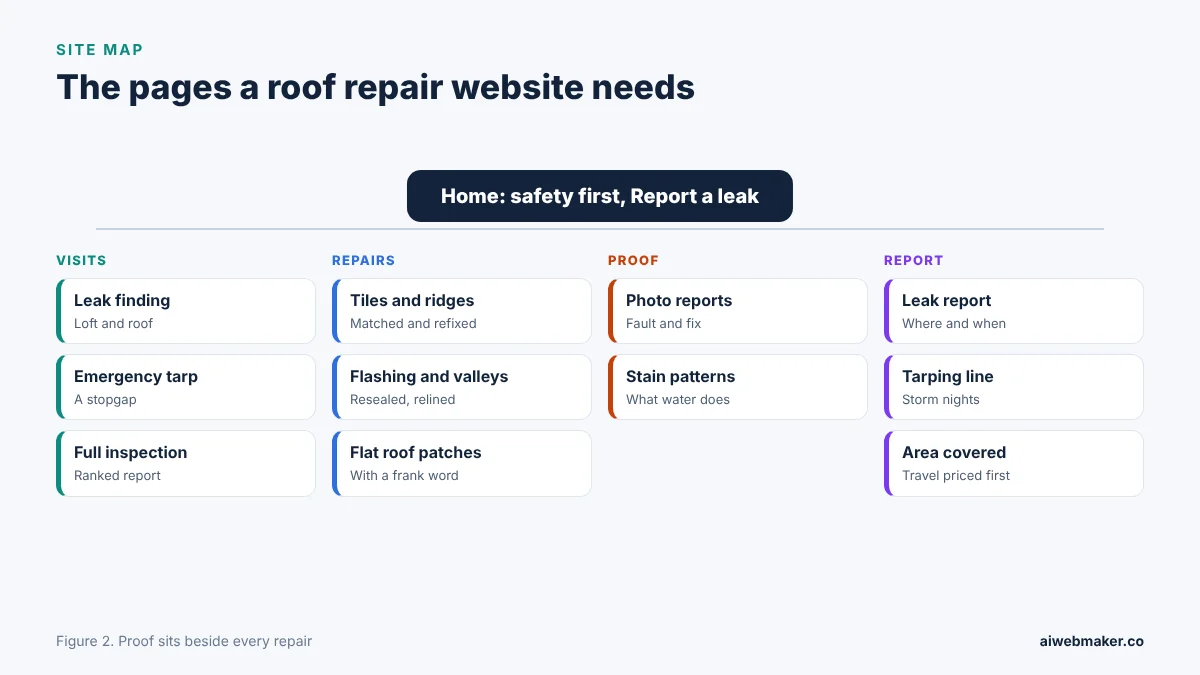
Sorted by urgency, the roof repair pages fall into visits, repairs, proof and the leak report. Visit pages explain the leak finding visit, the emergency tarp and the full inspection, while repair pages list the everyday fixes. Patchwork Roof Repairs, the sample crew, opens with a strip of safety advice for water through the ceiling and then three ways it comes out: a leak finding visit, an emergency tarp and a full roof inspection. Its page explains tarping, walks through an inspection in order and reads what a stain is telling the homeowner. The roof repair website example with photo reports after every visit lists slipped and cracked tiles, flashing, ridge and hip tiles, valley relining, roof window seals and flat roof patches, then shows pages from a photo report, reviews, questions and a leak report form.
Why the stain is rarely under the hole
Leak finding is a skill worth explaining, because homeowners assume the hole sits directly above the stain and distrust anyone who looks elsewhere. Water usually travels along felt, battens and rafters before it drips, sometimes a metre or more from where it entered. That is why a careful roofer starts in the loft with a torch and follows the track back, rather than lifting tiles above the stain. Moisture readings show which timbers are wet and help separate a live leak from an old one. Some dark patches on top floor ceilings after frost are condensation from a poorly vented loft, not a leak at all. A page that explains these patterns turns a paid leak finding visit from a mystery into a sensible first step.
| What shows inside | Where water often gets in | Usual repair |
|---|---|---|
| Damp near the chimney breast | Flashing cracked or lifted at the stack | Reseal or replace flashing, repoint if needed |
| Drips only in wind driven rain | Slipped tiles or a gap at the verge | Refix tiles and the verge |
| Stain where two slopes meet | A worn or blocked valley | Clear and reline the valley |
| Damp around a roof window | A failed seal or missing flashing | Refit flashing and reseal |
| Dark patches after frost | Condensation from poor loft ventilation | Add vents, no roof repair needed |
Emergency tarping, explained as a stopgap
A tarp is a heavy waterproof sheet laid over the damaged part of a roof and held down with timber battens, so rain runs over it and off the eaves. It buys time when conditions are too wet, too windy or too dark to replace tiles safely. Homeowners often worry that a tarp will damage the roof or stay for months, so the page should explain how it is fixed without nails through sound tiles. Responsible crews never go onto a roof in high wind, lightning or ice, and protect the loft from inside with sheeting and buckets instead. A tarp left too long can trap moisture, so the permanent repair should follow within days. Crediting the tarp cost against the repair, where a firm does both, is a fair practice worth stating.
Photo reports and repairs ranked by urgency
Nobody can see their own roof, so a photo report is the strongest proof a repair crew can offer. Each defect can get a photo, a mark on a sketch of the roof and a note on how urgent it is. Ranking repairs as needed now, needed this year or worth watching lets the homeowner plan spending instead of facing one alarming total. Buyers use such reports to negotiate with sellers, and landlords use them to approve work without visiting. Before and after photos of each repair show that the work was done and how it was finished. Publishing sample report pages on the website shows exactly what a customer will receive.
| Ranking | What it means | Example |
|---|---|---|
| Needed now | Water is getting in or soon will | Cracked flashing at a chimney |
| Needed this year | A weak point likely to fail in bad weather | Loose ridge tiles |
| Worth watching | No action yet, check again later | Moss building up on a north slope |
| Not a roof problem | The cause lies elsewhere | Condensation from a poorly vented loft |
Patch, repair or replace: honest advice that brings repeat calls
The advice that wins most loyalty is telling a homeowner when a repair is enough and when a roof is nearing the end of its life. Many roofs with one blocked valley and a few slipped tiles are offered full replacements they do not need, and homeowners know it. A repair crew that says what patching will buy, in months or years, earns calls for the next storm and recommendations to neighbours. Matching old tiles and slates matters here, since a new tile may look brighter for a season until it weathers. Flat roof patches deserve a frank word on how long the surrounding membrane will last. The AI website builder that drafts roof repair pages with leak reports sets out visit, repair and report sections after the crew describes its work and area in plain sentences, and each section can be adjusted until it reads exactly as the crew advises on the roof.
| Sign | Usually a repair | Suggests planning a replacement |
|---|---|---|
| A few slipped or cracked tiles | Yes | Only when slipping is widespread |
| Cracked flashing | Yes | Rarely on its own |
| Worn valley | Relining | If the slopes either side are failing too |
| Sagging lines across a slope | Investigate first | Often, once structure is checked |
| Flat roof splits and blisters | Patching for a time | When splits keep returning across the surface |
Roof leak repair near me and the phrases people type at night
Homeowners search for roof leak repair, slipped tile repair, emergency roof tarp, roof inspection or flat roof repair, nearly always with their town and often late at night. Headings for the tarp, the inspection, each stain pattern and each repair let the page match those phrases in the words people use. The map listing should only advertise night hours if the tarping line truly answers, and it should show real photos of repairs. Reviews that mention a tarp before midnight or a repair that cost a fraction of a replacement quote persuade the next caller. Articles on why a stain appears far from a leak, or what to check after a storm, reach homeowners before water does. That kind of writing brings the crew calls from people who already trust its judgement.
The roof repair crew's yearly website ledger
A roof repair crew's yearly ledger for the website holds two repeating entries, hosting and the domain, while twelve storm and leak articles written on credits total near $7.80. Busy crews settle the year most cheaply with a single $119 payment. A crew in its first season may spread the cost at $19 each month. Posting new report photos, changing a price or adding a district is never billed. The $189 tier stays on the table as a yardstick only.
| Item | Yearly | Monthly |
|---|---|---|
| Hosting the roof repair pages | $119 | $228 over twelve months |
| Domain | Depends on the ending | Depends on the ending |
| Higher plan, for comparison | $189 a year | Not needed |
| Twelve storm and leak articles at about $0.65 | About $7.80 | About $7.80 |
| Report photo, price and district updates | No charge | No charge |
| Year before the domain | About $126.80 | About $235.80 |
Replacement pushed and no photos: why homeowners phone someone else
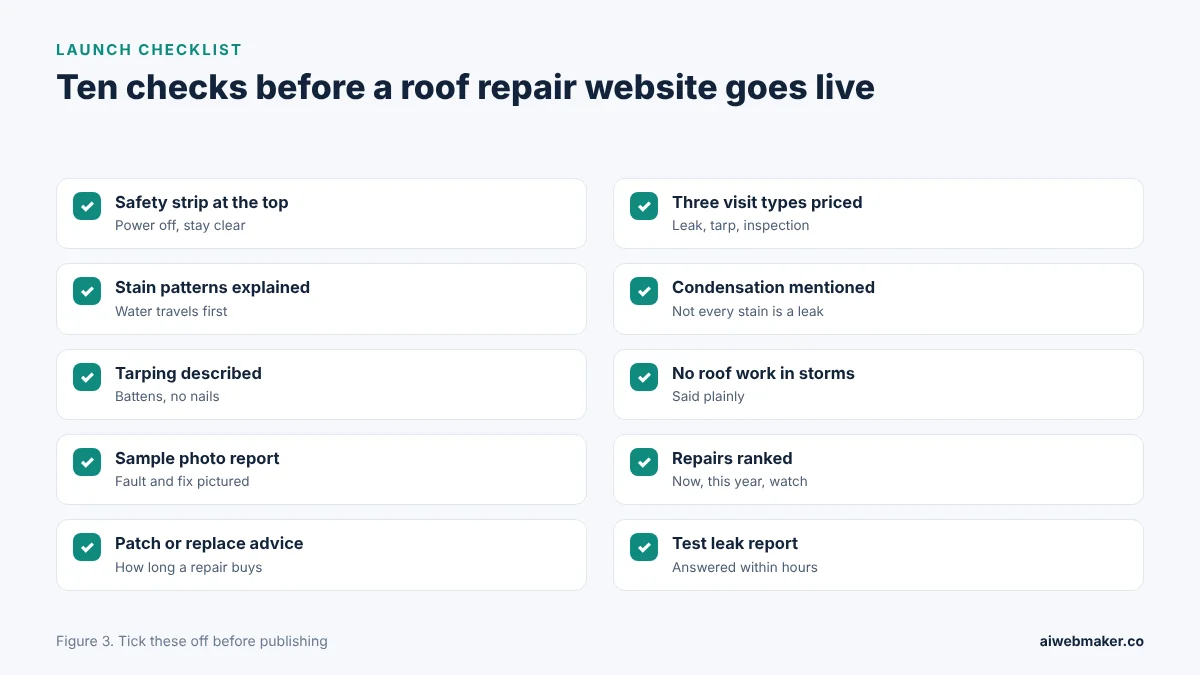
Homeowners phone someone else when a repair site pushes full replacements before anyone has looked in the loft. No safety advice for water through the ceiling makes the crew seem unaware of what the caller is facing. Visit prices hidden until the roofer arrives feel like a trap on the doorstep. A site without sample photo reports gives no reason to believe the work will be shown. Stock images of perfect new roofs say nothing about leaks traced and fixed. Ten steps that close those gaps make up the launch list set out here.
Frequently asked questions
Why is the ceiling stain not under the leak?
Water runs along felt, battens and rafters before it drips, sometimes travelling a metre or more from where it entered. The stain shows where the water finally falls, not where it came in. A roofer therefore starts in the loft and follows the track back towards the source. Lifting tiles directly above the stain often misses the real fault. Explaining this on the website helps homeowners trust the leak finding visit.
Will a tarp damage the roof?
A tarp fitted properly does not damage the roof, because it is held down with battens rather than nailed through sound tiles. It should be checked after strong wind, since loose edges can flap and lift. Leaving a tarp for months can trap moisture, so the permanent repair should follow within days. The website can describe how the crew fits and checks tarps. Clear information calms homeowners who have never seen one go on.
Can old roof tiles be matched?
Old tiles and slates can usually be matched closely, especially when a crew keeps reclaimed stock of common types. Exact matches are harder for unusual or discontinued tiles. A new tile can look brighter for a season until it weathers and blends in. The photo report should show the match so the homeowner can judge it. Honest wording here prevents disappointment when the repair is first seen from the garden.
Does anyone go onto a roof during a storm?
Responsible crews do not go onto a roof in high wind, lightning or ice, because the risk of a fall is too great. When conditions are unsafe, they protect the loft from inside with sheeting and buckets. A tarp goes on as soon as conditions allow, followed by the permanent repair once the roof is dry. Safety rules for working at height vary by country and should always be followed. A website that says this openly shows the crew values its people as well as its customers.
A handful of slipped tiles, and the website year is covered
One small repair of a few slipped tiles usually earns more than a roof repair crew's $119 hosting year. Billed by the month, $19 is a small slice of even the cheapest call out. Every leak finding visit that leads to a valley reline or a flashing repair adds work the pages helped bring in. Safety advice first, honest stain patterns and photo reports that show each fix persuade homeowners more than any promise of a new roof. Crews that publish real report pages give strangers a reason to let them up a ladder. Leak reports that arrive already describing where the water shows and when tell the crew its pages are being read.
Build your website in Minutes and get the AI Tools that work
Start Building Your Website →