Pool Builder Website Cost, Explained From the First Spade to the Swim
Set against a garden pool, the website that sells it costs little: hosting is a $119 annual line or a $19 monthly one, and a domain is bought too. The rest covers who commissions pools, pages, pool types, site surveys, stages and payments, barriers, equipment and care, search and costs.
- No coding required
- Live in minutes
- Blog, SEO and chatbot tools included
Set against a garden pool, the website that sells it costs almost nothing: hosting is a $119 annual line or a $19 monthly one, with a domain picked by its ending. No charge is raised while a pool firm shapes its pages and tries them out on screen inside AI Web Maker. One signed pool would cover that figure for generations. The real difficulty is that families are committing to a large, slow and disruptive project, and the true cost hides under the lawn and behind the side gate. They want to know what they are buying, how long the garden will be a building site and how the water will be kept safe for children. This guide sets out the families, the pages, pool types, survey findings, stages and payments, barriers, equipment and care, search and a yearly budget.
This article is part of our complete guide: Home Services Website Builder.
Families with a garden and long summers: who commissions a pool
Pool enquiries usually come from families who have talked about a pool for years and finally have the garden, the budget or the climate to justify one. Some want a lap pool for exercise, others a family pool with steps and a shallow end for young children. Owners of small courtyards or narrow plots ask about plunge pools that fit where a full pool cannot. People with older pools sometimes ask about replacing or upgrading, though that work differs from a new build. Holiday home owners want a pool that will attract bookings and survive months without daily attention. All of them want a realistic idea of cost, time on site and safety before they invite a builder to walk the garden.
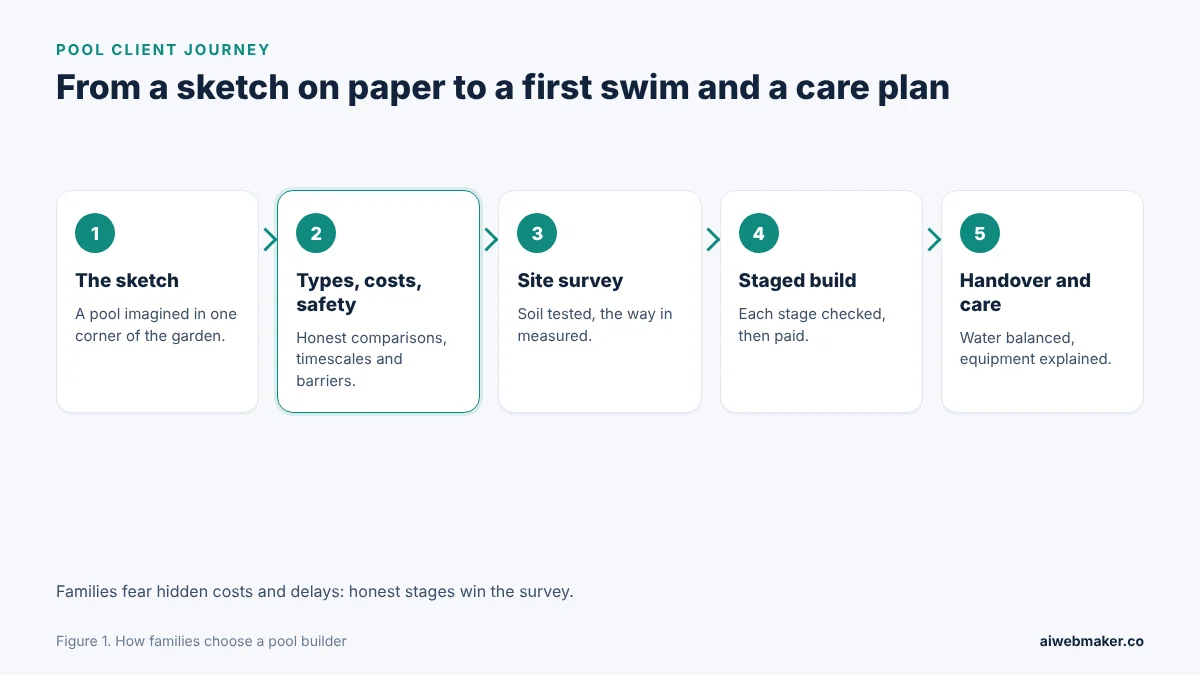
Ambition drives the first card of this journey and patience carries the rest. The opening card is the sketch, a pool imagined in a particular corner of the garden. The highlighted card is research, when families compare pool types and look for evidence that the builder explains costs, timescales and safety honestly. A site survey follows, testing the soil and measuring the way in, and it turns the sketch into a written quote. The final cards cover the staged build and the handover, when the water is balanced, the equipment explained and a care plan offered for the seasons after.
Pool types, stages, barriers and care: the pages a pool builder needs
A pool builder's pages should answer families' questions in the sequence they arise, starting with which type of pool suits their garden. Each type deserves a short section with starting prices for a stated typical garden. A survey page explains what is tested and why no honest price comes before it. The build stages, a timescale table and the payment schedule show how a long project becomes several short ones. Safety barriers need a section of their own, written plainly rather than buried in small print. Equipment, covers and the care plan follow, with the survey request at the end of the page.
| Page or section | What families ask | What it should state |
|---|---|---|
| Pool types | Concrete, fibreglass or plunge? | Build method, strengths, starting prices |
| Site survey | Why can't you price from a photo? | Soil, groundwater, access and soil removal |
| Stages | What happens, and when? | Each stage, its check and its payment |
| Timescales | How long will the garden be a site? | Typical weeks per stage and what delays them |
| Safety barriers | How will the children be kept safe? | Fencing during the build, permanent barrier before filling |
| Equipment and care | What runs the pool afterwards? | Heat pumps, covers, filtration, care plans |
| Survey request | What happens next? | Pool type, town, season, the width of the way in |
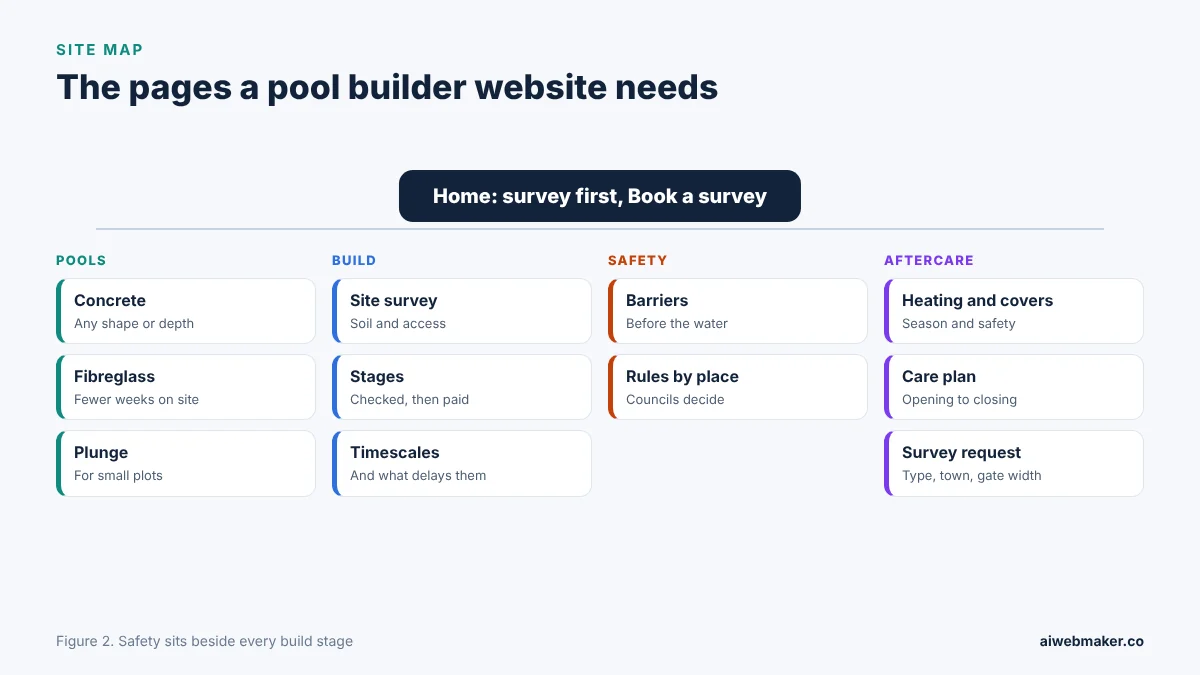
Branching from a single home page, a pool builder's site divides into pools, the build, safety and aftercare. Pool pages compare types and starting prices, while build pages cover the survey, stages, timescales and payments. Bluecrest Pool Builders, the sample firm, presents three ways to put water in the garden: a concrete pool, a fibreglass pool and a plunge pool. Its page then runs from the survey to the first swim in stages, gives an honest table of how long each stage takes and explains the barrier fitted around the water before anyone swims. The pool builder website example with build stages and a safety barrier also lists a heat pump, a safety cover, underwater lights, a filtration upgrade, paving and coping and a care plan, with photos from six stages of one build, questions and a survey request.
Concrete, fibreglass or plunge: the choice that sets the price
The type of pool shapes the cost, the time on site and what the garden can accommodate, so families need a fair comparison before the survey. Concrete pools are built on site over a steel frame and can take almost any length, depth or outline. Fibreglass pools arrive as one piece shells from a factory mould, which means fewer weeks on site but set shapes and sizes. The shell travels by road and is lifted in, so access to the garden can rule fibreglass out. Plunge pools are short and deep, suiting courtyards and narrow plots where a full pool will not fit. Honest notes on the trade offs help families arrive at the survey already leaning towards the right choice.
| Pool type | How it is built | Strengths | Points to weigh |
|---|---|---|---|
| Concrete | Sprayed concrete over a steel frame | Any shape, depth or curve | Longest time on site, curing weeks |
| Fibreglass | Factory shell set on a stone bed | Fewer weeks on site, smooth surface | Set sizes, needs room to lift the shell in |
| Plunge | Concrete or fibreglass, short and deep | Fits small plots, quick to heat | Too short for real lap swimming |
What hides under the lawn: soil, groundwater and the way in
No honest builder prices a pool from a photograph, because the expensive surprises sit below the surface and behind the side gate. Clay, rock or high groundwater can change the dig, the shell and the drainage around it. A narrow side passage may need a smaller digger and a conveyor for the soil, which adds days. A typical pool produces several lorry loads of soil, and removal is a real cost that must be priced. Slopes need retaining walls, and trees nearby bring roots and falling leaves. A page that names these factors explains why prices are given as starting figures and why the survey always comes first.
| Site factor | Why it changes the price | What the survey checks |
|---|---|---|
| Soil type | Clay and rock slow the dig | Test holes and the soil profile |
| Groundwater | Water in the hole complicates the build | How high the water sits in wet months |
| Access width | Decides the machines that can reach | The narrowest point of the way in |
| Soil removal | Lorry loads to carry away | Volume and where it can be loaded |
| Slope | May need retaining walls | Levels across the garden |
| Trees and services | Roots, leaves, buried pipes and cables | What lies near the planned pool |
Stages and payments that never run ahead of the work
A pool build stretches over months, and silence between visits is what makes clients nervous. Breaking it into stages, such as survey and design, approvals, dig and frame, shell and pipes, finishes, and fill and handover, gives families a clear map. Each stage can end with a check the owners are welcome to attend, followed by the payment for that stage. Concrete pools have quiet weeks while the shell cures, and saying so in advance stops families thinking the builder has vanished. Weather, rock and late deliveries can move dates, and promising to tell the client the day a date moves builds lasting trust. Payments that follow the stages, never ahead of them, protect both sides.
Barriers before water: pool safety and local rules
A garden pool is a drowning risk for young children and pets from the day the hole is dug, and the website ought to state it in plain words. Temporary fencing around the dig, locked every evening, protects children through the build. The permanent barrier should be fitted before the pool is filled, never afterwards. Rules on barrier height, gates and alarms differ between countries and often between local councils, as in Australia, parts of the United States and many European countries, so the builder should check what applies to each address. Gates that close and latch on their own, out of a child's reach, are a common requirement. Covers and alarms can be offered as extra layers, while the page makes clear that the local authority has the final word.
Heating, covers and the care plan after handover
Equipment decisions shape how long the swimming season lasts and how much work the pool needs, so they deserve careful explanation. A heat pump sized to the pool volume and the season wanted extends swimming into cooler months, and its placement away from bedroom windows matters to neighbours. Safety covers on a track close the whole pool off, adding protection and keeping heat in. Lighting, filtration upgrades and paving laid to fall away from the water complete the picture. A care plan for monthly visits through the season, plus spring opening and autumn closing, keeps the relationship going after handover. The AI website builder for pool builders and their survey requests produces draft sections for pool types, stages and equipment once the builder outlines its work in a couple of sentences, and every section stays open to editing until it matches the firm's real contracts.
Concrete pool builders near me and other searches families make
Families type pool builder, concrete pool, fibreglass pool installation or plunge pool, nearly always with their town, and many also ask how long a pool takes to build. Across North America the usual term is an inground pool, so builders there should use that phrase. Plain headings for each pool type, each stage and each timescale help the page answer those searches directly. A map listing earns its place with the region served, survey days and real photos of pools at different stages. Reviews that mention dates kept and fences up on day one carry more weight than shots of finished water. Articles on choosing between concrete and fibreglass, or on barrier rules, reach families long before they book a survey.
A pool builder's online costs for the year
Every year, a pool builder's web presence calls for hosting and a domain, while twelve pool planning articles bought through credits cost roughly $7.80 between them. A builder with a full season pays least through one $119 payment. A newly formed crew can manage the year as $19 monthly payments instead. Adding finished pools, stage photos or new districts is not billed. For comparison alone, the $189 tier also has a row.
| Item | Yearly | Monthly |
|---|---|---|
| Hosting the pool builder pages | $119 | $228 over twelve months |
| Domain | Depends on the ending | Depends on the ending |
| Higher plan, for comparison | $189 a year | Not needed |
| Twelve pool planning articles at about $0.65 | About $7.80 | About $7.80 |
| Project, stage and area updates | No charge | No charge |
| Year before the domain | About $126.80 | About $235.80 |
Finished pools only and no word on barriers: why families hesitate
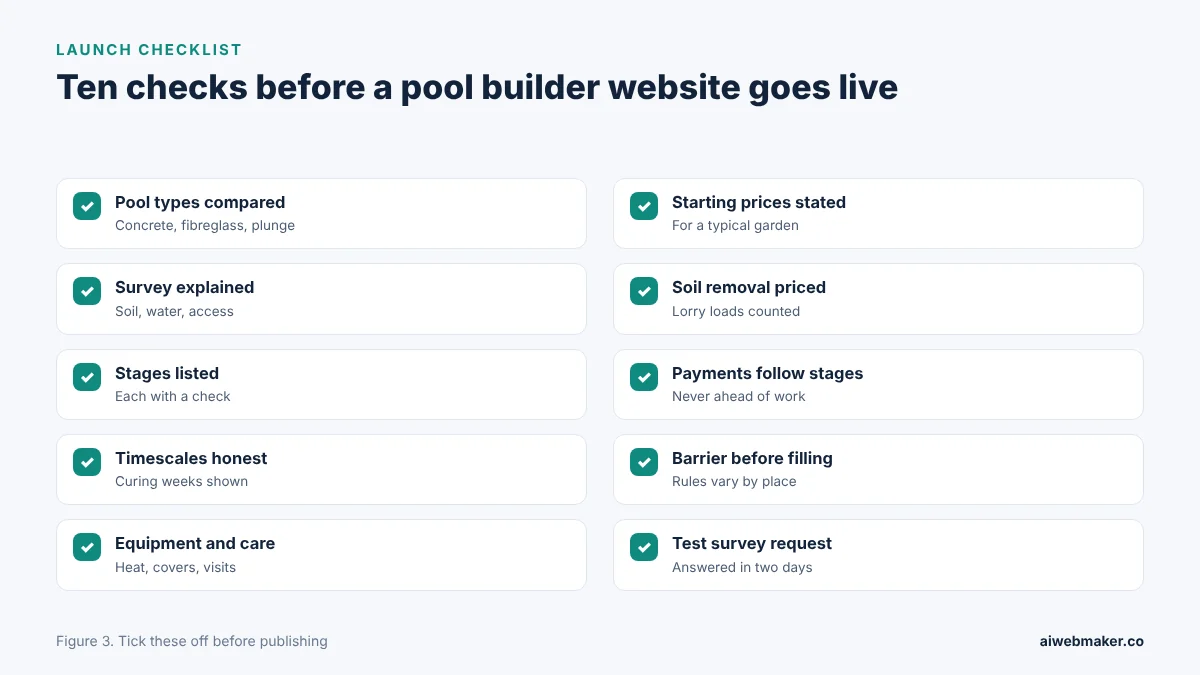
Families hesitate when a pool site shows only sparkling finished pools and never explains what happens in the months before. No mention of a survey suggests prices that will grow once the digger finds clay. Missing timescales leave them unable to plan a summer around the build. Silence on safety barriers worries every parent of young children. One headline figure without staged payments raises the fear of paying for work not yet done. The ten checks set out in the next figure answer every one of those hesitations.
Frequently asked questions
Does a garden pool need permission?
Whether a garden pool needs permission depends entirely on the address, so a builder's website should avoid general promises. Some places treat a garden pool as permitted work, while others require planning approval, a building permit or both. Barrier rules apply almost everywhere, though their details differ. A builder can explain what usually applies at the survey and prepare drawings for any application. The decision rests with the local authority.
How much of the garden is out of use during the build?
Expect a working area around the pool and a route from the gate to it for the whole build. Lawn along that route usually needs reseeding during the finishing stage. Machines, materials and the soil being removed all need space while they wait. Families with children should plan where play can continue safely away from the dig. A realistic description on the website helps households prepare for months of disruption.
Where does all the excavated soil go?
A typical pool produces several lorry loads of soil, which is usually carried away and priced as part of the quote. Some families keep part of it to level the lawn or build raised beds. Access for lorries and loading space affect how removal is organised. The survey should estimate the volume and the method. Clear wording prevents a large surprise line on the final invoice.
What does a care plan include after handover?
A care plan usually includes regular visits through the swimming season, plus opening the pool in spring and closing it in autumn. Visits can cover water testing, cleaning, checking the equipment and advising the owners. Having the crew who built the pool look after it helps catch problems early. Plans are often optional and can be stopped with notice. Explaining the plan on the website keeps the relationship going beyond handover.
One signed pool, and hosting is settled for generations
A pool builder's $119 hosting year is small beside even one survey fee, and a single signed pool covers generations of it. On monthly billing, $19 is a sliver of any stage payment on a concrete build. Every care plan sold at handover adds visits through the seasons that follow. Honest notes on soil, access, timescales and barriers persuade careful families better than any photo of blue water at sunset. Builders who post each stage of real projects show that dates are kept and gardens are respected. Survey requests that already mention the width of the side gate show visitors understood what matters.
Build your website in Minutes and get the AI Tools that work
Start Building Your Website →