Pest Control Website Cost, Safety Notes and Prevention Contracts
Hosting a pest control site takes a yearly $119, or a $19 payment for any month taken singly, and a domain is added. Covered here: how customers choose, pest pages, the treatment process, preparation and safety, commercial contracts, discretion, search and the annual bill.
- No coding required
- Live in minutes
- Blog, SEO and chatbot tools included
Hosting costs a pest control firm $119 for the year with AI Web Maker, and the monthly alternative is $19, with the domain bought on top. While technicians write and correct their pest pages in the preview, AI Web Maker bills nothing, so every treatment and safety note can be checked before launch. One commercial contract, or even one wasp nest and one mouse treatment, generally covers that yearly fee. Guardline Pest Control is an invented company, yet its AI Web Maker pest control business website follows each job from inspection to aftercare and is worth studying before you draft your own. The real challenge in this trade is that customers arrive in two very different states, some frightened by droppings in the kitchen tonight and others planning to protect a restaurant or rental block for years. A pest control website has to calm the first group within seconds and give the second group enough detail to sign a contract. What follows covers how both groups choose, the pages to build, the inspection and treatment process, preparation, safety, commercial work, discretion, search and what the year costs.
This article is part of our complete guide: Home Services Website Builder.
Panic or planning: how pest control customers decide
Pest control customers fall into two camps, and each reads a website in a completely different way. Householders who have just heard scratching in the loft or found bed bugs after a trip need the number to call, how soon someone can come and reassurance that the problem is common and treatable. Restaurant owners, hotel managers, landlords and facilities staff behave like buyers, comparing service reports, visit schedules, qualifications and insurance before they commit. Both groups care deeply about safety, especially where children, pets or food are involved. A site that separates the urgent route from the planning route serves both without forcing either to wade through the other's information.
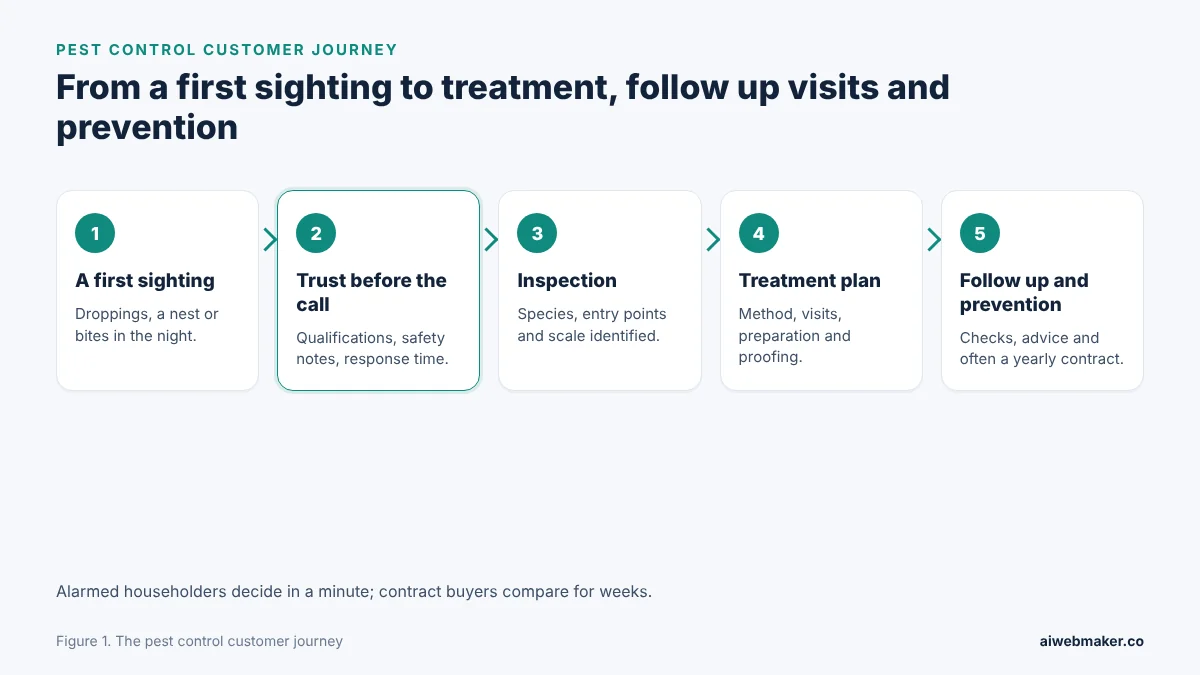
Across these five stages, the second carries the most weight, since that is where an anxious customer decides whether this firm can be trusted inside the home. A first sighting, whether droppings, a nest or bites in the night, sends the customer searching. Proof of qualifications, a clear safety approach and a stated response time win the call. The inspection then identifies the pest, the entry points and the scale of the problem before any treatment is agreed. Follow up visits and prevention advice close the loop, and many single call outs become yearly contracts at that point. Every page of a pest control website should support one of these stages and point plainly to the next.
Pest pages, treatment pages and the urgent route
Customers search by the creature they have found, so a pest control site needs a page for each main pest rather than one general services page. Rodents, crawling insects, bed bugs, stinging insects and birds all bring different questions about risk, preparation and the number of visits. Commercial customers need a separate route that explains contracts, reports and visit schedules. The urgent route, with a phone number and response time, should be visible from every page. A table like the one below helps decide which pages to build first.
| Page | Who reads it | What it should cover |
|---|---|---|
| Rats and mice | Householders hearing noises, food businesses | Signs, proofing, bait stations, follow up visits |
| Ants and cockroaches | Kitchens, flats, rental homes | Identification, treatment rounds, hygiene advice |
| Bed bugs | Households, hotels, landlords | Preparation, number of visits, discretion |
| Wasps and stinging insects | Urgent callers in warm months | Nest treatment, safety, how bees are handled |
| Birds | Commercial roofs, warehouses | Proofing, netting, legal protections that vary |
| Commercial contracts | Restaurants, hotels, managers | Visit schedules, reports, audit support |
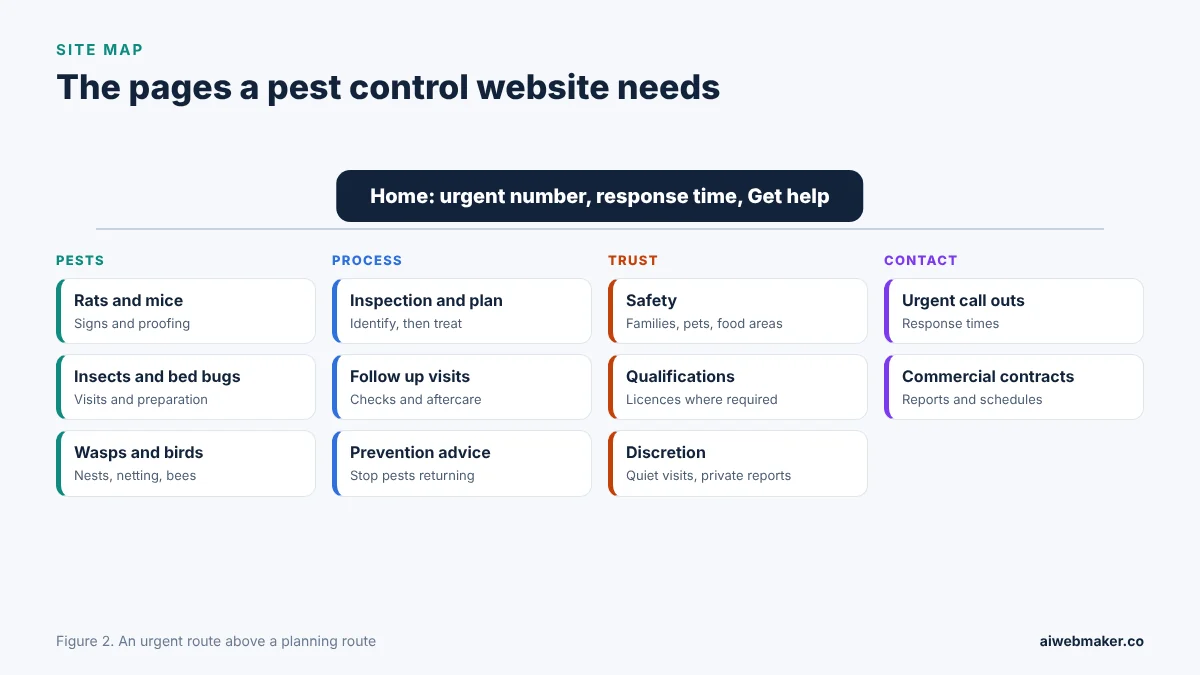
Split into four groups, a pest control site sorts its pages into pests, process, trust and contact, with the urgent number pinned above all of them. Process pages explain inspection, the agreed plan, follow up and prevention. Trust pages hold qualifications, safety for families, pets and food areas, and the firm's approach to discretion. Our sample business, Guardline Pest Control, puts a section on urgent call outs and a section on homes and businesses on its services page, gives safety for families, pets and food areas its own heading beside the types of treatment it uses, and states its response times on the contact page. Its process page runs from inspection and assessment to an agreed treatment plan, follow up visits and aftercare guidance, with preventive advice and the guarantee and follow up policy close by, and the about page covers customer care, discretion, qualifications and the area served; the pest control website example with urgent call outs and a treatment process was built in 57 seconds.
Inspection, identification and the treatment plan
Good pest control starts with an inspection, because treating the wrong pest or missing the entry point wastes money and lets the problem return. Many professional firms follow integrated pest management, an approach that combines inspection, proofing, monitoring and targeted treatment, using pesticides only where they are needed. The technician identifies the species, finds where it is getting in and judges how established it is. The agreed plan then sets out the treatment, the number of visits, any proofing work and what the customer must do. Follow up visits check progress and adjust the plan, since few infestations clear in a single visit. Explaining these stages on the website shows customers they are paying for a method, not a quick spray.
| Stage | What the technician does | What the customer receives |
|---|---|---|
| Inspection | Looks for signs, entry points and harbourage | A clear explanation of the problem |
| Identification | Confirms the species and its likely source | The right treatment for that pest |
| Treatment plan | Agrees method, visits and proofing | Written steps and preparation advice |
| Proofing | Seals gaps, fits mesh or door strips | Fewer routes back into the building |
| Follow up | Checks bait, traps or monitors | Progress reports and adjustments |
Preparing a home before treatment, and what happens after
Preparation instructions vary by pest and by method, so a website should explain them clearly and point customers to the firm's own preparation sheet. Bed bug treatments often require bedding to be laundered and clutter reduced, while customers are usually told not to carry belongings between rooms. Cockroach and ant treatments may need cupboards emptied and food stored away. Flea treatments often begin with thorough vacuuming, and pets should be treated by a vet at the same time. After treatment, the technician should state how long rooms must be left empty and when surfaces can be cleaned. Clear preparation pages reduce failed visits and help each treatment work the first time.
| Pest | Typical preparation | After the visit |
|---|---|---|
| Bed bugs | Launder bedding, reduce clutter, keep items in place | Avoid moving belongings, allow follow up visits |
| Cockroaches | Empty cupboards, store food sealed | Delay deep cleaning of treated areas |
| Fleas | Vacuum floors, arrange pet treatment with a vet | Keep vacuuming as eggs continue to hatch |
| Rats and mice | Clear access to lofts and under sinks | Report activity, keep food covered |
| Wasps | Keep people and pets away from the nest | Expect activity to fade over a day or so |
Safety around children, pets and food areas
No pesticide is completely harmless, and honest firms explain how they reduce risk instead of promising perfect safety. The website should say that products are applied according to their labels, that bait stations are tamper resistant where children or pets are present and that food surfaces, fish tanks and pet bowls are covered or removed. Customers should be asked to mention pregnancy, asthma, allergies and every animal in the home, including birds and fish. Rules on which products may be used, and on who may apply them, differ from country to country and even between regions, which is why the firm should name the licences or certificates its technicians hold where such schemes exist. If anyone may have been exposed to a product, the page should advise contacting a doctor or the local poison advice service. Careful, plain safety notes win the trust of exactly the customers who worry most.
Contracts for kitchens, warehouses and landlords
Commercial pest control is built on contracts, and the website should explain them in the language of the people who sign them. Food businesses usually need routine visits, written service reports and records that support food safety inspections. Warehouses and factories care about rodent monitoring, proofing and protecting stored goods. Hotels and holiday lets need quick, discreet responses to bed bugs between guests. Landlords and property managers want a firm that can communicate with tenants and handle several buildings. A table setting out each type of client, with what the contract covers, helps buyers see that the firm understands their world.
| Client | What they need most | What the contract should include |
|---|---|---|
| Restaurants and food producers | Records for inspections | Routine visits, service reports, sighting logs |
| Warehouses and factories | Protected stock | Rodent monitoring, proofing, bird control |
| Hotels and holiday lets | Fast, quiet response | Bed bug procedures, discreet vehicles |
| Landlords and managers | Tenants kept informed | Notice letters, unit by unit reporting |
| Schools and care settings | Extra caution | Treatment timing, product choice, sign off |
Discretion, guarantees and a clear enquiry route
Discretion matters to almost every pest control customer, since few people want neighbours, guests or diners to learn about the problem. The website can say whether plain vehicles are available, how technicians introduce themselves at the door and how reports are kept private. Guarantees should be written in plain terms, stating what is covered, for how long and which customer actions, such as fixing a broken air brick, the guarantee depends on. The enquiry route should invite customers to describe what they have seen, where and for how long, so the firm can judge urgency. The AI website builder that pest control firms use for their pest and process pages turns a paragraph about the firm into draft services, process, about and contact pages. Clear promises and a quiet manner are what turn a single call out into a long relationship.
Searches people make with a mouse in the kitchen
People with a pest problem type urgent phrases such as wasp nest removal, bed bug treatment or mice in the loft, often adding their area. Each pest page can carry its own phrase in the heading and first paragraph, so search engines pair each worry with the page that answers it. A map listing that keeps its hours correct and shows real vans and staff, with a link back to the site, captures many emergency searches on phones. Reviews that mention a calm technician, a clear explanation and a problem that did not return persuade far more than star ratings alone. Seasonal articles, such as keeping mice out as the weather cools or spotting early wasp activity in spring, reach customers before the problem peaks. A steady supply of useful answers makes the firm the name people already recognise when trouble appears.
Yearly hosting arithmetic for a pest control firm
Only the hosting and the domain come round every year, while each seasonal article written with AI credits comes to roughly $0.65. Firms already holding several contracts spend least by paying for the hosting once a year. A newly licensed technician working alone may prefer the monthly bill during the first season. New pest pages, changed response times or updated safety notes leave the total untouched. Yearly and monthly figures follow, and the $189 tier sits beside them only so the gap between plans is visible.
| Item | Yearly | Monthly |
|---|---|---|
| Hosting the pest control pages | $119 | $228 over twelve months |
| Domain | Depends on the ending | Depends on the ending |
| Higher plan, for comparison | $189 a year | Not needed |
| Twelve seasonal pest articles at about $0.65 | About $7.80 | About $7.80 |
| Pest pages, safety notes and response times | No charge | No charge |
| Year before the domain | About $126.80 | About $235.80 |
Gaps that make a worried caller try another firm
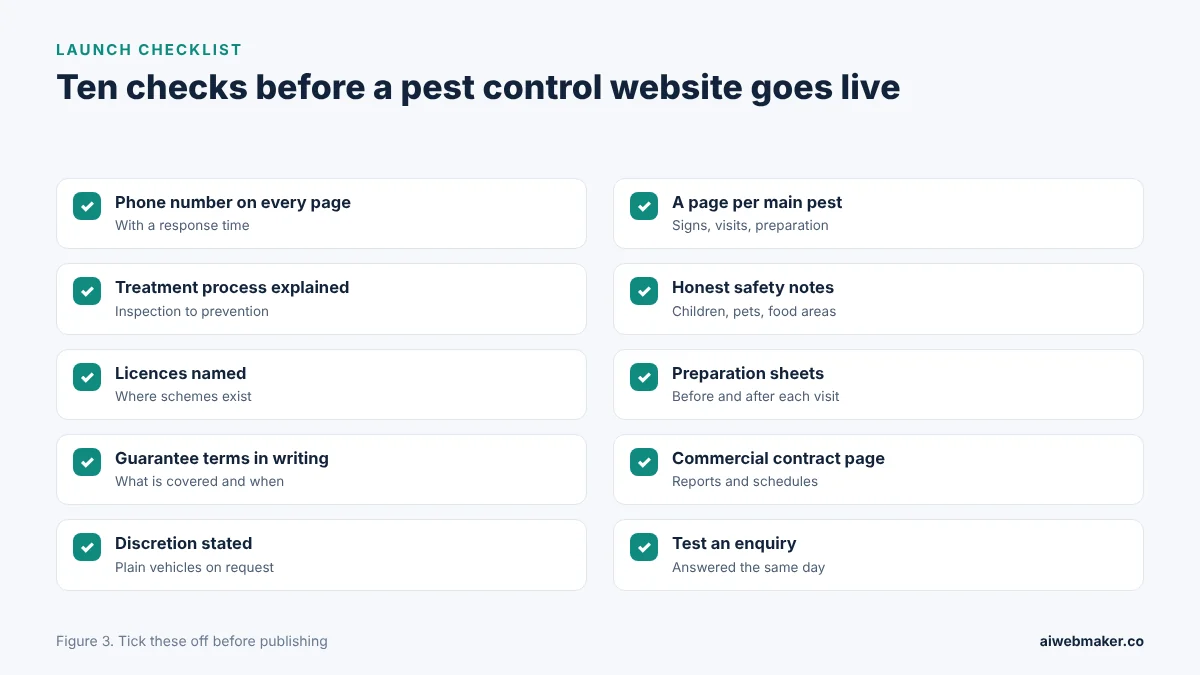
A worried caller tries another firm when the phone number is hard to find or no response time is given. Vague safety claims, or none at all, alarm parents and pet owners at the moment they most need reassurance. A missing explanation of the treatment process makes the visit sound like a single spray with no follow up. No mention of qualifications or insurance leaves commercial buyers unable to tick their own boxes. Silence on discretion keeps hotels and restaurants from even asking. Ten simple checks that close these gaps are collected in the pest control launch list below.
Frequently asked questions
Can a household stay at home during a pest treatment?
Whether a household can stay at home depends on the pest, the product and the method, so the technician's instructions and the product label must always come first. Some treatments, such as bait stations, allow normal life to continue, while others ask people and pets to leave treated rooms for a set time. Households with babies, pregnant members, asthma or animals should mention this when they first get in touch. Rules on products and on how soon rooms can be used again vary by country, which is another reason to follow the firm's written advice. A website that explains this calmly prevents both panic and careless shortcuts.
How many visits does a typical infestation need?
The number of visits depends on the pest and how established it is, so honest firms give a typical range rather than a promise. A single wasp nest is often dealt with in one visit. Rodent problems commonly need an initial treatment followed by several checks of bait or traps. Bed bugs and cockroaches usually need more than one treatment, because eggs can survive the first round. Explaining these patterns on each pest page stops customers feeling misled when a second visit is booked.
Are bees treated the same way as wasps?
Bees are usually handled differently from wasps, because they are valuable pollinators and in many places their treatment is restricted or discouraged. Many pest control firms refer honey bee swarms to local beekeepers who can collect them safely. Bumblebee nests are often left alone when they pose little risk, since they last only one season. Practice differs from one region to the next, so the bee policy deserves a sentence of its own on the wasp page. Customers respect a firm that knows when a pest is not really a pest.
Can a wasp nest treatment carry a starting price?
A standard wasp nest treatment can carry a starting price, since the work is fairly predictable for most homes. The page should explain what can raise the figure, such as nests at height, inside cavities or in hard to reach roof spaces. Larger infestations of rodents or bed bugs are better priced after an inspection, with the factors explained in advance. Commercial contracts can show what each visit includes rather than a single figure. Clear starting points help anxious customers act quickly without fearing a surprise bill.
One contract against the cost of the year
One commercial contract, or a couple of household treatments, usually pays for more than a year of pest control hosting at $119. Even on the monthly route, one wasp call out covers several $19 bills. Every restaurant, landlord or hotel that signs after reading the process and safety pages adds income that recurs season after season. Calm safety notes, honest visit counts and a visible urgent route answer the questions anxious customers struggle to ask out loud. A diary that mixes urgent call outs with steady contract visits is the result a pest control website should aim for.
Build your website in Minutes and get the AI Tools that work
Start Building Your Website →