Paving Website Cost, Driveway Bases and Rain That Drains Away
Paving firms settle hosting at $119 per year or let it trickle out monthly at $19, buying a domain according to its ending. Covered: customers, service pages, surfaces, sub bases, drainage and permission, quotes and deposits, search and a yearly budget.
- No coding required
- Live in minutes
- Blog, SEO and chatbot tools included
Paving firms on AI Web Maker settle hosting at $119 per year, or let it trickle out at $19 a month, with a domain bought according to its ending. Laying out driveway, patio and repair pages, then looking them over in the preview, adds nothing to any AI Web Maker invoice. One modest patio repays the hosting many times, so the money is not what holds a paving firm back. What holds it back is that every homeowner has seen a sunken driveway or a patio that floods, and most cannot tell good groundwork from bad. The firm that explains what happens below the surface, where the rain goes and what the quote includes wins the site visit. Ahead are the customers, the service pages, surface choices, sub bases, drainage and permission, quotes and deposits, search and the yearly sums.
This article is part of our complete guide: Home Services Website Builder.
Kerb appeal, parking and a summer patio: who asks for paving
Paving enquiries come from homeowners at very different moments, and each brings a different worry. A family with a second car needs more parking and wonders whether the front garden can become a driveway. Someone selling a house wants the approach to look tidy before the photographs. A household planning summer evenings outdoors wants a patio that suits the house and does not turn into a pond. Owners of older properties ask for repairs to sunken blocks, cracked flags or broken steps. Each of them compares contractors on photos of finished work, how the base is built and whether the price is written down in full.
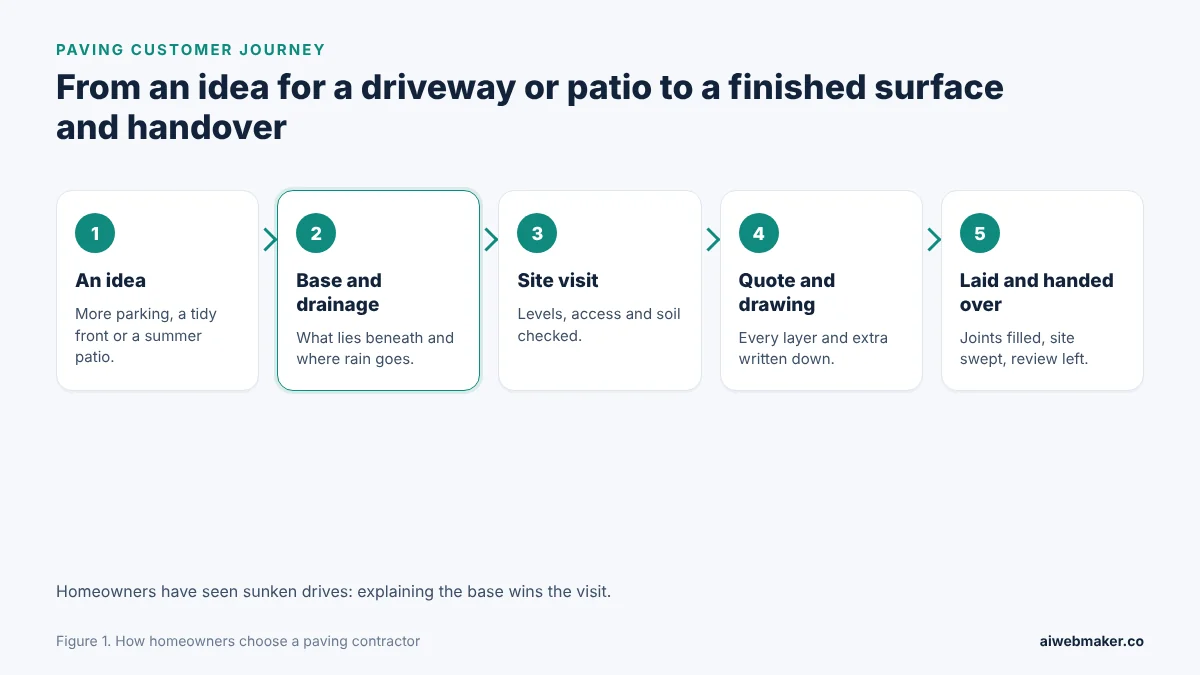
The journey begins with a picture in the homeowner's head and ends with a surface that still looks right years later. A first idea, often sparked by a neighbour's new driveway, leads to browsing photos and surfaces. The highlighted step is understanding the base and the drainage, because that is where homeowners have seen other jobs fail. A site visit with levels taken follows, then a written quote with a drawing. The laying itself, finished with joints filled and the site cleared, decides whether a review and a neighbour's enquiry follow.
Pages for driveways, patios, paths and repairs
Each surface and job type on a paving contractor's site merits its own section, because a homeowner after a stone patio searches differently from one planning an asphalt drive. Block paving driveways and natural stone patios usually bring the most enquiries. Asphalt and permeable paving need their own explanations of cost, upkeep and drainage. Paths, steps and repairs are modest jobs that frequently open the door to a full driveway later. A drainage section and a list of what every quote includes tie the site together.
| Page or section | What the homeowner asks | What it should cover |
|---|---|---|
| Block paving driveways | Will it sink or spread? | Base depth, edge restraint, patterns |
| Natural stone patios | Which stone suits the house? | Stone types, full mortar bed, falls |
| Asphalt driveways | Is it cheaper and how long does it last? | Layers, edges, weed control |
| Permeable paving | Does it avoid flooding? | How water soaks through, upkeep |
| Paths and steps | Are they safe in the wet? | Grip, rise and tread, lighting |
| Repairs and relaying | Can it be fixed, not replaced? | Lifting, rebasing, matching |
| Drainage | Where will the rain go? | Falls, channels, soakaways, rules |
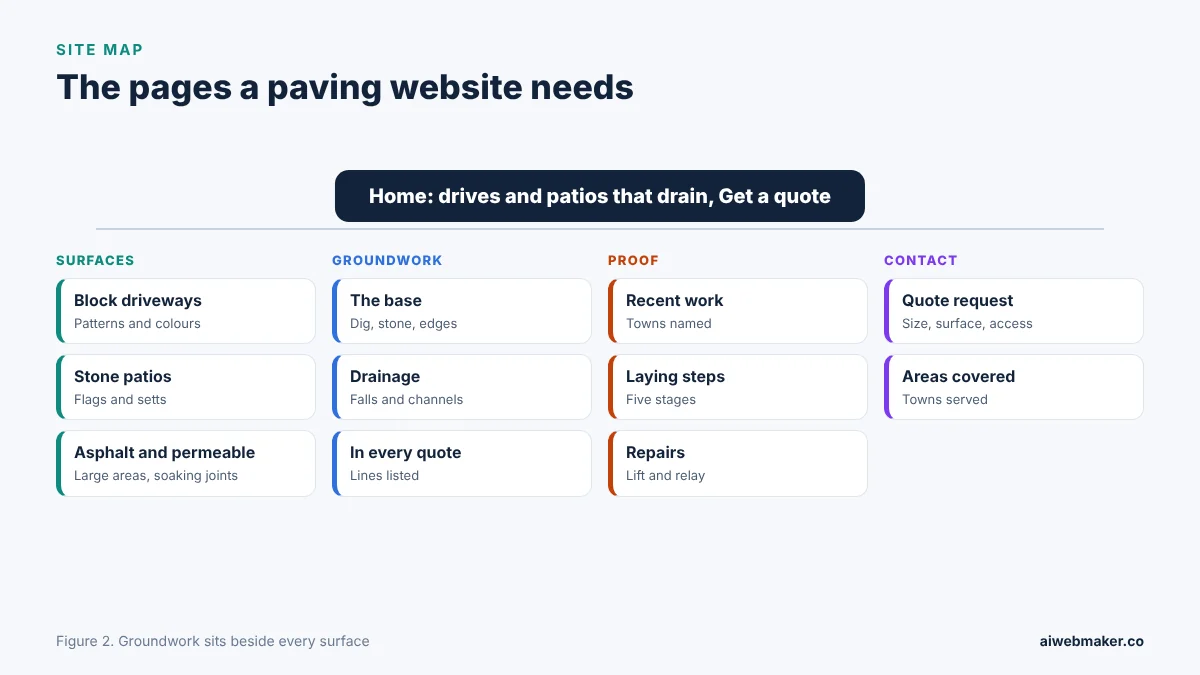
Split by the homeowner's questions, a paving site forms four groups: surfaces, groundwork, proof and contact. Surface pages carry block driveways, stone patios and asphalt with permeable options. Groundwork pages explain bases, drainage and what every quote covers, while proof pages show finished work and the laying sequence. Our sample contractor, Setstone Paving, keeps it all on one scrolling page with cards for block paving driveways, natural stone patios, asphalt driveways, permeable paving, paths and steps, and repairs and relaying. A surface comparison table, a drainage section and a list of what goes into every driveway quote come next. The paving website example with drainage explained and a written quote finishes with recent work, five laying steps, site visit questions and a quote request.
Block, natural stone, asphalt or permeable: comparing surfaces honestly
Homeowners choose a surface with their eyes, so the contractor's job is to explain how each one lives over the years. Concrete blocks are affordable, come in many colours and can be lifted and relaid when a pipe needs repair. Clay pavers keep their colour longer, while granite setts are extremely hard wearing and suit traditional streets. Sandstone and slate flags give patios a natural look but need sealing or regular cleaning in damp, shaded spots. Asphalt is quick to lay over large areas but needs firm edges and can soften slightly in very hot weather. Permeable block lets rain soak through the joints, which helps with drainage rules but needs its joints kept clear.
| Surface | Living with it | Upkeep | Often chosen for |
|---|---|---|---|
| Concrete block | Many colours, easily relaid | Re sanding joints, cleaning | Driveways on a budget |
| Clay pavers | Colour holds for decades | Light cleaning | Period homes, paths |
| Granite setts | Extremely hard wearing | Very little | Entrances, edging, traditional drives |
| Sandstone or slate flags | Natural look | Cleaning or sealing in shade | Patios and terraces |
| Asphalt | Smooth, quick over large areas | Edge checks, weed control | Long or wide driveways |
| Permeable block | Rain drains through | Keeping joints clear | Front gardens, flood prone streets |
Beneath the surface: sub bases, edges and why paving sinks
Most paving failures start below the surface, so a firm that explains its groundwork stands apart from those that only show the finish. Soil is dug out to a depth that suits the load, deeper for driveways that carry cars than for patios that carry chairs. A layer of crushed stone is spread and compacted in stages, often over a membrane that separates it from the soil. Edges are fixed in concrete so blocks cannot creep outwards, and the laying course of sand or mortar sits on top. Joints are filled and the surface compacted again, with falls set so water runs away from the house. Showing photographs of these hidden stages, with a short caption each, proves the work is done properly.
| Layer | Purpose | What happens when it is skimped |
|---|---|---|
| Dig out | Removes soft topsoil and roots | Ruts and dips as soil settles |
| Membrane | Separates soil from stone | Stone sinks into clay over time |
| Compacted sub base | Spreads the load of cars | Sunken tyre tracks |
| Edge restraint | Holds the paving in place | Blocks creep and joints open |
| Laying course | Gives a true, level bed | Rocking flags and uneven blocks |
| Jointing | Locks units together | Loose blocks and weeds |
Rainwater, falls and permission rules for front gardens
Drainage decides whether a driveway or patio becomes a pleasure or a problem, and homeowners rarely think about it until the first storm. Every surface needs a gentle fall away from the house, and patios must sit well below the damp proof course so rain cannot splash above it. Water can run into a channel drain, a soakaway, a planted border or straight through a permeable surface. In England, for example, paving more than five square metres of a front garden with an impermeable surface that drains onto the road usually needs planning permission. A new vehicle crossing over a pavement often needs approval from the local highway authority as well, and rules differ widely between countries and councils. A contractor who explains these points and checks local rules on the site visit protects the homeowner from expensive surprises.
Written quotes, deposits and a builder that drafts the paving firm's pages
A paving quote should read like a recipe, listing every layer and every extra rather than a single total. Dig out depth and disposal of soil, sub base depth, membrane, edging, the surface itself, jointing, drainage channels and any steps all deserve a line. Tight access through a house or a narrow gate, and anything found during the dig, should be explained as possible extras. Deposits, where taken, are best kept modest, agreed in writing and arranged directly between the homeowner and the firm. The AI website builder that drafts paving pages for driveways and patios writes the surface cards, the drainage section and the quote request once the contractor sums up its surfaces and service area in a short note, and none of the drafting or previewing is charged. A clear quote page tells homeowners exactly what they are comparing.
Words homeowners type when a driveway is on the list
Homeowners search for block paving driveways, patio installers, natural stone patios, asphalt driveways, permeable paving and driveway drainage, together with their town. In the United Kingdom asphalt is often called tarmac, and in North America block paving is usually described as pavers, so headings can use the local words. A separate heading for each surface lets a search engine match the phrase a homeowner types. The map listing benefits from bright photos of finished driveways, the area covered and accurate hours. Reviews mentioning tidy sites, careful levels and good drainage after heavy rain persuade cautious buyers. Articles on weeds in joints, when a new drive can take a car or how permeable paving works keep the site useful between enquiries.
Hosting, a domain and articles for a paving firm in one table
Paving pages recur on just two bills, the host and the domain name, while twelve surface guides from AI credits total roughly $7.80. A contractor with a full diary keeps the yearly figure lowest at $119. A firm laying its first drives may prefer $19 a month. New photos, prices or surfaces never add a fee. Each column of the table tracks one way of paying, and the $189 row exists for comparison alone.
| Item | Yearly | Monthly |
|---|---|---|
| Hosting the paving pages | $119 | $228 over twelve months |
| Domain | Depends on the ending | Depends on the ending |
| Higher plan, for comparison | $189 a year | Not needed |
| Twelve driveway and patio articles at about $0.65 | About $7.80 | About $7.80 |
| Photo, price and surface updates | No charge | No charge |
| Year before the domain | About $126.80 | About $235.80 |
Doubts that stop a homeowner booking the site visit
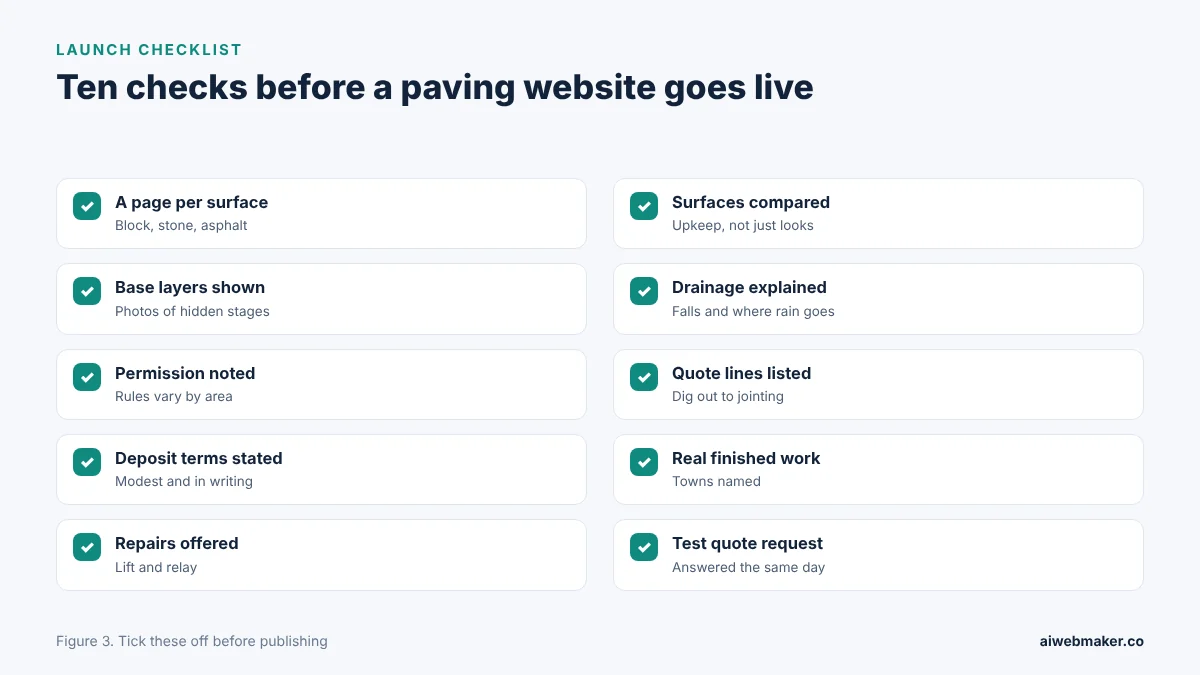
Homeowners hesitate when a paving website shows only glossy finishes and says nothing about the base underneath. No mention of drainage leaves them fearing a flooded patio or a fine for an unapproved front garden. A single price with no breakdown looks like a figure that will grow once work starts. Stock photos, or pictures with no town named, suggest the firm has little real work to show. A demand for a large cash deposit is the classic warning sign of the doorstep paving cowboy. Ten checks, illustrated next, put each worry to rest.
Frequently asked questions
When can a car be parked on a new driveway?
Block paving can usually take a car once it has been jointed and compacted, which is often the day the work finishes. Asphalt needs time to cool and harden, and the installer should give a specific waiting period. Driveways with mortar bedded stone or concrete edges may need several days before heavy loads. The website can give typical waiting times for each surface and remind homeowners to avoid turning wheels on the spot at first. Clear guidance prevents marks and dips in a brand new surface.
Why do weeds appear in paving joints?
Weeds in paving joints usually grow from seeds that blow into the jointing sand, not from roots pushing up through a properly laid base. A good membrane and a well compacted sub base stop most growth from below. Regular brushing, topping up joints and in some cases a joint sealant keep surface seeds from taking hold. Permeable paving needs its joints kept clear for drainage, so weed control matters even more there. Honest upkeep advice is better than a promise that weeds will never appear.
Is it possible to lay flags or blocks on top of an old concrete slab?
New paving can sometimes be laid over old concrete if the slab is sound, level and well drained. The finished surface must still sit well below the damp proof course, which often rules out simply building upwards. Cracked or sunken concrete usually needs breaking out, because faults below will show through the new surface. A site visit with levels taken is the only reliable way to decide. Explaining this on the website saves homeowners from quotes that skip essential work.
How should deposits for paving work be handled?
Deposits for paving work are best kept modest and agreed in writing, usually to cover materials ordered for the job. Staged payments tied to clear milestones, such as base completed and surface laid, protect both sides. Homeowners should be wary of anyone demanding a large cash payment before any work begins. The website can state the firm's own payment terms plainly so there are no surprises. Open, written terms mark out a legitimate contractor more clearly than any badge.
Driveways needed to repay the paving pages
Takings from one patio, or even a small driveway repair, normally dwarf the $119 needed to keep a paving firm online for twelve months. At the monthly rate, a $19 instalment disappears inside a single morning's materials. Every homeowner who reads about the base, checks the drainage section and books a visit is work the site helped win. Honest groundwork photos, clear surface comparisons and written quotes convince careful buyers more than any slogan. Firms that keep posting finished driveways with the town named become the local name people pass on. Enquiries that already mention a surface, a size and a drainage worry prove the pages have been read closely.
Build your website in Minutes and get the AI Tools that work
Start Building Your Website →