Painting Company Website Cost and the Prep Work Clients Never See
Painters and decorators can keep the site hosted for $119 over a year, or for $19 billed monthly, and add a domain. Inside: how clients compare painters, the pages to build, pricing methods, preparation, sheens, quote visits, old paint safety, search and the yearly sum.
- No coding required
- Live in minutes
- Blog, SEO and chatbot tools included
A year of hosting for a painting company's website costs $119 on AI Web Maker, while crews preferring smaller payments can choose $19 monthly, with the domain added on top. AI Web Maker sends no invoice while the crew drafts its pages and studies them in the preview, so sample photos can give way to real rooms before anything is spent. A single bedroom repaint normally earns more than that yearly fee, which makes the money a minor line in the budget. Prep, coats and colour choices are all laid out on the painting company website example, an imaginary decorating crew's site from AI Web Maker, which makes the rest of this guide easier to picture. The harder problem is that painting quotes look alike on paper, and a homeowner cannot tell good preparation from a rushed coat until the finish starts to fail. The site has to bring that hidden labour into view, through photos, plain explanations and honest pricing. What follows covers how clients compare painters, the pages a painting site needs, pricing methods, preparation, sheens and coats, the quote visit, old paint safety, search and what the year costs.
This article is part of our complete guide: Home Services Website Builder.
Who hires a painter, and what do they weigh before calling?
Painters are usually called at a few predictable points in the life of a home, and each point shapes what the client checks. Owners getting a house ready to sell want neutral colours and a quick finish, while new owners want fresh rooms before the furniture arrives. Landlords between tenants care about hard wearing paint and a fixed turnaround, and property managers ask about phasing work across occupied buildings. Homeowners whose exterior paint is peeling or chalking usually act after noticing damage, and they worry most about weather and scaffolding. Because almost every one of these clients collects two or three quotes, the painter whose website answers their particular worry tends to be the one invited to measure up.
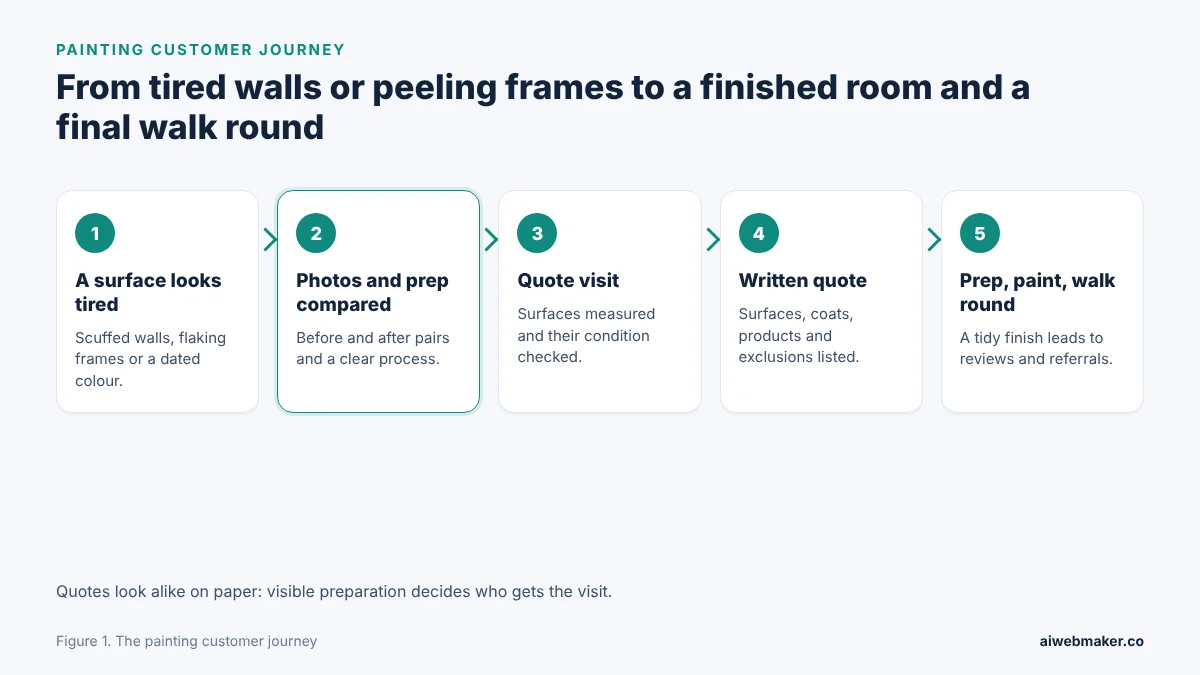
Most painting jobs are won or lost at the second step of this journey, before any painter has seen the house. A client notices scuffed walls, flaking window frames or a colour that no longer suits the room, and starts searching. At the comparison stage, photos of finished work and a clear account of preparation separate one company from another, since prices alone rarely explain themselves. The quote visit follows, where measurements and surface condition turn into a written price. The final stage, with preparation, painting and a walk round alongside the client, settles whether the client writes a review and passes the name on. A painting website should therefore put its strongest proof where the comparison happens, on the home page and the service pages.
Interior, exterior and commercial: which pages carry the work?
A painting site works best when each kind of job has its own page, because a client repainting a hallway reads for different details than one restoring timber cladding. Interior pages should cover walls, ceilings and woodwork, along with how furniture and floors are protected. Exterior pages need to discuss render, masonry, timber and metal, plus access equipment and weather. Cabinet and joinery painting, often sprayed, attracts its own searches and deserves its own description. Commercial work, from offices to rental blocks, rests on scheduling and disruption rather than colour choice. A short page for each, linked to matching photos, lets every client find a direct answer.
| Page | What the client wants to know | What the page should include |
|---|---|---|
| Interior painting | Which rooms and surfaces are covered | Walls, ceilings, woodwork, furniture protection |
| Exterior painting | Whether the finish will survive the weather | Surfaces, repairs, access, weather windows |
| Cabinets and joinery | Whether old units can be refreshed | Brush or spray, primers, curing time |
| Commercial painting | How disruption is kept low | Out of hours work, phasing, low odour paints |
| Projects | What finished work looks like | Before and after pairs, room types, towns |
| Quote request | What happens after asking | Visit, written quote, typical timing |
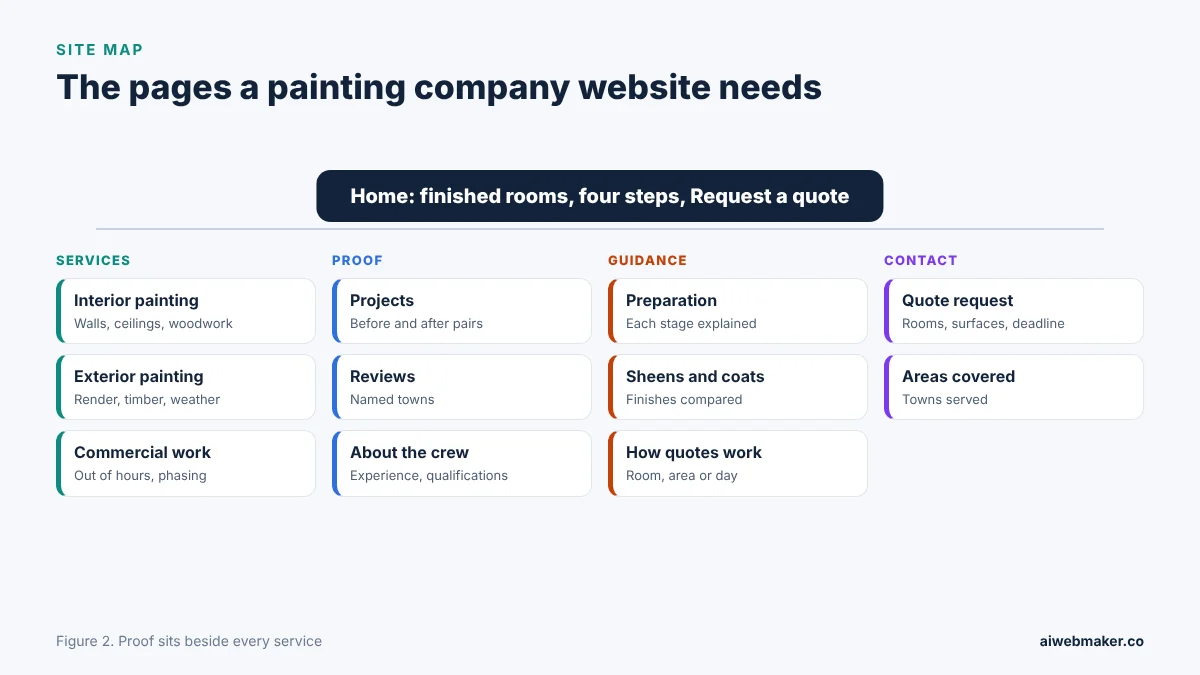
Grouped by purpose, a painting company's pages fall into services, proof, guidance and contact, with the quote request reachable from all of them. Service pages separate interiors, exteriors, cabinets and commercial jobs. Proof pages hold photos and reviews, while guidance pages explain preparation, sheens and quotes. Our sample business, True Coat Painting, devotes its projects page to before and after pairs, and its services page puts a section on preparation and finishing beside residential and commercial work. Its home page walks through four steps from quote to finish and adds a section on a full exterior repaint from start to finish, while the about page covers the team, its experience, qualifications and the places it works. The contact page tells customers what to expect once an enquiry is sent, and the house painting website example with before and after projects was produced in 50 seconds.
Pricing a repaint by the room, the area or the day
Painters price work in a few common ways, and naming the method on the website stops clients comparing quotes that measure different things. Pricing by the room suits standard bedrooms and living spaces, provided the page says whether ceilings, doors and skirting are included. Pricing by area, per square metre or per square foot, suits large walls, new builds and commercial spaces where surfaces are similar. A day rate fits repairs and jobs whose preparation is hard to predict until work begins. Fixed project prices are common for full exteriors, where scaffolding, repairs and several elevations are bundled together. Whatever the method, a written quote that lists surfaces, coats, products and exclusions gives clients something fair to compare.
| Pricing method | Where it fits | What the page should make clear |
|---|---|---|
| Per room | Bedrooms, living rooms, hallways | Whether ceilings, doors and woodwork are included |
| Per square metre or foot | Large walls, new builds, offices | How area is measured and what is excluded |
| Day rate | Repairs, touch ups, uncertain preparation | Crew size and what a typical day covers |
| Fixed project price | Full exteriors, whole houses | Stages, access costs and repair allowances |
Why preparation decides how long the paint lasts
Preparation decides how long a finish lasts, because paint only performs as well as the surface beneath it. Interior walls need cleaning, filling, sanding and dusting, with stains sealed so they do not bleed through the new colour. Woodwork needs keying, gaps caulked and bare patches primed before any top coat. Outside, surfaces are washed, loose paint is scraped back, rotten timber is repaired and bare wood is primed, and every step depends on dry weather. Cheap quotes usually save time by skipping these stages, which is why the cheaper finish so often peels within a few seasons. A page that lists each preparation step, with photos of the work in progress, explains why a careful quote costs what it does.
| Preparation stage | What happens | Why it matters |
|---|---|---|
| Protecting the room | Floors, furniture and fittings covered | Prevents splashes and dust damage |
| Cleaning | Grease, mould and dirt washed off | Helps the paint grip the surface |
| Scraping and sanding | Loose paint removed, edges feathered | Stops new coats lifting with the old |
| Filling and caulking | Cracks, holes and gaps sealed | Gives a smooth, unbroken finish |
| Priming and sealing | Bare areas and stains treated | Even colour and lasting adhesion |
Sheens, coats and paint types in plain words
Clients often choose a colour in minutes and then struggle with sheen, so a short guide to finishes saves a long conversation at the quote visit. Flat and matt finishes hide small flaws and suit ceilings and quiet rooms, though some are harder to wipe clean. Eggshell and satin carry a gentle sheen that copes better with hands, bags and cleaning, so they suit busy rooms and hallways. Semi gloss and gloss are traditional for doors, trims and cabinets, where knocks and washing are frequent, but they show every dent in the surface beneath. A table of finishes that stays honest about trade offs lets the client arrive at the visit already knowing what they want.
| Finish | Look | Often used for | Trade off |
|---|---|---|---|
| Flat or matt | No shine | Ceilings, bedrooms, living rooms | Can mark more easily |
| Eggshell | Soft glow | Living rooms, dining rooms | Shows a little more texture |
| Satin | Gentle sheen | Hallways, kitchens, children's rooms | Highlights poor preparation |
| Semi gloss | Clear shine | Doors, trims, bathrooms | Shows dents and brush marks |
| Gloss | High shine | Woodwork, metal, cabinets | Needs the most careful preparation |
What happens at the quote visit, and what helps beforehand?
A quote visit should be explained before the client books it, since many people worry about being pressured into a large job on the spot. The page can say who visits, roughly how long the visit takes and whether the painter checks for damp, cracks or failing coats. Asking the client to mention the rooms, surfaces and any deadline in the enquiry, and to have photos ready in case the painter asks, shortens the first conversation. A written quote should follow within a stated time and list surfaces, coats, products and anything excluded. The AI website builder that drafts painting company pages and quote requests writes the service pages, the gallery and the contact page once the owner sums up the crew's work in a few lines. A calm visit and a clear quote are the first proof of a tidy job.
Old paint, lead and safe working on site
Older homes can hide paint layers containing lead, so a painting company should explain how it handles them and note that the rules vary between countries. In the United States, for example, federal rules govern renovation and painting work that disturbs paint in most homes built before 1978, and other countries publish their own guidance. Where lead may be present, dry sanding, power scraping and burning off old paint can release harmful dust or fumes, which is why careful firms test first and use wet methods, containment and thorough cleaning. Households with young children or someone pregnant should be told how the work area is sealed and cleaned each day. Clients who see this care spelled out know the company respects both their home and their health.
What clients type when they want a decorator nearby
Clients looking for a painter type plain phrases such as house painters near me, exterior house painting or kitchen cabinet painting, often followed by a district. Each service page can carry one of these phrases in its heading and opening line, so search engines can match the page to the request. A map listing with current hours, real job photos and the website address catches many urgent local searches, especially on phones. Reviews that mention tidy work, careful preparation and keeping to the agreed time make that listing more persuasive than any slogan. Short articles on choosing sheens or caring for fresh paint bring readers months before they need a crew. Over a year, these pages build a body of local proof that rivals without a website cannot match.
The painting site's bill across a year
Only two charges recur each year, the hosting and the domain, while articles drafted with AI credits cost well under a dollar each. A firm with a full diary spends least when it pays the hosting once a year. A crew that has just started taking jobs may find the monthly route easier on cash flow. Adding projects, changing prices or rewriting a service page leaves the bill exactly where it was. The table puts the two payment rhythms next to each other, with the $189 tier included purely for contrast.
| Item | Yearly | Monthly |
|---|---|---|
| Hosting the painting pages | $119 | $228 over twelve months |
| Domain | Depends on the ending | Depends on the ending |
| Higher plan, for comparison | $189 a year | Not needed |
| Twelve colour and preparation articles at about $0.65 | About $7.80 | About $7.80 |
| New projects, prices and service changes | No charge | No charge |
| Year before the domain | About $126.80 | About $235.80 |
Signs that send a homeowner to the next painter
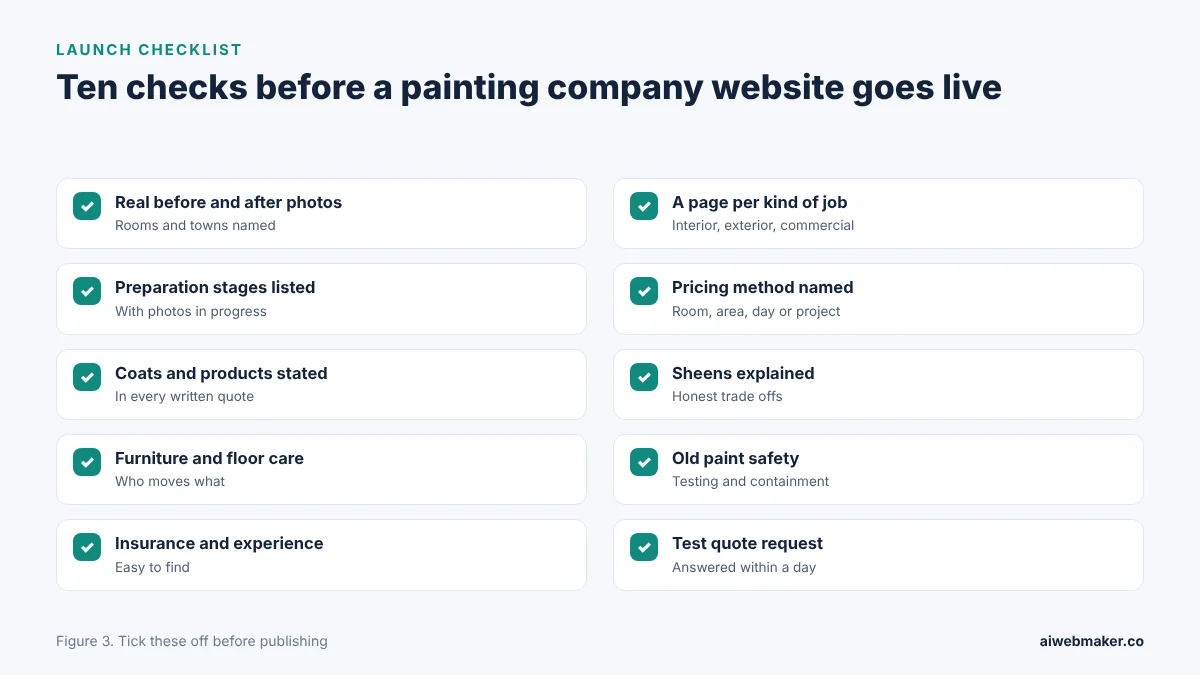
Homeowners leave a painting website quickly when the gallery holds stock photos or a few blurry rooms with no town named. A services page that never mentions preparation suggests the crew skips it. No word on how quotes are worked out makes every figure feel arbitrary. Missing insurance or experience details worry anyone about to hand a stranger the keys. Silence on furniture protection and cleaning up raises fears of splashes on floors and sofas. Each gap has a simple fix, and ten of those fixes appear in the painter's launch list pictured here.
Frequently asked questions
Are two coats of paint always enough?
Two coats are the usual standard for walls, but they are not enough in every case, and a website that says so earns trust. A dramatic change of colour, such as deep red to white, can need a primer and a third coat for an even finish. Fresh plaster usually needs a thinned first coat or a suitable primer before the top coats go on. Some woodwork needs an undercoat beneath gloss. Stating the number of coats in every written quote lets clients compare like with like.
When is it too cold or damp to paint outside?
Outdoor painting should wait when the temperature is below the minimum on the label, rain is due or surfaces are wet with dew. Many exterior paints set a minimum air and surface temperature, and some are made for cooler conditions. High humidity slows drying and can leave a weak or patchy film. Painters often avoid early mornings and late afternoons in cool seasons, when dew settles on walls and frames. A page explaining these limits helps clients accept weather delays without frustration.
Should furniture be moved before the painters arrive?
Clients usually move small items, ornaments and pictures, while the crew moves or covers larger furniture, but each company should write down its own approach. Valuables, fragile pieces and electronics are best handled by the owner. Large items are commonly gathered in the middle of the room and covered with sheets. Floors are protected with dust sheets or a heavier covering, and switch plates may be removed. A clear note on who moves what avoids a slow start on the first morning.
How long should fresh paint be left before cleaning it?
Fresh paint can feel dry within hours, but it often takes far longer to cure fully, so gentle care is wise for the first few weeks. Curing times vary by product, temperature and humidity, and the manufacturer's guidance is the best reference. Walls should not be scrubbed or wiped hard until the paint has hardened. Furniture pushed against fresh paint can stick or leave marks, so leaving a small gap helps. A short aftercare note on the website, repeated at handover, prevents marks and callbacks.
One room or one exterior covers the year
One interior room usually earns a painting company more than the $119 that keeps its pages live through the year. Paid month by month, the $19 is a small part of a single morning's work. Every exterior repaint won after a client studies the projects page adds a margin that pays for hosting many times over. Honest pricing methods, visible preparation and real photos give homeowners the evidence they cannot gather from three similar quotes. Painters who add a new before and after pair after each job keep that evidence fresh through every season. A diary filled by clients who already understand the quote shows the site earning its keep.
Build your website in Minutes and get the AI Tools that work
Start Building Your Website →